Prehistoric Mystery: What Really Killed the Giant Insects?
The prehistoric world was a place of both wonder and terror. Towering ferns dominated the land, strange amphibians crawled through swamps, and colossal dragonflies with wingspans as wide as hawks ruled the skies. These giant insects, some growing far larger than anything alive today, were once among the most successful creatures on Earth. Yet, their reign ended mysteriously. What really killed these giants of the insect world? Scientists have debated this question for decades, and recent research is uncovering fascinating clues.
In this article, we’ll explore the rise of giant insects, the environment that allowed them to thrive, and the theories behind their decline. By the end, you’ll understand why insects are much smaller today—and what their story reveals about evolution, survival, and the fragile balance of Earth’s ecosystems.
The Rise of Giant Insects
Carboniferous and Permian Eras: The Age of Giants
Around 300 million years ago, during the Carboniferous and early Permian periods, Earth looked very different from today. The planet was warm, humid, and covered with vast swampy forests filled with towering clubmosses and ferns. These ecosystems supported a booming population of arthropods, including insects.
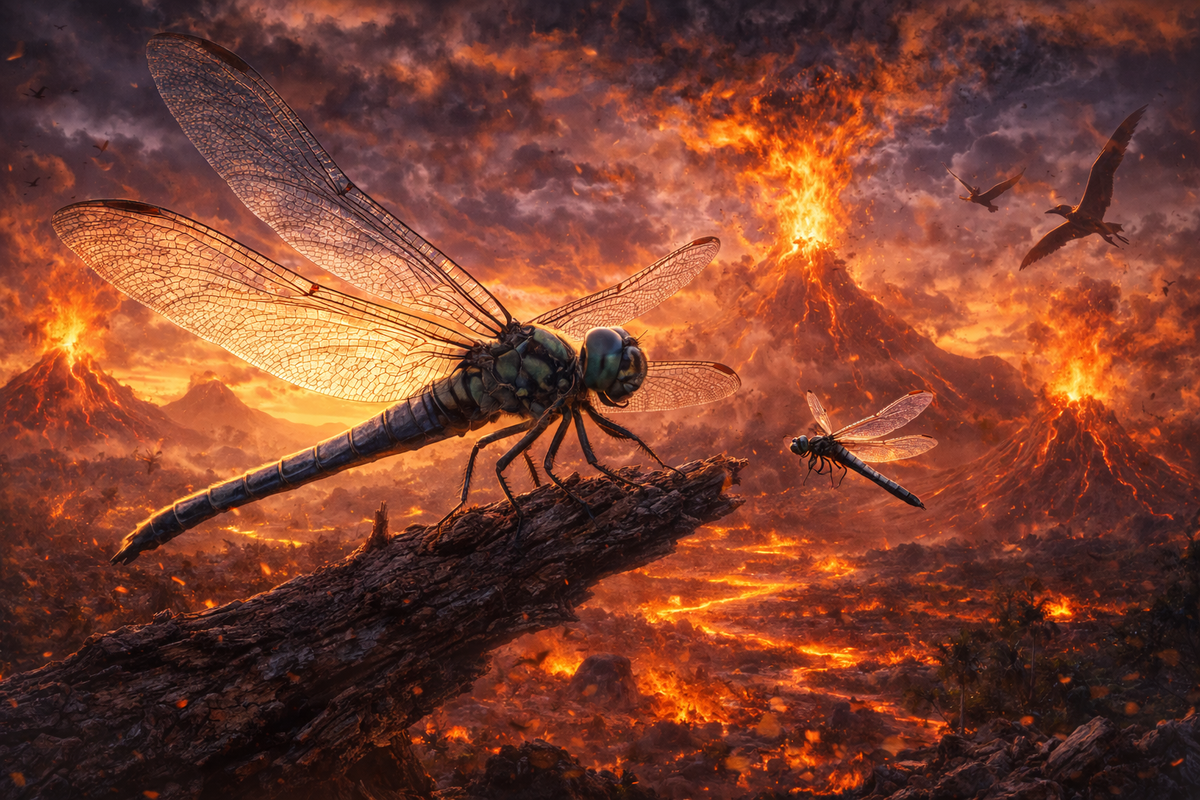
It was during this era that insects grew to enormous sizes. The most famous is Meganeura, a dragonfly-like insect with a wingspan of up to 70 centimeters (27 inches). To put that in perspective, it was larger than many modern birds of prey. Other examples include:
Arthropleura, a millipede-like creature that stretched more than 2 meters long.
Pulmonoscorpius, a scorpion reaching up to 70 centimeters in length.
Giant cockroach-like insects, some over 10 centimeters long, scuttled across the forest floors.
These sizes are astonishing when compared to modern insects, most of which rarely exceed a few inches. The question is—why were they so big?
Oxygen: The Key to Gigantism
The Atmospheric Advantage
One of the most widely accepted explanations involves oxygen levels. During the late Carboniferous, Earth’s atmosphere contained up to 35% oxygen, compared to today’s 21%. This surplus of oxygen created an environment in which insects could grow larger than ever before.
Insects breathe through spiracles—tiny openings in their exoskeleton that connect to a network of tubes (tracheae) delivering oxygen directly to their tissues. Unlike vertebrates, they don’t have lungs or blood to transport oxygen efficiently. Normally, this system limits how big they can grow because oxygen can’t travel far enough inside their bodies.
But in an oxygen-rich atmosphere, this limitation disappears. More oxygen could diffuse into their bodies, allowing insects to reach gigantic proportions.
Evidence from Fossil Records
Studies of fossilized insects show a direct correlation between atmospheric oxygen levels and insect size. The largest species appear in layers dating to the oxygen-rich Carboniferous, while smaller insects emerge as oxygen levels decline in later periods.
This strongly suggests that the oxygen boom was the fuel for insect gigantism—but it doesn’t fully explain why they eventually vanished.
The Decline of the Giants
The Fall in Oxygen Levels
Toward the end of the Permian period, oxygen levels began to drop significantly. By around 250 million years ago, atmospheric oxygen had fallen closer to 15%, one of the lowest levels in Earth’s history.
For giant insects, this would have been catastrophic. Their huge bodies demanded enormous amounts of oxygen, and when the atmosphere couldn’t provide it, survival became impossible. Smaller insects, which required less oxygen, had the evolutionary advantage and began to dominate.
The Rise of Birds and Bats
Another major factor in the decline of giant insects was predation pressure. During the late Permian and into the Mesozoic era, new flying vertebrates appeared—first early reptiles, then later birds and bats.
Unlike insects, birds and bats had powerful lungs and more efficient metabolisms, giving them superior speed and agility in the air. Giant insects, with their clumsy bulk and limited maneuverability, were easy prey. Natural selection favored smaller, faster insects that could outmaneuver predators.
Climate Shifts and Mass Extinctions
The Permian-Triassic extinction event, often called “The Great Dying,” wiped out about 90% of life on Earth. Massive volcanic eruptions, climate chaos, and ocean anoxia devastated ecosystems. While insects survived as a group, the larger species seem to have been disproportionately affected.
The combination of low oxygen, new predators, and catastrophic climate shifts spelled the end for the age of giant insects.
The Science Behind the Mystery
Why Don’t We See Giant Insects Today?
Even though oxygen levels have fluctuated since prehistoric times, we’ve never seen the return of truly giant insects. Why? Scientists point to several reasons:
Competition with Vertebrates: Birds, bats, and even mammals dominate the skies today, leaving no ecological niche for giant flying insects.
Physical Constraints: Modern oxygen levels (21%) simply can’t sustain enormous insect bodies.
Evolutionary Balance: Smaller insects reproduce faster and adapt more quickly, keeping them ahead in evolutionary survival.
Modern Experiments
Laboratory experiments with modern insects support the oxygen theory. When raised in oxygen-rich environments, insects like dragonflies and cockroaches grow larger than normal. Conversely, low-oxygen environments stunt their growth.
This provides strong evidence that prehistoric oxygen surpluses really were the driving force behind gigantism.
Lessons from the Past
The story of giant insects isn’t just a prehistoric curiosity—it has implications for understanding life today.
Climate and Ecosystems
Their rise and fall highlight how fragile ecosystems are to shifts in climate and atmosphere. Just as falling oxygen ended their dominance, today’s species face threats from rising carbon dioxide, habitat destruction, and human-driven climate change.
Evolutionary Innovation
The rise of birds and bats demonstrates how new predators or competitors can completely reshape ecosystems. Insects were once the rulers of the skies—but vertebrates took over. This kind of evolutionary displacement continues today in other ecosystems.
Human Imagination
Giant insects continue to fascinate us. From science fiction movies featuring oversized bugs to debates about prehistoric life, they spark both fear and wonder. Understanding their story grounds our imagination in real science while reminding us how much life has changed over millions of years.
FAQs: Giant Insects Explained
1. What was the largest insect that ever lived?
The largest known insect was Meganeuropsis permiana, a dragonfly-like predator with a wingspan of up to 71 centimeters (28 inches).
2. Why were insects larger in prehistoric times?
Higher oxygen levels in the Carboniferous period allowed insects to grow much larger because their breathing system could deliver more oxygen throughout their bodies.
3. Could giant insects return if oxygen levels rose again?
In theory, yes—but in practice, birds, bats, and mammals dominate today’s ecosystems, leaving no room for giant insects to thrive.
4. Did humans ever live alongside giant insects?
No. Giant insects disappeared long before the age of dinosaurs, millions of years before humans evolved.
5. Are any modern insects still “giant”?
The Goliath beetle and Atlas moth are among today’s largest insects, but they are tiny compared to prehistoric giants.
Smithsonian National Museum of Natural History
Scientific American – Oxygen and Prehistoric Life
Conclusion
The mystery of the giant insects is not really a mystery anymore—science has pieced together the puzzle. Their size was made possible by an oxygen-rich atmosphere, but when oxygen levels fell, they couldn’t survive. Add in new predators like birds and bats, plus massive climate upheavals, and the reign of the giant insects was over.
Today, the descendants of those ancient creatures are much smaller, but their story teaches us about the delicate balance of life, the power of evolution, and the dramatic ways Earth’s atmosphere can shape the course of history.
The age of giant insects may be gone, but their legacy lives on—in fossils, in scientific discoveries, and in the awe they still inspire.