The Strange and Complex Anatomy of Leeches
At first glance, a leech may seem like a simple worm-like creature, little more than a slimy parasite. But behind that unassuming exterior lies a fascinatingly complex anatomy that has intrigued biologists for centuries. From multiple gut pouches to an intricate nervous system and specialized feeding tools, the leech’s body is uniquely adapted to its parasitic lifestyle.
Do Leeches Really Have 10 Stomachs?
The popular claim that leeches have 10 stomachs is not entirely accurate but stems from a real anatomical feature.
Leeches do not have multiple true stomachs like ruminant animals.
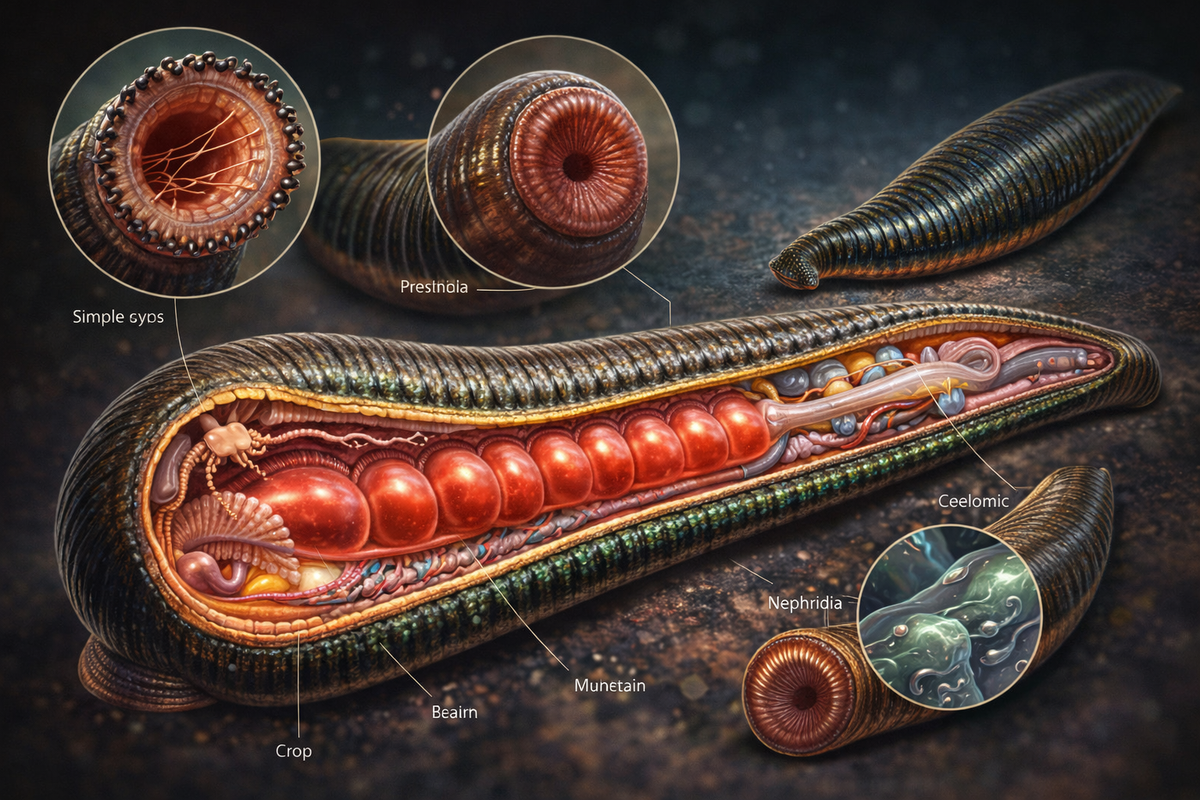
Instead, they possess a digestive system with a muscular pharynx and a crop divided into 10–17 lateral caeca (pouches).
These caeca act as storage chambers for blood meals.
This adaptation allows leeches to store blood for months after a single feeding, slowly digesting it over time. For species like Hirudo medicinalis (the medicinal leech), this is crucial for survival in environments where hosts are not always available.
👉 So, while they don’t have 10 stomachs in the strict sense, their crop system functions much like having multiple expandable “stomachs.”
The “32 Brains” of a Leech
Another striking claim is that leeches have 32 brains. While not literally true, it reflects the segmented organization of their nervous system.
Leeches belong to the phylum Annelida, meaning their bodies are divided into segments.
Each segment contains a pair of ganglia—clusters of nerve cells.
In total, there are 32 ganglia, with one in nearly every body segment.
These ganglia act as mini-brains, controlling local muscles and sensory organs.
Above these, a central supraesophageal ganglion (the “head brain”) coordinates movement and sensory processing.
👉 In effect, leeches operate with distributed intelligence, where each segment can function somewhat independently, yet the whole body remains coordinated.
Reproductive Anatomy: 9 Pairs of Testes
Leeches are hermaphrodites, meaning they have both male and female reproductive organs. In Hirudo medicinalis:
There are 9–10 pairs of testes sacs, which produce sperm.
These are paired with female structures, including an ovary.
During mating, two leeches align ventrally and exchange sperm, which fertilizes eggs internally.
This reproductive system gives them high adaptability, ensuring they can reproduce efficiently in various environments.
The Jaws and Teeth of a Blood-Feeder
One of the most formidable aspects of leech anatomy is its feeding apparatus.
Most blood-feeding leeches have three muscular jaws arranged in a triradiate (Y-shaped) pattern.
Each jaw is lined with 60–100 sharp chitinous teeth.
When a leech bites, these jaws slice the skin with surgical precision, creating a characteristic Y-shaped wound.
As they feed, leeches secrete hirudin, a powerful anticoagulant that prevents blood clotting, ensuring a steady flow.
👉 In total, a leech may have several hundred teeth—perfectly adapted to cut and hold onto their host.
A Survival Machine
These unique anatomical features give leeches remarkable survival advantages:
Efficient Feeding: Their teeth and anticoagulants allow them to feed without detection, often for hours.
Extended Storage: The multi-caecal gut enables them to store blood meals and survive long fasting periods.
Distributed Nervous System: Their 32 ganglia give them resilience, allowing body parts to function even when damaged.
Reproductive Flexibility: Hermaphroditism and multiple testes pairs increase reproductive success.
More Than Just Parasites
Leeches have been both feared and revered throughout history. Once infamous for bloodletting in medicine, they are now valued again in modern microsurgery, where their anticoagulant properties and ability to restore blood flow help save grafts and reattached limbs.
Their complex anatomy—once reduced to odd claims about “32 brains” and “10 stomachs”—is, in reality, a finely tuned system honed by evolution to ensure survival in some of the most demanding ecological niches.
Conclusion
Leeches may look simple on the outside, but their internal design is extraordinary.
Their multi-chambered gut explains the myth of “10 stomachs.”
Their 32 ganglia create the impression of “32 brains.”
Their 9 pairs of testicles highlight their reproductive adaptability.
Their hundreds of teeth make them efficient blood-feeders.
This combination makes leeches one of nature’s most efficient parasitic survivors—a reminder that even the most overlooked creatures can hold some of the most fascinating biological secrets.