
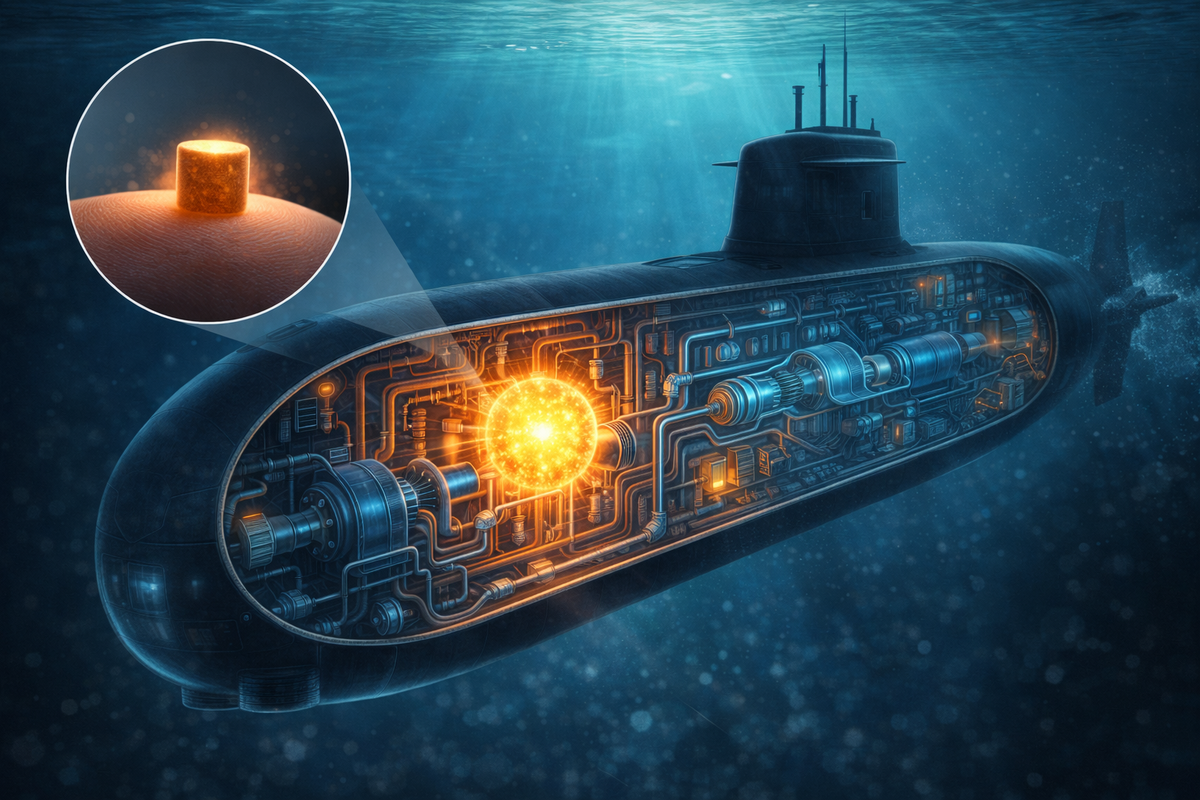
How 4 Kilograms of Uranium-235 Powers a Nuclear Submarine for 30 Years
The silent endurance of nuclear submarines is one of the marvels of modern engineering. Unlike diesel-electric submarines, which require frequent refueling and surfacing for air, nuclear submarines can remain submerged for months, limited only by crew endurance and food supplies. The secret behind this extraordinary capability lies in the incredible energy density of uranium-235 (U-235), the fuel that powers their nuclear reactors.
The Extraordinary Energy of Nuclear Fission
At the heart of a submarine’s power system is the process of nuclear fission. When a U-235 nucleus absorbs a neutron, it becomes unstable and splits into two smaller nuclei (called fission fragments), releasing:
~200 MeV (million electron volts) of energy per fission event.
Additional neutrons, which can strike other U-235 atoms, sustaining a chain reaction.
Byproducts including gamma rays and heat, which are harnessed for propulsion and electricity.
For perspective, the energy from a single fission event is millions of times greater than a chemical reaction, such as burning a molecule of coal or oil.
How Much Energy in 4 Kilograms of Uranium-235?
Let’s break it down:
Mass of fuel: 4 kg of U-235
Number of atoms: ~1.02 × 10²⁵ atoms
Energy per fission: ~200 MeV = 3.2 × 10⁻¹¹ joules
If a significant fraction of those atoms undergo fission, the total energy released is on the order of:
👉 3.3 × 10¹⁴ joules
That’s equivalent to:
~80,000 tons of coal
~11 million liters of oil
Enough to run a nuclear submarine continuously for ~30 years
This immense energy density explains why nuclear submarines can operate for decades without refueling, while conventional submarines would require thousands of tons of fuel.
How the Energy Is Used
The process inside a submarine reactor looks like this:
-
Fission Heat: The splitting of U-235 nuclei releases heat.
-
Steam Generation: The heat converts pressurized water into steam.
-
Turbine Drive: Steam spins turbines that provide both:
-
Electricity for onboard systems.
-
Propulsion by driving the submarine’s propeller shaft.
-
-
Condensation & Recycling: Steam is cooled back into water, completing a closed cycle.
Because the fuel is so compact, a nuclear submarine does not need vast fuel tanks. Instead, it dedicates space to crew facilities, weapons, and technology—making it an ideal long-endurance vessel.
Safety and Control
Nuclear fission is powerful, but it must be controlled carefully. Submarine reactors use:
Control rods made of neutron-absorbing materials (like cadmium or boron) to regulate the fission rate.
Coolant systems to transfer heat away from the reactor core safely.
Shielding to protect the crew from radiation.
These measures ensure a steady, safe supply of power for decades of operation.
Why Uranium-235?
Uranium-235 is ideal because:
It is fissile—it can sustain a chain reaction with thermal (slow) neutrons.
It has a relatively high energy yield per reaction.
Compact amounts can fuel reactors for decades.
Enrichment ensures that the uranium used has a high enough concentration of U-235 to maintain efficient operation in compact submarine reactors.
Strategic Advantages
Nuclear-powered submarines revolutionized naval strategy by offering:
Endurance: Months underwater without surfacing.
Stealth: No need for air intake, making them harder to detect.
Range: Global deployment without logistical fuel support.
Power: Sufficient energy for propulsion, life support, advanced sonar, and weapons systems.
This combination makes them the backbone of modern navies, particularly for deterrence and long-range missions.
Conclusion: A Tiny Fuel Load, Decades of Power
The fact that just 4 kilograms of U-235 can drive a submarine for about 30 years illustrates the staggering power of nuclear energy. By harnessing the fundamental forces within the atom, nuclear submarines achieve endurance and power far beyond what chemical fuels could ever allow.
In the confined, high-demand environment of a submarine, uranium’s compact energy density is not just an advantage—it is the enabling factor that makes modern nuclear navies possible.