
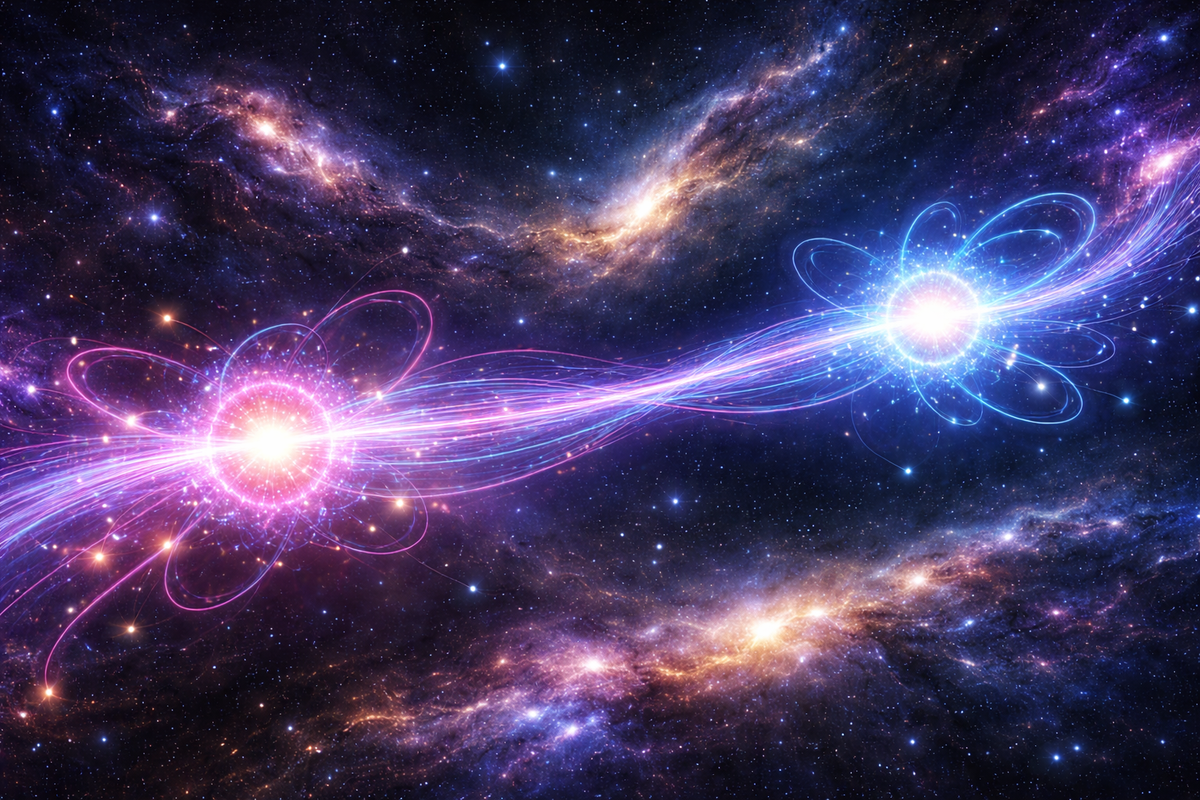
Quantum Entanglement: The Invisible Thread Connecting Particles Across Galaxies
Imagine two particles, separated by billions of light-years, yet somehow still connected in a way that makes them behave as one. When something happens to one particle, the other reacts instantly, no matter the distance. This phenomenon—quantum entanglement—is one of the strangest and most fascinating discoveries in physics.
It challenges our understanding of space, time, and reality itself. As Albert Einstein once said with skepticism, it is “spooky action at a distance.” And yet, countless experiments have shown that entanglement is not only real but may also be one of the keys to unlocking the mysteries of the universe.
What Is Quantum Entanglement?
At its core, quantum entanglement happens when two particles interact in such a way that their states become linked.
If one particle spins clockwise, the other spins counterclockwise.
If one particle’s position shifts, the other’s state adjusts accordingly.
This connection remains intact even if the particles are separated by galaxies.
The most mind-bending part? This “communication” appears to happen instantly, faster than the speed of light, ignoring distance altogether.
From a quantum perspective, it’s almost as if the two particles are not separate things, but different expressions of the same entity.
Einstein’s Skepticism
Einstein, along with Boris Podolsky and Nathan Rosen, introduced the EPR paradox in 1935. They believed quantum mechanics must be incomplete, because entanglement suggested an impossible link across space.
Einstein rejected the idea of faster-than-light communication, insisting that “hidden variables” must exist to explain the phenomenon without breaking the rules of relativity.
Yet, starting in the 1960s, physicists like John Bell developed mathematical tests (Bell’s theorem) that showed hidden variables cannot explain entanglement. Since then, dozens of experiments—including those conducted as recently as 2015 with “loophole-free” conditions—have confirmed that entanglement is real.
Why It’s So Strange
Entanglement is unsettling because it seems to defy three fundamental principles of physics:
Locality – The idea that objects are only influenced by their immediate surroundings.
Causality – Causes must come before effects in space and time.
Relativity – Nothing can travel faster than the speed of light.
Entangled particles break—or at least bend—these rules. They show us that, on the quantum scale, the universe may not be made of independent pieces at all, but of a deeply interconnected whole.
Potential Applications of Entanglement
While it seems abstract, quantum entanglement has very real applications:
1. Quantum Cryptography
Entangled particles can create encryption keys that are unhackable. If an outsider tries to measure or interfere with the entangled state, the connection collapses, instantly revealing the intrusion. This could revolutionize secure communications.
2. Quantum Teleportation
Not the teleportation of people, but of information. Using entangled pairs, scientists can transfer quantum states instantly from one location to another, no matter the distance. This has already been demonstrated experimentally, even between ground stations and satellites.
3. Quantum Computing
Entanglement allows quantum computers to process information in ways impossible for classical computers, enabling them to solve problems far beyond today’s capabilities.
Entanglement and the Deeper Structure of Reality
Beyond technology, entanglement hints at something profound: the universe may be fundamentally interconnected.
Some physicists suggest entanglement reflects a hidden network beneath space-time itself.
Others propose it could help explain dark energy, gravity, or even the fabric of the cosmos.
The idea that space and time emerge from a deeper quantum reality is gaining traction in theoretical physics.
In this sense, entanglement is more than a scientific puzzle—it may be a glimpse into the true architecture of the universe.
Conclusion: The Universe as a Web of Connection
Quantum entanglement is not science fiction. It is a proven phenomenon that forces us to rethink the limits of space, time, and separateness. What began as Einstein’s “spooky action at a distance” has become a central pillar of modern physics, with implications stretching from unbreakable cryptography to the fundamental nature of reality.
It shows us that the universe is not just vast and empty—it is profoundly linked. Like an invisible thread, entanglement weaves particles, information, and perhaps even consciousness into a web of unity.
When two particles can remain bound across galaxies, we are reminded that the cosmos is stranger, deeper, and more interconnected than our minds can easily grasp. And maybe, in that strangeness, lies the key to the next great revolution in science.