
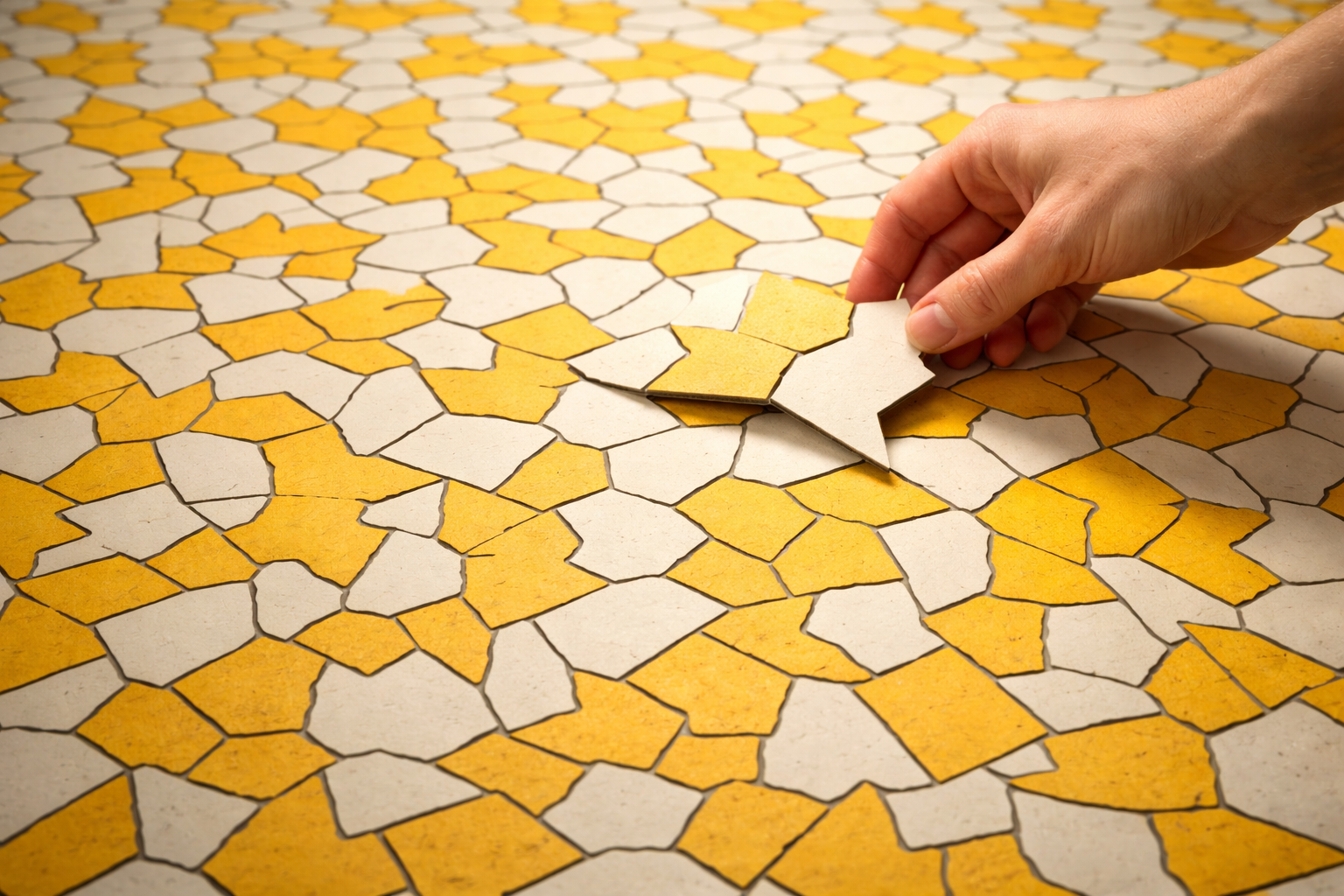
The “Einstein” Tile: The One Shape That Can Cover an Infinite Floor Without Ever Repeating
If you’ve ever stared at a tiled wall and felt the weird comfort of repetition—square after square, pattern after pattern—then the “Einstein tile” is the kind of discovery that quietly breaks your brain. It’s not about Albert Einstein. It’s not about physics. It’s about a question mathematicians have obsessed over for decades:
Can a single shape tile the plane forever… but only in a way that never repeats?
In other words, can one shape cover an infinite flat surface with no gaps and no overlaps, while also refusing to form a repeating wallpaper pattern? That puzzle is known as the Einstein problem, named as a pun on the German phrase ein Stein (“one stone”).
And in the early 2020s, the answer finally arrived—wearing a jagged little silhouette that people started calling the Hat.
What followed wasn’t just a new tile. It was a new way to think about order, randomness, and the kind of “hidden structure” nature loves to use—especially in things like quasicrystals and complex materials.
The Dream: A Tiling That Refuses to Become a Pattern
A normal tiling repeats. If you slide a tiled floor over by a fixed distance (say, one tile width), everything lines up exactly the same. That repeating property is called translational symmetry—the defining feature of periodic patterns.
Now imagine the opposite: you can tile forever, but there is no shift you can make that overlays the tiling onto itself perfectly. The layout never falls into a repeating loop. It has structure—often beautiful structure—but no periodic “grid” underneath it.
Those are aperiodic tilings. Mathematicians have known aperiodic tilings for a long time, but traditionally they required sets of shapes—two or more distinct tiles working together, like the famous Penrose tilings. The holy grail was different:
One single shape that forces aperiodicity all by itself, without extra rules or color-matching constraints.
That single-shape holy grail is what mathematicians started calling an “einstein” tile.
For years, the problem sat in that frustrating category of “it might exist, but proving it is hard.” Then the Hat showed up and changed the conversation.
Meet the Hat: A Strange Little Shape with Huge Consequences
The shape that broke the dam is commonly known as the Hat—a polygonal tile that can cover the plane, but only in non-repeating ways. The story is part math, part human drama, part internet-era collaboration.
According to accounts from the researchers involved, the Hat was first noticed by David Smith, an amateur mathematician, who then connected with professional mathematicians including Craig S. Kaplan, Joseph Samuel Myers, and Chaim Goodman-Strauss. They worked out the proofs and shared the results publicly in 2023.
Their preprint, An aperiodic monotile, laid out the key achievement: a true aperiodic monotile—an einstein tile—forced by geometry alone.
The Hat’s outline looks almost playful, like a fedora silhouette with angular edges. But the important detail isn’t its “hat-ness.” It’s the way the shape can only fit together in hierarchical clusters that keep forcing new structure at larger and larger scales.
In the simplest language: the Hat can tile the plane, but it can’t do it in a way that settles into a repeating rhythm.
Why This Was So Hard: Tiling Is Easy, Forcing Non-Repetition Is Not
Many shapes tile the plane. Squares tile. Triangles tile. Hexagons tile. Even oddly shaped polygons can often tile if you’re clever with rotations and reflections.
The “Einstein problem” wasn’t asking whether a shape can tile. It was asking for something much stricter:
-
The shape must tile the plane (so it’s not trivial).
-
But every tiling it creates must be non-periodic (so it’s not secretly a normal repeating tile).
-
Ideally, it should do this without extra “matching rules” drawn on the tile.
That last part matters. Earlier solutions existed, but they required additional constraints—like colored markings that tell you which edges may touch. The Hat result was celebrated because it showed you can force aperiodicity with pure geometry, no extra instructions printed on the tile.
This is why mathematicians got excited: it wasn’t just “here’s a weird tiling.” It was “here’s a single shape that compels non-repetition.”
The Secret Engine: Hierarchy and Substitution
One of the most beautiful ideas in aperiodic tilings is that non-repeating patterns can still be deeply organized. They often grow by substitution: small clusters combine into larger “super-tiles,” which combine into even larger super-tiles, and so on. It’s like a pattern that repeats its logic without repeating its layout.
The Hat proof uses this kind of hierarchical structure. The researchers show the Hat forms clusters (sometimes called “metatiles”) that behave like building blocks in a substitution system. That system forces a pattern that can keep expanding forever, but never becomes periodic.
To a non-mathematician, this can sound abstract, so here’s the intuition:
A periodic tiling is like wallpaper: once you find the smallest repeating chunk, you can stamp it forever.
A Hat tiling is like a self-similar story: themes repeat, but the exact sentences never do.
You keep seeing “familiar” structures—echoes of earlier arrangements—but the overall tiling refuses to fall into a single repeating cell.
The Word “Einstein”: Not the Scientist, the Pun
This is one of the most charming details. “Einstein tile” is a pun: ein Stein means “one stone” in German, and it also nods to Albert Einstein, which makes it memorable.
So when people say “the Einstein tile,” they’re usually referring to:
the general problem: one shape that tiles only aperiodically
and, more specifically, the Hat (and later related shapes)
The Twist: The Hat and the Spectre
The Hat wasn’t the end of the story. Soon after, the same research group introduced another family of tiles called Spectres, which pushed the idea even further.
One major leap is that certain “spectre” tiles are described as strictly chiral aperiodic monotiles—meaning the tilings can be forced to use only one “handedness” of the tile, without needing the mirror image at all, while still remaining aperiodic.
That may sound like a technical flex (and it is), but it also hints at something profound: geometry can enforce not only non-repetition, but also a kind of directional “bias” that echoes how chirality shows up in nature (like left-handed vs right-handed molecules).
The Hat opened the door. The Spectre explored the hallway.
Why People Outside Math Should Care
At first glance, this looks like a pure math party trick. A tile that never repeats—cool, but so what?
Here’s the real reason it matters: aperiodic order is a blueprint nature uses.
The most famous real-world parallel is quasicrystals—structures that have order but not periodic repetition. They aren’t random; they have pattern logic. But they don’t repeat like normal crystals do.
Aperiodic monotiles are like a clean mathematical “language” for studying how order can exist without periodicity. And that has implications in materials science and engineering, where researchers explore how aperiodic structures can produce unusual mechanical or physical properties. Even Wikipedia’s overview notes ongoing interest in metamaterials and honeycomb-like structures inspired by Hat-based tilings.
In other words, the Einstein tile isn’t just a curiosity. It’s a new tool for thinking about structure—how complexity can be generated from simplicity.
The Emotional Hook: A Shape That Feels Like a Paradox
Part of what made the Hat discovery go viral is that it taps a deep human fascination: the idea that something can be both simple and inexhaustible.
One shape. Infinite floor. No repeats.
It’s like watching a kaleidoscope that never cycles back to a previous image. You can sense rules, but you can’t predict the full outcome. That blend—order without repetition—hits the same mental nerve as good music, good architecture, and good stories. Familiar, but never dull.
Scientific American described the Hat’s public impact as something that “took the math world by storm,” precisely because it is visually intuitive yet conceptually deep.
What the Hat Looks Like in Practice
If you look at a patch of Hat tiling, you’ll notice something quickly: the tiles don’t sit in a neat grid. They assemble into clusters that appear almost like “islands” or “whorls,” often with subtle rotational groupings.
What’s mesmerizing is that your brain keeps trying to find the repeat. It keeps trying to locate the “tile unit” that can be copied.
But the repeat never arrives.
That’s the whole point.
The University of Waterloo page created for the Hat tiling (by Craig Kaplan’s group) shows generated patches and explains the core idea in plain language: the Hat forces aperiodicity through geometry, and patches can be built by substitution.
The Cultural Ripple: Contests, Museum Exhibits, and Public Math
Once the Hat became known, it escaped academia. The National Museum of Mathematics (MoMath) even ran public-facing celebrations and competitions around Hat and Spectre designs, encouraging people to create artistic renditions.
That’s a sign of something rare: a deep mathematical result that is also visually shareable.
Most big math breakthroughs aren’t “draw-able.” This one is.
The Real Legacy: A New Chapter in “One Shape” Geometry
The Hat didn’t just solve a niche puzzle. It changed the landscape of what’s considered possible in tiling theory.
For decades, the Einstein problem hovered like a legend: maybe solvable, maybe impossible, maybe requiring ugly constraints. The Hat showed a clean, elegant route: a single tile, a topological disk, no extra matching rules, forced by hierarchical structure.
And just as importantly, it reminded people that breakthroughs don’t always come from the expected place. An amateur’s curiosity can collide with professional expertise and produce something that shifts an entire field.
That narrative—humble beginning, huge consequence—is part of why the Hat became more than math news. It became a small cultural moment.
The Takeaway: Why the Einstein Tile Feels Like Philosophy
There’s a quiet philosophical punch in this discovery.
A repeating world is comforting. It suggests predictability. But reality, at its richest levels, often behaves differently: patterns without loops, structure without identical return. The Einstein tile gives a mathematical model of that idea—an infinite construction where novelty never runs out, yet chaos never fully wins.
One shape. Endless complexity. No repetition required.
It’s hard not to see that as a metaphor for life: we repeat efforts, routines, and structures, but the whole story never quite repeats itself. The “same” day is never the same day. The “same” struggle changes shape as we grow.
Maybe that’s why this odd little Hat hit so many people the way it did.
It didn’t just solve a problem. It visualized a truth: infinite variety can emerge from a single rule—and the absence of repetition can still be deeply, beautifully ordered.