Anne Hathaway’s Red Reign: Inside Her 2026 People Beauty Triumph and the Devil Wears Prada 2 Premiere Look That Owned the Night
There are celebrity wins, there are fashion moments, and then there are those rare collisions of timing, image, and myth that feel almost too perfect for public life. Anne Hathaway’s April 2026 run belongs to that last category. In the space of a few days, she was unveiled as PEOPLE’s 2026 World’s Most Beautiful cover star and stepped onto the The Devil Wears Prada 2 premiere circuit in a pair of looks so precise, so commanding, and so image-aware that they felt less like outfits and more like visual strategy. The result was not simply another red carpet success. It was a full-spectrum celebrity narrative: legacy, reinvention, glamour, and control, all told in fabric, posture, and light.
What made the moment irresistible was not only Hathaway’s beauty, which has long been too easy a headline, but the way she framed it. At 43, she met PEOPLE’s honor with a kind of disbelieving wit, calling it “still a little surreal” and saying it was never something she expected. That reaction mattered. In an era when celebrity branding is often aggressively self-serious, Hathaway’s response arrived with a softness that made the coronation feel more human and, paradoxically, more powerful. The star was not just being celebrated for surface radiance; she was being recognized at a moment when public perception, career timing, and personal ease had finally snapped into focus.
And then came the red.
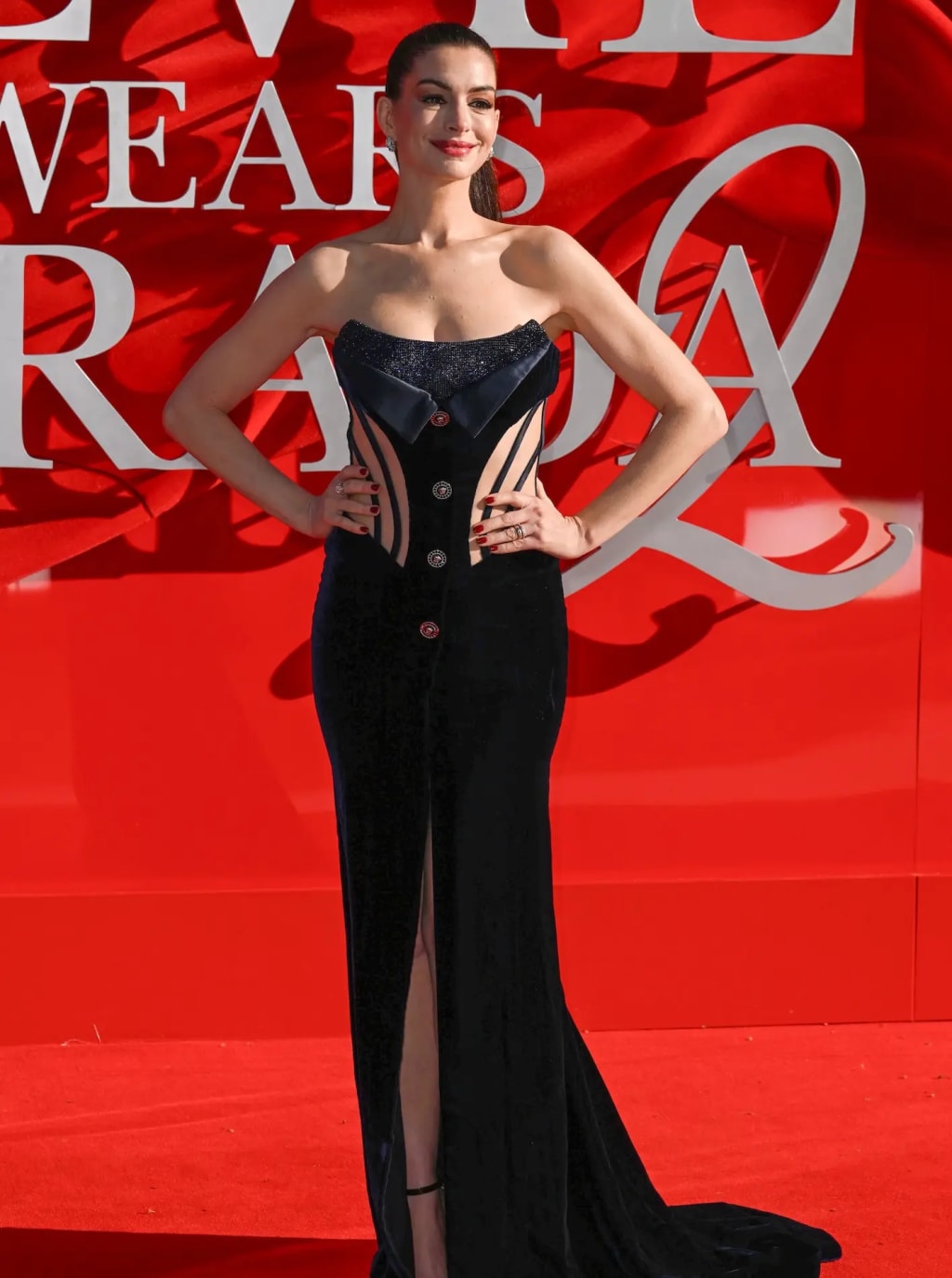
At the New York premiere of The Devil Wears Prada 2 on April 20 at Lincoln Center, Hathaway wore a custom red Louis Vuitton gown that instantly set the visual tone for the sequel’s rollout. Coverage around the premiere consistently highlighted the look’s sculptural impact: a dramatic satin silhouette, corseted structure, and an exaggerated skirt that turned the carpet into a stage. Two days later, at the London premiere on April 22, she pivoted into a navy Atelier Versace design with a velvet V-shaped skirt, sheer tuxedo-inspired bodice, high slit, Bulgari jewelry, and a sharply defined high ponytail. The quick shift from scarlet sweep to midnight seduction proved something essential about Hathaway’s current fashion era: she is not dressing for attention alone. She is dressing in chapters.
That is why this is a red reign, not a red-carpet recap.
Why This 2026 Anne Hathaway Moment Feels Bigger Than a Cover
Awards and honors mean different things depending on when they arrive. On paper, PEOPLE’s annual beauty issue is a glossy celebration. In practice, it often functions as a cultural temperature check. It tells readers not merely who looks beautiful, but whose image currently feels resonant, trusted, and emotionally legible to the public. Hathaway’s selection lands in the sweet spot of that equation. She is old enough now to be read not as an ingénue but as an institution, yet young enough in energy and visual impact to remain thrillingly current.
The 2026 timing is especially potent because it arrives alongside a year of heightened visibility. PEOPLE notes that Hathaway has five releases in 2026, including The Devil Wears Prada 2 and Christopher Nolan’s The Odyssey. That volume matters. It reframes her not as a star being nostalgically revisited, but as one operating at an unusually active, high-profile level. The cover, then, reads as a recognition of endurance rather than a simple beauty accolade.
There is also a subtler cultural shift working in her favor. Hathaway has spent years moving through wildly different public archetypes: princess-in-training, rom-com lead, prestige actress, internet fixation, fashion darling, Oscar winner, meme subject, and finally something more durable than all of them combined. Her 2026 image feels smoother because it is less anxious. In PEOPLE’s coverage around the issue, she speaks about having had the “longest unbroken awkward phase in Hollywood,” a line that is funny on its face but revealing underneath. It suggests a star who is no longer trying to outrun awkwardness, only style it more elegantly.
That emotional polish is what makes the Most Beautiful moment feel earned. Beauty, in the contemporary celebrity economy, is no longer only symmetry and bone structure. It is coherence. It is a sense that the face, the career, the wardrobe, the voice, and the timing are finally telling the same story. Hathaway’s current story is not about being the youngest woman in the room or the loudest woman in the room. It is about being the one whose image has fully matured into authority.
The Red Dress That Turned Nostalgia Into Power
If the PEOPLE cover provided the headline, the New York premiere look provided the image that made the headline unforgettable. Hathaway’s custom Louis Vuitton gown was not merely red. It was the kind of red that understands camera physics. Under flash, under carpet lighting, under the soft diffusion of event photography, scarlet can either flatten into costume or bloom into legend. This one bloomed.
Reports from the premiere describe a custom red satin Louis Vuitton gown with sculptural architecture and a corseted bodice, paired with matching heels. That combination was strategic on several levels. First, it visually echoed the Devil Wears Prada universe, where fashion is never innocent and color is never accidental. Second, it synchronized with the sequel’s promotional iconography, including the striking red “2” used in marketing imagery. Third, it reminded viewers that Hathaway’s relationship to red carpet dressing has become increasingly architectural over the last few years: less princess, more power object.
Imagine the dress through a fashion editor’s lens: shot at f/1.8, the background melting into a blur of premiere signage and camera flashes, while the gown holds the frame like a lit match in a dark theater. The bodice is the command. The skirt is the aftershock. The silhouette does what the best celebrity fashion always does: it translates personality into line. On Hathaway, the effect was neither aggressive nor sweet. It was controlled heat.
And that is what made the look so intelligent. In a lesser styling conception, the sequel to a beloved fashion film could have tempted Hathaway toward irony or archival cosplay. She could have recreated an old Andy Sachs mood, nodded too literally to early-2000s styling, or leaned into fan-service camp. Instead, the gown said something much more persuasive: Andy Sachs grew up, and so did the woman who played her. The reference was embedded in the confidence, not the costume.
London After Dark: The Versace Pivot
Then came London, and with it a masterclass in escalation.
For the European premiere on April 22, Hathaway arrived in a custom Versace gown that was moodier, sharper, and more overtly cinematic than her New York look. According to PEOPLE and InStyle, the design featured a floor-length velvet V-silhouette skirt with a slit, a strapless sheer corset, a sparkling bustier element, exposed side detail, and a tuxedo-inflected structure, styled with Bulgari jewelry and black heels. Perhaps most importantly, Hathaway wore her hair in a tightly lifted high ponytail that gave the entire look a new tensile energy.
Where New York was red-command glamour, London was nocturnal precision. Velvet absorbs light; sheer panels redirect it; crystal or metallic embellishment punctures it. On the carpet, that interplay creates movement even in stillness. The dress read as both tailored and fluid, feminine and severe, a combination that is catnip for photographers because it delivers contrast in a single frame. The tuxedo allusion added a whisper of masculine structure, which only heightened the sensuality of the exposed silhouette. This is how brand-safe provocation works in luxury fashion: not through excess, but through tension.
The ponytail deserves its own paragraph. It took the look from merely glamorous to editorial. Hair down might have softened the gown’s sharpness. A loose updo might have tilted romantic. But the high ponytail introduced lift, length, and attitude. It opened the face, sharpened the jawline, and let the dress’s upper architecture breathe. Suddenly Hathaway was not only wearing Versace; she was slicing through the red carpet in it.
This is the language of modern “hot” style at the luxury level. Not exposed skin for its own sake, but a complete control over where the eye lands: the collarbone under flash, the velvet edge against bare skin, the sparkle just above the bodice line, the line of the ponytail echoing the vertical fall of the skirt. It is seduction translated into tailoring.
Why
The Devil Wears Prada 2
Makes the Fashion Hit Harder
No sequel was ever going to carry more wardrobe pressure than The Devil Wears Prada 2. The original film’s afterlife in fashion culture has been extraordinary. It did not merely generate memorable costumes; it became a reference language. Miranda Priestly remains shorthand for exacting glamour and institutional fashion power, while Andy Sachs represents transformation, ambition, and the complicated seduction of style itself.
That is why Hathaway’s premiere dressing matters beyond celebrity style pages. She is not just attending another premiere. She is returning to one of the defining fashion-text films of the century, two decades after the original’s 2006 release, in a sequel that reunites core cast members including Meryl Streep, Emily Blunt, and Stanley Tucci. Even the event setting amplified the idea of legacy meeting present tense.
In comments to PEOPLE, Hathaway connected her own growth to Andy Sachs’s evolution, saying they are both more confident now. That quote is the secret key to the whole 2026 fashion narrative. Confidence is what separates a reunion from a return. Reunion implies nostalgia. Return implies authority. Hathaway’s press-tour wardrobe has been built around the second word.
Director David Frankel’s comments, as summarized by InStyle, suggest the sequel engages with professional and personal growth in a changed media landscape, focusing on a woman navigating her 40s. That thematic maturity makes Hathaway’s fashion choices feel even more aligned with the project. These looks are not trying to preserve youth in amber. They are presenting adulthood as the sharper, more dangerous aesthetic.
The Psychology of Anne Hathaway’s Allure in 2026
Celebrity culture always rewards contradiction when it is worn well. Hathaway’s current allure works because she embodies several opposites at once.
She is classic, but not stale.
She is glamorous, but not inaccessible.
She is polished, but not cold.
She is self-aware, but not cynical.
That balance is extremely difficult to manufacture, which is why it photographs so expensively when it appears naturally. In the PEOPLE coverage surrounding her beauty issue, Hathaway also speaks about family life and the way motherhood has informed her fashion choices. That detail matters because it grounds the spectacle. The fantasy becomes more compelling when the woman at its center appears to understand its limits. Luxury is always hotter when it does not look desperate for approval.
There is also the question of face. Hathaway’s beauty has always had a uniquely cinematic quality: large, expressive eyes; a smile that can read fairy-tale or razor-sharp depending on styling; bone structure that supports both softness and drama. In 2026, stylists and photographers seem to be using that versatility with greater precision. The cover-star version of Hathaway leans luminous and emotionally open. The premiere version leans tensile, knowing, and almost feline in composure. Same face, different voltage.
That voltage is what makes audiences project so much onto her. She can read as approachable in one frame and untouchable in the next. For celebrity culture, that duality is gold. It keeps the star both aspirational and narratively active. Viewers are not just looking at the clothes; they are reading the attitude inside them.
Red as Strategy, Not Decoration
The word “red” in Hathaway’s 2026 run is doing heavy symbolic work. Red is not a neutral celebrity color. It is too loaded with appetite, danger, heat, romance, warning, confidence, and spectacle. On the Devil Wears Prada 2 carpet, it also carried meta-textual charge: the franchise’s famous high-fashion severity, the camp pleasure of devil imagery, and the sequel’s own promotional design language. Hathaway’s red Louis Vuitton therefore landed as a remarkably efficient piece of branding.
But red only works at this level when the wearer can resist being overwhelmed by it. Many stars wear red and disappear into the color. Hathaway wore red and made it seem like an extension of temperament. That is a different skill. It comes from posture, expression, pacing, and restraint. The dress did not need cluttered accessories or gimmicky styling because the silhouette and the wearer were already doing enough.
In editorial terms, the look struck the ideal luxury ratio: one part old-Hollywood command, one part current high-fashion sculpture, and one part franchise-savvy symbolism. Not a costume. Not a nostalgia trap. A clean, camera-hungry statement.
The Real Win: Anne Hathaway Has Moved Past Reinvention
The most interesting stars eventually outgrow the need to constantly “reinvent” themselves. Reinvention is useful early on, when the industry wants proof of range. But at a certain level, the more seductive achievement is integration. The public can see the old selves still present—the ingénue, the rom-com heroine, the awards-season actress, the fashion plate—but all of them have been absorbed into something steadier.
That is what Hathaway’s 2026 beauty win and premiere looks reveal. She is no longer auditioning for relevance. She is curating legacy in real time.
The PEOPLE cover confirms broad cultural affection. The Devil Wears Prada 2 press tour confirms fashion authority. Together, they create a bigger story than either could alone. It is a story about a woman who has survived long enough in public life to become more interesting, not less. A woman whose glamour is no longer dependent on ingénue softness, but on mastery—of image, of tone, of timing, of self-presentation.
And that may be the true reason this moment feels so electric. Anne Hathaway is not chasing the camera. She understands exactly what it wants, exactly what it remembers, and exactly how to give it something better than repetition. In New York, she gave it red architecture. In London, she gave it midnight edge. In PEOPLE, she gave it candor, humor, and a beauty narrative rooted in self-possession rather than perfection.
That combination is lethal in the best editorial sense. It creates the sensation every luxury magazine wants to bottle: a star who feels both timeless and suddenly, thrillingly now.
Final Verdict
Anne Hathaway’s 2026 “most beautiful” moment works because it never relies on beauty alone. It is built on sequencing. First, the cultural anointing: PEOPLE names her its World’s Most Beautiful cover star for 2026. Then, the visual proof: a red Louis Vuitton premiere look that turns nostalgia into power. Then, the escalation: a navy Versace London appearance that deepens the mood from radiant to razor-sharp. Around it all is the return of The Devil Wears Prada, a franchise whose fashion legacy magnifies every styling choice.
The result is a celebrity-fashion narrative that feels unusually complete. Hathaway has not simply won a beauty title or worn a great dress. She has staged a season of image-making so coherent that it reads like editorial fiction—except it happened in real time, under flash, in velvet, satin, crystal, and confidence.
In 2026, Anne Hathaway is not just back in red. She is reigning in it.