Beyond the Plot of Kafka on the Shore: What Murakami Is Really Doing Under the Surrealism
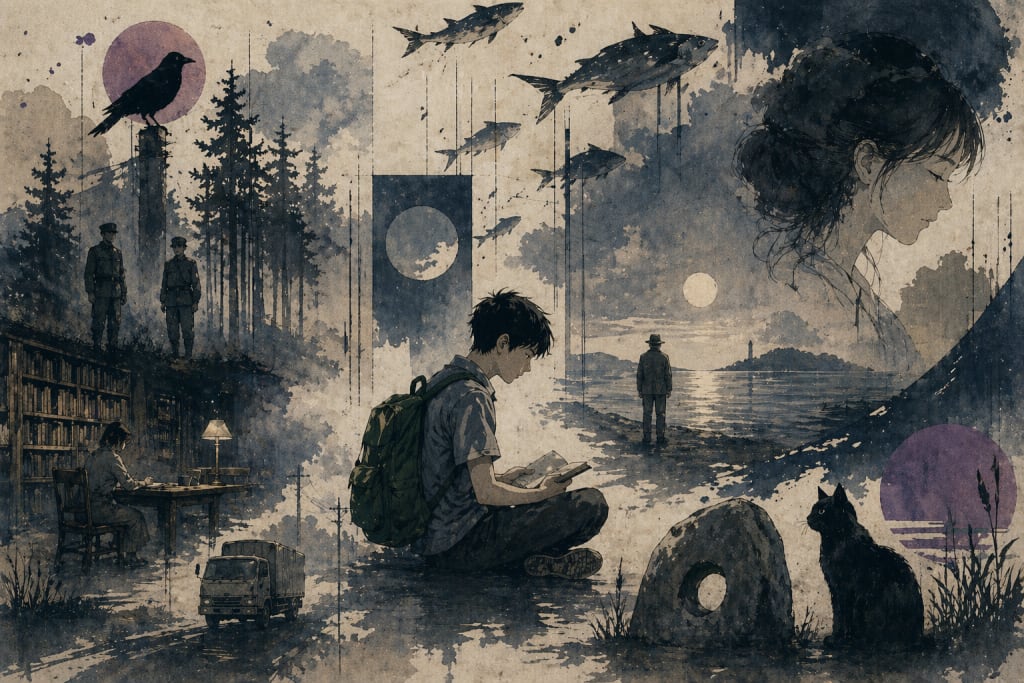
Haruki Murakami’s Kafka on the Shore is one of those novels that can be understood on the level of plot and still feel unresolved in the mind. You can follow what happens. You can remember the characters, the journeys, the talking cats, the prophecy, the strange entrance stone, the wartime incident, the dreamlike forest, the soldiers, the voice called Crow, and still feel that the book is hiding its real center somewhere under the visible story.
That feeling is normal. In fact, it is part of the design.
Murakami is not writing a puzzle novel where every surreal thing has one fixed solution waiting at the back of the book. He is writing a symbolic novel in which the surreal elements behave like the logic of the unconscious: they reveal pressure, guilt, desire, memory, fear, destiny, and inner transformation in forms that are sometimes more truthful than realistic explanation would be. The “real thing” under the surrealism is not usually a secret fact. It is an emotional, psychological, and metaphysical truth.
That is why Kafka on the Shore can feel so deep and so slippery at the same time. It is not asking only, “What happened?” It is asking:
- What does it mean to become yourself?
- What do you inherit from violence you didn’t choose?
- Can memory imprison a life?
- Is fate something outside you, or something you unconsciously help create?
- What lies on the other side of language, identity, and ordinary reality?
The novel answers these questions through symbols, doubling, dream logic, myth, and surreal events rather than through neat rational explanation.
1. First: how to read Murakami’s surrealism properly
Before going into specific scenes, it helps to know what kind of surrealism Murakami is using.
In some books, surreal elements are there to confuse reality itself. In Kafka on the Shore, the surreal elements usually do three things:
A. They externalize inner reality
A character’s fear, loneliness, repression, desire, or split identity may appear outwardly as an event, a figure, a dream, or a supernatural phenomenon.
So the strange thing is not “random.” It is an outer form of something happening inwardly.
B. They connect different layers of time
Past and present in this novel are never fully separate. Trauma, memory, war, love, and absence do not stay in their own era. They leak forward. Characters become haunted not only by their own lives but by unfinished currents from before them.
C. They open a border zone
Murakami loves thresholds: forests, libraries, dreams, songs, wells, stones, empty rooms, sleep states, and strange weather. These are places where the border between conscious and unconscious, living and dead, self and other, present and past becomes thin.
In Kafka on the Shore, much of the surrealism is happening in that border zone.
So when you ask, “What does this really mean?” the best method is not, “What literal event does this correspond to?” but:
- What pressure in the novel does this image carry?
- What inner truth is this strange event expressing?
- What transition or conflict is the character going through here?
That reading method makes the book much clearer.
2. Kafka Tamura: the novel as an inner initiation
At the deepest level, Kafka on the Shore is a coming-of-age novel — but not in an ordinary realist sense.
Kafka Tamura runs away at fifteen because he is trying to escape a prophecy and escape his father. But the deeper truth is that he is trying to become a self without being destroyed by inheritance.
He is not only leaving home. He is entering the labyrinth of identity.
The novel’s real movement is not geographical. It is initiatory.
Kafka must pass through:
- fear of his father
- fear of sexuality
- fear of fate
- fear of violence inside himself
- fear of abandonment
- fear of emptiness
- and finally the fear of becoming real
That is why so much of his story feels mythical. He is less like an ordinary runaway and more like a boy entering a ritual underworld journey.
The strange things around him are part of that initiation.
3. The prophecy: not just fate, but psychological inheritance
Kafka’s father gives him a prophecy modeled after Oedipus: that he will kill his father and sleep with his mother and sister.
On the surface, this sounds like a curse. But Murakami is doing more than retelling Greek tragedy.
The prophecy matters because it installs guilt before action. Kafka becomes haunted by desire, fear, and violence before he has even done anything. He begins to live as if destiny is inside him.
This is psychologically important.
A child shaped by a cruel, dominating father often internalizes the father’s voice. The prophecy then becomes not only fate but psychic programming. Kafka is terrified that he contains the thing he hates. He fears that the father has planted darkness in him.
So one of the novel’s deepest questions becomes:
Are you doomed to become what wounded you?
That is one of the real engines under the surrealism.
4. Crow: the voice Kafka hears
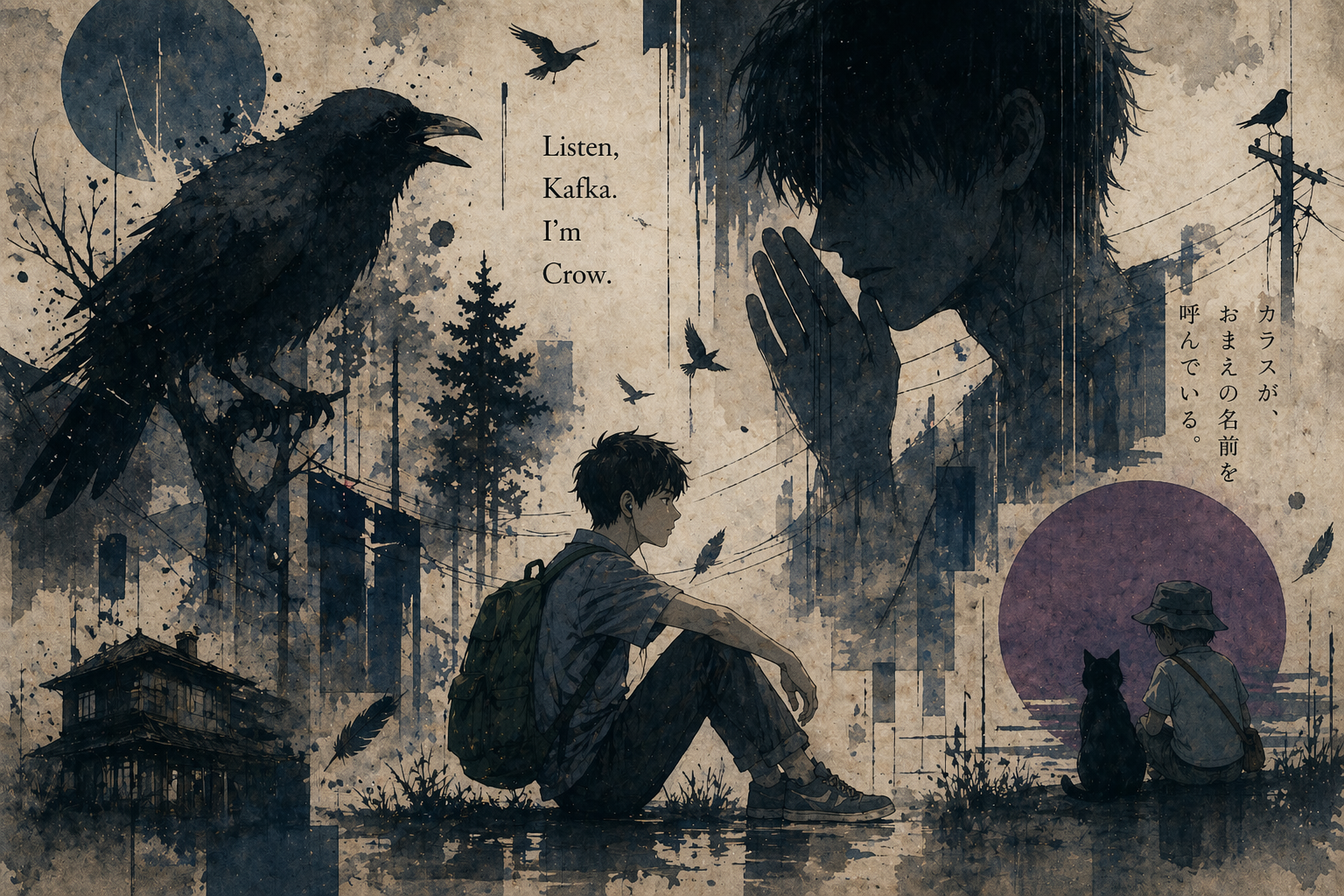
The voice of “the boy named Crow” is one of the clearest examples of Murakami externalizing inner reality.
Crow is not best read as just a ghost, just an imaginary friend, or just a literal supernatural being. He works more powerfully as a split-off part of Kafka’s psyche.
Crow is:
- Kafka’s toughness
- Kafka’s survival instinct
- Kafka’s dark intelligence
- Kafka’s cruel honesty
- Kafka’s dissociated inner witness
- and sometimes Kafka’s shadow self
Crow says the things Kafka cannot openly say to himself. He is often colder, sharper, and more ruthless than Kafka’s ordinary consciousness. He gives commands, warnings, and grim interpretations.
You can think of Crow as the voice Kafka needs in order to survive the trial of becoming himself.
But Crow is not pure wisdom. He is also part of Kafka’s fragmentation. He exists because Kafka is not yet whole.
That is important.
Crow helps him move through the world, but Crow also shows that Kafka is divided. The novel is partly about whether Kafka can become a person who no longer needs to split himself this way.
So when Kafka hears voices or Crow speaks, Murakami is dramatizing internal conflict as dialogue.
This is one of the book’s most important techniques: he turns interior struggle into external event.
5. The dreams and erotic ambiguity: desire, guilt, and the unconscious
A lot of readers get stuck on the sexual material because it feels intentionally unstable: dreamlike, symbolic, taboo, and uncertain in status.
That instability is the point.
Murakami is not writing simple erotic realism here. He is linking sex to:
- identity
- maternal absence
- longing for union
- fear of the forbidden
- the prophecy
- memory
- and the unconscious crossing boundaries
Kafka’s desire is always entangled with absence and taboo because his emotional development is damaged by abandonment and by the father’s prophecy. He does not desire freely. He desires under the burden of myth and lack.
That is why the sexual scenes often feel dreamlike or morally blurred rather than grounded. Murakami is showing that for Kafka, sexuality is not just bodily. It is haunted by symbol, fear, and confusion about who he is.
This is not meant to feel clean. It is meant to feel like the psyche under pressure.
The question is less “Did this happen literally in the normal sense?” and more “What psychic truth is being enacted here?”
Usually the answer is: Kafka is moving through the tangle of desire, guilt, and identity that his father’s prophecy forced into him.
6. Miss Saeki: memory turned into a life-form
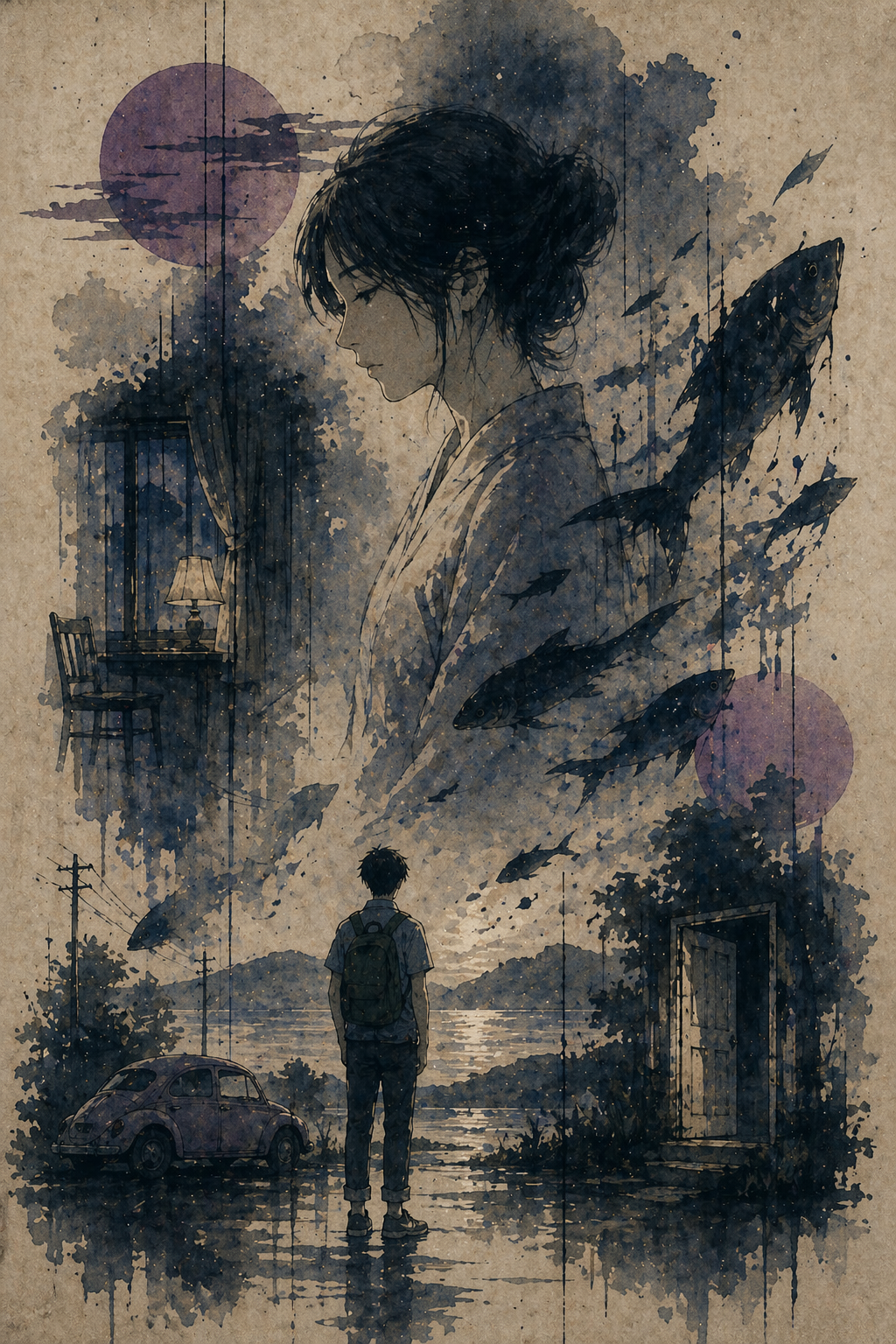
Miss Saeki is one of the most haunting characters in the novel because she is both a person and a condition.
She is not just a tragic woman working in a library. She is someone whose life stopped moving at the point of lost love.
That is her real symbolic meaning.
She has survived physically, but inwardly she remains bound to a wound in the past. She is a person whose memory has become stronger than her present life. She inhabits time strangely because grief has hollowed out the ordinary sequence of living.
This is why the younger version of her seems to appear, and why her presence feels doubled. Murakami is giving form to the idea that a person can remain psychically split between the self who continued living and the self who never left the site of loss.
Miss Saeki is memory become architecture.
She is also one of the keys to the whole novel, because Kafka on the Shore is deeply interested in what happens when memory becomes too strong:
- It preserves love
- but it can also imprison life
- It gives continuity
- but it can also stop growth
- It can keep the dead close
- but it can prevent the living from living
Kafka is drawn toward her because she represents both desire and the dangerous beauty of unresolved memory.
In some ways, Miss Saeki is what Kafka could become if he surrendered entirely to longing and the past.
7. Nakata: innocence after rupture
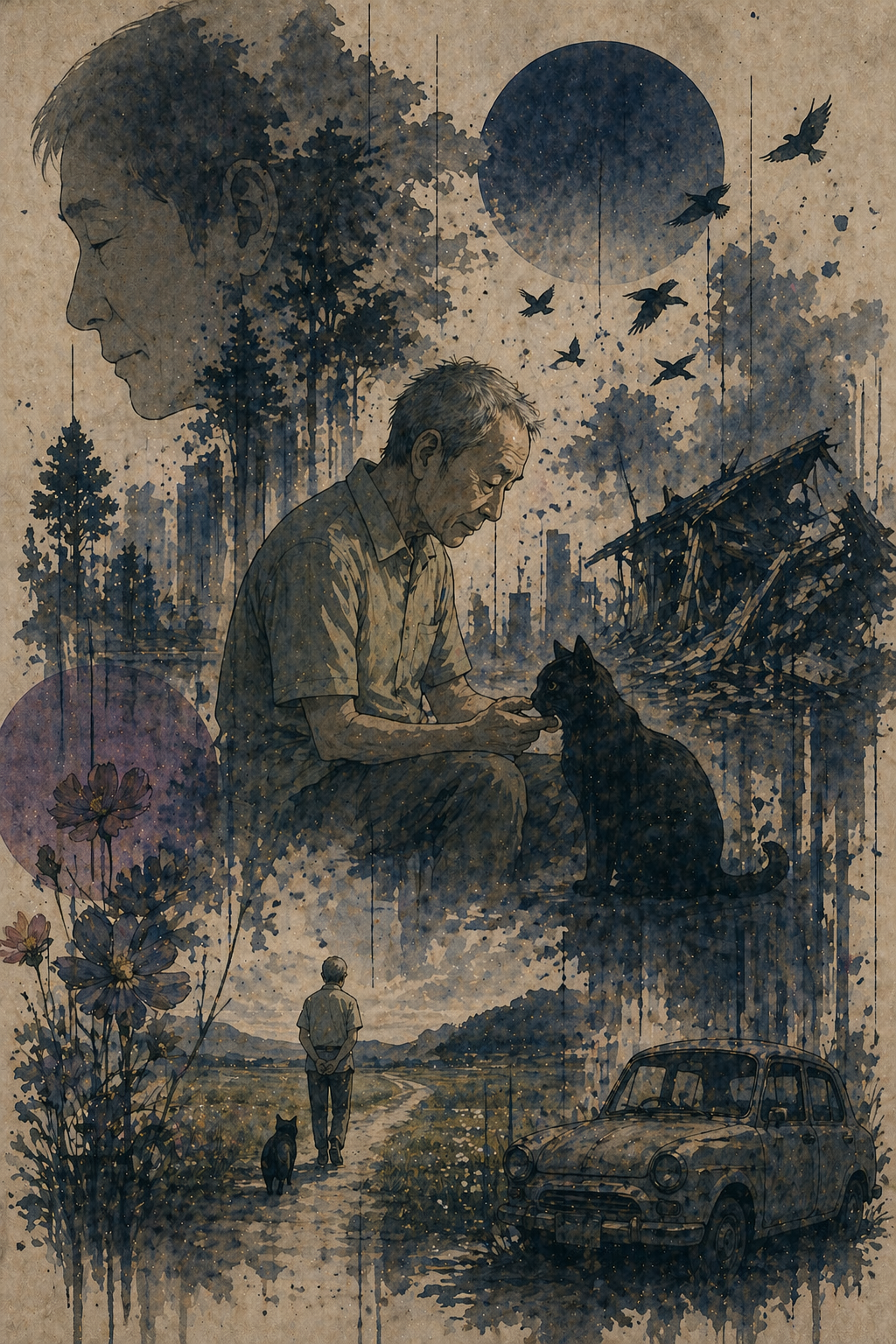
Nakata is one of the most mysterious characters in the novel, but symbolically he is one of the clearest.
As a child, after the wartime incident, he becomes “empty” in a certain sense. He loses ordinary intellectual capacity, but gains strange access to another order of reality: cats, intuitions, thresholds, weather, souls, and entrances.
He is not “simple” in a mocking or diminishing way. He is simplified.
Something has been removed from him, and that loss makes him open to another frequency of the world.
He is like:
- a pure threshold-being
- a damaged innocent
- a post-trauma vessel
- someone who lives outside ordinary ego complexity
Kafka is tangled, split, symbolic, burdened, sexualized, intellectualized. Nakata is almost the opposite. He is emptied out.
That is why the two characters feel complementary. Many readers see them as doubles or split aspects of one deeper human pattern.
Kafka is the self burdened by consciousness and inherited darkness.
Nakata is the self emptied of complexity and therefore open to the hidden world.
Together they form a larger map of broken identity.
8. The wartime incident: why it matters so much
The wartime “Rice Bowl Hill” incident is one of the novel’s deepest unexplained events, but it is not random mystery. It is foundational.
A group of schoolchildren suddenly collapses in the woods. Nakata is the only one who never fully returns in the ordinary sense. Something happened there that connected war, state secrecy, nature, and altered consciousness.
What does it mean?
The incident can be read on several levels at once.
A. Historical trauma entering the novel’s metaphysical system
Murakami often writes as if modern life is haunted by historical violence. War is not just background history. It tears holes in reality and leaves traces in consciousness.
The wartime incident suggests that history itself can distort the border between worlds.
Japan’s wartime violence, secrecy, militarization, and buried guilt do not remain fully in the past. They create spiritual and psychic aftereffects.
B. A rupture in ordinary consciousness
For Nakata personally, the incident is the wound that makes him what he is. He returns from it altered, emptied, and psychically open.
So the incident is the origin of his strange gifts — but these gifts are inseparable from loss.
Murakami is showing that special access often comes through damage, not mastery.
C. Nature as a zone of altered law
The forest and mountain in the novel are never just settings. They are liminal places. In the wartime incident, the children enter a zone where ordinary logic fails.
This is one of Murakami’s recurring ideas: certain spaces allow contact with hidden layers of reality, but that contact may wound as much as reveal.
So the incident is both historical trauma and metaphysical breach.
9. The soldiers in the forest: why they are there
The two soldiers Kafka encounters in the forest are one of the book’s most quietly powerful surreal elements.
They appear as men out of wartime, somehow still existing outside ordinary time. Why?
They represent several things at once.
A. History that has not ended
These soldiers are like preserved fragments of wartime consciousness. They suggest that history is not dead just because chronology has moved on. Some parts of history remain active in hidden zones.
Murakami often treats the past as something still walking around in another register. The soldiers embody that idea.
B. Guardians of the threshold
They also function like border-keepers. The forest in Kafka’s journey is not just a physical forest. It is an initiatory zone, almost an underworld or psychic interior. The soldiers stand at the edge of that world like mythic guides or guardians.
They belong to the logic of threshold-crossing stories.
C. Frozen duty, frozen identity
The soldiers are also examples of people caught in role and time. They continue existing in relation to an old mission, an old order, an old violence. In this sense they are ghostly not because they are transparent apparitions but because they are identities unable to re-enter ordinary life.
This connects them to the whole book’s obsession with people trapped by unfinished states:
- Miss Saeki trapped by memory
- Nakata trapped by his rupture
- Kafka trapped by prophecy
- the soldiers trapped by war
The novel is full of lives suspended between states.
10. The forest itself: not just a forest
The forest is one of the novel’s clearest symbolic spaces.
When Kafka enters the forest, he is not just walking into nature. He is entering the unconscious, the underworld, the deepest layer of self-testing. In myth and fairy tale, forests often mean:
- loss of orientation
- confrontation with hidden truth
- trial
- danger
- death/rebirth
- the space where identity is stripped down
Murakami uses the forest exactly this way.
The forest in Kafka on the Shore is where ordinary maps fail. That means it is the right place for meeting figures from other times, for confronting fear, and for choosing whether to return changed.
The forest is not there to be decoded like a puzzle location. It is there as a symbolic descent.
Kafka has to go in because he cannot become himself without entering what he fears.
11. Johnnie Walker and the cat killings: cruelty, soul-harvesting, and paternal horror
You mentioned the animal killed by the truck driver, but in the novel the most memorable animal killings are the cats murdered by Johnnie Walker. This is one of the darkest and most disturbing parts of the book, and it matters a lot symbolically.
Johnnie Walker is not just a weird villain in a costume. He is one of Murakami’s clearest embodiments of ritualized evil.
He is connected to:
- sadism
- domination
- soul manipulation
- aestheticized violence
- and paternal terror
His killing of cats is horrifying because cats in Nakata’s world represent living presences, innocence, relation, and communication. To harvest their souls into a flute is to convert life into control, sound, and power.
This matters because Johnnie Walker is not killing merely for appetite. He is killing to make something. That makes him an artist of domination, which is far darker.
Many readers connect him to Kafka’s father, and that is right at least symbolically. Even if you don’t reduce him to one-to-one identity, he carries paternal violence in heightened form.
He is:
- the abusive father as mythic figure
- masculine domination transformed into ritual cruelty
- the force Kafka must symbolically overcome
- the evil that treats life as material for aesthetic control
In that sense, the cat killings are not random grotesquerie. They dramatize the world of domination and soul-theft that Kafka is trying to escape.
Nakata kills Johnnie Walker, but even this act is strange and dreamlike. It is as if one damaged but innocent part of the human self has to destroy a monstrous father-force so that another part can continue.
Again, Murakami turns psychic truth into surreal narrative.
12. The truck driver Hoshino and the stone: ordinary man meets metaphysical labor
Hoshino is crucial because he begins as an ordinary, somewhat drifting young man and becomes involved in cosmic work he does not intellectually understand.
This is very Murakami.
He often gives the deepest metaphysical labor not to the most intellectual character, but to the one willing to show up, listen, and act.
Hoshino’s function in the novel is partly to demonstrate that meaning is not always accessed by cleverness. Sometimes it is accessed through loyalty, openness, and action.
The entrance stone is symbolic of threshold activation. Stones in myth and religion often mark permanence, buried force, gateways, and ritual turning points. In Kafka on the Shore, the stone is tied to opening and closing the passage between worlds or states.
Hoshino becomes the one who must help manage this threshold.
This is important because Murakami keeps insisting that large metaphysical processes depend on ordinary human participation. The world is strange, but it still requires people to take responsibility.
Hoshino grows because he accepts this responsibility without fully mastering it conceptually.
13. Why cats speak to Nakata
The talking cats are not there just to create whimsical Murakami flavor. They tell you something very deep about Nakata.
Nakata can speak with cats because he exists outside ordinary human symbolic structure. He has been damaged in a way that reduces conventional social and intellectual capacities, but that damage opens another form of contact.
Cats in the novel represent:
- alternate intelligence
- ordinary mystery
- beings that live close to instinct, silence, and parallel perception
- a nonhuman order that most adults have lost access to
Nakata’s ability to speak with them signals that he is not fully sealed inside normal adult consciousness.
He is like a person who has lost one human world and gained partial access to another.
This is why he is so moving. His gift is inseparable from his wound.
14. Rain of fish, leeches, and impossible events
Murakami uses bizarre natural events not mainly as fantasy spectacle but as signs that the boundaries of ordinary reality have weakened.
When fish fall from the sky or other impossible phenomena occur, the novel is signaling that hidden forces are surfacing. Reality is no longer behaving according to the rules of the everyday because inner, historical, and metaphysical pressures are breaking through.
This is one of the book’s key ideas:
Reality is not as sealed as we think.
When the psyche is disturbed enough, when history remains unprocessed enough, when thresholds open far enough, the world begins reflecting that disturbance.
The strange weather and impossible occurrences are reality becoming porous.
15. Oshima: interpretation, androgyny, and the refusal of rigid categories
Oshima is one of the book’s most intellectually clarifying characters, but he is also important symbolically.
He represents:
- intelligence without cruelty
- identity beyond rigid binaries
- language as guidance
- and the possibility of selfhood that does not obey inherited categories
In a novel so preoccupied with prophecy, bloodline, and predetermined roles, Oshima matters because he lives in defiance of rigid classification. He is thoughtful, ironic, compassionate, and not trapped in a simplistic identity structure.
That makes him one of Kafka’s best guides.
He helps anchor the novel’s deeper moral position: identity is real, but not reducible. A human being is always more than the categories imposed on them.
This matters especially in Kafka’s struggle, because his whole life has been contaminated by imposed narrative — by his father’s prophecy. Oshima offers a counter-model: intelligence, chosen selfhood, and interpretive freedom.
16. The “real thing” under surrealism: the novel is about divided selves
If I had to reduce the book’s hidden structure to one major idea, I would say this:
Kafka on the Shore is about split selves trying to become whole.
Look at the pairs and divisions:
- Kafka / Crow
- Kafka / Nakata
- older Miss Saeki / younger Miss Saeki
- present / past
- conscious / unconscious
- ordinary world / threshold world
- innocence / violence
- fate / freedom
The novel constantly doubles and divides because it is showing human identity not as stable, but as fragmented and searching for integration.
Kafka especially is not a whole self at the beginning. He is a boy driven by fear, prophecy, and division. The surreal elements are the shapes this fragmentation takes.
The novel’s real movement is toward a kind of reintegration — not a perfect one, but enough to return to life differently.
17. Is the novel saying fate is real?
Yes and no.
Murakami is not really writing a simple deterministic novel where a prophecy works like a machine. He is more interested in the relationship between fate and unconscious participation.
That means fate in the novel behaves like something both outside and inside the self.
Kafka feels fated because:
- his father gives him a narrative
- his wounds push him toward certain desires and fears
- history and memory surround him
- he carries inherited darkness
But the novel is not saying he has no agency. It is saying agency is difficult when the unconscious is full of things you do not understand.
So the deeper question becomes:
Can you become free by going through the labyrinth of what shaped you, instead of pretending it isn’t there?
That is much more interesting than a simple “yes, fate exists” answer.
18. Why the ending feels both clear and unclear
The ending of Kafka on the Shore gives emotional resolution more than literal closure.
That frustrates some readers at first, but it is deliberate.
Murakami wants you to feel that Kafka has changed, that some thresholds have been crossed, some violence has been metabolized, some inner divisions have been faced. But he does not want to close every symbolic thread into one legal explanation.
That is because the book is not really about solving the mystery in detective form.
It is about passing through a psychic ordeal.
At the end, what matters most is not “Can every supernatural event be diagrammed?” but “Has Kafka become someone able to return to the world?”
That is the novel’s deeper resolution.
19. What Murakami wants you to feel, not just understand
This matters maybe most of all.
Murakami is not only asking you to decode symbols. He is asking you to experience a mode of being.
He wants you to feel:
- how lonely identity can be
- how the past stays alive
- how memory can become a room you live in
- how violence can be inherited
- how desire can be haunted
- how growing up can feel like entering a mythic forest
- how the self can be many things at once
- and how reality is never as solid as daytime thinking assumes
This is why the book lingers. It is not just clever. It touches something pre-rational.
20. The simplest overall meaning of Kafka on the Shore
If I had to summarize the whole novel for someone who already knows the plot and wants the deeper truth, I’d say this:
It is a novel about becoming a self by walking through memory, prophecy, desire, violence, and the unconscious without being destroyed by them.
Kafka has to enter the symbolic forest of his inheritance.
Nakata has to complete a task opened by old rupture.
Miss Saeki has to release a life frozen in memory.
Hoshino has to accept spiritual responsibility.
The world itself has to open and close a threshold.
Everything surreal in the novel serves this deeper process.
The “real thing” under the surrealism is not one hidden literal answer. It is the drama of transformation.
Final word
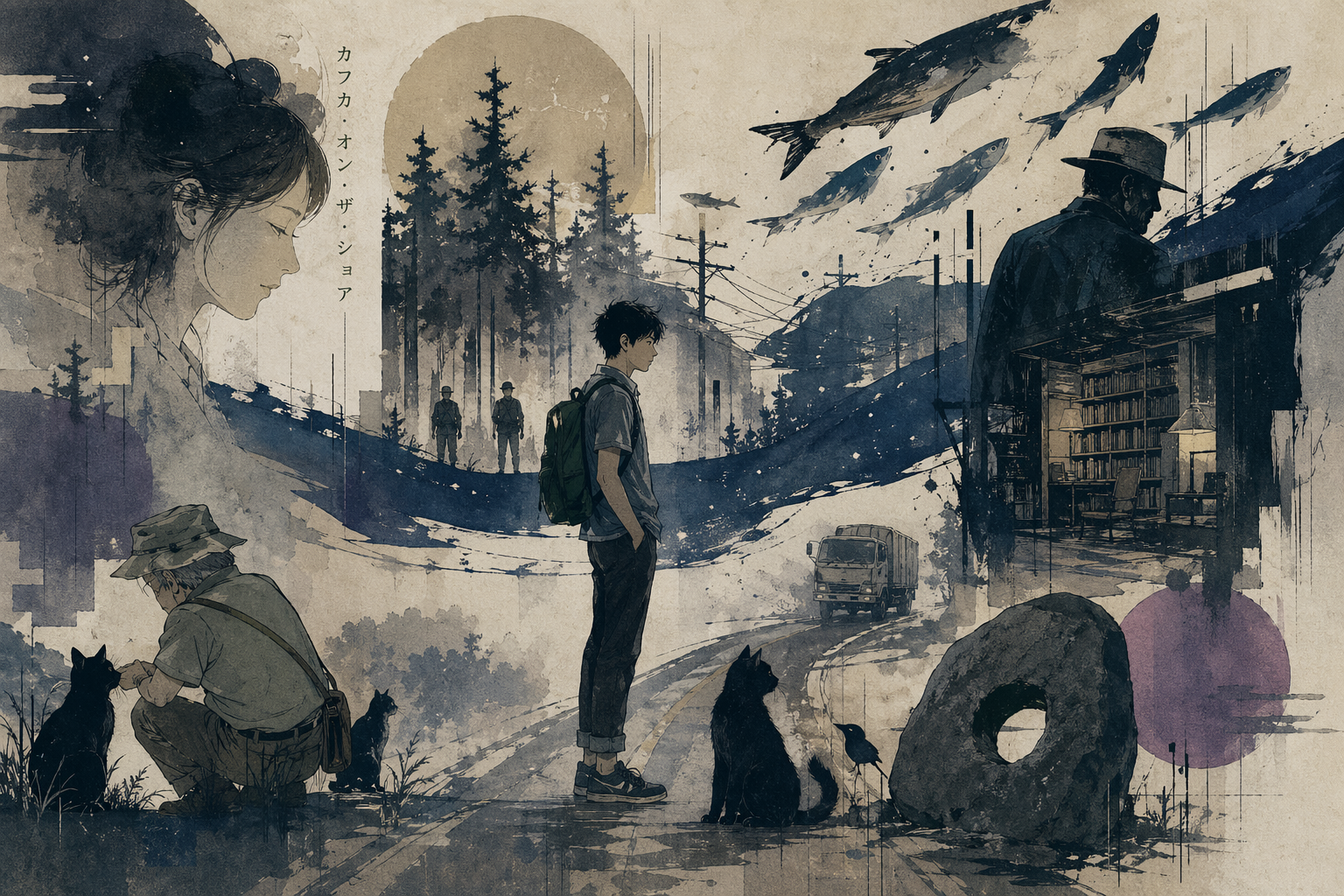
You are actually in a very good place with Kafka on the Shore if you already understand the story but feel the deeper layer pulling at you. That means you read it correctly. Murakami wanted the book to remain open after the plot ended.
The best way to understand it is not to force every event into realism, but to read it as a symbolic dream-novel about identity, memory, trauma, desire, and passage through the unconscious.
So when you think of:
- Crow, think divided self.
- Miss Saeki, think memory that never stopped living.
- Nakata, think innocence after rupture.
- the soldiers, think history suspended.
- the forest, think initiation.
- the wartime incident, think trauma opening a metaphysical wound.
- the cat killings, think domination and soul-violence.
- the strange events, think reality becoming porous under psychic and historical pressure.
Then the novel begins to open.
Not into one final answer, but into a much deeper kind of understanding.
If you want, I can next write you a second companion piece just on Miss Saeki, Kafka, and the Oedipal prophecy, or one only on Nakata and what he symbolizes.