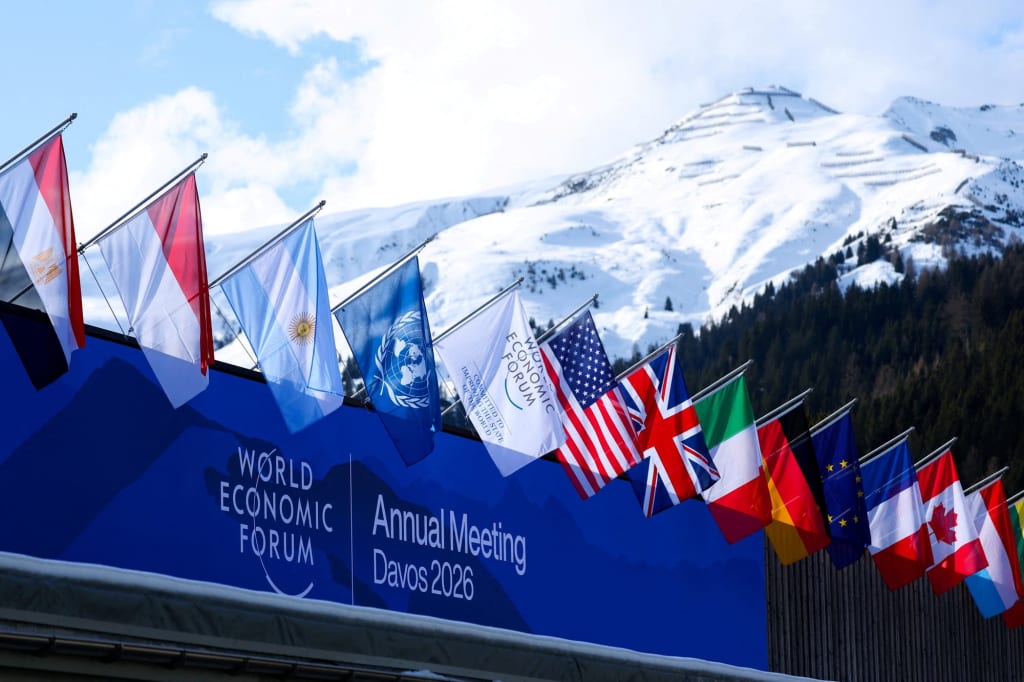
World Economic Forum 2026: Global Trade Disputes Unpacked
Global trade used to be sold as a simple promise: countries that trade together grow together.
Goods move across borders. Companies build supply chains. Consumers get cheaper products. Exporters reach new markets. Governments benefit from jobs, investment, and tax revenue. Globalization, at least in its most optimistic form, was presented as a machine that could turn openness into prosperity.
But at the World Economic Forum 2026 in Davos, that old promise looked far more fragile.
The world did not gather in Switzerland to celebrate smooth globalization. It gathered in a climate of tariffs, export controls, sanctions, shipping disruptions, energy shocks, national-security anxiety, industrial subsidies, technology rivalry, and growing mistrust between major powers. Trade was still essential, but it was no longer treated as politically neutral. It had become a weapon, a shield, a bargaining chip, and a battlefield.
The WEF’s own trade takeaways from Davos 2026 captured the mood clearly: leaders called for rules-based and predictable trade, but also admitted that the world cannot simply return to the old model. The report highlighted tariff threats, geoeconomic confrontation, WTO reform, supply-chain resilience, and the growing use of trade measures for non-economic goals.
That is the story of global trade in 2026.
It is not dead.
It is being redesigned under pressure.
Davos 2026 and the New Trade Reality
The Annual Meeting 2026 took place in Davos-Klosters from January 19 to January 23, bringing political leaders, business executives, economists, policymakers, and civil society figures into one of the world’s most influential economic forums.
But the atmosphere around trade was unusually tense. The WEF’s Global Risks Report 2026 placed geoeconomic confrontation near the center of the global risk landscape, with tariffs, sanctions, investment restrictions, export controls, and economic coercion becoming tools of rivalry rather than rare emergency measures. Euronews reported that geoeconomic confrontation was identified as the top threat to global stability in 2026.
That matters because trade disputes are no longer limited to disagreements over steel, cars, soybeans, or market access. They now touch almost every major question facing the world:
Who controls advanced semiconductors?
Who dominates electric vehicles?
Who owns rare earth supply chains?
Who sets AI standards?
Who controls shipping chokepoints?
Who benefits from green industrial subsidies?
Who can weaponize food, fuel, or finance?
Who writes the next generation of global trade rules?
In the past, trade disputes were often treated as technical fights for lawyers, customs officials, and negotiators. In 2026, they are geopolitical events. A tariff is no longer just a tax. It can be a diplomatic warning. An export control is no longer just a regulatory tool. It can be a national-security wall. A supply-chain shift is no longer just a business decision. It can be a strategic realignment.
That is why Davos 2026 felt different.
The world was not debating whether trade matters.
It was debating whether trust can survive inside trade.
The Tariff Era Returns
Tariffs were one of the loudest themes around Davos 2026.
The WEF noted that, heading into Davos, U.S. President Donald Trump threatened new tariffs against eight European countries resisting his proposal involving Greenland. Those threatened measures were later dropped after a meeting with NATO Secretary General Mark Rutte, but the episode unsettled markets and reinforced a broader fear: tariffs are increasingly being used for political and strategic objectives, not just trade disputes.
That is a major shift.
Traditional trade disputes usually involve claims such as dumping, subsidies, unfair barriers, or market discrimination. But the new tariff politics often blends trade with security, territorial pressure, migration, climate policy, digital rules, or geopolitical loyalty.
This creates uncertainty for businesses. A company planning a factory, import contract, or supply-chain route needs some predictability. If tariffs can appear suddenly because of a diplomatic clash, investment becomes riskier. Businesses delay hiring. Consumers face higher prices. Smaller companies, which lack legal teams and global hedging strategies, suffer most.
A recent U.S. legal battle over tariffs shows how messy the system has become. Investopedia reported that a ruling by the U.S. Court of International Trade invalidated a 10% global tariff imposed under Trump, potentially opening the door to at least $8.3 billion in refunds for U.S. businesses, though the practical and legal process remains complicated.
That case highlights a bigger problem: trade policy is becoming unstable not only internationally, but domestically. Companies may pay tariffs, pass costs to consumers, challenge the measure in court, and then face uncertainty over refunds, future taxes, or replacement policies.
In other words, the tariff itself is only part of the cost.
The uncertainty is another tax.
U.S.-China Tensions Still Shape Everything
No trade dispute matters more than the one between the United States and China.
The two economies remain deeply connected, but their relationship is increasingly defined by strategic rivalry. Trade tensions now overlap with disputes over semiconductors, AI, electric vehicles, rare earth minerals, energy, Taiwan, industrial subsidies, cybersecurity, and military power.
In May 2026, U.S. President Donald Trump and Chinese President Xi Jinping met in Beijing in an attempt to stabilize economic relations. AP reported that the summit was expected to extend a trade truce and potentially create a new U.S.-China “Board of Trade” to reduce the risk of future tariff conflicts. Yet the same report made clear that deeper tensions remain over rare earths, advanced chips, electric vehicles, and strategic influence.
The IMF welcomed constructive U.S.-China dialogue, saying reduced tensions between the world’s two largest economies would benefit the global economy. Reuters reported that the IMF saw diplomatic engagement as important for lowering uncertainty, even as the world economy remained under pressure from energy shocks and geopolitical instability.
That is the paradox.
Everyone knows a full U.S.-China trade breakdown would be dangerous.
But both sides also believe key industries are too strategically important to leave fully exposed to the other.
The result is managed tension rather than true peace. Tariffs may pause. Summits may calm markets. Purchase agreements may be announced. But the deeper rivalry remains.
For companies, this means “China plus one,” “friend-shoring,” and supply-chain diversification are no longer optional buzzwords. They are survival strategies.
Trade Is Becoming Security Policy
One of the clearest messages from Davos 2026 was that trade is now part of security policy.
Countries are no longer asking only, “Where can we produce this most cheaply?” They are asking:
Can we still access this during a crisis?
Is this supplier politically reliable?
Could this technology be used against us?
Could this mineral supply be cut off?
Could sanctions block this transaction?
Could a shipping route be disrupted?
Could export controls stop production?
This is why semiconductors, rare earths, batteries, pharmaceuticals, energy infrastructure, and AI chips dominate trade conversations. These are not ordinary goods. They are strategic assets.
The WEF’s discussion of WTO reform for the AI age noted that about 72% of global goods trade still takes place under the WTO’s default tariff rules, showing that the rules-based system still matters deeply even as geopolitical pressure increases.
That number is important because it counters the idea that globalization has fully collapsed. The WTO system may be strained, but it still underpins most goods trade. Customs procedures, transparency standards, and market-access rules still structure global commerce.
The danger is not that the system has disappeared.
The danger is that political rivalry is slowly hollowing it out.
If countries increasingly bypass multilateral rules in the name of security, trade becomes less predictable. And when trade becomes unpredictable, the cost eventually reaches ordinary people through prices, shortages, job disruption, and weaker growth.
The WTO Reform Question
Davos 2026 also made clear that the World Trade Organization remains essential—but incomplete.
The WTO is still the backbone of global trade rules, but it faces serious pressure. Its dispute-settlement system has been weakened for years. Major economies increasingly act outside the multilateral framework. New trade issues such as AI, digital services, data flows, climate measures, and industrial subsidies are not fully covered by older rules.
The WEF’s April 2026 coverage of the WTO’s 14th Ministerial Conference in Yaoundé described the meeting as taking place at a pivotal moment marked by geopolitical tensions, economic fragmentation, and rapid digital transformation. Nearly 2,000 trade officials attended the March 2026 conference, only the second WTO Ministerial hosted on the African continent.
UNCTAD’s March 2026 Global Trade Update similarly argued that reforming WTO rules is critical to restoring confidence, especially for developing countries that are more vulnerable to volatility because they often rely on a narrow range of exports and have less capacity to absorb shocks.
This is one of the most important points in the trade debate.
When rich economies fight trade wars, they can often absorb some damage. They can subsidize industries, borrow money, shift suppliers, and use diplomatic leverage. Poorer economies have fewer options. A sudden tariff, shipping disruption, export ban, or commodity shock can hit government budgets, food prices, jobs, and currency stability very quickly.
That is why WTO reform is not just a bureaucratic issue.
It is a development issue.
Developing Countries Are Caught in the Middle
Many developing economies are now trapped between competing trade blocs.
They want access to U.S., Chinese, European, Gulf, and regional markets. They want investment. They want technology transfer. They want infrastructure. They want industrial development. But they do not want to be forced into rigid geopolitical camps.
Southeast Asian economies, for example, are often described as winners of supply-chain diversification because companies are moving production outside China. But the WEF warned that Southeast Asia is also at the sharp end of global realignments, as localization gains ground over globalization and fragmentation increases fragility.
That is the hidden cost of “friend-shoring.” It can bring investment to some countries, but it can also force them into difficult diplomatic positions. If a factory moves to Vietnam, Malaysia, Mexico, India, or Indonesia because companies want alternatives to China, those countries may benefit economically. But they also face pressure to align standards, security policies, and trade commitments with powerful partners.
For smaller economies, the ideal world is open trade with many partners.
The emerging world is more conditional: trade with us, but not too much with them.
That creates pressure on countries that simply want development.
Supply Chains: From Efficiency to Resilience
The old supply-chain model prioritized efficiency. Companies searched for the lowest cost, fastest production, and leanest inventory. That model worked well in stable times, but recent shocks exposed its fragility.
The pandemic disrupted medical supplies and shipping. Russia’s war in Ukraine disrupted food, fertilizer, and energy markets. Middle East conflict threatened oil and shipping routes. U.S.-China tensions affected technology supply chains. Climate events interrupted agriculture and logistics.
The WTO Director-General’s recent Financial Times article warned that protectionism during global shocks makes everyone poorer. The article argued that trade policy should support supply-chain adaptability rather than block it, especially during crises such as energy disruptions linked to the Strait of Hormuz.
This is exactly why businesses now talk less about “just in time” and more about “just in case.”
Companies are building backup suppliers.
Governments are stockpiling strategic goods.
Manufacturers are diversifying routes.
Countries are investing in domestic capacity.
Trade corridors are being rethought.
Digital customs systems are becoming more important.
The goal is no longer maximum efficiency alone.
The goal is resilience.
But resilience is expensive. Duplicate suppliers, local production, inventories, and compliance systems all raise costs. Those costs eventually show up somewhere: consumer prices, lower margins, government subsidies, or reduced investment elsewhere.
Resilience is necessary.
But it is not free.
Energy Shocks and Trade Disputes
Energy remains one of the most dangerous links between geopolitics and trade.
In 2026, Middle East tensions and disruptions around the Strait of Hormuz became a major concern for the global economy. Reuters reported that the IMF warned oil prices above $100 per barrel due to Middle East tensions were pushing the world economy toward an adverse scenario, with global GDP growth potentially falling to 2.5% for the year, down from 3.4% in 2025.
Energy shocks affect trade in several ways.
They raise shipping costs.
They increase manufacturing costs.
They worsen inflation.
They pressure import-dependent countries.
They change currency flows.
They affect food and fertilizer prices.
They create export restrictions and emergency trade measures.
They force governments to choose between consumer subsidies and fiscal discipline.
That is why trade disputes cannot be separated from energy security. A tariff fight may be manageable when oil is cheap and supply chains are stable. But when energy prices spike, trade restrictions become far more painful.
Energy is the bloodstream of trade.
When it becomes unstable, everything else becomes more expensive.
The Green Trade Conflict
Another major source of trade friction is the green transition.
Countries want to lead in electric vehicles, batteries, solar panels, wind technology, hydrogen, critical minerals, and clean industrial production. But the green economy is also becoming a subsidy battlefield.
The United States, China, Europe, India, and others are all trying to build domestic green industries. That creates disputes over subsidies, dumping, market access, carbon border measures, and industrial policy.
China’s dominance in electric vehicles and clean-energy manufacturing has become a major point of tension with Western economies. AP’s coverage of the U.S.-China summit noted that China’s growing strength in electric vehicles remains one of the key unresolved strategic disputes.
This is one of the hardest trade problems of the decade.
On one hand, the world needs rapid clean-energy deployment. Cheap solar panels, batteries, and EVs can accelerate decarbonization.
On the other hand, countries fear becoming dependent on one supplier for the industries of the future. They want domestic jobs, industrial capacity, and technological sovereignty.
So the green transition is producing a strange conflict: the world needs global scale, but politics demands local control.
That tension will define green trade for years.
AI, Data, and Digital Trade
Davos 2026 also made clear that the next trade disputes will not be only about physical goods.
Digital trade is becoming central. AI models, cloud services, data flows, digital payments, cybersecurity rules, software, platform regulation, and intellectual property are now part of the trade agenda.
The WEF’s report on WTO reform for the AI age warned that without modern rules, commercial outcomes risk being dictated by geopolitics rather than predictable standards.
AI makes this urgent.
Who can export advanced chips?
Who can train frontier models?
Can data cross borders?
Can governments demand local data storage?
Can AI services be restricted for national security?
Who owns AI-generated intellectual property?
How should digital taxes work?
Can small countries participate in AI trade, or will the market be dominated by a few powerful economies?
These questions are trade questions now.
The old trade system was built around goods moving through ports. The new system must also handle data moving through servers, models moving through APIs, and digital services moving instantly across borders.
That is why WTO reform, digital agreements, and AI governance are increasingly linked.
The next trade war may not begin at a customs checkpoint.
It may begin in a data center.
Fragmentation Is the New Globalization
One of the strongest themes at Davos 2026 was fragmentation.
Globalization is not disappearing, but it is becoming more regional, political, and selective. Countries still trade, but they increasingly prefer trusted partners. Companies still globalize, but they diversify. Governments still support open markets, but only when national-security concerns are satisfied.
The WEF argued that geoeconomic confrontation is making waves locally and that localization is gaining ground over globalization. The consensus at Davos was that increasing fragmentation is increasing fragility in many regions.
This new model has many names:
Friend-shoring.
Near-shoring.
Re-shoring.
De-risking.
Strategic autonomy.
Economic security.
Supply-chain resilience.
Industrial sovereignty.
All of these phrases point to the same reality: countries want trade, but they want less vulnerability.
The problem is that one country’s resilience can look like another country’s exclusion. When everyone tries to protect themselves at once, the global system can become less efficient, less cooperative, and more unequal.
Fragmentation may reduce some risks.
But it creates others.
What Businesses Heard at Davos
For business leaders, Davos 2026 sent a clear message: trade uncertainty is now permanent enough to plan around.
Companies can no longer assume stable tariffs, smooth shipping, predictable regulations, or politically neutral supply chains. They need scenario planning.
A serious 2026 trade strategy now includes:
Mapping supply-chain exposure.
Identifying tariff risks.
Diversifying suppliers.
Monitoring export controls.
Tracking sanctions.
Building compliance teams.
Preparing for energy shocks.
Using digital trade tools.
Understanding carbon border rules.
Investing in geopolitical risk intelligence.
Building resilience into contracts.
This is not just for multinational giants. Small and medium-sized enterprises are also affected, often more severely. A small importer may not survive sudden tariffs. A small exporter may lose a market overnight. A manufacturer dependent on one imported component may stop production if that component is restricted.
The WEF’s trade takeaways emphasized that small businesses need support to navigate the new trade environment.
That point deserves more attention. Global trade disputes are often discussed at the level of presidents and CEOs. But the pain often lands on small firms, workers, and households.
The Everyday Cost of Trade Conflict
Trade disputes can sound abstract: tariffs, safeguards, countermeasures, rules of origin, export controls, industrial subsidies.
But the effects are ordinary.
A family pays more for electronics.
A farmer loses an export market.
A factory delays expansion.
A small business waits longer for parts.
A worker’s job becomes uncertain.
A government spends more on fuel imports.
A hospital pays more for medical equipment.
A student buys a more expensive laptop.
A country faces food inflation.
The WEF’s recent article on the everyday costs of geoeconomic confrontation emphasized that global rankings and strategic disputes eventually translate into local hardship.
That is the most important truth often lost in elite trade debates.
Trade conflict is not only about leverage between governments.
It is about prices, jobs, wages, shortages, and choices.
When trade becomes a battlefield, ordinary people pay admission.
Is Global Trade Collapsing?
No.
Global trade is not collapsing. It is changing.
Goods still move. Services still grow. Digital trade is expanding. Regional agreements continue. Companies still need markets. Consumers still want products. Governments still depend on exports and imports.
Even in the middle of fragmentation, most global goods trade still relies on WTO default rules, as the WEF noted.
But the character of trade is changing. The old assumption that economic integration would naturally reduce political conflict has weakened. Countries now trade and distrust at the same time. They cooperate in one sector and restrict another. They buy from each other while preparing for confrontation.
That is the new trade reality:
Connected, but suspicious.
Open, but conditional.
Global, but fragmented.
Efficient, but less trusted.
Trade is still alive.
The politics around it are much harsher.
What Davos 2026 Really Revealed
The most important lesson from the World Economic Forum 2026 is that global trade disputes are no longer side issues. They are central to the future of the global economy.
Tariffs affect inflation.
Export controls affect technology.
Energy shocks affect growth.
WTO reform affects predictability.
Digital rules affect AI.
Green subsidies affect climate strategy.
Supply-chain shifts affect development.
Geopolitical rivalry affects everything.
The WEF’s Davos trade takeaways said the world needs rules-based, predictable trade, but cannot simply return to the past. That may be the most honest summary of 2026.
The old globalization model had real flaws. It created winners and losers. It concentrated production. It ignored some security risks. It left many workers feeling abandoned. It underestimated political backlash.
But replacing it with permanent trade confrontation would be worse.
The challenge is to build a trade system that is more resilient, fairer, more secure, and still open enough to support growth.
That is easy to say.
Hard to do.
Final Verdict
World Economic Forum 2026 made one thing clear: global trade has entered a more contested age. Tariffs, sanctions, export controls, industrial subsidies, energy shocks, AI competition, green technology rivalry, and supply-chain security are reshaping the rules of globalization.
Davos did not signal the end of trade. It signaled the end of naïve trade optimism. Leaders still want open markets, but they also want strategic control. Businesses still want global supply chains, but they now need backup plans. Developing economies still want access to world markets, but they are increasingly caught between rival powers.
The biggest risk is not that trade stops overnight. The bigger risk is that trade becomes less predictable, less cooperative, and more expensive—slowly weakening growth, raising prices, and making global crises harder to manage.
The best path forward is not a return to the old model without reform. It is a renewed rules-based system that recognizes security concerns without turning every economic dispute into a weapon. That means WTO reform, digital trade rules, fairer development pathways, supply-chain resilience, and major-power dialogue.
Global trade is still one of the world’s most powerful engines of prosperity.
But in 2026, it is also one of its most dangerous fault lines.