
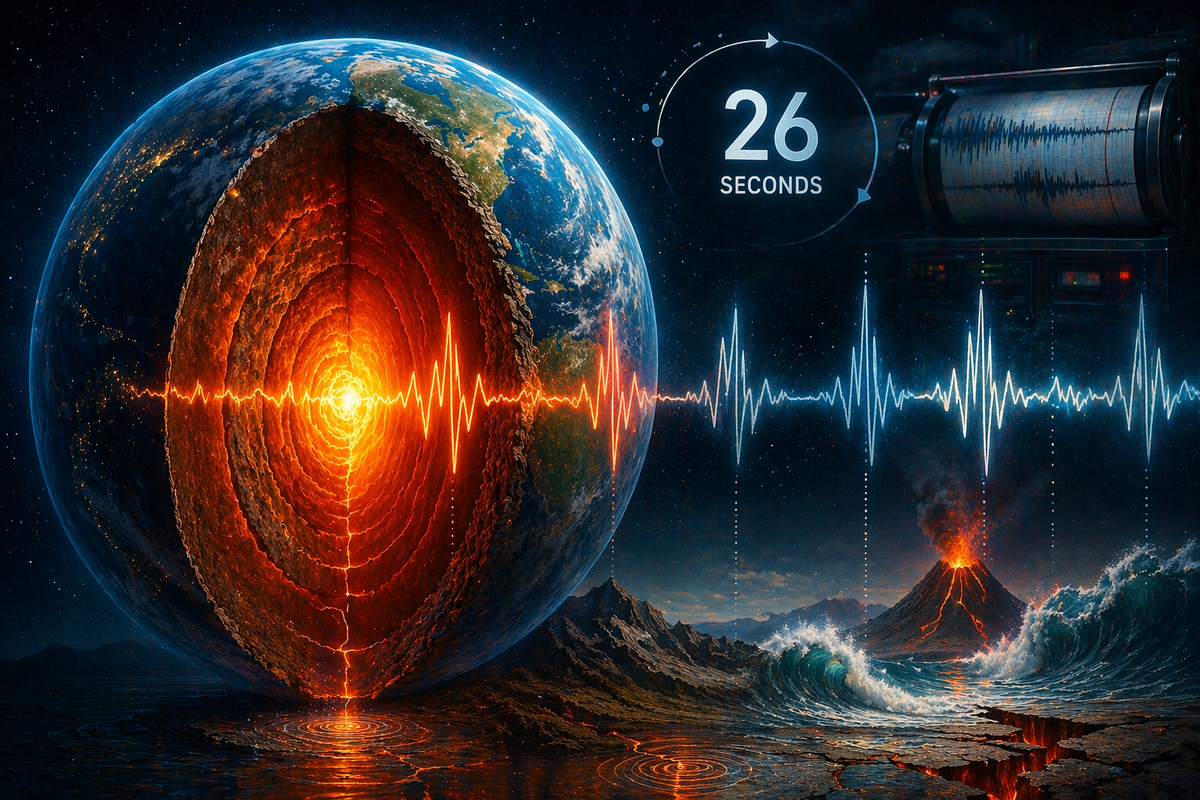
Earth’s Mysterious 26-Second “Heartbeat”: A Seismic Puzzle That Has Defied Explanation for Over 60 Years
Our planet hums with constant motion—earthquakes, shifting tectonic plates, volcanic eruptions, crashing ocean waves. Seismologists have spent decades cataloging these natural vibrations, turning Earth itself into a subject of constant study. Yet among all the chaotic signals the planet produces, one of the strangest is also one of the most regular: a faint seismic pulse that repeats every 26 seconds.
First detected in the 1960s, this peculiar “heartbeat” of Earth has fascinated and baffled researchers for over half a century. Unlike earthquakes, which occur suddenly and without predictable rhythm, this pulse is steady, clock-like, and remarkably consistent, always seeming to emanate from the same small region of the globe. Despite numerous investigations, scientists still can’t agree on what causes it.
The Discovery: Jack Oliver’s Puzzling Signal

The mystery began in the early 1960s, when geologist Jack Oliver, a pioneer in seismology, noticed a strange, repeating blip in global seismograph data. Every 26 seconds, seismic stations picked up a faint but distinct signal.
At first, many thought it was some form of “noise”—a product of faulty equipment or human activity. But the signal proved real, appearing across different instruments worldwide, regardless of location. Unlike random seismic background noise, this pulse was precise, unwavering, and repeating like clockwork.
Oliver’s early studies placed the source somewhere in the Atlantic Ocean, though the exact location would only be refined decades later.
Pinpointing the Source: The Gulf of Guinea
Later investigations, particularly in the 1980s and 1990s, localized the pulse to the Gulf of Guinea, a region off the coast of West Africa, near the Bight of Bonny and close to the volcanic island of São Tomé.
The area is geologically active, featuring a continental shelf, strong ocean currents, and volcanic structures. Yet despite its interesting features, nothing about it explained why it would produce such a unique seismic rhythm that is not observed elsewhere on Earth.
Possible Explanations
Over the years, scientists have proposed several theories to explain Earth’s mysterious 26-second pulse:
1. Ocean Wave Resonance
Some seismologists argue the signal may be caused by powerful ocean waves striking the continental shelf in a rhythmic pattern.
The theory suggests that the interaction between waves and the seafloor produces a repeating seismic “echo” that radiates through the Earth.
The Gulf of Guinea does experience intense wave activity, but similar continental shelf regions elsewhere in the world do not produce this exact pulse, leaving a major gap in this explanation.
2. Volcanic Activity
Others believe the signal is tied to volcanic processes, possibly from São Tomé or nearby undersea volcanic features.
Volcanic activity can produce rhythmic tremors, known as “volcanic harmonic tremors,” which sometimes resemble repeating pulses.
Yet no active volcano in the region has been definitively linked to the 26-second signal.
3. Seafloor Oscillations or Resonance Chambers
A more speculative idea is that unique geological features beneath the Gulf of Guinea act like a natural resonating chamber, amplifying vibrations at a specific interval.
This would be similar to how a musical instrument produces sound at certain frequencies.
4. Anthropogenic Influence?
Some skeptics have wondered whether human activity (such as offshore drilling or shipping) could contribute.
However, the pulse predates large-scale industrial activity in the region and has remained consistent for decades, making this explanation unlikely.
Why the Mystery Persists
One reason the 26-second pulse remains unsolved is that it doesn’t fit neatly into seismology’s main priorities. The field typically focuses on earthquakes, tectonic hazards, and volcanic risks—events with direct consequences for human populations.
By contrast, this pulse is subtle, harmless, and does not appear to be linked to any major hazards. As a result, while intriguing, it has remained at the fringes of scientific research. Funding and attention for studying it in depth have been limited.
The Strangeness of Its Consistency
What makes the “heartbeat” especially odd is its stability.
It has been recorded since at least the 1960s and continues today.
It has not significantly shifted in timing or strength.
No other region of the planet produces a comparable rhythmic seismic pulse.
This persistence suggests the phenomenon is tied to a long-standing natural process, not a transient or human-caused event.
Why It Matters
Although the 26-second pulse may not pose risks, its existence is scientifically important. Solving the mystery could:
Provide new insights into ocean-seafloor interactions.
Reveal hidden processes of volcanic or tectonic activity.
Improve our understanding of Earth’s background seismic “hum.”
It also highlights the fact that, even in the modern scientific era, our planet still holds deep mysteries.
Earth’s Other Rhythms
Interestingly, the 26-second heartbeat is not the only strange vibration Earth produces:
Scientists have also detected the “Earth’s hum”—a very faint, continuous vibration unrelated to earthquakes, caused by the constant motion of ocean waves across the globe.
Volcanic tremors and geyser activity sometimes produce repeating seismic signals, though none as consistent as the Gulf of Guinea’s pulse.
The difference is that the 26-second signal is both global and localized: it originates in one place but can be detected around the world.
A Puzzle for Future Generations
More than 60 years after its discovery, Earth’s faint 26-second seismic heartbeat remains unsolved. Each theory offers clues but falls short of complete explanation.
For now, the Gulf of Guinea continues to pulse, every 26 seconds, like the quiet beat of a hidden drum beneath the ocean. It is a reminder that while humanity has mapped the continents, split the atom, and reached the Moon, the Earth beneath our feet still carries secrets.
Conclusion
The mysterious 26-second pulse is one of geology’s enduring puzzles—an unexplained rhythm that bridges the natural and the uncanny. Whether it is the ocean hammering the continental shelf, hidden volcanic activity, or an unknown geophysical process, it remains a symbol of science’s unfinished business with the planet we call home.
In an age where we often think we have mastered nature, the Earth’s “heartbeat” humbles us. It pulses steadily, unexplained but undeniable, reminding us that the world is far more complex and mysterious than we may ever fully understand.