If Cancer Came Tomorrow: The Viral Theory, the Metabolic Argument, and the Dangerous Hope Behind “Alternative” Cancer Plans
Explore Dr. Eric Berg’s metabolic cancer theory, fasting claims, and controversial drug ideas with a careful, evidence-aware Revlox breakdown.
Cancer has always attracted two kinds of fear.
The first is obvious: the fear of diagnosis, treatment, pain, uncertainty, and mortality. The second is quieter but just as powerful: the fear that the official medical system may not be telling the whole story. That second fear is where many viral cancer theories begin. They often mix biology, suspicion, personal testimony, pharmaceutical distrust, and a promise that the body may be able to fight back if only the right hidden levers are pulled.
One such theory has been popularized by Dr. Eric Berg, who argues that if he were diagnosed with cancer, he would approach it not simply as a genetic disease, but as a metabolic one. In his framing, cancer is deeply connected to mitochondria, fuel supply, glucose metabolism, immune evasion, and the body’s internal terrain. He presents cancer as something fragile yet adaptive, almost parasite-like in its survival strategy: stealing energy, avoiding immune destruction, and finding alternate routes when one pathway is blocked.
It is a compelling story. It is also a story that needs careful handling.
Modern oncology does recognize that cancer metabolism matters. Tumors often rewire the way they consume energy. Many cancer cells rely heavily on glucose fermentation even when oxygen is available, a phenomenon commonly associated with the Warburg effect. But mainstream cancer science does not reduce all cancer to a single metabolic failure. Cancer is not one disease. It is a family of diseases shaped by genetics, epigenetics, immune behavior, tissue environment, inflammation, metabolism, and many other forces. That is why a blood cancer, a brain tumor, breast cancer, colon cancer, and pancreatic cancer cannot be responsibly treated as if they were the same enemy wearing different clothes.
Still, Berg’s theory has gained attention because it speaks to a question many patients quietly ask: if cancer uses fuel, can we starve it?

The Metabolic Cancer Argument
At the heart of Berg’s claim is the idea that cancer cells are metabolically vulnerable. He suggests that cancer survives by hijacking the body’s energy systems and depending heavily on pathways such as glycolysis, the process by which cells break down glucose for energy.
From this point of view, cancer is not only a genetic accident. It is also a disease of broken energy management. The mitochondria, often described as the powerhouses of the cell, become central characters in the story. If healthy cells can switch fuel sources under stress, but cancer cells struggle to adapt, then perhaps pushing the body into a fasting state could create a hostile environment for tumors.
This is where prolonged fasting enters Berg’s hypothetical plan.
He argues that if he had cancer, one of the strongest tools he would consider would be extended fasting: not eating food for several days, while using water and selected nutrients. His logic is that fasting removes the steady stream of fuel cancer cells depend on, while healthy cells are better equipped to adapt. In advanced disease, he suggests he might fast for longer periods, possibly many days or even two weeks or more.
This idea has a certain biological elegance. Fasting lowers insulin, changes glucose availability, increases ketone production, and triggers cellular stress responses. Researchers have studied fasting, calorie restriction, and fasting-mimicking diets in cancer contexts, especially around chemotherapy tolerance and metabolic changes. Some early studies suggest short-term fasting or fasting-mimicking diets may have potential supportive roles, but evidence remains preliminary and highly context-dependent. The American Cancer Society-linked review literature also notes that cancer patients receiving chemotherapy are often advised to increase calories and protein, not restrict them, because malnutrition can become dangerous during treatment.
That is the crucial tension. Fasting may be biologically interesting, but cancer patients are not laboratory diagrams. They are people who may already be losing weight, losing muscle, struggling with appetite, recovering from surgery, or enduring chemotherapy. MD Anderson warns that fasting during cancer treatment must be evaluated case by case, because malnutrition can cause weight loss, fatigue, and slower healing.
So the question is not whether fasting affects cancer biology. It does affect biology. The real question is whether prolonged fasting improves survival, reduces tumor burden, or safely supports treatment in real patients with specific cancers. On that question, the evidence is not strong enough to support self-directed extreme fasting as a cancer treatment.
The Food Layer: Cruciferous Vegetables, Fermented Foods, and Polyphenols
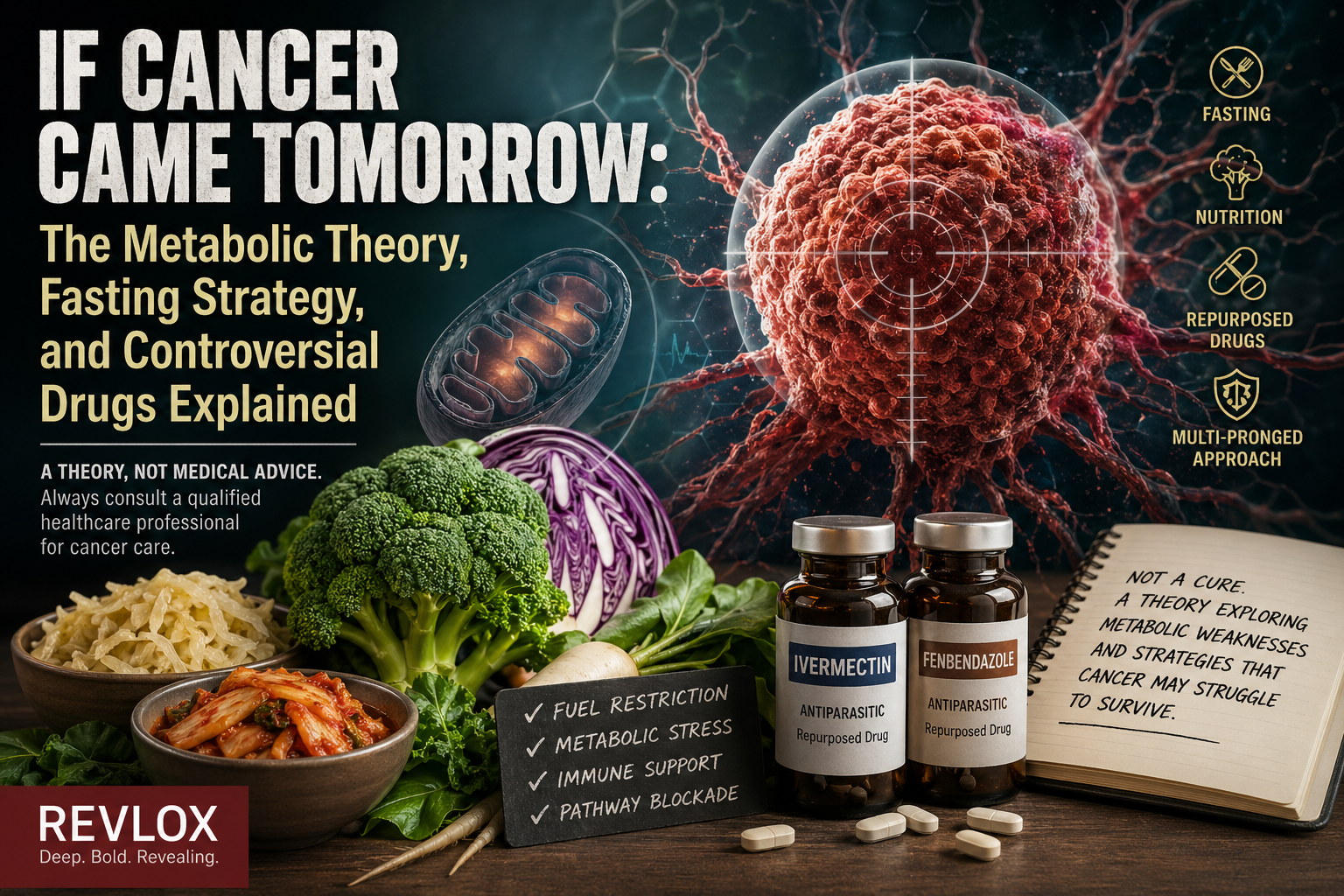
Berg’s theory also emphasizes what he would eat outside fasting windows. The list is familiar to anyone who follows nutrition science or wellness media: cruciferous vegetables such as broccoli, cauliflower, cabbage, mustard greens, radish, and turnip; fermented foods such as kimchi, sauerkraut, and kombucha; and plant compounds such as sulforaphane, quercetin, resveratrol, and berberine.
Here, the conversation becomes less controversial but still easy to exaggerate.
A diet rich in plant foods is widely associated with better health outcomes and lower risk of several chronic diseases. The American Cancer Society recommends healthy dietary patterns that emphasize vegetables, fruits, whole grains, and legumes, while limiting red and processed meat, sugary drinks, and highly processed foods. Studies link such patterns with lower cancer risk and better overall health.
Cruciferous vegetables contain compounds that are actively studied for cancer prevention mechanisms. Fermented foods may support gut microbial diversity. Polyphenols have antioxidant and signaling effects in the body. But none of this means broccoli cures cancer. None of it means kombucha replaces chemotherapy. None of it means supplements can safely reproduce the complexity of a whole-food diet.
The responsible takeaway is simple: a plant-forward, nutrient-dense diet can support general health and may reduce cancer risk, but once cancer is diagnosed, nutrition becomes part of supportive care—not a standalone cure.
The Most Controversial Part: Ivermectin and Fenbendazole
The most explosive part of Berg’s hypothetical plan is his mention of two antiparasitic drugs: ivermectin and fenbendazole.
He frames the choice through the parasite analogy. If cancer and parasites share survival strategies, he argues, then antiparasitic drugs might disrupt cancer survival pathways too. He points to glycolysis and microtubules, claiming that drugs used to harm parasites may also interfere with tumor growth.
This is where the article must slow down.
Ivermectin is a real human medicine with legitimate uses against certain parasitic infections. It also has laboratory research suggesting potential anticancer mechanisms in cells and animal models. Some reviews have explored its effects on cancer-related pathways, including proliferation, metastasis, angiogenesis, and cell signaling. But laboratory promise is not the same thing as proven cancer treatment. Many compounds kill cancer cells in a dish and fail in humans because the dose, delivery, toxicity, tumor environment, and patient biology do not translate.
Fenbendazole is even more problematic. It is primarily a veterinary deworming drug. The American Cancer Society states that fenbendazole has not been tested in human studies as a cancer treatment, is intended for animals, and has never been approved by the FDA for humans for any purpose.
That does not mean scientists should never investigate repurposed drugs. Drug repurposing is a legitimate research field. Many old, cheap medicines deserve proper clinical study. But “interesting mechanism” is not the same as “safe cancer protocol.” The distance between those two ideas is where real patients can get hurt.
In recent years, cancer organizations and oncologists have become increasingly concerned about online claims surrounding ivermectin and fenbendazole. Macmillan Cancer Support published guidance warning patients about misleading claims around ivermectin and cancer, while oncology experts have emphasized that evidence remains limited and that these drugs should not be treated as proven cancer therapies.
The danger is not curiosity. The danger is substitution.
A patient asking their oncologist about a repurposed drug is one thing. A patient abandoning surgery, chemotherapy, immunotherapy, targeted therapy, or radiation because a viral video made an unproven protocol sound suppressed and miraculous is something else entirely.
The Patent Argument: Suspicion, Profit, and Reality
Berg’s explanation also includes a familiar claim: these drugs are not recommended because they are cheap, off-patent, and not profitable, while chemotherapy and radiation generate enormous revenue.
This argument resonates because healthcare economics can be deeply troubling. Cancer drugs can be extremely expensive. Pharmaceutical incentives do shape research priorities. It is reasonable to criticize profit-driven medicine.
But the patent argument is not enough to prove a treatment works.
Many cheap, old, generic treatments are widely used in medicine when evidence supports them. Aspirin, metformin, steroids, antibiotics, beta blockers, and many anesthetic drugs are not rejected simply because they are old or inexpensive. If a low-cost drug clearly improved cancer survival in large, well-designed trials, it would be difficult for oncology to ignore it forever. In fact, cancer researchers actively study repurposed drugs, including metformin, aspirin, mebendazole, propranolol, statins, and others.
The stronger criticism is not “no one studies cheap drugs.” Some researchers do. The real problem is that cheap drugs often attract less funding for large trials. That is a valid issue. But lack of funding does not automatically convert weak evidence into strong evidence.
A theory can be plausible, underfunded, and still unproven.
Why This Theory Feels So Powerful
The reason Berg’s theory spreads is not just because of biology. It spreads because it offers emotional control.
Cancer makes people feel invaded. A metabolic theory gives them a map. Fasting gives them an action. Supplements give them tools. Repurposed drugs give them a sense of hidden opportunity. The parasite analogy gives the enemy a shape. The pharmaceutical-profit argument gives the story a villain.
That is powerful narrative engineering.
It also fits perfectly into the internet age. Online health culture rewards confidence more than caution. A short video saying “this is what I would do if I had cancer” feels intimate and brave. A cautious oncologist explaining trial phases, tumor heterogeneity, contraindications, and survival endpoints sounds less exciting. But the less exciting voice is often the one trying hardest not to mislead you.
The National Cancer Institute’s guidance on complementary and alternative medicine makes this point in a broader way: many non-standard practices still need more research, and people with cancer should discuss them with their healthcare providers before using them.
That is not a dismissal. It is a safety boundary.
The Missing Word: “Alongside”
One of the most important distinctions in cancer care is the difference between “instead of” and “alongside.”
Eating better alongside treatment can be wise. Managing sleep, stress, muscle mass, and metabolic health alongside treatment can be valuable. Discussing clinical trials alongside standard care can be smart. Asking an oncologist about fasting-mimicking diets, drug interactions, or repurposed-drug research alongside treatment can be reasonable.
But replacing proven care with an internet protocol is where risk multiplies.
Cancer is often time-sensitive. Early-stage disease may be curable with surgery, radiation, chemotherapy, immunotherapy, targeted therapy, hormonal therapy, or a combination. Delays can allow tumors to spread. Once spread occurs, options may become more limited. That is why medical misinformation is not just “another opinion.” It can change outcomes.
Recent public-health reporting has documented growing concern among cancer specialists that patients are being influenced by online “cures” and delaying or rejecting evidence-based treatment. Experts have warned that misinformation can lead to preventable harm, especially when patients pursue restrictive diets or unproven remedies instead of oncology care.
This is where any article about Berg’s theory must be honest: the ideas may be fascinating, but fascination is not a treatment plan.
A Safer Way to Read Berg’s Theory
The best way to read this theory is not as a prescription. It is as a window into several real scientific questions:
Can cancer metabolism be targeted more effectively?
Can fasting or fasting-mimicking diets reduce treatment toxicity for some patients?
Can specific dietary patterns improve resilience during cancer therapy?
Can old drugs be repurposed after proper clinical testing?
Can patients be given more agency without being pushed toward dangerous self-experimentation?
These are worthy questions. They deserve research. They deserve open conversation. They do not deserve to be flattened into “do this if you get cancer.”
The mature position is neither blind trust nor blind rebellion. It is disciplined curiosity.
Yes, cancer metabolism matters. Yes, food and fasting affect the body’s internal environment. Yes, drug repurposing is a legitimate scientific field. Yes, the economics of cancer medicine deserve scrutiny. But also yes: cancer patients need evidence, monitoring, dosing accuracy, liver and kidney safety checks, drug-interaction review, nutritional assessment, imaging, pathology, staging, and specialist care.
The body is not a YouTube comment section. It does not reward confidence alone.
What Someone Should Actually Do After a Cancer Diagnosis
If cancer is diagnosed tomorrow, the first step should not be panic, fasting, supplements, or ordering veterinary medicine online. The first step should be confirmation and staging.
That means understanding the exact cancer type, grade, stage, biomarkers, genetic mutations if relevant, imaging results, and treatment options. A second opinion from a qualified oncologist can be valuable, especially for complex or aggressive cancers. If someone is interested in metabolic therapy, fasting, supplements, or repurposed drugs, those questions should be brought into the medical conversation openly.
The right question is not, “Can I secretly add this?”
The right question is, “Could this interfere with my treatment, liver function, kidney function, immune status, surgery, anesthesia, chemotherapy, immunotherapy, or targeted therapy?”
That question can save lives.
Final Verdict: A Theory Worth Discussing, Not a Protocol Worth Copying
Dr. Eric Berg’s hypothetical cancer approach is built around a dramatic idea: cancer is metabolically weak, parasite-like in behavior, and vulnerable to fuel restriction and antiparasitic disruption. As a story, it is gripping. As a biological conversation, parts of it touch real areas of research. As a self-directed treatment plan, it is unsafe.
Fasting, diet, ivermectin, fenbendazole, and supplements should not be presented as replacements for oncology care. The strongest evidence still supports diagnosis-specific, medically supervised cancer treatment. Nutritional strategies and experimental metabolic ideas may have a place in future cancer care, but they must be tested, monitored, and individualized.
Hope is essential in cancer. But hope must be protected from oversimplification.
A good cancer plan should not be built from fear of the system or faith in a viral theory. It should be built from evidence, expert guidance, patient values, and careful exploration of every safe option available.
That is the real power move: not blind obedience, not reckless rebellion, but informed, courageous, medically supervised decision-making.
Disclaimer: This article discusses Dr. Eric Berg’s personal theory and hypothetical approach as described in the source material. It is not medical advice, not a treatment protocol, and not a recommendation to use fasting, ivermectin, fenbendazole, supplements, or any non-prescribed therapy for cancer. Cancer treatment decisions must be made with a qualified oncologist. Some ideas discussed below are experimental, controversial, or unsupported by strong human clinical evidence.