
Bangladesh’s Viral ‘Trump’ Buffalo: When Eid Cattle Markets Accidentally Entered Global Politics
Bangladesh has seen many Eid al-Adha cattle market sensations over the years. There have been giant bulls with heroic names, goats treated like celebrities, cows with better diets than most gym influencers, and animals so large that entire neighborhoods gather just to confirm they are real.
But this time, the internet was not ready.
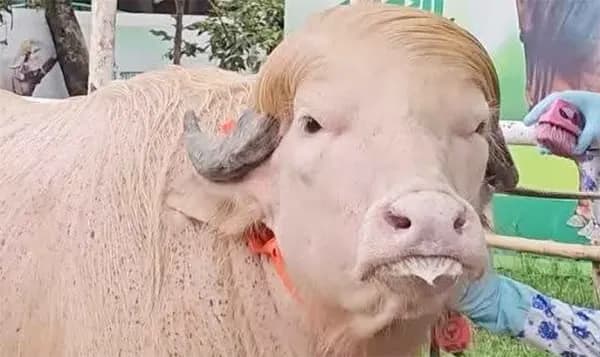
Ahead of Eid al-Adha, an albino buffalo in Narayanganj became a viral attraction after people began saying it resembled Donald Trump. Not because it wore a red tie. Not because it gave speeches. Not because it promised to make the cowshed great again.
No.
Because of the hair.
The buffalo reportedly had pinkish skin and golden-colored hair, which some visitors felt gave it a strangely familiar presidential look. Soon, people began calling it “Trump,” and crowds started showing up to see the animal for themselves. In true South Asian fashion, once one person said, “Bhai, eita toh Trump er moto,” the entire internet took five seconds to form a political analysis committee.
And then came the best line.
A visitor reportedly said the buffalo was “very calm and polite in nature,” which “definitely does not match with Donald Trump.”
That sentence alone deserves a national comedy award.
When the Cattle Market Becomes a Diplomatic Summit
Usually, Eid cattle markets are about size, weight, price, teeth, diet, and bargaining skills. Buyers inspect animals like professional scouts. Sellers explain feeding routines like they are managing Olympic athletes. Someone always claims, “Bhai, ei goruta shudhu apple aar badam khay.”
But the moment a buffalo gets compared to a world leader, the entire market changes.
Suddenly, this is no longer just livestock.
This is international relations with horns.
People do not simply ask, “How many kilos?”
They ask, “Does the hairstyle match?”
They do not only check the animal’s legs.
They compare facial structure.
They do not only bargain.
They make geopolitical jokes.
Somewhere in Narayanganj, a buffalo stood peacefully, probably thinking about grass, while humans around it debated whether it looked like one of the most recognizable political figures on Earth.
That is the internet at its finest.
A buffalo wants lunch.
The public sees foreign policy.
The Hairstyle That Launched a Thousand Shares
Let’s be honest: the golden hair did most of the work.
If the buffalo had been completely ordinary, it might have remained just another impressive Eid animal. But the moment people saw that golden hair, the jokes practically wrote themselves. The resemblance did not need to be perfect. The internet does not require laboratory-level accuracy. It only requires enough similarity for someone to say, “Wait a minute…”
And after that, the post goes viral.
Source: https://www.independent.co.uk/asia/south-asia/bangladesh-buffalo-trump-netanyahu-eid-b2977164.html
The buffalo’s pinkish skin also helped. Albino animals already draw attention because they look unusual, rare, and visually striking. Add a golden hairline and a famous name, and suddenly the animal becomes a full social media event.
This is how modern fame works.
One day you are standing in a farm.
The next day The Independent is posting about you.
The Calm and Polite Problem
The funniest part of the whole story is not even the resemblance. It is the reported personality review.
“The buffalo is very calm and polite in nature.”
This is the kind of sentence that makes Bangladesh comedy undefeated. Because the visitor did not stop there. He added that this calmness “definitely does not match with Donald Trump.”
That is not just a comment.
That is character analysis.
That is a livestock-based political review.
That is a man standing in front of a buffalo and saying, “Physically, yes. Temperamentally, no.”
Imagine being so famous that even a peaceful buffalo in Narayanganj gets compared to your speaking style. The buffalo did nothing controversial. It made no statements. It held no rallies. It did not interrupt anyone. It did not accuse the goat next door of fake news.
It simply existed.
And somehow, it still entered political satire.
Bangladesh Knows How to Make Animals Famous
Every Eid season, Bangladesh creates animal celebrities.
Some are famous because they are enormous. Some are famous because they have unusual colors. Some are famous because sellers give them dramatic names like Boss, King, Titanic, Sultan, Hero Alam, or something even more ambitious.
But naming cattle after world leaders is a special genre.
It is funny because it mixes two completely different worlds: rural livestock culture and global political celebrity. One belongs to farms, markets, and Eid sacrifice. The other belongs to elections, press conferences, and cable news.
When these worlds collide, the result is absurdly entertaining.
A buffalo named Trump does not need a campaign slogan. The slogan is already obvious:
Make Grass Great Again.
Netanyahu Also Entered the Chat
The screenshot also mentions “Trump” and “Netanyahu” buffaloes drawing large crowds. That means this was not just one animal going viral. This was apparently a whole political livestock universe.
At that point, the farm was no longer a farm.
It was the United Nations of buffaloes.
You can imagine visitors walking in like:
“Trump koi?”
“Netanyahu koi?”
“Bhai, Biden nai?”
“Putin ashbe next year?”
This is how quickly Bangladeshi humor escalates. Give people one political buffalo, and within minutes they will ask for the entire G7 summit in cattle form.
The Internet Loves Low-Stakes Absurdity
Part of why this story works so well is that it is harmlessly ridiculous.
The world is usually full of heavy news: wars, elections, economic crises, climate disasters, diplomatic tension. Then suddenly, a buffalo with golden hair appears from Bangladesh and gives everyone permission to laugh for thirty seconds.
That matters.
The internet often becomes exhausting because everything is serious, angry, or divisive. A viral buffalo story is different. It is silly. It is visual. It is easy to understand. Nobody needs a political science degree. Nobody needs a long explanation.
The joke is immediate:
Buffalo has golden hair.
People say buffalo looks like Trump.
Visitor says buffalo is calmer than Trump.
Comedy complete.
Sometimes the best viral stories are the ones that require no deep analysis, only a working sense of humor.
The Buffalo Did Not Ask for This
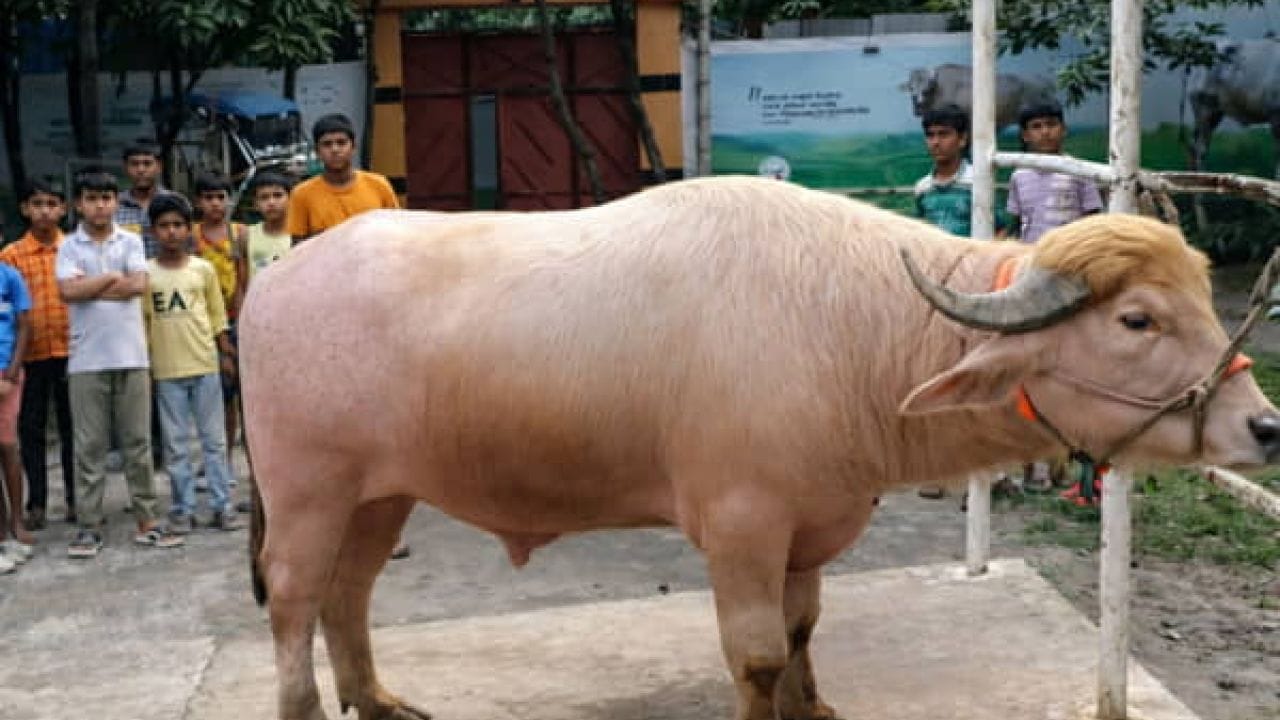
The most innocent character in the whole story is, of course, the buffalo.
It did not choose this life.
It did not ask to be compared to a former U.S. president. It did not request media coverage. It did not hire a PR team. It did not wake up thinking, “Today I will become an international meme.”
It was probably just standing there, chewing peacefully, while humans projected global politics onto its face.
That is the strange fate of viral animals. They become symbols without consent. One minute they are livestock. The next minute they are content.
Still, compared to many forms of fame, this buffalo handled it with grace. Calm. Polite. Unbothered.
A true statesman, honestly.
Eid Markets Are Already Theatrical
Anyone who has visited a Bangladeshi Eid cattle market knows they are not quiet places.
They are loud, colorful, emotional, and full of performance. Sellers praise their animals like proud parents. Buyers negotiate like courtroom lawyers. Children stare in wonder. YouTubers arrive with cameras. People gather around the biggest animals. Someone always asks the price just to feel shocked.
So when a buffalo gets a funny political name, it fits perfectly into the existing drama.
Eid markets are not just economic spaces. They are social events. People go there to buy, yes, but also to look, compare, joke, photograph, and experience the seasonal excitement.
A viral animal becomes part of that festival atmosphere.
It gives people a story to tell:
“Bhai, ajke ami Trump buffalo dekhe ashchi.”
That sentence alone is worth the trip.
From Narayanganj to International Media
The funniest part is how a local joke can become international news.
Somewhere, a person at a farm says the buffalo looks like Trump. Local people laugh. A newspaper covers it. Social media picks it up. Then international media posts it. Suddenly, people who may not even know where Narayanganj is are reading about Bangladeshi buffaloes named after world leaders.
This is globalization in its purest form.
Not trade.
Not diplomacy.
Not technology.
Buffalo memes.
Bangladesh exported humor, and the world accepted the shipment.
Why the Story Feels So Bangladeshi
This entire incident has a very Bangladeshi flavor.
The casual nickname.
The crowd gathering.
The political joke.
The straight-faced visitor quote.
The Eid market energy.
The ability to turn one animal’s hairstyle into a national entertainment moment.
Bangladesh has a special talent for finding humor in ordinary life. People can be under pressure, dealing with heat, traffic, price hikes, politics, and daily stress—but give them one strange-looking buffalo, and suddenly everyone becomes a comedian.
That is not a small thing.
Humor is survival.
Sometimes a viral buffalo gives people exactly the kind of nonsense they need.
Final Verdict: The Buffalo Won the Internet
The “Trump” buffalo became viral because it had everything a good internet story needs: an unusual animal, a famous comparison, Eid market excitement, political humor, and one perfectly timed quote about the buffalo being too calm and polite to fully match its namesake.
It is silly, but it is also strangely beautiful.
For a brief moment, a buffalo in Bangladesh became international content without saying a word. People laughed. Crowds came. Newspapers posted. Social media did what social media does best: took one visual joke and carried it across borders.
And honestly, the buffalo deserves respect.
It stayed calm.
It stayed polite.
It avoided controversy.
It did not hold a press conference.
It did not start a trade war.
It simply stood there with golden hair and became the most peaceful political lookalike of the season.
In a world full of noisy leaders, perhaps the viral buffalo gave us the leadership model we never knew we needed:
Eat grass.
Stay calm.
Look iconic.
Say nothing.


