
Peptide Skincare: How to Add It to Routines
Peptide skincare is having a big moment in 2026, but the real reason it matters is not just trendiness. Peptides are being embraced because they fit the current move toward skin longevity, barrier support, and calmer routines instead of aggressive exfoliation and overcomplicated product stacks. Cleveland Clinic notes that peptides may help support collagen and elastin, while Vogue’s 2026 skincare reporting says peptides are becoming central to routines focused on repair, resilience, and healthier-looking skin over time.
The good news is that adding peptides to your routine is usually simple. They are not like prescription actives that need a whole new strategy. In most cases, a peptide product fits where your serum or treatment step already goes: after cleansing and before moisturizer, with sunscreen last in the morning. Cleveland Clinic and the American Academy of Dermatology both emphasize that skin care generally works best when applied from lighter to heavier layers, with treatment products before moisturizer and sunscreen at the end of your daytime routine.
What peptides do for skin
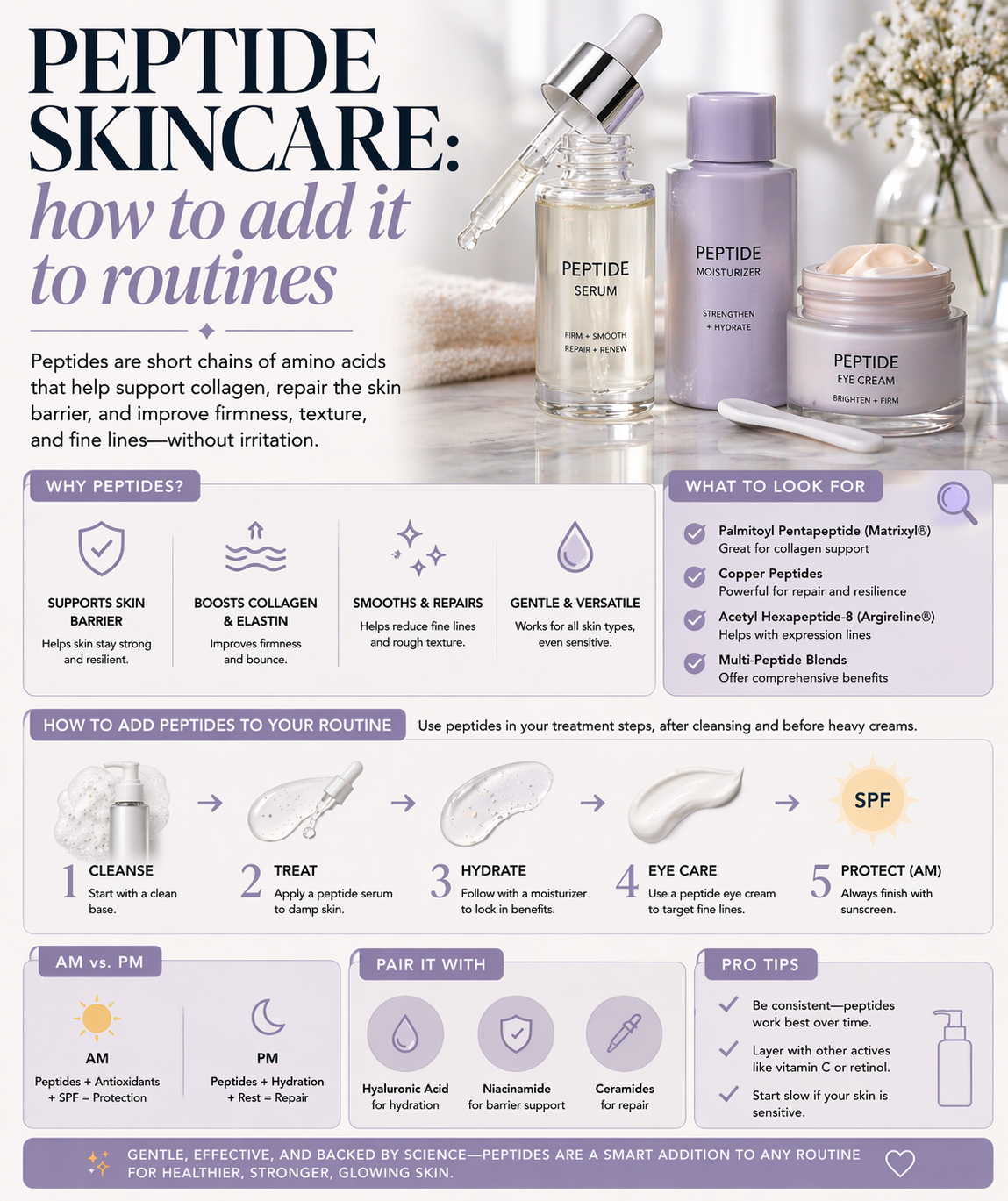
Peptides are short chains of amino acids, and in skin care they are used because they can help signal the skin to support proteins like collagen and elastin. Cleveland Clinic says that by acting as building blocks for these proteins, peptides may help skin stay stronger and more flexible. Vogue’s 2026 skincare coverage adds that peptides are being used not only for collagen support but also for their anti-inflammatory and barrier-friendly profile.
That said, peptides are not magic. Cleveland Clinic points out that just because a product contains peptides does not automatically mean it will be highly effective, because formulation matters a lot. Vogue’s recent Argireline coverage makes the same broader point in a more specific way: a well-formulated peptide product tends to perform better than a peptide claim standing on its own.
Who should add peptides
Peptides make the most sense if your goals are firmness, smoother texture, early fine lines, barrier support, or a gentler anti-aging routine. Vogue’s 2026 trend report specifically connects peptides with healing, barrier-repairing routines, and Cleveland Clinic notes that some research also suggests peptides may help calm inflammation associated with aging skin.
They can also be useful if your skin is not tolerating harsher routines well. Because 2026 skincare is shifting away from aggressive exfoliation and toward repair, peptides are often a smart “support” ingredient when your skin feels a little stressed, overworked, or sensitized. That does not make them a replacement for everything else, but it does make them easier to live with than stronger actives for many people.
Where peptides fit in a routine
The simplest placement is this: cleanse, apply your peptide serum or treatment, then moisturize. In the morning, follow with sunscreen as your final step. Cleveland Clinic’s routine order says serums go after cleansing and before moisturizer, and both Cleveland Clinic and AAD say sunscreen should come last in the daytime routine.
A very simple peptide routine looks like this:
Morning
- Gentle cleanser
- Peptide serum or peptide moisturizer
- Moisturizer, if needed
- Sunscreen
Night
- Cleanser
- Peptide serum or peptide treatment
- Moisturizer
If you prefer fewer steps, a peptide moisturizer is an easy way in. If you want a more targeted product, a peptide serum usually makes more sense because it fits naturally into the treatment step before cream. That placement follows the general serum-before-moisturizer rule from Cleveland Clinic and AAD.
How to add peptides without overwhelming your skin
The smartest approach is not to rebuild your entire routine overnight. AAD says using too many products, especially multiple anti-aging products, can irritate skin and make things look worse instead of better. Cleveland Clinic also recommends minimizing the number of new products you add at once.
So if you are starting peptides, do one of these:
- Replace your current serum with a peptide serum
- Swap your regular moisturizer for a peptide moisturizer
- Add one peptide product only at night first, then expand later if you want to use it twice daily
AAD also recommends patch testing before adding a new product to your routine, which is especially helpful if your skin is reactive or you already use several actives.
What peptides pair well with
In a general routine, peptides tend to work best when the rest of the lineup is calm and supportive. Because they are often positioned as repair-focused rather than irritating, they make a lot of sense alongside moisturizer and sunscreen, and they fit naturally into routines already built around skin health and resilience. Vogue’s 2026 coverage specifically places peptides in the same larger conversation as niacinamide, antioxidants, and cellular-support ingredients.
If you already use a retinoid, peptides can often still fit into the routine. Vogue’s Argireline article says that peptide products are generally compatible with retinoids, though it also stresses that the exact formulation matters. A practical way to handle this is to keep your routine simple and add one new step at a time, especially if your skin gets irritated easily.
The one place to be a little more thoughtful is when your peptide product is very copper-peptide-focused and you are also using strong acidic vitamin C at the same time. Vogue’s Argireline piece notes that some peptide formulas, especially copper peptides, may be worth separating from vitamin C to avoid oxidation concerns and potential loss of efficacy.
Morning vs night: when should you use peptides?
Either can work. Some brands position peptide products for twice-daily use, and because peptides are not usually sun-sensitizing in the way retinoids can be, they are flexible. The main decision comes down to your routine style: morning if you want a supportive, elegant treatment layer under moisturizer and sunscreen, night if you want your actives concentrated after cleansing with fewer daytime layers. Cleveland Clinic’s routine guidance supports either placement as long as the peptide product sits in the treatment step before moisturizer.
A good practical split is:
- Morning peptides if your routine is otherwise simple
- Night peptides if you already do vitamin C in the morning
- Both morning and night if your skin likes them and your routine stays calm enough not to trigger irritation
Realistic expectations
Peptides are usually a consistency ingredient, not an overnight-results ingredient. Cleveland Clinic makes clear that peptides may help support stronger, more flexible skin, but also notes that the science and product formulation can vary. Vogue’s Argireline coverage is similarly blunt that even promising peptides give subtle, temporary, and consistency-dependent results rather than dramatic transformations.
So it is better to think of peptides as a routine improver than a miracle fix. They make the most sense when you want your skin care to feel more supportive, more modern, and less punishing. That is also why they fit the broader 2026 move toward regenerative, barrier-aware skincare so well.
The easiest peptide routine by skin goal
For beginners
Cleanser, peptide serum, moisturizer, sunscreen in the morning. Cleanser, moisturizer at night. Add the peptide step slowly if needed.
For anti-aging without a complicated routine
Morning: cleanser, peptide serum, moisturizer, sunscreen.
Night: cleanser, retinoid or peptide treatment, moisturizer. Keep it simple and avoid piling on too many “anti-aging” steps at once.
For sensitive or barrier-stressed skin
Use a peptide moisturizer or a gentle peptide serum once daily first, patch test, and skip adding multiple new actives at the same time.
Final thoughts
Peptide skincare fits 2026 because it supports the kind of routines people actually want now: calmer, more strategic, and more focused on skin resilience than punishment. Cleveland Clinic says peptides may help support collagen and elastin, while Vogue’s 2026 reporting positions them as one of the defining ingredients of the year’s barrier-friendly, regenerative approach.
The easiest way to add peptides is not to overthink it. Put them where your treatment step goes, keep sunscreen last in the morning, patch test first, and do not crowd your face with too many new actives at once. That is how peptides become a useful part of your routine instead of just another trend bottle on the shelf.