
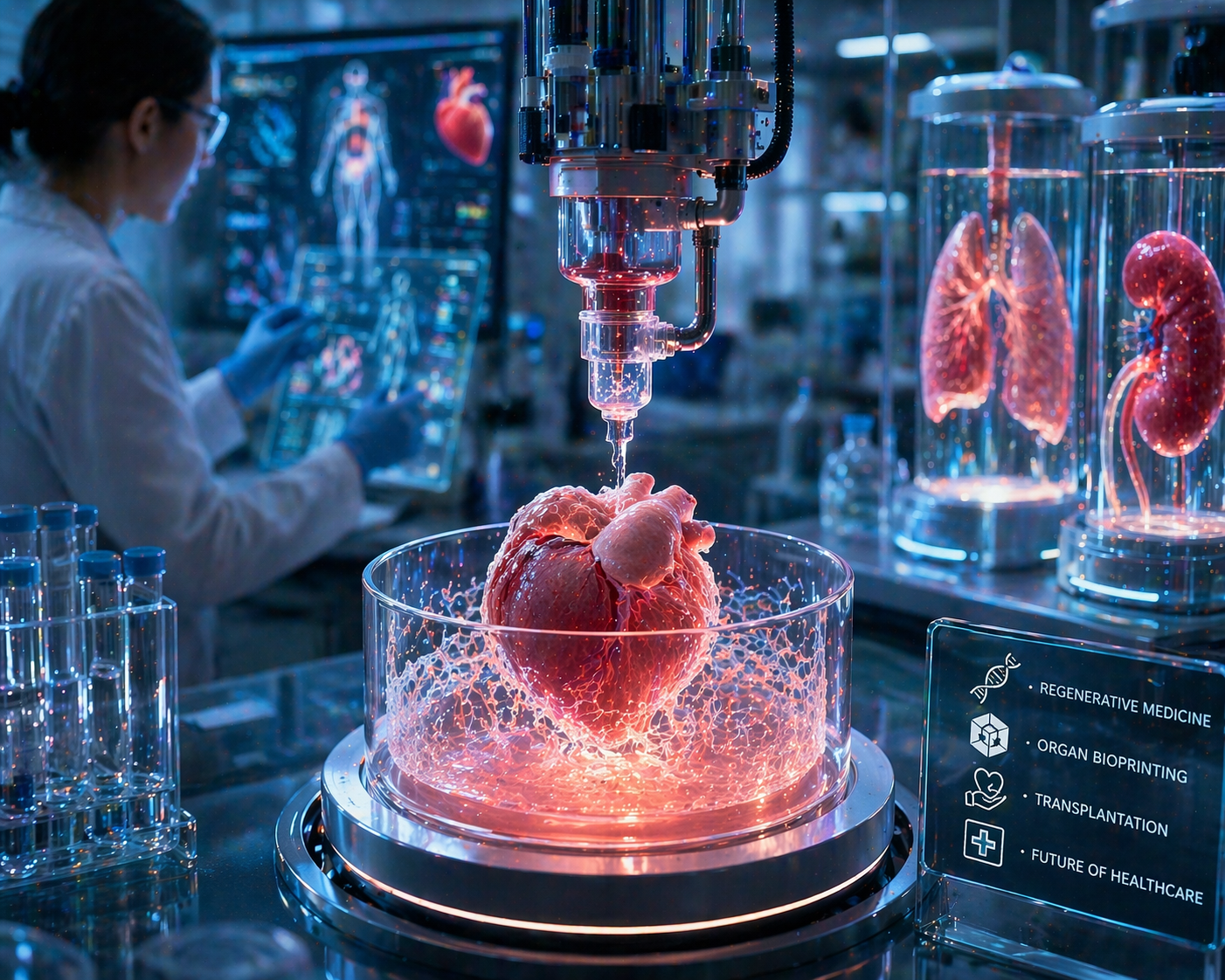
Lab-Grown Human Organs: How Regenerative Medicine Is Transforming Transplants and Healthcare
The future of medicine is no longer the realm of distant science fiction—it’s unfolding right now in laboratories around the world.
Lab-grown human organs, once an ambitious dream, are beginning to enter clinical trials, opening the door to a radical new era of regenerative medicine.
An era where organ shortages might become a thing of the past, burn victims heal faster than ever, and personalized treatments are tailored at the cellular level.
Let’s explore how bioengineered tissues and organs are being cultivated, where they are already making an impact, and what this means for the future of healthcare.
The Urgent Need for Lab-Grown Organs
Every year, hundreds of thousands of people worldwide sit on waiting lists, hoping for a life-saving organ transplant.
For many, the wait is fatal.
The shortage of donor organs, coupled with risks like organ rejection and long recovery times, has pushed scientists to search for alternatives.
And after decades of research, lab-grown organs—also called biofabricated organs—are finally beginning to show real-world potential.
Using a mix of stem cells, bioprinting, organoid cultivation, and tissue engineering, researchers are not just repairing damaged tissues—they are building functional human parts from scratch.
Major Breakthroughs: Lab-Grown Organs Enter Human Trials
🧬 1. Intestinal Repair Using Lab-Grown Organoids
In a groundbreaking achievement, researchers at Cincinnati Children’s Hospital successfully used lab-grown intestinal tissue to repair damage in patients.
Scientists cultivated miniature intestines (organoids) derived from patient stem cells.
These organoids were then implanted to repair damaged gut tissue.
This marks the first successful human application of intestinal organoids.
Not only does this represent a leap forward for patients suffering from congenital gut disorders, but it also proves that lab-grown tissues can integrate with living human bodies—an essential step toward growing full organs for transplant in the future.
🧬 2. Lab-Grown Skin Healing Burn Victims
In Melbourne, Australia, doctors made history by using lab-grown human skin—crafted from a patient’s own cells—to treat severe burns.
Instead of relying on painful skin grafts, scientists cultivated new skin in a lab.
The lab-grown skin was transplanted onto the burn wound, significantly reducing infection risk and promoting faster, healthier healing.
This technique is a game-changer for trauma care and offers new hope for millions of burn victims worldwide.
🧬 3. Artificial Hearts Entering Human Trials
While traditional organ cultivation is advancing, mechanically lab-grown hearts are also making strides.
BiVACOR, a biotechnology company, has developed a total artificial heart that has already been successfully implanted in a small number of patients under early feasibility studies.
Unlike earlier artificial hearts, BiVACOR’s device mimics the natural pulse and adjusts to body demands, offering a realistic alternative for patients awaiting heart transplants.
This innovation could save thousands of lives, especially for those suffering from advanced heart failure.
Source: Wikipedia - Artificial Heart
Organoids Revolutionizing Drug Testing and Personalized Medicine
Beyond transplants, organoids—tiny, lab-grown versions of human organs—are changing how new drugs are tested and how medicine is tailored to individuals.
🧪 Drug Testing Platforms
Traditionally, new medications are tested on animals and later in human trials.
But organoids offer more accurate, ethical, and efficient testing platforms.
Pharmaceutical companies are increasingly using miniature livers, kidneys, and lungs to predict human responses more reliably—reducing time, costs, and ethical concerns.
This innovation could dramatically accelerate the discovery of safer, more effective treatments.
🧪 Personalized Pregnancy Treatments
Researchers have also grown miniature fetal organs from cells collected through amniotic fluid.
This technique allows doctors to predict congenital diseases and design personalized therapies for unborn babies—pioneering a future where pregnancy care is tailored at the cellular level.
The Challenges Ahead
While the promise of lab-grown organs is immense, significant hurdles remain:
Vascularization: Ensuring lab-grown tissues can build complex blood vessel networks necessary for survival inside the body.
Immune System Compatibility: Even personalized organs must be engineered to evade immune rejection without heavy immunosuppressant drugs.
Scalability and Costs: Producing organs affordably and at scale is still a massive technical and economic challenge.
However, with breakthroughs accelerating every year, many experts believe fully functional, transplantable lab-grown organs could become commonplace within the next two decades.
Conclusion: A New Era of Medicine Is Being Grown—Cell by Cell
The age of lab-grown human organs is no longer a distant hope.
It is becoming reality.
From repairing intestines with organoids to healing burns with lab-cultivated skin to creating entire artificial hearts, biofabrication is transforming healthcare as profoundly as antibiotics or vaccines once did.
The future may soon be one where no patient dies waiting for a donor, where pregnancy complications are treated before birth, and where organ replacements are customized to the individual down to the very DNA.
We are not just curing disease anymore.
We are growing life anew.
And the revolution is only beginning.