The Dancing Plague of 1518: Strasbourg’s Deadly Dance Mystery
In the summer of 1518, a woman stepped into the streets of Strasbourg and began to dance.
There was no festival. No music. No wedding procession. No obvious reason.
Her name, according to later accounts, was Frau Troffea. At first, her strange movement may have seemed like a private breakdown, a public embarrassment, or a religious fit. But she did not stop. She danced for hours. Then she danced again the next day. Her feet swelled. Her body weakened. Still, she moved.
Then others joined.
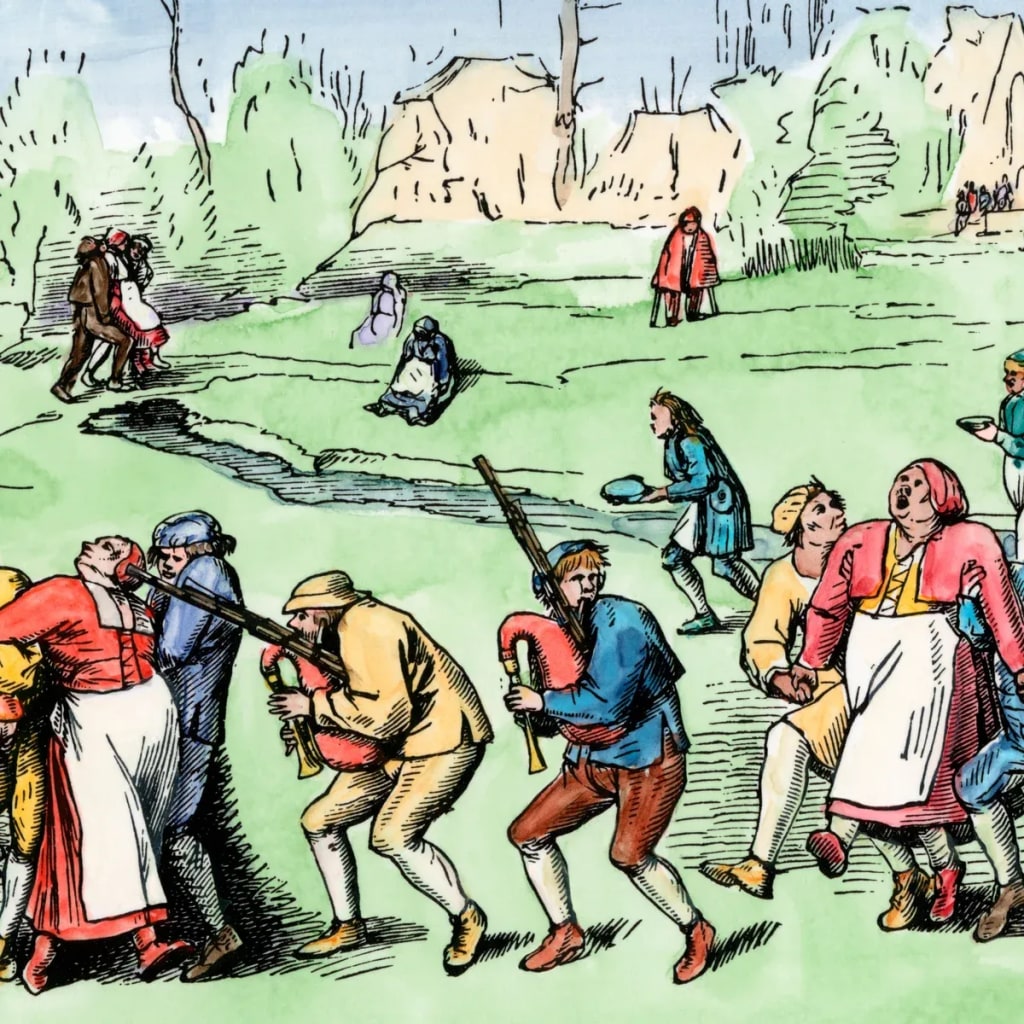
Within days, the spectacle turned into something terrifying. Men and women began dancing in streets, markets, and public spaces as if seized by a force they could not resist. Some appeared entranced. Some collapsed. Some reportedly danced through pain, hunger, thirst, and exhaustion. By the time Strasbourg’s leaders took action, the city was facing one of the strangest public health crises in European history: the Dancing Plague of 1518.
It sounds like folklore. But the event is not simply a modern internet legend. Contemporary and near-contemporary documents—including city council notes, chronicles, sermons, and medical references—support that a real dancing outbreak occurred in Strasbourg. Britannica describes it as an event in which hundreds of citizens danced uncontrollably and apparently unwillingly for days, with the mania lasting about two months.
The mystery is not whether people danced.
The mystery is why.
What Was the Dancing Plague of 1518?
The Dancing Plague of 1518 was an outbreak of compulsive dancing in Strasbourg, located in modern-day France but then part of the Holy Roman Empire. It began in July 1518 and faded by early September. The outbreak is often called a form of dancing mania or choreomania, a phenomenon recorded in parts of Europe between the medieval and early modern periods.
The Strasbourg case became famous because it was unusually well documented. It also produced one of the most haunting images in medical history: ordinary people apparently trapped inside their own bodies, dancing not from joy, but compulsion.
According to popular retellings, hundreds danced and many died. That dramatic version may contain truth, but it needs caution. Sources agree that the dancing happened, but historians still debate the number of participants and whether deaths occurred at the scale later stories suggest. Britannica notes that “a number” died from exertion, while other scholarly discussions warn that the exact death toll remains controversial.
Key Takeaway: The Dancing Plague of 1518 was real, but the most sensational versions often simplify a much more complex historical mystery.
Who Was Frau Troffea?
The outbreak is usually said to have begun with Frau Troffea, sometimes spelled Trauffea. In mid-July 1518, she reportedly began dancing in a narrow Strasbourg street and seemed unable to stop. Public Domain Review’s historical essay, drawing on the work of John Waller and older chronicles, describes her dancing without musical accompaniment, ignoring her husband’s pleas, collapsing from exhaustion, and then resuming again.
Her role matters because mass events often need a first visible act. Frau Troffea became the spark. Once people saw her dancing, the behavior entered public imagination. It became a spectacle, then a fear, then a pattern others could unconsciously imitate.
This is one reason the mass psychogenic illness theory is so persuasive. In such events, symptoms can spread socially, especially when people share the same fears and expectations. The body expresses distress in a culturally recognizable form.
In Strasbourg, that form was dance.
Strasbourg on the Edge
To understand the dancing plague, we must understand Strasbourg’s condition in 1518.
This was not a calm, healthy, prosperous society suddenly struck by random weirdness. The region had endured hardship, including hunger, disease, and social stress. John Waller’s research emphasizes that the decades before the outbreak were memorable for their harshness, and that stress can help trigger spontaneous trance states and mass psychogenic phenomena.
Britannica summarizes Waller’s argument clearly: Strasbourg’s residents were under overwhelming stress from famine and diseases such as smallpox and syphilis, while also living within a religious culture that feared supernatural punishment.
That context is essential. The dancers were not modern people experiencing symptoms in a secular medical world. They were early 16th-century Europeans living in a culture where saints, curses, sin, demons, pilgrimage, and divine punishment were not symbolic ideas. They were part of everyday reality.
If the mind believed a curse could force the body to dance, the body might obey.
The Power of St. Vitus
One of the most important religious ideas behind the outbreak was the cult of St. Vitus.
St. Vitus was associated with dancers, epileptics, and nervous disorders. In medieval and early modern Europe, some believed that failing to honor or appease St. Vitus could result in a curse that forced people to dance. Britannica notes that Waller connected the Strasbourg outbreak to a local belief that those who failed to propitiate St. Vitus could be cursed with compulsive dancing.
This belief system gave the illness a script.
If people feared that St. Vitus could make sinners dance, then compulsive dancing became a culturally available symptom. People under extreme stress did not need to invent a new form of suffering. Their society had already given them one.
That does not mean the dancers were pretending.
It means the body can express real distress through the symbols a culture provides.
Pro Tip: When studying historical mysteries, always ask: “What did people at the time believe was possible?” Their beliefs shaped not only how they explained events, but sometimes how they experienced them.
The City’s Strange Response
Strasbourg’s leaders did not immediately treat the outbreak as supernatural possession. According to historical accounts, physicians blamed a natural cause: overheated blood, a theory rooted in humoral medicine. Instead of isolating the dancers or stopping the movement, authorities first accepted medical advice that the dancers should continue until the illness exhausted itself.
So they made one of history’s strangest public health decisions.
They arranged places for the afflicted to dance. They opened guildhalls. They set up stages in public markets. They hired musicians. They even brought in healthy dancers to encourage the afflicted to keep moving.
To modern readers, this sounds absurd. But in the medical worldview of the time, it had a logic: if the illness was caused by excessive heat or corrupted humors, maybe movement could burn it out.
Instead, it appears to have worsened the outbreak.
By turning private suffering into public performance, the city may have amplified the contagion. More people saw the dancers. More people heard the music. More people absorbed the fear. The city unintentionally created a stage for social contagion.
Key Takeaway: Strasbourg’s attempted cure may have helped spread the dancing plague by making the behavior more visible, rhythmic, and socially reinforced.
What Caused the Dancing Plague?
No single explanation is universally accepted, but several theories dominate the discussion.
The most serious possibilities include:
- Mass psychogenic illness
- Ergot poisoning
- Religious trance
- Social contagion
- Extreme stress response
- Fraud, sect behavior, or ritual performance
The “something darker” question is understandable because the event feels supernatural. People dancing themselves into injury or collapse seems too strange for ordinary explanation. But “strange” does not automatically mean demonic, occult, or paranormal.
The best explanation is probably psychological, social, and religious—not because the event was fake, but because human bodies can do extraordinary things under fear, belief, and group pressure.
Theory One: Mass Psychogenic Illness
The most widely accepted explanation is mass psychogenic illness, sometimes loosely called mass hysteria. This refers to real physical symptoms spreading through a group without a single infectious pathogen or toxin causing them.
Britannica identifies John Waller’s theory of mass psychogenic disorder as the most widely accepted explanation. Waller argued that extreme stress, famine, disease, and fear of St. Vitus created the conditions for a trance-like outbreak.
This explanation works because it accounts for several key facts:
First, the symptoms spread socially. One woman began dancing, then others joined.
Second, the form of the illness matched local beliefs. People feared a dancing curse from St. Vitus.
Third, the outbreak occurred during a period of hardship. Stress can make communities more vulnerable to collective symptoms.
Fourth, the authorities’ response may have reinforced the behavior. Music, stages, and public attention gave the outbreak more power.
Mass psychogenic illness does not mean “imaginary.” The suffering can be real. People can faint, tremble, convulse, feel pain, lose control, or enter altered states. The cause is psychological and social, but the experience is physical.
That is what makes the Dancing Plague so unsettling. It shows that fear can move through a community like a disease.
Theory Two: Ergot Poisoning
Another famous theory blames ergot poisoning.
Ergot is a fungus that can grow on rye and produce compounds capable of causing hallucinations, convulsions, and other severe symptoms. Because rye bread was a staple food in parts of Europe, some researchers suggested that contaminated grain could have triggered the outbreak. Smithsonian notes that ergot poisoning has been proposed because it can produce hallucinations, spasms, and delusions.
But ergot poisoning has problems as an explanation.
It can cause convulsions, burning pain, hallucinations, and severe illness, but it does not neatly explain coordinated dancing for days or weeks. It also would not easily explain why the behavior spread in a socially patterned way, beginning with one visible dancer and expanding through imitation and expectation.
Smithsonian also notes objections to ergot theories, including that not all affected regions consumed rye in the right way and that outbreaks did not always align with conditions favorable to the fungus.
So ergot poisoning remains possible in a broad sense, but it is not the strongest explanation for Strasbourg 1518.
Theory Three: Religious Trance and Social Contagion
Another way to understand the dancing plague is as a religious trance epidemic.
In this view, the dancers were not poisoned and not deliberately performing. Instead, they entered altered states shaped by religious fear, ritual expectations, and social pressure. Waller’s work on dancing mania connects such outbreaks to stress and trance, while also emphasizing the role of late medieval supernatural belief.
This explanation does not compete with mass psychogenic illness; it strengthens it. The “illness” was not only inside individual minds. It was inside a culture.
People believed saints could punish. They believed bodies could be seized. They believed pilgrimage could heal. They believed dance could be a curse. In that world, compulsive dancing was not random. It made sense.
That is why the outbreak eventually shifted from medical treatment to religious response. Once dancing failed as a cure, authorities reportedly sent sufferers toward shrines associated with St. Vitus. The outbreak then faded.
The cure worked not because St. Vitus can be scientifically tested, but because the cure matched the belief system that shaped the illness.
Was It Something Darker?
If by “darker” we mean demonic possession, occult ritual, or paranormal force, there is no strong evidence for that.
But if by “darker” we mean a society so crushed by famine, disease, fear, and religious dread that the human body turned suffering into a public epidemic, then yes—the story is dark.
The Dancing Plague is not frightening because it proves demons exist.
It is frightening because it shows how deeply fear can enter the body.
The dancers may have been people whose lives were already unbearable. They lived in a world where hunger, plague, divine punishment, and social instability were constant threats. When one person broke, others followed—not because they were weak, but because they shared the same pressure.
This is the most haunting interpretation: Strasbourg did not dance because it was joyful.
It danced because it was desperate.
Why the Death Toll Is Still Debated
The phrase “danced themselves to death” is the most famous part of the story. It is also the part that needs the most caution.
Some sources state that dancers died from exhaustion, heart attack, stroke, or collapse. Britannica says a number died from exertion, while Public Domain Review cites chronicles describing people dancing until unconsciousness and, in some cases, death.
However, historians debate the scale and certainty of the deaths. Later accounts may have amplified the horror. Some records are separated from the event by decades or centuries. And because early modern chroniclers often wrote with moral, religious, or dramatic intent, their descriptions must be read carefully.
So the safest conclusion is:
People definitely danced compulsively.
Some likely collapsed from exhaustion and injury.
Deaths may have occurred.
The exact number of deaths is uncertain.
That nuance does not weaken the story. It makes it more responsible.
What the Dancing Plague Teaches Us Today
The Dancing Plague of 1518 still matters because it reveals something uncomfortable about human beings: we are not isolated minds inside separate bodies. We are social creatures. Fear spreads. Behavior spreads. Symptoms can spread.
Modern examples of mass psychogenic illness have occurred in schools, workplaces, factories, religious gatherings, and communities under stress. The form changes depending on culture. In one setting, people may faint. In another, they may tremble. In another, they may report strange smells, dizziness, or possession-like states.
In Strasbourg, they danced.
That is why the case remains so powerful. It is not only a weird medieval curiosity. It is a mirror. It asks what happens when a community reaches its breaking point and has no language for its suffering except the one its culture provides.
Key Takeaway: The Dancing Plague was probably not a mystery of music or movement. It was a mystery of pressure—psychological, social, religious, and physical pressure building until the body spoke in dance.
Conclusion
The Dancing Plague of 1518 began with one woman in the streets of Strasbourg and grew into one of history’s strangest recorded outbreaks. Frau Troffea’s dance became a public crisis. Dozens, perhaps hundreds, joined. Authorities tried to cure the afflicted by giving them space, music, and encouragement to keep dancing. Instead, the mania spread before eventually fading as mysteriously as it began.
Was it mass psychosis? The best modern answer is close: mass psychogenic illness, shaped by extreme stress and powerful religious belief.
Was it ergot poisoning? Possible in theory, but less convincing as a full explanation.
Was it something darker? Not in the supernatural sense. But in the human sense, absolutely. The darker truth is that suffering can become contagious when a community shares fear, hunger, disease, and belief.
The dancers of Strasbourg were not simply bizarre historical curiosities. They were people living at the edge of endurance. Their bodies expressed what their world could not contain.
And that is why, more than five centuries later, the Dancing Plague still feels so disturbing.
It reminds us that sometimes history’s strangest mysteries are not caused by monsters in the dark.
Sometimes they are caused by the darkness people are already carrying inside.
Frequently Asked Questions
What was the Dancing Plague of 1518?
The Dancing Plague of 1518 was an outbreak in Strasbourg where citizens danced uncontrollably and apparently unwillingly for days or weeks. It began in July 1518 and faded by early September.
Who started the Dancing Plague?
The outbreak is usually said to have begun with a woman named Frau Troffea, who started dancing in the street and seemed unable to stop.
How many people joined the dancing?
Estimates vary, but sources often describe dozens to hundreds of people. Britannica says as many as 400 people were eventually consumed by the dancing compulsion.
Did people really dance themselves to death?
Possibly, but the death toll is debated. Some chronicles and modern summaries say people died from exertion, collapse, stroke, or exhaustion, but historians disagree on the number and certainty of deaths.
What caused the Dancing Plague of 1518?
The most widely accepted explanation is mass psychogenic illness triggered by extreme stress, famine, disease, and religious fear, especially belief in a dancing curse linked to St. Vitus.
Was ergot poisoning responsible?
Ergot poisoning has been suggested because contaminated rye can cause hallucinations and spasms. However, it does not fully explain the socially contagious pattern of organized dancing, so many historians find it less convincing.
Why did authorities hire musicians?
Strasbourg’s leaders believed the dancers might recover if they danced the illness out of their bodies. They provided dance spaces and musicians, but this likely made the outbreak worse by encouraging more dancing.
What is mass psychogenic illness?
Mass psychogenic illness is when real physical symptoms spread through a group because of shared stress, fear, expectation, or social influence rather than a single infectious disease or toxin.
Was the Dancing Plague supernatural?
There is no strong evidence that it was supernatural. The most credible explanation is a combination of psychological stress, cultural belief, religious fear, and social contagion.
Why is the Dancing Plague still famous?
It remains famous because it is both well documented and deeply strange. It shows how culture, belief, stress, and the body can combine to create behavior that seems almost impossible from a modern perspective.