
Appalachian Horror Folklore: Chilling Tales Rooted in Regional Legends
Appalachia has always been a place where the mountains feel alive.
The region stretches across old ridges, coal towns, hollers, forests, river valleys, abandoned roads, churchyards, cabins, and communities shaped by hardship, music, migration, faith, survival, and story. Its mountains are among the oldest in the world, worn down by time but still powerful enough to shape the imagination. In Appalachia, the landscape does not sit quietly behind the folklore. It is part of the folklore.
A foggy ridge becomes a warning. A dark hollow becomes a place where people lower their voices. A creek bend remembers a drowning. A ruined cabin still has a story attached to it. A graveyard road is avoided after sundown. A strange light seen between the trees becomes something more than weather, more than reflection, more than rumor.
This is the world of Appalachian horror folklore.
It is a tradition filled with haints, boogers, witches, ghost lights, graveyard omens, cryptid-like creatures, Cherokee monsters, granny magic, death signs, forbidden hollers, and old warnings that sound simple until the sun goes down. Some stories come from European settler traditions. Some are rooted in Cherokee and other Indigenous stories. Some carry African American spiritual influence. Some grew from mining towns, frontier hardship, church culture, isolation, illness, and sudden death. Others are modern legends shaped by highways, radio, podcasts, and internet horror.
But the strongest Appalachian horror stories share one quality: they feel close to home.
These are not distant Gothic tales in aristocratic castles. They are stories from porches, barns, woodsheds, logging roads, back bedrooms, family cemeteries, coal camps, and places where a person might still know the name of the family who lived there. Appalachian horror is intimate. It belongs to kinship, memory, land, and warning.
It asks a question that is older than any modern horror film:
What if the mountain knows something you do not?
Why Appalachia Creates Such Powerful Horror Folklore
Appalachian folklore grew from a region where geography and daily life were deeply connected. Mountains isolated communities. Weather could be dangerous. Roads were difficult. Medical care was not always nearby. Death, illness, poverty, and accident were part of life. People relied on neighbors, family stories, religious faith, practical knowledge, and oral tradition.
In that environment, folklore did several things at once. It entertained. It warned. It explained. It preserved history. It taught children where not to go. It gave shape to grief. It helped people talk about fear without always naming it directly.
This is why Appalachian supernatural stories often feel practical. They are not merely about ghosts for the sake of ghosts. They warn against staying out too late, trusting strange voices in the woods, disrespecting the dead, crossing certain places at night, ignoring dreams, mocking old beliefs, or wandering into hollers where one does not belong.
Collections such as Boogers, Witches, and Haints: Appalachian Ghost Stories, part of the Foxfire Americana Library, preserve this oral tradition by gathering stories of supernatural encounters, witches, spirits, magical animals, and strange happenings from Appalachian communities. Publisher descriptions of the book emphasize “boogers,” witches, haints, and evil spirits as central figures in these collected ghost stories.
That phrase—boogers, witches, and haints—captures the Appalachian horror imagination beautifully. These are not polished monsters. They are local words for local fear.
A haint is more than a ghost. A booger is more than a monster. A witch is not always the broom-riding figure of Halloween decoration. In Appalachian tradition, these words can refer to things felt before they are understood: a presence in the room, a shape by the fence line, a curse in the body, a spirit that keeps returning, a shadow that follows.
Appalachian horror works because it rarely separates the supernatural from everyday life. The ghost is not in a faraway mansion. It is in the room where your grandmother slept. The witch is not in a fantasy kingdom. She lives over the ridge. The warning is not written in an ancient book. It is something your uncle said never to do.
Haints: The Restless Dead of the Mountains
One of the most important words in Appalachian ghost lore is haint.
A haint is often understood as a ghost, spirit, or restless presence, but the word carries a rougher and more regional feeling than “ghost.” A ghost may be sad, gentle, or tragic. A haint can be troublesome, angry, hungry, unfinished, or dangerous. It may knock on walls, appear at the foot of a bed, follow travelers, rattle doors, mimic voices, or return to the place where something terrible happened.
Modern summaries of Appalachian folklore often describe haints as spirits that linger with intent, not simply drifting souls. While interpretations vary by family and community, the core idea is that a haint is a presence that has not fully left the world.
Haint stories often come with sensory details. People hear footsteps in empty rooms. A chair rocks by itself. A dog refuses to enter a house. A cold spot forms near a doorway. A dead relative appears at the foot of a bed before news of a death arrives. A voice calls from the woods, using the name of someone familiar.
The most frightening haint stories involve repetition. A sound happens every night at the same hour. A figure appears on the same road. A door opens after being latched. A family keeps seeing the same woman in the same corner of the house. Repetition turns a strange incident into a haunting.
Haints also reflect Appalachian attitudes toward the dead. Death was often handled at home in earlier generations. Bodies were washed, watched, mourned, and buried within the community. Family cemeteries were common. The dead were near, not hidden away in distant institutions. That closeness gave ghost stories emotional weight.
A haint might be feared, but it might also be recognized.
Sometimes the dead came back not to harm but to warn. In Appalachian ghost lore, a strange dream, a knock at the door, or a figure seen near a bed could be interpreted as a death sign. The boundary between haunting and omen was thin.
This is what makes haint stories so chilling. They are not always about monsters. Sometimes they are about the dead trying to be heard.
Boogers: The Shape of Fear in the Dark
The Appalachian word booger does not always mean one fixed creature. It can refer to a frightening spirit, monster, unknown thing, or eerie presence. It is related to the broader idea of the “boogeyman,” but in Appalachian storytelling, boogers often feel more physical, local, and immediate.
A booger might be something that waits in the woods. It might scratch at the wall. It might appear as an animal too large to be natural. It might be a dark figure on the road. It might be a shapeless thing children are warned about.
The power of the booger is uncertainty. It does not need a clear taxonomy. In fact, it is scarier because people do not fully know what it is.
Booger stories often work as warnings for children. Do not go near that old mine. Do not wander into the woods after dark. Do not play near the creek alone. Do not mock the graveyard. Do not answer when something calls from the trees.
These warnings may sound supernatural, but many also contain practical survival lessons. Appalachia’s landscape has real dangers: cliffs, snakes, deep woods, abandoned wells, mine shafts, flash floods, wild animals, and exposure. A booger story can keep a child close to home.
This is one of the oldest functions of horror folklore. It turns danger into story so people remember it.
The booger may not be real in a literal sense, but the place it warns about may be very real.
Granny Witches and Mountain Magic
Appalachian witch lore is complex. It includes fear of harmful witchcraft, but also respect for folk healing, herbal knowledge, charms, and protective practices often associated with “granny women” or mountain healers.
A granny woman might know herbs, birth work, healing prayers, weather signs, wart cures, protective charms, or remedies passed through generations. Not every granny woman was considered a witch. In many communities, such women were respected as healers. But the line between healing power and feared power could be blurry.
A witch, in darker Appalachian tales, could curse livestock, sicken a child, stop butter from churning, send nightmares, cause wasting illness, or throw a “witch ball” at a victim. Folklore about witch balls appears in broader American folk-magic traditions, including Appalachian Kentucky traditions where cow or horse hair could be rolled into a small ball and symbolically used to harm a victim.
Protective magic was just as important as harmful magic. People used Bible verses, charms, iron objects, salt, red thread, horseshoes, protective plants, and spoken prayers. Some painted porch ceilings or used blue tones associated in broader Southern tradition with warding off haints. Some kept certain objects near doors, beds, or windows to prevent spirits or witches from entering.
This mixture of Christian belief, folk magic, herbal knowledge, and old-world superstition is one of Appalachian folklore’s defining features. A person might attend church on Sunday and still believe in signs, charms, curses, and haints. These were not always seen as contradictions. They belonged to the same survival worldview.
In Appalachian horror, witches are frightening not because they wear pointed hats, but because they are socially close. The witch may be a neighbor, relative, widow, healer, or strange old woman living nearby. That closeness makes the fear personal.
A monster in the woods can be avoided. A witch in the community is harder to escape.
Spearfinger: The Cherokee Stone-Skinned Terror
Among the most chilling figures associated with Appalachian Indigenous folklore is Spearfinger, known in Cherokee tradition as Uʻtlûñ′tă or related names depending on transcription and source. She is commonly described as a stone-skinned, shape-shifting ogress with a sharp finger like a spear. She uses this deadly finger to cut victims open and eat their livers.
World History Encyclopedia describes Spearfinger as a Cherokee legend about a liver-eating, shape-shifting ogress who kills people with her finger and is finally defeated. The same source notes that she represents unexpected and unseen dangers, functioning almost as an embodiment of death.
Spearfinger is especially terrifying because she does not always appear as a monster. In many retellings, she can disguise herself as an old woman or familiar figure, sometimes approaching children or unsuspecting people in a comforting form. Her horror is not only physical violence. It is deception.
She appears safe, then reveals herself as death.
This makes Spearfinger one of the most psychologically powerful figures in Appalachian folklore. She teaches suspicion of appearances. She warns that danger may speak kindly. She reminds listeners that the familiar can become threatening when the world is out of balance.
Respect is important here. Spearfinger is not just a “creepy monster” invented for modern horror content. She belongs to Cherokee storytelling traditions, which carry cultural meaning beyond entertainment. Modern writers should avoid stripping her from context or turning her into a generic creature. Her story is part of a larger Indigenous worldview about danger, community, survival, and the relationship between people and the land.
That said, her influence on Appalachian horror is undeniable. A stone-skinned woman hiding in the mountains, mimicking care, and feeding on life itself is one of the region’s darkest mythic images.
The Raven Mocker: Death at the Edge of the Bed
Another frightening figure from Cherokee tradition is the Raven Mocker, often described as a powerful witch-like being associated with death, sickness, and the stealing of life. In many tellings, Raven Mockers prey upon the weak, sick, or dying, extending their own lives by taking life from others.
Unlike a monster that attacks in the open, the Raven Mocker belongs to the dread of illness and the deathbed. It is the fear that something unseen waits near the vulnerable. In some traditions, only powerful medicine people can recognize or oppose such beings.
Modern Appalachian folklore collections and summaries often group Raven Mockers with other Cherokee mountain beings such as Spearfinger, Stone Coat, and the Nunnehi, showing how Indigenous stories remain part of the broader regional supernatural imagination.
The Raven Mocker is terrifying because it turns sickness into spiritual vulnerability. A person is not only physically weak; they may be prey. This reflects an older worldview in which illness, death, spirit power, and moral danger were closely linked.
In horror terms, the Raven Mocker is almost perfect. It is unseen, ancient, predatory, and connected to the moment when humans are most helpless. It does not need a dramatic chase scene. It waits near the bed.
The Brown Mountain Lights: Ghost Lights in the Blue Ridge
One of Appalachia’s most famous unexplained phenomena is the Brown Mountain Lights of North Carolina. For generations, people have reported mysterious lights appearing near Brown Mountain in the Blue Ridge. The lights are often described as glowing orbs or floating lights seen at a distance, sometimes moving, fading, or reappearing.
Blue Ridge Outdoors includes the Brown Mountain Lights among Appalachian legends alongside Mothman, the Flatwoods Monster, Bigfoot, and the Bell Witch, noting how the ancient mountain landscape has inspired stories of unexplained animals and strange apparitions in the night sky.
The Brown Mountain Lights have inspired many explanations. Some propose natural causes such as atmospheric effects, reflections, vehicle lights, swamp gas, or geological phenomena. Others preserve folklore explanations involving spirits, lost lovers, murdered people, Indigenous legends, or ghostly lanterns searching the mountain.
The power of ghost lights lies in distance. They are seen but not reached. They appear across valleys, ridges, or marshy places. They invite explanation but resist capture. This makes them perfect folklore objects.
In Appalachian horror, lights in the mountains are rarely just lights. They may be warnings, spirits, tricks, or lures. They suggest that the landscape is signaling something, but the message is unclear.
The most unsettling thing about a mystery light is not that it shines. It is that it seems to know where it is going.
The Bell Witch: Appalachian-Adjacent Terror With Regional Influence
The Bell Witch legend is most closely associated with Adams, Tennessee, and is not always categorized strictly as Appalachian depending on how boundaries are drawn. But culturally, it has deeply influenced Southern and Appalachian ghost lore.
The story centers on the Bell family, who allegedly experienced violent supernatural disturbances in the early nineteenth century: knocking sounds, voices, physical attacks, strange animals, curses, and a spirit that seemed to communicate directly. The Bell Witch became one of America’s most famous haunting legends and remains a major part of regional supernatural storytelling.
Blue Ridge Outdoors includes the Bell Witch among well-known Appalachian legends, showing its place in the broader mountain-South horror imagination.
The Bell Witch legend matters because it combines many elements found throughout Appalachian horror: family haunting, invisible force, witchcraft accusation, domestic terror, religious anxiety, and oral tradition. It is not a ghost confined to a ruined location. It enters the home. It speaks. It torments. It becomes part of family life.
That domestic quality is deeply Appalachian in feeling. The horror is not far away. It is in the room at night, in the voice no one can explain, in the sound under the bed.
Mothman and the Modern Appalachian Monster
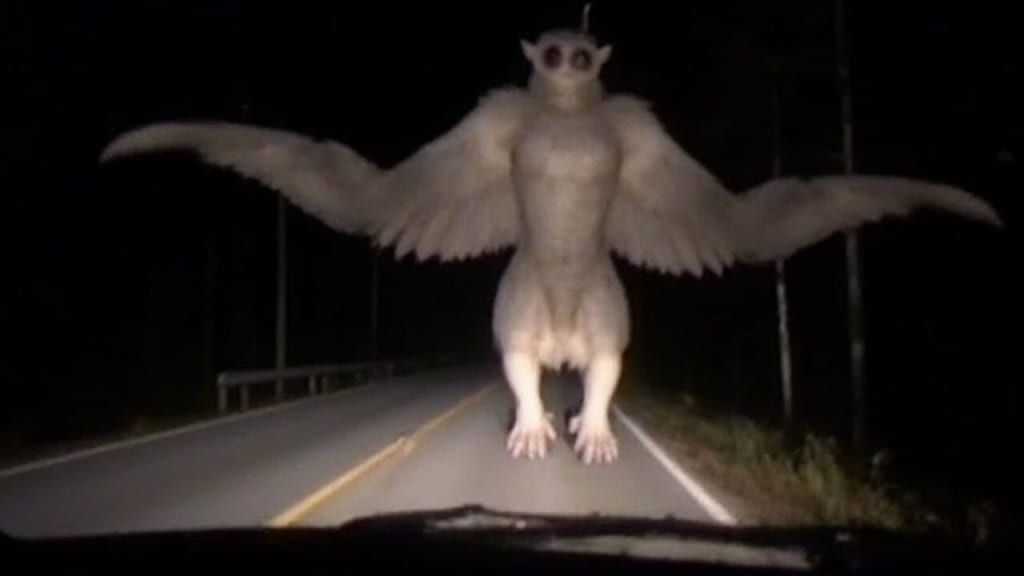
While older Appalachian horror includes haints, witches, and Indigenous monsters, modern Appalachian folklore also includes cryptids. The most famous is Mothman, associated with Point Pleasant, West Virginia, in the 1960s.
Mothman is usually described as a large winged humanoid with glowing red eyes. Sightings were reported before the collapse of the Silver Bridge in 1967, a tragedy that killed 46 people. Over time, Mothman became linked with omen folklore, disaster anxiety, and modern cryptid culture.
Again, Blue Ridge Outdoors groups Mothman with other Appalachian legends, showing how modern monster lore has become part of the region’s supernatural identity.
Mothman is different from a traditional haint or witch. It belongs to the age of highways, newspapers, industrial ruins, Cold War anxiety, UFO culture, and mass media. But it still fits Appalachia because it appears in a liminal landscape: abandoned TNT bunkers, river roads, bridges, dark skies, and economically troubled communities.
Mothman shows that Appalachian folklore is not frozen in the past. It continues to generate new monsters from modern fears.
A haint may come from the graveyard. Mothman comes from the edge of the industrial dark.
The Flatwoods Monster: A Space-Age Mountain Nightmare
Another famous West Virginia legend is the Flatwoods Monster, also known as the Braxton County Monster. In 1952, witnesses reported seeing a strange figure after a bright object appeared in the sky. The creature was described in various accounts as tall, strange-shaped, glowing-eyed, or mechanical-looking.
This legend belongs to the UFO age, but it also fits Appalachian horror because of its setting: rural hills, frightened witnesses, dark woods, and a community suddenly forced into the national imagination.
Like Mothman, the Flatwoods Monster shows how Appalachian folklore absorbs new cultural anxieties. In earlier centuries, a strange being in the woods might be called a witch, haint, spirit, or booger. In the 1950s, with UFO sightings in the news and atomic-age fears spreading, the strange being became extraterrestrial.
The monster changed because the era changed.
Yet the emotional pattern remained the same: something in the woods is not human, not animal, and not safe.
Don’t Whistle in the Woods
One of the most popular modern Appalachian horror warnings is: do not whistle in the woods at night.
This warning circulates widely in regional storytelling and online Appalachian horror culture. Sometimes it is connected to attracting spirits, mimics, witches, or things that should not be called. Sometimes it is presented as old mountain wisdom. Sometimes it overlaps with Indigenous-inspired or internet-amplified ideas about not acknowledging strange sounds in the woods.
Whether or not every version has deep historical roots, the warning works because it fits the Appalachian landscape perfectly. The woods at night are already full of sound: insects, owls, wind, branches, creeks, animals moving through leaves. A whistle is human-made, intentional, and attention-seeking. It says, “I am here.”
In horror logic, that is dangerous.
The deeper fear is response. If you whistle and something whistles back, what then? If it copies your sound exactly, is it a person? An animal? A spirit? A mimic? Something that learned your voice?
This is why the “don’t whistle” warning has become so effective in modern Appalachian horror. It combines old folk caution with contemporary fear of mimics and unknown entities. It turns a simple action into an invitation.
Some doors should not be opened. Some names should not be spoken. Some sounds should not be answered.
Mimics: Voices From the Trees
Modern Appalachian horror often includes stories of mimics—entities that copy human voices, animal sounds, or the cries of loved ones in order to lure people into the woods.
This theme appears across many cultures, but it has become especially popular in Appalachian internet horror. A person hears their mother calling from the tree line, even though she is inside the house. A hunter hears a child crying in a hollow where no child could be. A camper hears their friend’s voice outside the tent, but the friend is asleep beside them.
The fear is ancient: the voice is familiar, but the source is wrong.
This overlaps with older fears found in stories like Spearfinger, where danger may appear in a trusted form. It also matches practical wilderness caution. If you hear something strange in the woods at night, blindly following it can be dangerous.
Mimic stories are effective because humans are deeply responsive to voices. We are wired to recognize loved ones, respond to distress, and investigate calls for help. A creature that uses the familiar voice weaponizes compassion.
In Appalachian horror, the woods do not always attack. Sometimes they call your name.
Signs, Omens, and Death Warnings
Appalachian folklore is rich with signs and omens. A bird hitting a window, a dog howling, a clock stopping, a picture falling, a strange dream, three knocks, an unexplained light, or a whippoorwill calling near a house could be interpreted as a sign of death or misfortune.
These beliefs reflect a worldview in which the natural and supernatural are not separate. Animals, weather, dreams, and household accidents may carry meaning. The world is always speaking, if one knows how to listen.
Death omens are especially common in rural folklore because death was historically closer to home. People died in houses. Bodies were kept before burial. Families watched for signs. Dreams and unusual events became part of mourning culture.
From a modern skeptical view, many omens are coincidences remembered because they happened near emotional events. But folklore is not only about prediction. It is about meaning-making. When something terrible happens, people look backward and ask: were there signs?
In horror storytelling, omens create dread before the event. They suggest that the world knows what is coming, even if humans do not.
Abandoned Mines and Coal Camp Ghosts
Appalachian horror is inseparable from coal country. Mines, coal camps, company towns, and industrial ruins carry some of the region’s darkest real histories. Cave-ins, explosions, black lung disease, labor conflict, poverty, and environmental destruction all haunt the landscape.
Ghost stories naturally gather around mines. Miners hear knocking from sealed tunnels. Lights appear underground. A dead worker is seen near the entrance before an accident. A mine whistle blows when no one is there. The sound of picks echoes in abandoned shafts.
These stories are not random. Mines are underworld spaces. They are dark, dangerous, and filled with death risk. Workers descend into the earth and may not return. That alone gives mining folklore mythic power.
Coal camp ghosts also reflect community memory. A lost miner, grieving wife, child killed by accident, or family displaced by industry can become part of local haunting tradition. The ghost preserves what history may overlook.
In Appalachian horror, the mine is not only a workplace. It is a wound in the mountain.
The Haunted Church and the Graveyard Road
Churches are central to many Appalachian communities, and so are churchyard ghost stories. A rural church may sit at the bend of a road, surrounded by old graves and trees. At night, such places become natural centers for supernatural imagination.
Stories may involve singing heard when the church is empty, lights moving among graves, a preacher seen at the pulpit long after death, or a woman in black standing near a family plot. Graveyard roads may be avoided after dark because of ghostly figures, black dogs, phantom funeral processions, or unexplained cold spots.
These stories often mix fear with reverence. The church is sacred, but sacred places can still be frightening. In fact, they may be frightening because they are sacred. They mark the boundary between this world and the next.
The graveyard road is especially powerful because it connects travel and death. A person driving past a cemetery at night may feel watched. The stones are silent, but the names remain.
Appalachian ghost stories often treat the dead as close neighbors. The graveyard is not far away. It is part of the community map.
Why Appalachian Horror Feels Different From Other American Horror
Appalachian horror has its own flavor.
Southern Gothic often focuses on decaying families, social secrets, religious hypocrisy, and grotesque beauty. New England horror often leans toward Puritan dread, old villages, witch trials, and cosmic fear. Western horror may center on deserts, isolation, frontier violence, and ghost towns.
Appalachian horror is mountain-bound. It is rooted in isolation, oral tradition, poverty, kinship, harsh land, old beliefs, and the feeling that every ridge hides another story.
Its monsters are often ambiguous. Is that thing a ghost, witch, warning, animal, or memory? Is the haunting supernatural or inherited trauma? Is the fear coming from the woods or from the family history no one wants to discuss?
Appalachian horror also resists outside stereotypes. Too often, outsiders reduce Appalachia to poverty, backwardness, or caricature. Good Appalachian horror does something different. It respects the intelligence of regional folklore. It understands that mountain stories are not ignorance. They are cultural memory.
The best Appalachian horror does not mock people for believing in haints. It asks why those beliefs survived.
The Danger of Exploiting Appalachian Folklore
Because Appalachian horror has become popular online, there is a risk of flattening the region into a spooky aesthetic: creepy cabins, banjos, toothless stereotypes, “don’t go in the woods” memes, and generic monsters with mountain labels.
That approach misses the point.
Appalachian folklore belongs to real communities with complex histories. It includes Indigenous traditions, settler traditions, African American influence, religious culture, labor struggle, environmental trauma, music, healing practices, and family storytelling. Treating it as just “hillbilly horror” is disrespectful and shallow.
Writers and creators should approach Appalachian folklore with care. Cherokee figures like Spearfinger and Raven Mocker should not be stripped of cultural context. Granny magic should not be reduced to cartoon witchcraft. Coal ghosts should not ignore the real suffering of miners. Haint stories should not be treated as disposable jump scares.
The region’s horror is powerful because it is rooted in lived experience.
Respect makes the stories scarier, not weaker.
Why These Legends Still Matter
Appalachian horror folklore still matters because it gives voice to things that are hard to speak directly: grief, isolation, illness, exploitation, danger, poverty, family secrets, environmental fear, and spiritual uncertainty.
A haint may represent unresolved death. A witch may represent social suspicion. A booger may represent wilderness danger. A ghost light may represent the unknown. A mine ghost may represent industrial trauma. A mimic may represent the fear that even familiar voices cannot be trusted.
These stories endure because they are flexible. They can be retold on porches, in books, in podcasts, in online forums, in horror films, and around campfires. Each generation reshapes them.
Yet the core remains the same: Appalachia is a place where the land remembers.
Final Verdict
Appalachian horror folklore is one of America’s richest supernatural traditions. Its legends are not simply scary stories invented for entertainment. They are rooted in mountain geography, oral history, Indigenous storytelling, settler superstition, religious belief, folk healing, coal-country tragedy, and the practical dangers of rural life.
The region’s haints, boogers, witches, ghost lights, mimics, death omens, and monsters speak to a world where the boundary between the living and dead is thin, where the woods are never empty, and where old warnings still matter.
Spearfinger brings the terror of deception and death from Cherokee tradition. Raven Mockers haunt the edge of sickness and mortality. Brown Mountain Lights glow across ridges that refuse easy explanation. Mothman and the Flatwoods Monster prove that modern Appalachia still creates new legends. Granny witches and haints show how household life, healing, fear, and spirit belief intertwine.
The best Appalachian horror does not depend on cheap shock. It depends on atmosphere, memory, and respect for the land. It understands that a dark hollow is not frightening only because something might be hiding there. It is frightening because generations have told you not to go there after sunset—and no one ever explained exactly why.
In Appalachia, the mountains are old, the roads are lonely, the graves are close, and the stories do not die easily.
Sometimes they knock on the wall.
Sometimes they call from the trees.
And sometimes, if you listen too closely, they answer back.


