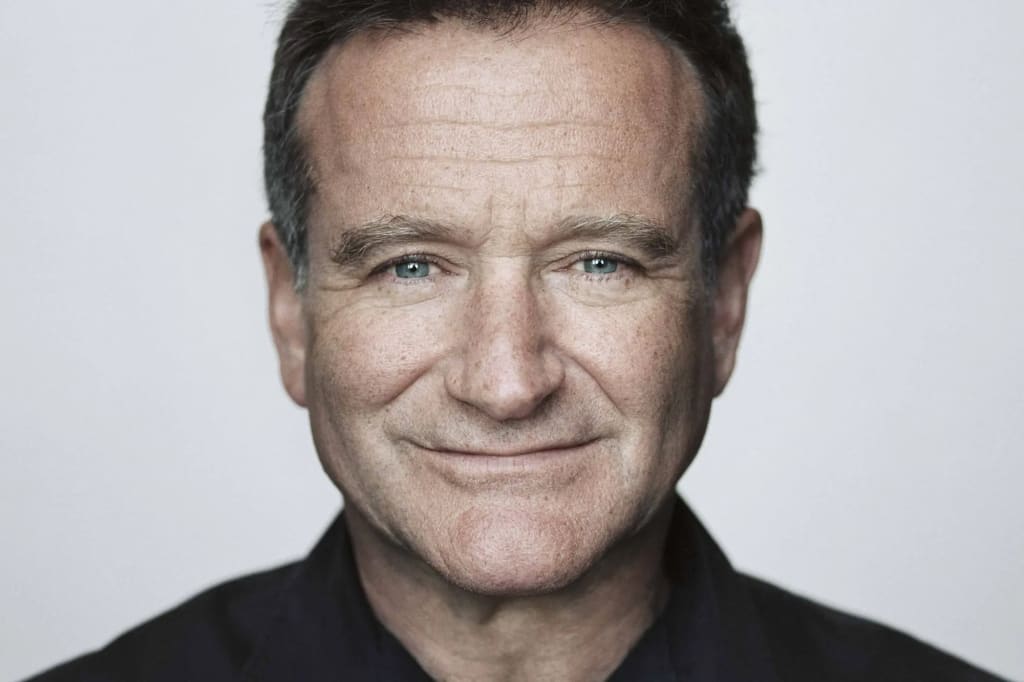
Robin Williams at 75: Remembering the Actor Who Made the World Laugh and Feel
Today, July 21, 2026, we remember Robin Williams on what would have been his 75th birthday.
Born Robin McLaurin Williams in Chicago on July 21, 1951, he became one of the most distinctive and beloved entertainers of his generation. His career moved effortlessly between explosive stand-up comedy, family entertainment, animation and deeply emotional drama. He could make an audience laugh until it hurt, then quiet the same room with a performance filled with tenderness, loneliness or grief.
More than a decade after his death, Williams remains present in popular culture through characters that continue to comfort, inspire and entertain audiences of every age.
Children discover him as the Genie in Aladdin or the unpredictable adventurer Alan Parrish in Jumanji. Families return to Mrs. Doubtfire. Students still respond to John Keating’s call to live courageously in Dead Poets Society. Adults continue to find compassion and emotional truth in Good Will Hunting, Awakenings and The Fisher King.
His work has not faded because it was never built on comedy alone.
Williams understood vulnerability.
Behind the voices, impressions and astonishing improvisation was an actor capable of recognizing sadness in others and making it feel less lonely. That rare combination—wild comic energy and profound emotional sensitivity—is why his performances remain so deeply loved.
A 75th Birthday Filled With Gratitude and Sadness
Robin Williams died on August 11, 2014, at the age of 63. Had he lived, he would have turned 75 today.
Milestone birthdays often invite speculation about the work an artist might still have created.
Williams might have returned to stand-up, played more dramatic roles, voiced new animated characters or mentored another generation of performers. He might have surprised audiences with something no one expected, as he had repeatedly done throughout his career.
Yet his 75th birthday is also an opportunity to appreciate how much he completed.
His career included television, theatre, stand-up specials, comedy albums, voice acting and dozens of films. He won an Academy Award, two Primetime Emmy Awards, five Grammy Awards and several Golden Globes, including the Cecil B. DeMille Award for his contribution to entertainment.
Those honours recognize only part of his impact.
The greater achievement was the relationship he created with audiences. People who never met Robin Williams often speak about him with the affection normally reserved for someone they personally knew.
He seemed familiar.
He made viewers feel welcomed into his imagination.
From a Quiet Childhood to Extraordinary Performance
Williams was born in Chicago and spent parts of his childhood in Illinois and Michigan before his family moved to California. He eventually studied acting and became a member of Juilliard’s Drama Division, where he trained alongside future actor Christopher Reeve.
Juilliard gave him classical training, but his abilities could never be contained entirely within a script.
He possessed an unusually fast associative mind. One idea triggered another, which led to an accent, character, sound effect or cultural reference. He could shift personalities in seconds and create the impression that several performers were occupying the same stage.
That speed was not simply uncontrolled energy.
It was supported by observation, timing, memory and technical skill. Williams noticed how people spoke, moved and tried to hide their insecurities. His comedy exaggerated those details, but it rarely felt detached from humanity.
After developing his craft in the San Francisco and Los Angeles comedy scenes, he began attracting television attention.
His breakthrough arrived through a visitor from another planet.
Mork From Ork and the Birth of a Television Star
Williams appeared as the alien Mork on an episode of Happy Days. The character proved so memorable that he received his own series, Mork & Mindy, which ran from 1978 to 1982. The role transformed Williams into a major television star and earned him a Golden Globe.
Mork was an ideal early vehicle for Williams.
Because the character was an extraterrestrial attempting to understand human behaviour, almost any vocal experiment, physical movement or improvised observation could belong naturally in the performance.
Williams could turn language upside down, react to everyday customs as though they were completely absurd and move from innocence to chaos within moments.
But Mork was not memorable only because he was strange.
Williams gave him curiosity and warmth. Beneath the comedy was an outsider trying to understand connection, love and belonging—emotional themes that would appear throughout Williams’ later work.
Mork & Mindy demonstrated that he could generate laughter at extraordinary speed. His film career would prove that he could do far more.
The Improvisational Genius Behind the Laughter
Robin Williams’ improvisation often seemed impossible to control.
He could move through accents, political commentary, fictional personalities and spontaneous dialogue before other performers had time to prepare a response.
Yet successful improvisation requires more than speaking quickly.
A great improviser listens carefully.
Williams reacted to audiences, fellow actors and the emotional temperature of a room. He could detect when to accelerate, when to change direction and when to become unexpectedly quiet.
His mind appeared to contain an enormous library of voices and references. He borrowed rhythms from radio announcers, politicians, teachers, relatives and strangers, transforming them into characters that felt immediately recognizable.
This unpredictability made his live performances thrilling. It also created unique challenges for filmmakers and animators, who had to capture and organize the flood of material he produced.
In the right role, that freedom became cinematic magic.
Good Morning, Vietnam: Comedy in the Middle of War
Williams received his first Academy Award nomination for playing radio broadcaster Adrian Cronauer in the 1987 film Good Morning, Vietnam. His performance also won a Golden Globe.
The role allowed Williams to use the rapid-fire style audiences already loved, but within a story carrying genuine political and emotional weight.
Cronauer entertains American service members with irreverent broadcasts during the Vietnam War. His humour offers temporary relief, yet the surrounding conflict increasingly challenges the boundaries placed upon what he is allowed to say.
Williams could have treated the character as a sequence of comic routines.
Instead, he showed a man becoming increasingly aware of the human cost hidden beneath official language.
The film established an important pattern in his career: laughter would open the audience emotionally, allowing more difficult truths to follow.
Dead Poets Society and the Teacher Audiences Never Forgot
In Dead Poets Society, Williams played English teacher John Keating, whose unconventional methods encourage students to question conformity and make meaningful use of their lives.
The performance earned Williams another Academy Award nomination and a Golden Globe nomination.
Keating is not the frantic performer many viewers expected from Robin Williams.
He is controlled, observant and often quiet.
Williams understood that the character’s influence depended on restraint. Keating does not dominate his students through volume. He creates space for them to think.
The film’s famous idea of “seizing the day” has endured because Williams delivered it without reducing Keating to a motivational speaker. The character carries disappointment and understands that courage can carry consequences.
For generations of students and teachers, John Keating became a symbol of education as awakening rather than memorization.
The performance demonstrated that Williams did not need constant improvisation to hold an audience. His stillness could be as powerful as his speed.
Awakenings and the Strength of Quiet Compassion
Williams delivered another restrained dramatic performance in Awakenings, playing neurologist Malcolm Sayer opposite Robert De Niro.
The film follows a physician treating patients who have remained unresponsive for years following an encephalitis epidemic. When a medication temporarily allows some of them to awaken, the medical breakthrough becomes a deeply human encounter with time, loss and fragile hope.
Williams’ character is shy and socially uncertain. He finds it easier to interact with research than with people.
As the patients awaken, however, he learns that medicine is not only about observing symptoms. It is also about recognizing the person living within them.
The role allowed Williams to express compassion without sentimental excess. His performance received a Golden Globe nomination and remains among the clearest examples of his dramatic range.
The Fisher King: Comedy, Trauma and Redemption
In Terry Gilliam’s The Fisher King, Williams played Parry, a man whose fantastical behaviour conceals devastating trauma.
The character is funny, unpredictable and imaginative, but the humour exists beside grief rather than replacing it.
Williams understood how people sometimes use comedy to survive pain. His performance never asks the audience to laugh at mental suffering. Instead, it reveals a person creating an elaborate world because reality has become unbearable.
He won a Golden Globe for the role and received another Academy Award nomination.
Parry embodies the complexity that made Williams exceptional.
The joy is genuine.
The pain is also genuine.
Neither cancels the other.
The Genie in Aladdin: A Voice Performance That Changed Animation
For many people, Robin Williams will forever be the voice of the Genie in Disney’s 1992 animated film Aladdin.
The role allowed him to unleash nearly every part of his comic imagination.
The Genie shifts voices, appearances, references and personalities with almost unlimited freedom. Williams’ performance helped make the character feel spontaneous in a medium where every image had to be carefully created by artists. Disney continues to describe him as the unforgettable voice behind the character.
The filmmakers built visual transformations around Williams’ improvisational style. His contribution was considered so distinctive that he received a special Golden Globe achievement award for the performance.
Yet the Genie’s lasting appeal does not come only from jokes.
At the centre of the character is loneliness.
He possesses enormous power but lacks freedom. He can grant wishes for others while remaining confined himself.
Williams gave the Genie comic brilliance, but he also gave him longing, loyalty and tenderness. That emotional foundation is why the character’s farewell remains moving after repeated viewings.
Mrs. Doubtfire: A Comedy About Family and Responsibility
In 1993, Williams starred as Daniel Hillard, a divorced father who disguises himself as an elderly British nanny so he can spend more time with his children.
The premise of Mrs. Doubtfire gave him opportunities for voices, physical comedy, improvisation and transformation. The film became one of his most recognizable family movies, and Williams won a Golden Globe for the performance.
But the movie’s emotional durability comes from its refusal to restore the family through an unrealistic ending.
Daniel loves his children, but love does not automatically make him responsible. His disguise creates comic situations while forcing him to learn skills he had avoided as a husband and father.
The closing message acknowledges that families can change shape without losing love.
For children experiencing separation or divorce, that idea gave the film significance beyond its comedy.
Williams made Mrs. Doubtfire outrageous and unforgettable. He also made Daniel’s fear of losing his children painfully recognizable.
Jumanji, Hook and the Child Within the Adult
Williams frequently played adults who had lost—or were rediscovering—a connection with childhood.
In Hook, he portrayed an adult Peter Pan who had forgotten Neverland and become consumed by work. The adventure requires him to remember imagination, play and fatherhood.
In Jumanji, he played Alan Parrish, who enters a supernatural board game as a child and returns decades later in an adult body. Alan must confront the fear and abandonment that remained frozen inside him.
These roles resonated with families because Williams never treated childhood as simple innocence.
His childlike characters often carried loneliness, fear and unfinished emotional needs.
He understood that growing older does not erase the child a person once was. Adulthood simply teaches that child how to hide.
Williams’ own capacity for play made these roles entertaining. His emotional intelligence made them meaningful.
Winning the Oscar for Good Will Hunting
Williams won the Academy Award for Best Supporting Actor for his portrayal of therapist Sean Maguire in Good Will Hunting. He received the award at the 70th Academy Awards in 1998.
Sean is a therapist who refuses to be impressed or intimidated by Will Hunting’s intelligence.
Will uses sarcasm and knowledge to prevent people from reaching him. Sean recognizes those defences because he has experienced pain himself.
Williams avoids turning the therapist into an all-knowing figure. Sean is grieving, imperfect and occasionally angry. His authority comes not from emotional invulnerability but from honesty.
The most remembered moments are quiet.
Sean sits across from Will and repeats a simple reassurance until the young man can finally stop protecting himself from what happened in his childhood.
Williams delivers the scene without theatrical excess. The emotional power comes from patience, eye contact and compassion.
His Oscar recognized the performance many viewers saw as the perfect combination of his gifts: humour, warmth, sadness and profound empathy.
The Darker Roles That Challenged His Public Image
Williams also deliberately chose characters that contradicted his comforting public persona.
In One Hour Photo, he played a lonely photo technician whose apparent gentleness develops into disturbing obsession.
In Christopher Nolan’s Insomnia, he portrayed a crime writer suspected of murder, offering a controlled and unsettling performance opposite Al Pacino.
These roles worked partly because audiences trusted Robin Williams.
His familiar warmth created discomfort when attached to characters capable of manipulation or violence.
The performances showed that his dramatic range extended beyond inspirational teachers, doctors and therapists. He understood isolation from several emotional directions and could make even troubling characters recognizably human. His career encompassed acclaimed work in both comedy and darker drama, a range noted in retrospectives from the Television Academy and Golden Globes.
The Awards Behind an Extraordinary Career
Williams’ honours reflected the variety of his work.
He won an Academy Award for Good Will Hunting, two Primetime Emmys and five Grammy Awards. He also earned competitive Golden Globes for Mork & Mindy, Good Morning, Vietnam, The Fisher King and Mrs. Doubtfire.
His performance as the Genie received a special Golden Globe achievement award, and in 2005 he received the Cecil B. DeMille Award for his contribution to entertainment.
Awards mattered, but Williams’ work was never confined to prestigious productions.
He moved freely between art-house drama, broad comedy, children’s animation, thrillers and live stand-up. He appeared willing to risk failure rather than repeat one successful version of himself indefinitely.
That restlessness produced an uneven filmography, but it also produced extraordinary variety.
He could be the Genie and Sean Maguire.
He could be Mrs. Doubtfire and the unsettling Sy Parrish.
Few performers have been accepted so completely in such different emotional worlds.
His Kindness Beyond the Screen
Stories about Williams’ generosity became an important part of how friends and colleagues remembered him.
Alongside Billy Crystal and Whoopi Goldberg, he helped lead American Comic Relief benefits using comedy to raise money and awareness for people experiencing homelessness. Comic Relief US later honoured the trio for their long-standing commitment to humanitarian work.
Williams also completed six USO tours between 2002 and 2013, including five overseas tours. He visited military personnel in 12 countries and made repeated visits to Iraq and Afghanistan, performing in difficult environments and spending time personally speaking with service members.
His generosity extended to education.
Juilliard records that he donated to student scholarships for years. His family later helped establish the Robin Williams Scholarship to continue that support for drama students.
These actions reflected a principle visible throughout his work: laughter mattered most when it was shared with people who needed it.
The Difference Between a Public Persona and a Human Life
Robin Williams’ public energy was so enormous that audiences sometimes assumed it represented his entire personality.
It did not.
Performers can give joy while experiencing pain. Comedy may express happiness, but it can also be a profession, coping mechanism, form of connection or way to create order from difficult emotions.
Williams spoke publicly at different times about addiction, recovery and depression. His death in 2014 led many people to assume that depression alone explained what happened.
The medical reality was more complicated.
In the final year of his life, Williams experienced a rapidly worsening combination of anxiety, confusion, insomnia, movement difficulties, paranoia and cognitive changes. He received a Parkinson’s disease diagnosis, but the full nature of his neurological condition was not understood before his death. Postmortem examination revealed extensive Lewy body disease.
His widow, Susan Schneider Williams, later described the experience in the medical journal Neurology and became an advocate for Lewy body dementia awareness, research and earlier diagnosis.
This context does not reduce Robin Williams to an illness.
It corrects an incomplete story.
He was not simply a comedian who secretly felt sad. He was a person facing a severe, complex and undiagnosed brain disease during his final months.
Remembering that reality encourages compassion for patients and families living with neurological conditions that can be difficult to identify.
Why Robin Williams Still Feels So Present
Many performers remain famous after death.
Robin Williams feels present in a different way.
His performances often speak directly to viewers.
John Keating asks people to examine how they are living.
Sean Maguire reminds a wounded young man that intelligence cannot replace emotional honesty.
The Genie shows that freedom matters more than unlimited power.
Mrs. Doubtfire demonstrates that families can survive change.
Alan Parrish confronts the childhood fear he spent years running from.
Williams’ characters frequently meet people who feel isolated and tell them, in different ways, that they are not beyond connection.
That message continues to find new audiences.
Streaming platforms, television broadcasts, school screenings and family traditions allow children born long after 2014 to encounter him for the first time.
His comedy may belong to particular decades, but his emotional generosity does not feel dated.
The Art of Making People Feel Seen
Williams’ greatest talent may not have been impersonation or improvisation.
It may have been recognition.
He could recognize the frightened child inside an adult, the sadness beneath humour and the loneliness hidden behind intelligence.
He could make those emotions visible without removing their dignity.
Even at his most energetic, his comedy was often rooted in observation. He understood how authority figures speak, how people perform confidence and how fear changes the body.
In drama, that same observational ability became empathy.
He did not merely play sadness.
He listened to it.
That is why audiences believed him as a teacher, doctor, therapist, father and friend.
How to Celebrate Robin Williams’ 75th Birthday
The most meaningful way to celebrate Robin Williams is to return to the work.
Watch a film that made you laugh as a child.
Revisit a performance you understand differently as an adult.
Share Aladdin or Jumanji with someone seeing it for the first time.
Watch Dead Poets Society and consider which parts of life have been postponed.
Return to Good Will Hunting and notice how much of Williams’ performance is built from listening rather than speaking.
His birthday can also be honoured through acts reflecting the generosity associated with his life:
- Support a mental-health or neurological-disease organization.
- Learn about Lewy body dementia.
- Help someone experiencing homelessness.
- Encourage a young artist.
- Make time for a person who feels alone.
- Use humour kindly rather than cruelly.
- Let someone know that their presence matters.
Robin Williams built a career around laughter, but his legacy asks for more than laughter.
It asks for compassion.
What Robin Williams Taught Us About Comedy
Comedy is sometimes dismissed as less serious than drama.
Williams’ work showed why that distinction is false.
Laughter changes the emotional possibilities of a room.
It helps strangers feel connected.
It gives people a temporary break from fear.
It allows painful ideas to enter without immediately overwhelming the audience.
Williams could use comedy to challenge authority, expose absurdity or create pure joy. But he also understood that humour can be an act of care.
The joke says: I see how difficult this is.
The laugh replies: I am still here.
That exchange may explain why people continue to speak about him with such love.
A Legacy Shared Across Generations
Robin Williams belongs to several generations at once.
Viewers who watched Mork & Mindy remember the arrival of an unpredictable new television star.
Those who grew up during the late 1980s and 1990s remember Dead Poets Society, Hook, Aladdin, Mrs. Doubtfire, Jumanji and Good Will Hunting.

Later audiences discovered him through Night at the Museum, his stand-up recordings and the films made available through streaming.
His influence can also be heard in performers who combine character work, improvisation and emotional openness.
Yet imitation rarely captures what made him singular.
The voices and speed were visible techniques.
The compassion underneath them was the essential quality.
Final Thoughts
On what would have been Robin Williams’ 75th birthday, it is natural to feel both gratitude and loss.
We are grateful for Mork, the Genie, John Keating, Mrs. Doubtfire, Alan Parrish, Peter Pan, Adrian Cronauer, Parry and Sean Maguire.
We are grateful for the voices, improvised explosions of imagination and scenes of extraordinary tenderness.
We are grateful for the laughter he brought to theatres, homes, military bases, charity events and people going through difficult days.
And we feel the loss of everything that might have come next.
Robin Williams was not beloved simply because he was funny.
He was beloved because his humour felt generous.
Even when his mind seemed to be travelling faster than everyone else’s, he reached back and invited the audience to follow.
His dramatic performances offered the same invitation in quieter form.
They asked people to be brave, forgive themselves, remain curious and recognize the pain hidden inside others.
Robin Williams died in 2014, but the emotional relationship he created with audiences did not end.
Every time the Genie bursts from the lamp, Mrs. Doubtfire enters the room or Sean Maguire sits patiently across from Will Hunting, part of that connection begins again.
Today, on his 75th birthday, we remember an extraordinary actor, comedian and human being whose work made millions of people feel lighter—and whose compassion continues to remind us to treat one another gently.
Happy 75th birthday in remembrance, Robin Williams.
July 21, 1951–August 11, 2014.
Frequently Asked Questions
When was Robin Williams born?
Robin Williams was born on July 21, 1951, in Chicago, Illinois.
How old would Robin Williams be today?
Robin Williams would have turned 75 on July 21, 2026.
When did Robin Williams die?
He died on August 11, 2014, at the age of 63.
What was Robin Williams best known for?
He was known for his rapid improvisation, stand-up comedy, television breakthrough in Mork & Mindy and films including Good Morning, Vietnam, Dead Poets Society, Aladdin, Mrs. Doubtfire, Jumanji and Good Will Hunting.
Did Robin Williams win an Academy Award?
Yes. He won Best Supporting Actor for playing Sean Maguire in Good Will Hunting.
How many Oscar nominations did Robin Williams receive?
He received four acting nominations, winning for Good Will Hunting after earlier nominations for Good Morning, Vietnam, Dead Poets Society and The Fisher King.
Did Robin Williams voice the Genie in Aladdin?
Yes. He voiced the Genie in Disney’s 1992 animated film Aladdin.
Did he receive an award for playing the Genie?
Yes. He received a special Golden Globe achievement award for the performance.
What television programme made Robin Williams famous?
Mork & Mindy, which ran from 1978 to 1982, made him a major television star.
What awards did Robin Williams win?
His honours included an Academy Award, two Primetime Emmys, five Grammys, multiple Golden Globes and the Cecil B. DeMille Award.
Was Robin Williams trained as an actor?
Yes. He studied drama at Juilliard and was a member of its Group 6.
Was Robin Williams involved in charity?
Yes. He was closely associated with Comic Relief, supported scholarships and completed six USO tours between 2002 and 2013.
What disease did Robin Williams have?
A postmortem examination revealed extensive Lewy body disease. The condition had not been correctly identified during his life.
Was he diagnosed with Parkinson’s disease?
He received a Parkinson’s disease diagnosis shortly before his death, but later findings revealed the broader Lewy body disease affecting his brain.
Why is Robin Williams still so loved?
His work combined extraordinary comedy with emotional honesty. Audiences remember not only how intensely he made them laugh but also how deeply his dramatic performances made them feel understood.
What is Robin Williams’ most famous dramatic role?
Opinions vary, but John Keating in Dead Poets Society and Sean Maguire in Good Will Hunting remain two of his most celebrated dramatic performances.
What is his most famous family film?
Mrs. Doubtfire, Aladdin and Jumanji are among the family films most strongly associated with him.
Did Robin Williams perform for military personnel?
Yes. He completed six USO tours, including five overseas, and visited troops in 12 countries.
Did Robin Williams support acting students?
Yes. He donated to Juilliard scholarships for years, and his family later helped establish an endowed scholarship bearing his name.
What is the best way to remember Robin Williams?
Revisit his work, share it with a new generation and honour the compassion behind his comedy by offering kindness to someone who needs it.