Could Godzilla Actually Exist? - The Nuclear Origins, Cultural Trauma, and Scientific Impossibility Behind Japan’s Most Iconic Monster
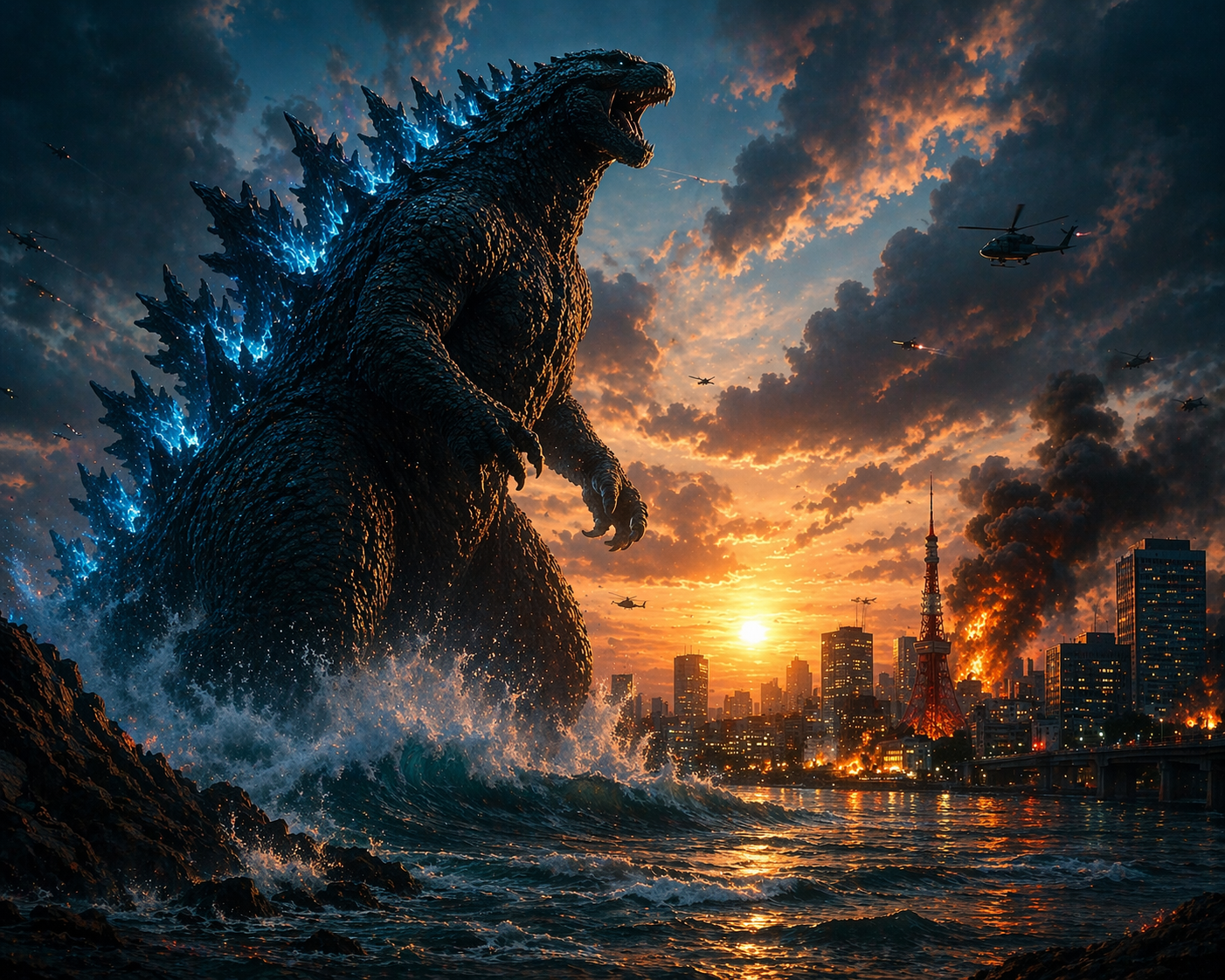
When Godzilla first roared onto Japanese screens in 1954, audiences did not see a fantastical monster. They saw a mirror—an enormous, radioactive reflection of the nation’s darkest trauma. Godzilla was not just entertainment. He was grief, fear, and rage materialized in reptilian skin. Born from atomic fire, he embodied the collective anxiety of a society living in the long shadow of Hiroshima and Nagasaki. Yet beyond cultural symbolism, the modern fascination with kaiju raises a deeper question: could a creature like Godzilla actually exist? And if not, why do we still cling to this impossible giant as a symbol of our deepest fears?
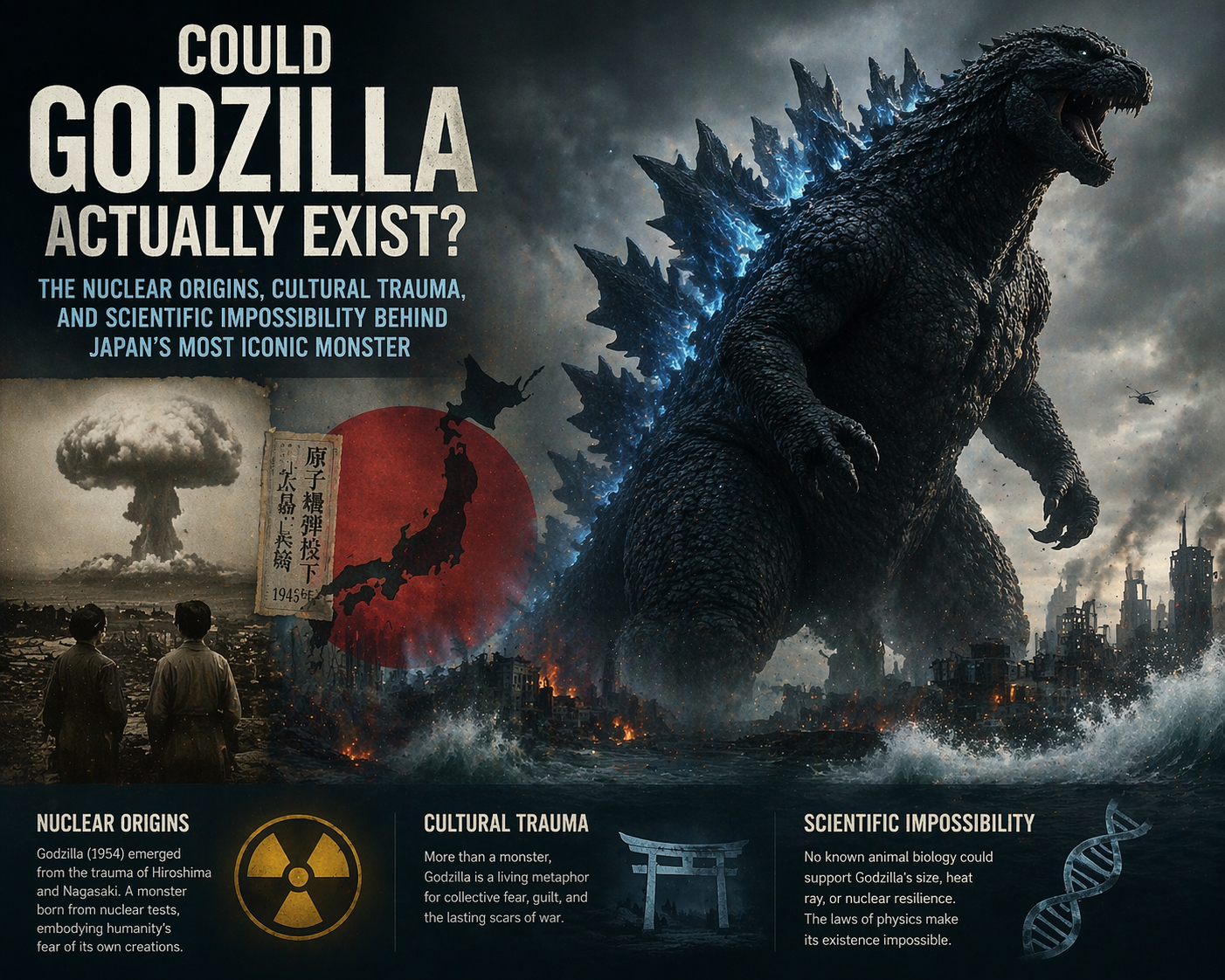
To understand Godzilla, you must understand Japan’s psychological landscape after World War II. In 1954, just nine years after the atomic bombings, Japan was still healing—physically, emotionally, and environmentally. Scars of radiation sickness lingered. Communities still mourned the dead. Survivors struggled with trauma that lacked vocabulary. Then came another blow: the Castle Bravo hydrogen bomb test at Bikini Atoll. The blast contaminated a Japanese fishing boat, the Daigo Fukuryū Maru (Lucky Dragon No. 5), giving its crew radiation sickness. One of the fishermen died. The tuna they caught became radioactive. For Japan, nuclear terror was no longer history—it was ongoing reality.
Two months later, Godzilla was born.
The original film depicts the monster as an ancient creature awakened and mutated by nuclear testing. Its skin resembles keloid scars—identical to those on Hiroshima survivors. Its breath is atomic fire. Its footsteps echo the unstoppable force of a bomb. Director Ishirō Honda, himself a soldier during the war, described Godzilla not as a monster but as “the embodiment of nuclear weapons.” The film is not subtle. It is a scream.
Other kaiju soon followed, each personifying different strands of postwar anxiety. Mothra represented environmental destruction and the spiritual consequences of human greed. Gamera symbolized Cold War unease and scientific hubris. These creatures were metaphors—living warnings.
But while these monsters thrived in fiction, the real world reveals why such beings could never exist outside movie screens. The first and most immediate problem is the Square-Cube Law, a fundamental rule of biology and physics. As a creature grows larger, its volume (and therefore weight) increases far faster than its structural strength. If Godzilla were 100 meters tall as depicted, he would weigh tens of thousands of tons—far more than his skeletal structure could ever support. Even if his bones were made of steel, they would buckle under his own mass the moment he tried to move.
Then come the metabolic demands. A creature that size would need a food intake so staggering it defies comprehension—thousands of calories every second just to lift its limbs. Land animals on Earth have upper limits for a reason. The largest dinosaurs grew massive but remained within strict biological boundaries. A living organism cannot simply scale upward indefinitely. Gravity punishes excess.
Movement poses another impossibility. Godzilla walks upright, yet no real bipedal creature could maintain balance with such disproportionate mass. The pressure on his feet would sink him into the ground instantly. His heart would need to be the size of a house to pump blood to the upper body. His lungs could not pull in enough oxygen. Even his roar, scientifically speaking, would require an enormous vocal apparatus that would collapse under its own weight. In short: the physics of Earth simply do not permit a Godzilla-sized organism to function.
Yet audiences continue to embrace Godzilla not because he is plausible, but because he represents something psychologically true. Godzilla was created in an era when nuclear anxiety was not an abstract concept but an everyday dread. Japan had witnessed cities evaporate. People lived with radioactive contamination. Families feared the next bomb. Godzilla gave shape to that fear—something physical, something you could see and name. In a way, he made the incomprehensible understandable.
The Cold War amplified these anxieties as nations stockpiled bombs powerful enough to destroy the planet many times over. In America, the fear expressed itself in alien invasions and giant ants. In Japan, it surfaced as behemoths rising from the sea, awakened by humanity’s arrogance. Godzilla was a warning not only to Japan, but to the world: nuclear power is not merely dangerous—it is destabilizing, uncontrollable, monstrous.
As decades passed, Godzilla evolved alongside global fears. In the 1970s, he became an environmental defender during pollution crises. In the 1980s, he reflected Cold War escalation. In 2016’s Shin Godzilla, he became a metaphor for governmental paralysis and natural disaster trauma, echoing the Fukushima nuclear meltdown and the Tōhoku earthquake. Each era reshaped him. Each fear remolded him.
This is why Godzilla endures. Not because he could exist, but because what he represents always does. Nuclear anxiety did not end with the Cold War. It continues today in escalating global tensions, rising stockpiles, and renewed arms races. Environmental destruction, climate change, and the fear of technological catastrophe echo the same existential dread that birthed Godzilla seventy years ago. Our monsters evolve with us because our dangers evolve with us.
Could Godzilla exist? Scientifically, no. Biologically, no. Physically, no. The laws of gravity, metabolism, structure, and physics deny him. But culturally, emotionally, metaphorically—he exists more profoundly than any real creature. Godzilla is the roar of a world afraid of its own inventions. He is the radioactive echo of human recklessness. He is the shape of catastrophe given flesh.
And maybe that is why he will never disappear. As long as we fear the things we have created, Godzilla will rise again—impossible, enormous, terrifying, and undeniably human.