
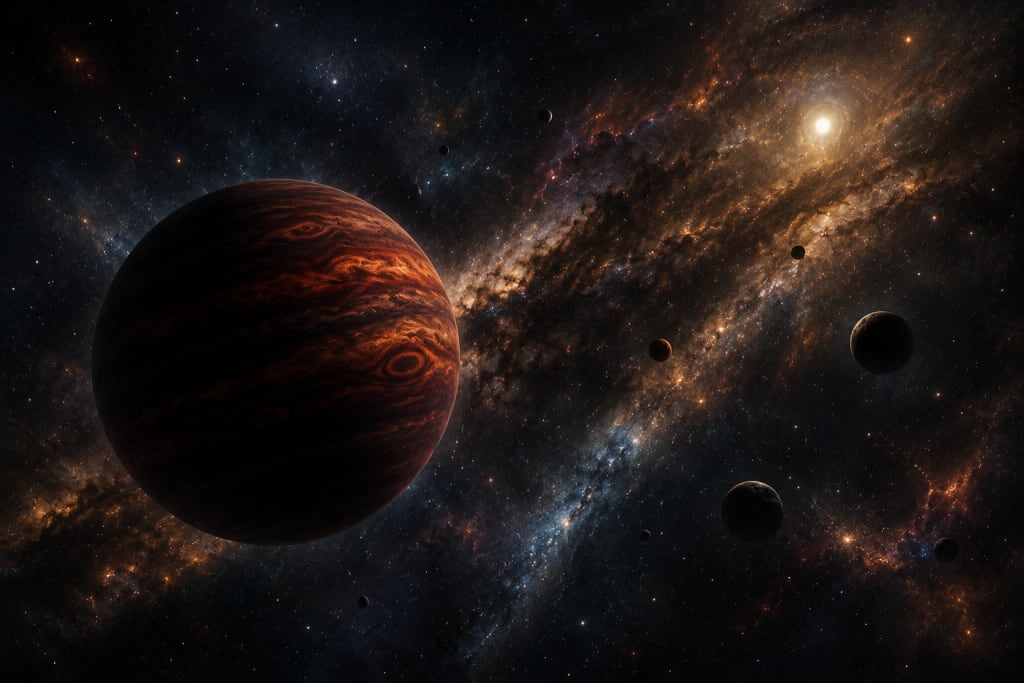
Rogue Planets: The Ghost Worlds Wandering the Galaxy
We are taught that planets orbit stars.
Earth orbits the Sun. Mars orbits the Sun. Jupiter, Saturn, Uranus, and Neptune all move through the same solar family, bound by gravity to the star that gives them light, warmth, seasons, and time. Even when we imagine planets beyond our solar system, we usually picture them the same way: worlds circling distant suns, moving through predictable orbits in alien skies.
But the universe is not always orderly.
It is violent. It is chaotic. It builds worlds, then tears them away. It forms young solar systems in clouds of gas and dust, then lets gravity turn those newborn systems into cosmic battlegrounds. Giant planets shove smaller worlds aside. Young stars pass too close. Binary stars twist orbits into instability. Planetary systems scatter, collide, and rearrange themselves until some worlds are thrown out completely.
These orphaned worlds are known as rogue planets.
They do not orbit any star. They do not have sunrise or sunset. They do not have ordinary days, years, seasons, or solar warmth. They drift alone through interstellar space, moving silently between stars like ghosts in the dark ocean of the Milky Way.
Some may be frozen beyond imagination. Some may be gas giants still glowing faintly with leftover heat. Some may be young planetary bodies still forming, surrounded by disks of gas and dust. Some may hide subsurface oceans beneath thick ice. Some may be closer to us than many known stars, passing unseen because they emit almost no light.
The most unsettling part is not that rogue planets exist.
It is that they may be incredibly common.
NASA-linked research has suggested that free-floating planets may far outnumber planets that orbit stars, and the upcoming Nancy Grace Roman Space Telescope could find hundreds of Earth-mass rogue worlds after launch, helping astronomers finally estimate how many of these dark wanderers fill the galaxy.
That means the Milky Way may not only be filled with stars.
It may also be filled with countless lost planets—worlds without suns, without daylight, and without a home.
What Are Rogue Planets?
A rogue planet is a planetary-mass object that is not gravitationally bound to a star in the normal way. Instead of orbiting a sun, it travels freely through space.
Astronomers also call them free-floating planets, unbound planets, isolated planetary-mass objects, or sometimes orphan planets. The terminology can become complicated because not every object in this category may have formed the same way. Some rogue planets may have formed inside normal planetary systems and later been ejected. Others may have formed more like tiny failed stars, directly from collapsing clouds of gas and dust.
That difference matters.
If a planet forms around a star and gets thrown out, it is truly an orphaned planet. It once had a sun and lost it.
If a planetary-mass object forms alone from a gas cloud, it may look like a planet in mass but behave more like a very low-mass star or brown dwarf in origin.
Astronomers are still working through those categories because rogue planets sit in a strange borderland. They force us to ask a surprisingly difficult question:
What makes a planet a planet?
Is it mass?
Is it formation history?
Is it whether it orbits a star?
Is it whether it cleared an orbit?
Rogue planets challenge the simple classroom definition. They are planet-like worlds, but they do not belong to solar systems. They are cosmic leftovers, escapees, or failed stars depending on how they formed.
That is what makes them so fascinating.
They reveal that planets are not always members of neat solar families.
Sometimes they are survivors of cosmic violence.
How Can a Planet Lose Its Star?
A planet does not simply drift away from its star like a balloon released into the sky. To escape a solar system, it usually needs a violent gravitational push.
Young planetary systems are especially chaotic. When a star forms, it is surrounded by a disk of gas and dust. Inside that disk, planets begin forming. But early planetary systems are not always stable. Giant planets can migrate. Worlds can pass too close to each other. Gravity can fling objects inward, outward, or completely away.
Imagine a young solar system with several massive planets. If two giant planets pass near each other, their gravitational interaction can dramatically change their orbits. One may move closer to the star. Another may be kicked farther out. A smaller world nearby may receive enough gravitational energy to escape the system entirely.
This is called planet-planet scattering.
It is one of the main ways rogue planets may be born.
Other processes can also eject planets. In dense star-forming regions, young stars often form close together. If another star passes near a planetary system, its gravity can disturb orbits and fling planets away. Binary or triple star systems can also destabilize planets. A planet orbiting one star in a multi-star system may eventually be kicked into deep space. Later in a star’s life, changes in mass and gravity can also destabilize planetary orbits.
The result is brutal.
A world that once had a sky dominated by a parent star may suddenly become a starless wanderer.
No more sunrise.
No more sunset.
No more orbit.
Only darkness.
Are Rogue Planets Frozen Dead Worlds?
Many rogue planets are likely extremely cold.
Without a star, a rocky planet like Earth would lose surface warmth quickly. Oceans would freeze. Atmospheres might collapse or freeze onto the ground depending on composition. Surface life, at least life like ours, would face impossible conditions.
But rogue planets are not all the same.
A gas giant ejected from its system may retain internal heat for a long time. Giant planets already radiate heat from within. Jupiter, for example, gives off more energy than it receives from the Sun. A rogue gas giant could remain faintly warm inside even without starlight.
A rocky rogue planet might also keep internal heat from radioactive decay or tidal heating if it has a massive moon. If it has a thick hydrogen atmosphere, that atmosphere could act like a blanket, trapping heat and potentially allowing liquid water beneath extreme pressure. If the planet has an icy shell, a subsurface ocean might survive below the frozen crust, much like scientists speculate about moons such as Europa and Enceladus.
That does not mean rogue planets are likely to be lush alien Earths. They would be dark, hostile, and difficult to detect. But they may not all be completely dead.
Some could be strange hidden worlds with warm interiors and frozen exteriors.
Some could have oceans sealed beneath ice.
Some could have chemistry happening in darkness.
This possibility makes rogue planets especially intriguing for astrobiology. Life on Earth depends heavily on sunlight, but not all life depends directly on the Sun. Deep-sea ecosystems around hydrothermal vents survive through chemical energy. If a rogue planet had a subsurface ocean and geothermal activity, it is at least imaginable that life could exist without a star.
That idea is speculative.
But it is not impossible.
The darkest worlds in the galaxy may still hold warmth deep inside.
How Do Astronomers Find Planets That Do Not Shine?
Rogue planets are incredibly difficult to detect because they do not shine like stars and do not orbit stars in a way that creates repeated signals.
Most exoplanets are found by watching stars.
The transit method detects tiny dips in starlight when a planet passes in front of its star.
The radial velocity method detects small wobbles in a star caused by an orbiting planet’s gravity.
But rogue planets do not have parent stars. That means astronomers cannot use those methods easily.
Instead, many rogue planets are found through gravitational microlensing.
Microlensing happens when a massive object passes in front of a more distant background star from our point of view. The foreground object’s gravity bends and magnifies the light of the background star. For a short time, the star appears brighter. If the foreground object is a planet, the signal can be brief, faint, and extremely hard to catch.
NASA explains that microlensing is especially useful for finding worlds that are far from their stars or free-floating, because the method depends on gravity rather than the planet’s own light.
This is how astronomers detect some of the loneliest objects in the galaxy: not by seeing the planets directly, but by watching how their gravity briefly distorts the light of something behind them.
It is almost poetic.
A rogue planet announces itself by bending starlight for a moment, then vanishing back into darkness.
A Rare Rogue Planet Was Recently Weighed
One of the most important recent rogue planet discoveries involved a free-floating object about 10,000 light-years from Earth.
Astronomers detected it using gravitational microlensing and were able to measure both its mass and distance with unusual precision, using ground-based observatories and the European Space Agency’s Gaia spacecraft. The object is roughly 70 times the mass of Earth, or about 22% the mass of Jupiter, making it close to Saturn’s mass.
This was important because rogue planets are often difficult to weigh. Microlensing events can reveal that something passed in front of a background star, but determining whether that object is a low-mass star, brown dwarf, planet, or something else can be challenging. Distance and mass are often entangled in the data.
In this case, combining observations allowed scientists to break that uncertainty. The object, known through microlensing event designations including KMT-2024-BLG-0792 and OGLE-2024-BLG-0516, appears to be either truly unbound or on an extremely wide orbit around a star.
That second possibility is worth noting. Some objects that appear rogue might technically orbit a distant star at enormous distances. If their orbit is so wide that the host star is hard to identify, they can look like free-floating worlds. Astronomers must be careful before declaring a planet truly starless.
Even with that caution, the discovery is a milestone.
It shows that astronomers are getting better at detecting and measuring these hidden worlds.
And it hints that many more are waiting.
Euclid’s Rogue Planet Discoveries
The European Space Agency’s Euclid telescope has also joined the hunt.
Euclid is primarily designed to study dark matter, dark energy, and the large-scale structure of the universe, but its powerful infrared observations can also reveal faint objects in star-forming regions. In 2024, ESA announced early results showing Euclid’s ability to detect free-floating planetary-mass objects in regions like Messier 78 and the Orion area, including objects just a few times the mass of Jupiter.
The Guardian reported that Euclid discovered dozens of rogue planets in the Orion Nebula region, many of them young and massive, still glowing faintly from the heat of formation.
These young rogue planets are different from cold ancient wanderers. Because they are only a few million years old, they still retain enough heat to be visible in infrared light. That makes star-forming regions excellent places to look for newborn free-floating worlds.
These discoveries raise a major question:
Were these objects ejected from young solar systems, or did they form directly like stars?
If many planetary-mass objects form alone, then the boundary between planets and stars becomes even stranger. Some rogue planets may not be lost children of solar systems. They may be independent cosmic objects born in isolation from the beginning.
The galaxy may be making planet-sized worlds in more than one way.
That changes how we think about planet formation itself.
A Rogue Planet Acting Like a Star
One of the strangest recent examples is Cha 1107-7626, a young free-floating planetary-mass object located about 620 light-years away.
Astronomers observed it rapidly accreting material—pulling in gas and dust at a rate reported around 6 billion tonnes per second during a powerful growth burst. The object is estimated to be about 5 to 10 times the mass of Jupiter and is still surrounded by material as it forms. Observations using the European Southern Observatory’s Very Large Telescope and NASA’s James Webb Space Telescope showed behavior more commonly associated with young stars.
This discovery is fascinating because it blurs categories.
If something has the mass of a planet but forms in isolation and feeds from a surrounding disk like a young star, is it a planet, a failed star, or something in between?
Astronomy often forces us to admit that nature does not always care about our labels.
Cha 1107-7626 shows that some free-floating planetary-mass objects are not just dead frozen wanderers. Some are young, active, and still growing. They may have disks. They may undergo bursts. They may behave like miniature versions of star formation.
That makes rogue planets even more mysterious.
They are not one population.
They are a family of strange worlds with different origins, ages, and fates.
How Many Rogue Planets Are in the Milky Way?
This is one of the biggest unanswered questions.
The estimates vary widely because rogue planets are so hard to detect. Some studies suggest billions. Others suggest there could be trillions. NASA-linked research has indicated that rogue planets may outnumber star-bound planets, and one estimate suggests the Nancy Grace Roman Space Telescope could find around 400 Earth-mass rogue worlds during its microlensing survey.
Some estimates go even further, suggesting there may be multiple rogue planets for every star in the Milky Way. The exact number depends on assumptions about planet formation, ejection rates, microlensing survey data, and the mass range being counted.
This uncertainty is important.
We should not say with certainty that there are trillions of rogue planets unless we make clear that this is an estimate, not a confirmed census. Astronomers have detected only a small number directly or through microlensing, and many candidates remain difficult to confirm.
Still, even the conservative picture is astonishing.
There may be billions of starless worlds drifting through our galaxy.
The Milky Way may be full of invisible planets moving between the stars.
Most will never pass near Earth.
Most will never be seen directly.
Most will remain dark forever.
But they are there, hidden in the gravitational architecture of the galaxy.
Could a Rogue Planet Enter Our Solar System?
This is where science fiction loves to panic.
A massive rogue planet enters the solar system. It disturbs the planets. It sends comets toward Earth. It blocks the Sun. It becomes a doomsday object.
In reality, the chance of a rogue planet passing close enough to seriously disrupt Earth is extremely small.
Space is vast. Even if rogue planets are common, the distances between objects are enormous. A rogue planet could pass through the outer regions of the solar system without anyone noticing for a long time, but a close encounter with Earth or the inner planets is extraordinarily unlikely on human timescales.
Some scientific estimates suggest the chance of a rogue planet entering the solar system and posing a direct threat to Earth is extremely low. The main danger from a distant passing rogue planet would be gravitational disturbance of comets or outer solar system objects, not immediate collision.
That said, rogue planets are still important for understanding solar system history. It is possible that our own early solar system ejected planets or planetary embryos. Some scientists have even proposed that the early solar system may have had an additional giant planet that was thrown out during the chaotic migration of Jupiter, Saturn, Uranus, and Neptune.
If true, our solar system may have once created its own rogue planet.
A lost sibling of the planets we know.
Could Rogue Planets Have Moons?
Yes, some rogue planets could have moons.
If a planet is ejected from its solar system, it may carry its moons with it if the gravitational interaction does not strip them away. A gas giant thrown into interstellar space could remain surrounded by a family of moons, much like Jupiter or Saturn.
This is one of the most interesting possibilities for habitability.
A rogue gas giant with a large icy moon could provide tidal heating. If the moon’s orbit is stretched or flexed by the planet’s gravity, internal friction could generate heat. That could maintain a subsurface ocean beneath ice.
This is similar to what happens with Jupiter’s moon Europa and Saturn’s moon Enceladus, where tidal forces help maintain internal heat and possible liquid water beneath icy crusts.
A rogue planet with moons would be a dark miniature system drifting alone.
No star.
No daylight.
But perhaps internal heat, oceans, and chemistry.
It is a haunting image: a planet and its moons wandering together through interstellar darkness, a tiny solar system without a sun.
Can Rogue Planets Have Atmospheres?
Some rogue planets could keep atmospheres, especially massive ones.
Gas giants naturally have thick atmospheres. If ejected into space, they would remain gas giants, though their upper atmospheres would become extremely cold. Young gas giants could still radiate heat from formation.
Rocky rogue planets might lose or freeze out parts of their atmospheres depending on size, composition, and temperature. A small rocky world with a thin atmosphere would likely become an airless frozen rock. But a larger rocky planet with a thick atmosphere, especially one rich in hydrogen, could retain heat for much longer.
A thick hydrogen atmosphere could create a greenhouse effect powerful enough to keep surface or subsurface conditions warmer than expected. Some theoretical studies have suggested that free-floating planets with dense atmospheres might maintain liquid water under certain conditions.
Again, this is speculative.
But it shows why rogue planets are not simply “dead rocks.” Their possibilities depend on mass, atmosphere, age, composition, internal heat, and whether they have moons.
A starless world may be cold on the outside, but its internal story could be more complex.
Are Rogue Planets Dangerous?
Rogue planets are dangerous in the abstract, but not in the way viral posts often imply.
They are not likely to suddenly crash into Earth. They are not hiding just beyond Neptune waiting to destroy the solar system. They are not responsible for every unexplained cosmic event.
The danger is mostly existential and imaginative.
Rogue planets remind us that solar systems are not guaranteed safe nurseries. Planet formation can be violent. Worlds can be expelled. A planet can lose its star and drift forever.
They also remind us how little we see.
Our sky looks full of stars, but planets without stars are almost invisible. The galaxy may contain a hidden population of dark worlds that ordinary telescopes cannot easily detect.
That is unsettling.
Not because they are coming for us.
Because they show how much of the universe exists beyond light.
Rogue Planets and the Meaning of “Lonely”
People often describe rogue planets as lonely.
Scientifically, loneliness is not a property of planets. A planet does not feel abandoned. It does not mourn its lost star.
But the metaphor is powerful because rogue planets violate our emotional idea of worlds. We imagine planets as part of systems: a sun, an orbit, a sky, a calendar, a family. Rogue planets break that image. They are worlds without belonging.
That is why they fascinate the public.
They are not just astronomical objects.
They are cosmic symbols.
A rogue planet is a place with no dawn. A world where the sky never brightens. A body moving through darkness for millions or billions of years, perhaps never coming close to another star again.
In a universe full of spectacular light, rogue planets are reminders of cosmic exile.
They are the forgotten worlds.
The Role of the Nancy Grace Roman Space Telescope
The future of rogue planet research may change dramatically with NASA’s Nancy Grace Roman Space Telescope.
Roman is designed to use gravitational microlensing to find exoplanets, including planets far from their stars and free-floating planets. NASA has said Roman’s microlensing survey could detect hundreds of rogue planets, even though it will observe only a relatively narrow region of the galaxy.
A NASA/IPAC report says Roman, set to launch by May 2027, could find around 400 Earth-mass rogue worlds, helping determine how common these objects really are.
This could be revolutionary.
Right now, rogue planet science is limited by small numbers. Astronomers have found candidates, but the statistics are uncertain. Roman could provide a much larger sample, especially of lower-mass rogue planets that are currently very difficult to detect.
If Roman finds many Earth-mass rogue planets, it would support the idea that planetary systems commonly eject smaller worlds.
If it finds fewer than expected, theories of planet formation and ejection may need revision.
Either way, Roman could turn rogue planets from mysterious oddities into a measurable galactic population.
That is how astronomy changes: one hidden population at a time.
Why Rogue Planets Matter for Planet Formation
Rogue planets are not just spooky cosmic objects. They are important scientific evidence.
They tell us how violent planetary systems can be.
If rogue planets are common, then ejection must be a normal part of planet formation. That means many solar systems may begin with more planets than they keep. Over time, gravitational interactions may sculpt stable systems by throwing unstable members into space.
Our own solar system may be the calm result of an earlier chaotic era.
This matters because astronomers want to understand why planetary systems look so different. Some stars have hot Jupiters orbiting extremely close. Some have compact systems of rocky super-Earths. Some have giant planets far out. Some may have lost planets entirely.
Rogue planets are the missing pieces of those stories.
They are the worlds that did not survive the architecture of their birth systems.
By studying them, astronomers can infer how often planetary systems experience chaos, how many planets are lost, and what kinds of worlds are most likely to be ejected.
A rogue planet is not just an isolated object.
It is evidence of a violent past.
The Darkest Kind of Planetary Weather
What would it be like on the surface of a rogue planet?
For a rocky rogue world without a thick atmosphere, the surface would be unimaginably cold. There would be no sunlight, only faint starlight from distant stars. If the planet had no internal heat reaching the surface, it might be a frozen wasteland of rock, ice, and darkness.
There would be no ordinary weather driven by solar heating. No warm winds created by sunlight. No day-night cycle. No seasonal change from orbiting a star.
But some rogue planets could still have weather if they have thick atmospheres and internal heat. Gas giants, for example, could have storms driven by internal energy. Young rogue planets may glow faintly in infrared. A massive atmosphere could circulate heat. Clouds could form from exotic compounds at extreme cold temperatures.
On a rogue gas giant, there might be enormous dark storms in an atmosphere lit only by internal heat and distant starlight.
On an icy rogue world, the surface might be motionless for ages, while deep below, internal heat slowly moves water or ice.
These are not worlds of familiar beauty.
They are worlds of extreme alien silence.
Could Humans Ever Visit a Rogue Planet?
In theory, a rogue planet passing relatively close to the solar system could become an interstellar exploration target.
Some scientists and science fiction writers have imagined rogue planets as stepping stones between stars. Because they may be more common than stars, the nearest rogue planet could possibly be closer than the nearest star system, though we have not confirmed such an object nearby.
A rogue planet would be a difficult target. It would be dark, cold, and hard to detect. A spacecraft would need to find it, navigate to it, and operate without solar power. Nuclear power would likely be necessary. Landing might be possible on a rocky rogue planet, but the scientific challenges would be enormous.
Still, the idea is fascinating.
A rogue planet could preserve ancient material from its birth system. It could have moons. It could have frozen atmospheres. It could offer clues about planetary ejection. It might even carry subsurface environments of astrobiological interest.
If humanity ever becomes a truly interstellar species, rogue planets may become important waypoints.
Not because they are welcoming.
Because they are everywhere.
The Cosmic Horror of Rogue Planets
Rogue planets feel almost like cosmic horror because they reveal a universe that is not hostile in a personal way, but indifferent in an absolute way.
A planet can be born, thrown away, and forgotten.
No star mourns it.
No orbit protects it.
No light follows it.
It simply continues.
That is what makes them so haunting. They are not monsters. They are not threats. They are worlds that lost the one thing we associate with planetary life: a sun.
In horror, isolation is terrifying. Rogue planets are isolation on a cosmic scale.
A haunted house is frightening because it is cut off from safety.
A rogue planet is a whole world cut off from the light.
That is why they capture the imagination so easily. They are scientifically real, but they feel mythic. They are the exiles of the galaxy, the planets without constellations, the dark bodies passing between suns.
They are not evil.
They are worse.
They are alone.
What Rogue Planets Teach Us About Earth
Rogue planets also make Earth feel more precious.
Our planet is not just a rock in space. It is part of a stable relationship with the Sun. We have sunlight, seasons, liquid water, photosynthesis, climate patterns, and a biological history shaped by our star. We orbit in a cosmic balance that has lasted billions of years.
That stability is not guaranteed everywhere.
Some planets are born too close to stars and burn. Some orbit too far and freeze. Some are torn apart. Some fall into their stars. Some collide. Some are ejected and become rogue worlds.
Earth’s ordinary sunrise is not ordinary at all.
It is a privilege of orbital stability.
Every morning is proof that our planet has not been thrown into the dark.
Rogue planets remind us that a world needs more than existence.
It needs a place.
Final Verdict
Rogue planets are among the most haunting objects in modern astronomy: worlds without suns, drifting freely through the galaxy after being ejected from young solar systems or perhaps forming alone from collapsing clouds of gas and dust. They challenge the simple idea that planets belong to stars and reveal a darker, more chaotic side of planet formation.
They are difficult to detect because they emit little or no light. Astronomers often find them through gravitational microlensing, when their gravity briefly bends the light of a distant background star. Recent discoveries, including a Saturn-mass free-floating planet about 10,000 light-years away, show that scientists are becoming better at detecting and weighing these ghost worlds.
The coming years may transform the field. NASA’s Nancy Grace Roman Space Telescope could detect hundreds of Earth-mass rogue planets after launch, helping determine whether these worlds number in the billions or even trillions across the Milky Way.
The most dramatic claims should be treated carefully. Rogue planets are not likely to threaten Earth, and many remain candidates rather than confirmed worlds. But their existence is real, and their implications are profound.
The galaxy is not only a place of stars and solar systems.
It is also a graveyard of lost worlds.
Somewhere in the darkness between the stars, countless planets may be drifting silently.
No sunrise.
No seasons.
No home.
Just gravity, memory, and the endless black.


