
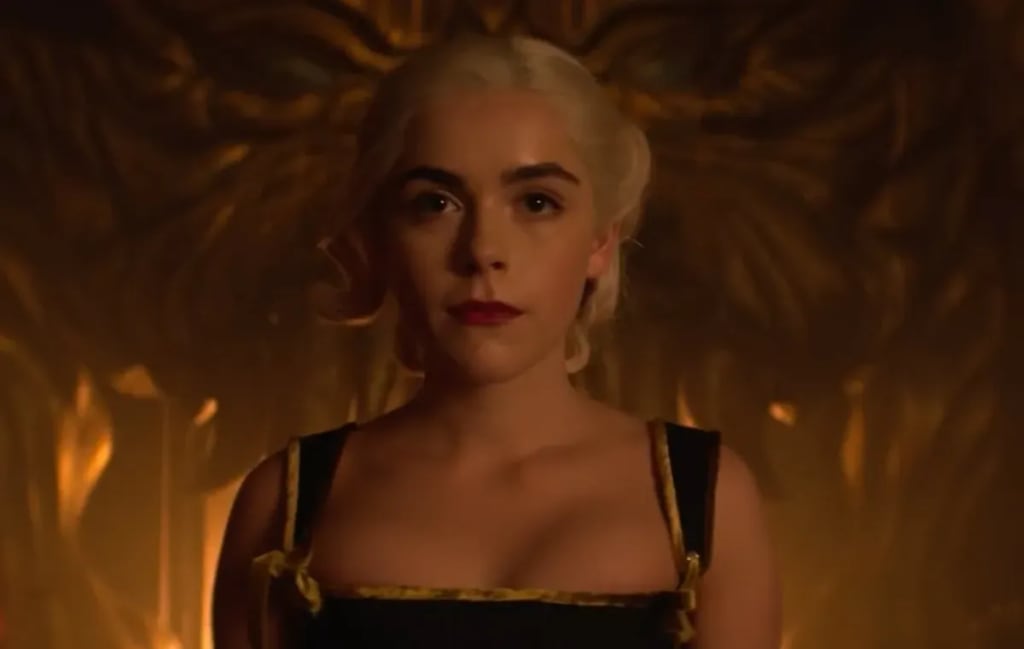
Kiernan Shipka as Sabrina Spellman: Courage, Rebellion, and the Dangerous Desire to Have It All
Kiernan Shipka’s Sabrina Spellman does not want to choose between being human and being a witch.
She wants both lives.
She wants to remain close to her mortal friends while mastering the supernatural power inherited from her family. She wants independence without abandoning the people she loves. She wants to challenge unjust institutions without losing access to the magic those institutions control.
Most importantly, she refuses to let anyone else decide what she must become.
That refusal defines Sabrina throughout Netflix’s Chilling Adventures of Sabrina.
She is compassionate, intelligent, courageous, stubborn, impulsive, and sometimes dangerously convinced that she alone understands the correct solution. She repeatedly confronts forces far older and more powerful than herself, including the Church of Night, Father Blackwood, Lucifer, pagan gods, the rulers of Hell, and reality-destroying Eldritch Terrors.
Her bravery saves lives.
Her recklessness also creates several of the disasters she must later repair.
This contradiction makes Sabrina compelling.
She is not a perfect heroine whose confidence is always rewarded. She is a teenager acquiring extraordinary power faster than she acquires the wisdom required to control it.
Shipka gives that journey emotional continuity. Whether Sabrina is defending a bullied friend, challenging Satanic authority, ruling Hell, confronting an alternate version of herself, or preparing to sacrifice everything, the performance remains grounded in one central belief:
No system—human, divine, infernal, or cosmic—has the right to own her.
Netflix released the first part of Chilling Adventures of Sabrina on October 26, 2018. The series ultimately ran for four parts, concluding on December 31, 2020. Netflix currently lists all four parts, starring Shipka alongside Ross Lynch, Miranda Otto, Lucy Davis, Chance Perdomo, Michelle Gomez, Jaz Sinclair, Lachlan Watson, Gavin Leatherwood, and Tati Gabrielle.
The series transformed Sabrina from the cheerful teenage witch familiar to many television viewers into the center of a Gothic coming-of-age horror story involving blood rituals, demonic contracts, resurrection, patriarchal religion, family secrets, apocalyptic threats, and the terrible consequences of attempting to control time.
Through it all, Shipka makes Sabrina feel recognizably young.
She may possess world-changing power, but she still wants love, friendship, approval, freedom, and the comforting belief that every mistake can somehow be fixed.
Spoiler Warning
This article discusses Sabrina Spellman’s complete story, including her parentage, Dark Baptism, relationship with Lucifer, rule over Hell, the creation of Sabrina Morningstar, the Eldritch Terrors, her final sacrifice, and the ending of Chilling Adventures of Sabrina.
A Timeline Clarification
Kiernan Shipka played Sabrina across the Netflix series from 2018 through 2020.
The show is commonly described as having four seasons because Netflix organized its releases as Parts 1 through 4. Structurally, however, those four parts were produced across two larger season orders.
The main release pattern was:
- Part 1: October 26, 2018
- A Midwinter’s Tale: December 14, 2018
- Part 2: April 5, 2019
- Part 3: January 24, 2020
- Part 4: December 31, 2020
Netflix’s current episode page preserves all four parts, beginning with Sabrina’s impending Dark Baptism and ending with the final battle against the Void.
Shipka later reprised Sabrina in two episodes of Riverdale during 2021 and 2022, extending the character’s screen life beyond the original series finale.
Who Is Sabrina Spellman?
Sabrina is introduced as a teenager living in Greendale with her aunts, Zelda and Hilda Spellman, and her cousin Ambrose.
She has grown up knowing that she is different.
Her late father, Edward Spellman, belonged to the witch world. Her mother, Diana, was mortal. Sabrina has therefore spent her life between two communities:
- The human world of Baxter High
- The supernatural world of the Church of Night
Netflix’s official description summarizes the central conflict as Sabrina navigating between mortal teenage life and her family’s connection to the Church of Night.
As her sixteenth birthday approaches, Sabrina is expected to complete a Dark Baptism.
The ceremony would require her to sign the Book of the Beast, pledge herself to the Dark Lord, and enter fully into witch society. In exchange, she would receive greater power, longevity, and formal magical education.
The cost is her freedom.
Signing the book means allowing Lucifer to claim authority over her.
Sabrina immediately recognizes the contradiction.
She is told that witchcraft will liberate her from mortal limitations, yet obtaining that freedom requires submission to a male ruler who expects permanent obedience.
Her first major conflict is therefore not simply a choice between magic and humanity.
It is a question about whether power received through surrender can ever be true freedom.
A Dark Reinvention of an Iconic Character
Sabrina Spellman first appeared in Archie Comics decades before the Netflix adaptation and later became widely known through lighter animated and live-action interpretations.
The Netflix series drew more directly from Roberto Aguirre-Sacasa and Robert Hack’s Chilling Adventures of Sabrina comic, launched as a horror-centered reimagining of the character in 2014. Archie Comics described that story as a dark reconstruction of Sabrina’s origin, placing her at a crossroads between an unearthly destiny and her mortal relationship with Harvey Kinkle.
Netflix similarly promoted its adaptation as a dark coming-of-age story involving horror, witchcraft, and the occult rather than a conventional supernatural sitcom.
The difference is immediate.
This Sabrina does not use magic primarily to solve comic teenage inconveniences.
Magic involves:
- Blood
- Sacrifice
- Contracts
- Possession
- Resurrection
- Religious authority
- Family betrayal
- Death
- Political power
- Eternal consequences
The familiar names remain—Sabrina, Harvey, Hilda, Zelda, Salem—but their world has become dangerous.
Even love can be weaponized.
Why Kiernan Shipka Was Right for Sabrina
When Netflix announced Shipka’s casting in January 2018, it described Sabrina as an empowered young woman who was half-human and half-witch.
That description captures the balance Shipka needed to create.
Sabrina had to appear young enough for her mistakes to feel credible but commanding enough to challenge ancient supernatural authorities.
She needed warmth for the mortal relationships, steel for the confrontations with the Church, humor for the show’s moments of camp, and emotional intensity for scenes involving death, betrayal, and apocalyptic danger.
Shipka had already spent much of her childhood playing Sally Draper in Mad Men, a character who also learned to read hypocrisy within an adult world that underestimated her.
Sabrina is far more openly confrontational, but Shipka again plays a young woman surrounded by institutions whose rules appear designed to limit her.
She does not perform Sabrina as someone waiting to discover confidence.
The confidence is present from the beginning.
What Sabrina must discover is how easily confidence can become arrogance.
Sabrina’s Courage Begins With Other People
Sabrina’s rebellion is not motivated only by personal freedom.
She repeatedly acts because someone else is being harmed.
In the mortal world, she challenges Baxter High’s refusal to protect vulnerable students. Early criticism of the series noted how Sabrina’s response to harassment and institutional indifference connected its witchcraft narrative with contemporary discussions of gender and power.
She helps form WICCA—the Women’s Intersectional Cultural and Creative Association—as a way to protect students and confront abusive behavior.
The name is playful, but the motive is serious.
Sabrina recognizes that institutions often ignore victims until someone creates an organized challenge.
This pattern continues in the witch world.
She objects to:
- The Church’s treatment of women
- The unquestioned authority given to male leaders
- The exploitation of students at the Academy of Unseen Arts
- The Weird Sisters’ cruelty
- Father Blackwood’s misogyny
- Lucifer’s claim over her body and destiny
- Traditions defended only because they are old
Sabrina cannot accept suffering simply because a rule says it is necessary.
Her compassion repeatedly moves her toward confrontation.
Rebellion Is Sabrina’s Natural Response
When authority tells Sabrina that something cannot be changed, her first instinct is to challenge the premise.
She does not ask only, “How do I survive this system?”
She asks, “Why should this system continue?”
That quality gives her heroic power.
It also creates danger.
Sabrina often assumes that identifying injustice means she already understands every consequence of changing it.
She is exceptionally good at recognizing what is wrong.
She is less reliable at predicting what will happen after she interferes.
This becomes one of the series’ most consistent patterns:
- Sabrina encounters an unacceptable situation.
- More experienced characters warn her that the solution carries risks.
- Sabrina concludes that their caution reflects cowardice or tradition.
- She acts.
- The immediate problem changes.
- A larger and more dangerous problem appears.
- Sabrina risks everything to repair it.
Her determination is admirable.
Her inability to accept limits becomes one of her most destructive traits.
The Dark Baptism Is Really a Fight Over Consent
The first part’s central ritual is presented as Sabrina’s destiny.
The Church speaks as though signing the Book of the Beast is simply what witches do.
Sabrina questions whether she has been given the full truth.
She asks what rights she will surrender, whether the agreement can be reversed, and why her power must be controlled by the Dark Lord.
These questions expose the ceremony as more than religious tradition.
It is a contract offered to a teenager by an institution withholding crucial information.
Sabrina’s refusal to sign is therefore an assertion of bodily and spiritual autonomy.
She rejects the idea that her family, church, or supernatural heritage can make consent unnecessary.
Even when she eventually signs the book during a crisis, the act is not presented as joyful acceptance.
It is a decision made under extreme pressure to gain enough power to protect others.
That distinction shapes everything that follows.
Lucifer interprets the signature as ownership.
Sabrina never does.
Her Mortal Friends Keep Her Human
Sabrina’s mortal life is not simply the weaker half of her identity.
It is where she learns the values that cause her to resist the Church of Night.
Harvey Kinkle, Rosalind Walker, Theo Putnam, and the wider Baxter High community remind her that power is not the only measure of a meaningful life.
Harvey Kinkle
Harvey represents Sabrina’s desire for ordinary love.
Their relationship is affectionate but strained by secrecy. Sabrina wants to protect him from the supernatural world, yet repeatedly makes decisions affecting his life without allowing him full participation.
The tragedy involving Harvey’s brother Tommy exposes the danger of that instinct.
Sabrina attempts resurrection because she cannot tolerate Harvey’s grief. Her motive is compassionate, but she treats death as a problem she can solve through determination.
The result is devastating.
This becomes an early warning about Sabrina’s relationship with power.
She does not abuse magic because she lacks empathy.
She abuses it because empathy convinces her that she cannot accept another person’s suffering.
Rosalind Walker
Roz challenges Sabrina intellectually and morally.
Her supernatural “cunning” allows her to perceive truths hidden from others, making her an important counterweight to Sabrina’s magical knowledge.
Roz is not simply a mortal friend requiring rescue.
She increasingly becomes an active supernatural participant capable of disagreeing with Sabrina and influencing the group’s decisions.
Theo Putnam
Theo’s story expands the show’s concern with identity and social control.
Sabrina supports Theo against bullying and exclusion, but the series also allows Theo to develop agency beyond Sabrina’s interventions.
These friendships matter because they prevent Sabrina’s story from becoming entirely about supernatural hierarchy.
They remind her that power should serve people rather than separate her from them.
The Spellman Family Is Her True Foundation
The emotional center of Sabrina’s life is the Spellman household.
Hilda Spellman
Hilda offers warmth, patience, practical care, and emotional safety.
She can be underestimated because she is gentler than Zelda, but her compassion has its own strength. Hilda understands that family care is not weakness and that magical knowledge can be used without cruelty.
Zelda Spellman
Zelda begins as a strict believer in the Church of Night.
She values tradition, discipline, and the authority of supernatural institutions. Her love for Sabrina is genuine, but it is often expressed through control.
As the Church’s corruption becomes impossible to deny, Zelda changes. Her journey parallels Sabrina’s in a quieter and more mature form: she learns that preserving faith may require rejecting the people claiming the right to define it.
Ambrose Spellman
Ambrose is Sabrina’s cousin, confidant, magical adviser, and frequent voice of caution.
His knowledge is valuable because he has lived long enough to understand that magic always produces consequences.
Sabrina regularly ignores his warnings.
He regularly helps her survive the result.
Chance Perdomo’s lively, intelligent performance made Ambrose one of the show’s most popular characters and gave Sabrina someone who could challenge her without treating her as a child.
The family argues, betrays, forgives, resurrects, protects, and repeatedly risks death for one another.
Whatever title Sabrina holds—student, witch, queen, daughter of Lucifer—her deepest identity remains Spellman.
The Church of Night Promises Power but Enforces Submission
The Church of Night is presented initially as Sabrina’s ancestral community.
It offers education, ritual, history, and belonging.
It also operates through hierarchy and fear.
Women possess enormous magical power but remain subject to male leadership. Father Faustus Blackwood defends inequality as sacred tradition. Students are punished through cruelty. Personal freedom is repeatedly subordinated to religious authority.
Sabrina’s conflict with the Church gives the early series its strongest political structure.
The Dark Lord offers witches abilities unavailable to mortals but expects worship and obedience in return.
Sabrina sees that exchange as fundamentally corrupt.
Critics identified the show’s combination of supernatural horror and resistance to patriarchal power as one of its defining contemporary elements.
The series sometimes simplifies this theme, but Shipka gives Sabrina’s anger sincerity.
She is not objecting to authority merely because she dislikes rules.
She recognizes that the rules are designed to preserve someone else’s control.
Lucifer’s Greatest Mistake Is Assuming Sabrina Wants His Approval
The revelation that Lucifer is Sabrina’s biological father changes the scale of her identity crisis.
She is not merely a witch with mortal ancestry.
She is connected directly to the ruler of Hell.
Lucifer interprets that connection as destiny.
He expects Sabrina to become an instrument of his will and eventually help fulfill his apocalyptic plans.
Sabrina does seek answers about her parentage.
She sometimes desires recognition from powerful figures.
She never accepts that blood gives Lucifer the right to command her.
This is one of the clearest expressions of her independence.
Many characters tell Sabrina who she is:
- The daughter of Edward Spellman
- A half-mortal witch
- A child of Lucifer
- A future queen
- A threat
- A savior
- A cosmic mistake
She listens, learns, and then defines herself differently.
The Platinum Hair Marks a Transformation
Sabrina begins the series with a warmer blonde style.
After signing the Book of the Beast and accessing greater power, her hair becomes the iconic platinum shade associated with the comic-book character.
The show’s makeup team described this visual shift as representing Sabrina’s movement into a darker and more supernatural phase of her identity.
The transformation works because it is both familiar and unsettling.
She now looks more recognizably like the classic Sabrina.
Emotionally, however, she has moved farther from the lighter versions of the character.
The platinum hair becomes a visual symbol of power, separation, and increasing confidence.
As Sabrina grows stronger, Shipka adjusts her physical presence.
Her movements become more deliberate.
Her voice becomes firmer.
She enters supernatural spaces as though she expects them to recognize her authority.
That confidence is compelling.
It also prepares the audience for her growing hubris.
Sabrina’s Power Does Not Automatically Make Her Wise
Sabrina develops abilities far beyond those of an ordinary teenage witch.
She performs resurrection, exorcism, protection magic, astral projection, teleportation, necromancy, healing, summoning, reality-altering rituals, and infernal acts connected to her celestial ancestry.
At several points, her power appears almost unlimited.
The show avoids making that power emotionally simple by repeatedly exposing her lack of foresight.
Sabrina often believes that possessing the ability to act creates an obligation to act.
That idea resembles a heroic principle, but it can become dangerous when combined with impatience.
She does not always ask:
- Who else will be affected?
- What rule is this spell violating?
- Why does the rule exist?
- Is the warning based on oppression or genuine danger?
- Am I helping someone, or am I trying to remove my own discomfort?
- Have I allowed the person involved to choose?
- What happens if I succeed?
The failure to ask these questions creates some of her greatest tragedies.
Resurrection Reveals Her Central Flaw
Sabrina’s attempts to reverse death illustrate both her compassion and her refusal to accept boundaries.
When Harvey loses Tommy, Sabrina cannot tolerate seeing someone she loves in pain.
She therefore turns to resurrection.
The act is motivated by kindness, but it also contains arrogance.
Sabrina assumes she has the right to alter death because she believes her intended outcome is good.
She does not fully consider what Tommy’s return may cost or whether the person restored will truly be the person who died.
The consequences damage her relationship with Harvey and teach her that magical success can still produce human catastrophe.
Yet Sabrina never completely loses the instinct to challenge death.
She continues searching for ways to save everyone.
This inability to accept loss becomes both her greatest strength and the reason she repeatedly risks reality itself.
Sabrina and Nick Scratch
Nick Scratch initially belongs completely to the witch world.
He is confident, knowledgeable, flirtatious, and more comfortable with supernatural morality than Sabrina.
Their relationship develops partly because Nick understands the part of Sabrina that Harvey cannot fully share.
He knows the Academy.
He knows the Church.
He understands magical danger.
He also respects Sabrina’s power rather than merely fearing it.
Nick’s sacrifice at the end of Part 2, when he contains Lucifer within himself, changes their relationship.
Sabrina enters Hell determined to rescue him.
Her loyalty is real, but their romance becomes strained by trauma, possession, addiction, guilt, and resentment.
The series does not present love as powerful enough to erase what Nick experienced.
He loves Sabrina.
He also suffers because of decisions connected to her family and destiny.
Their relationship becomes another example of Sabrina learning that saving someone physically does not automatically repair them emotionally.
Part 3: Sabrina Attempts to Rule Hell
After Lucifer is temporarily defeated, Hell requires a ruler.
Sabrina enters a contest for the throne, partly to prevent another claimant from gaining power and partly because she believes she can reform the infernal realm.
The premise captures her ambition perfectly.
Most people would consider surviving Hell enough.
Sabrina believes she can govern it better.
Part 3 embraces more overt camp, music, competition, and supernatural spectacle. Contemporary reviews noted that this phase leaned more confidently into the show’s extravagant Riverdale-like energy, while allowing Shipka to give Sabrina greater sass and authority.
Her decision to compete for the throne is not motivated solely by vanity.
Sabrina believes power should not be left to someone cruel.
The problem is that she attempts to rule Hell while continuing school, friendships, family life, romance, and coven responsibilities.
She still believes she can have everything without sacrificing anything.
The universe eventually forces her to confront the impossibility of that arrangement.
The Pagans Challenge the Coven
Part 3 also introduces a pagan carnival whose members threaten Greendale and the weakened witch community.
The conflict shifts the series away from a simple Christian-versus-Satanic structure.
The pagans represent older supernatural forces with their own gods, rituals, and claims over the land.
Sabrina again positions herself at the center of the resistance.
When events become disastrous, she uses time travel to change the outcome.
The immediate motive is understandable.
People she loves have died.
Her community has been defeated.
She has access to a mechanism that may reverse everything.
Sabrina does what she has always done.
She refuses to accept the loss.
The Creation of Two Sabrinas
Sabrina’s manipulation of time creates one of the show’s most important consequences.
Rather than closing the loop properly, she allows two versions of herself to exist.
One remains in the mortal world as Sabrina Spellman.
The other becomes Sabrina Morningstar and rules Hell.
At first, the solution appears ideal.
Sabrina has finally found a way to maintain both identities fully.
Spellman can remain with her family and friends.
Morningstar can fulfill the infernal role.
The compromise seems to prove Sabrina’s belief that she never truly has to choose.
The showrunner confirmed after Part 3 that this temporal paradox would become central to Part 4 and that Sabrina’s apparently clever solution would go catastrophically wrong.
The existence of two Sabrinas destabilizes reality.
Her refusal to choose has become a cosmic problem.
Sabrina Spellman and Sabrina Morningstar
Shipka’s dual performance allows the series to separate two parts of Sabrina’s desire.
Sabrina Spellman
Spellman remains connected to Greendale, the coven, Baxter High, her mortal friendships, and the family home.
She represents belonging, responsibility, and the part of Sabrina that still wants an ordinary emotional life.
Sabrina Morningstar
Morningstar becomes Queen of Hell.
She embraces grandeur, infernal authority, royal romance, and the supernatural destiny Sabrina once resisted.
She represents ambition, independence, and the fantasy of power without ordinary limitations.
Shipka distinguishes them without turning either into a simple good or evil twin.
Both are Sabrina.
Both believe they deserve to exist.
Both contain affection, pride, humor, and courage.
Their relationship is unusually tender because neither views the other as an enemy.
The tragedy is that reality may not be able to sustain them both.
Playing Two Sabrinas Shows Shipka’s Range
Shipka adjusts the performances through posture, rhythm, expression, and tone.
Spellman feels more burdened.
She carries responsibility for the coven and remains surrounded by reminders of her mistakes.
Morningstar appears lighter and more openly theatrical. She accepts the absurd grandeur of Hell and enjoys inhabiting her royal role.
The distinction is subtle enough that both remain recognizably the same person.
This becomes essential when Morningstar enters the alternate reality controlled by the Endless.
Shipka must then perform Sabrina as a character trapped inside a distorted television version of her own existence.
The sequence allows the series to acknowledge its lighter television ancestry while remaining deeply unsettling.
The Eldritch Terrors
Part 4 structures its threat around the Eldritch Terrors, ancient forces that attack reality through concepts such as darkness, isolation, the strange, the perverse, the cosmic, the returned, the endless, and the void.
These antagonists are effective because they cannot be defeated like ordinary villains.
They are not merely people with greater magical power.
They are conditions capable of changing reality itself.
Sabrina can confront a tyrant.
It is much harder to confront isolation, nothingness, or an endless fictional loop.
The Terrors also expose the limits of her usual approach.
Courage and spellcraft are not enough.
Each threat requires interpretation, cooperation, sacrifice, and acceptance that some forces cannot be controlled through confidence alone.
The Void Is Sabrina’s Final Enemy
The final Terror is the Void.
It consumes people, objects, and entire realities.
Sabrina attempts to contain it, but the process places part of the Void within her.
People and objects begin disappearing around her.
For perhaps the first time, Sabrina herself becomes the threat to everyone she loves.
Her instinct is still to fix the problem.
The difference is that she finally accepts that the solution may require her own death.
She devises a plan allowing the coven to drain her blood while extracting the people trapped inside the Void and sealing the Terror inside Pandora’s box.
The plan succeeds.
Sabrina does not survive.
The ending presents her death as the completion of a journey from wanting every possible life to giving up her own so that others may continue living.
Sabrina’s Final Sacrifice
Sabrina’s death is emotionally powerful because it reverses her usual relationship with loss.
For most of the series, she refuses to accept death.
She resurrects people.
She enters Hell.
She rewrites time.
She creates alternate solutions.
She looks for another spell.
In the finale, she stops demanding that someone else pay the cost.
She accepts that saving everyone may require a loss that cannot be undone.
This is the wisdom she lacked during the earlier resurrection stories.
The sacrifice does not mean Sabrina has lost her rebellious spirit.
She still refuses to let the Void determine the ending.
What changes is her understanding of responsibility.
Power is no longer the ability to avoid every consequence.
It is the willingness to accept the consequence personally.
The Controversial Afterlife Ending
The series ends with Sabrina in the Sweet Hereafter.
Nick later appears and explains that he has joined her after entering the Sea of Sorrows.
The two reunite and kiss.
Many viewers objected to this conclusion because it appeared to romanticize Nick’s decision to die in order to join Sabrina.
The moment may have been intended as a tragic Gothic reunion, but its implications are uncomfortable.
Sabrina’s sacrifice protects the living.
Nick’s death does not carry the same necessity.
The ending therefore complicates what should have been Sabrina’s moment of heroic completion.
Shipka herself said she was surprised when she read the finale because she had assumed Sabrina could not truly die. She nevertheless regarded it as a dramatic ending and hoped the character might still return in some form.
The later Riverdale appearances demonstrated that death did not completely close the character’s story.
Sabrina’s Greatest Strengths
Courage
Sabrina confronts beings who can imprison, kill, or erase her.
She rarely allows fear to prevent action.
Compassion
Her most reckless decisions often begin with genuine concern for another person.
She cannot easily ignore suffering.
Independence
She refuses to let heritage, religion, romance, or prophecy define her without consent.
Loyalty
Sabrina repeatedly enters dangerous worlds to protect her family and friends.
Moral Imagination
She can envision institutions operating differently.
She does not accept injustice as inevitable.
Adaptability
Sabrina learns quickly and can combine mortal reasoning with supernatural knowledge.
Hope
Even in Hell, she believes a better outcome can be created.
Sabrina’s Most Dangerous Flaws
Arrogance
Sabrina often assumes that being morally motivated makes her strategy correct.
Impulsiveness
She acts before gathering enough information.
Refusal to Accept Limits
She treats boundaries as challenges, even when those boundaries protect reality.
Secrecy
She frequently makes decisions for other people while withholding important facts from them.
Savior Complex
Sabrina believes she must personally solve almost every crisis.
Inconsistent Accountability
She recognizes consequences but sometimes repeats the same pattern with a new spell.
Desire to Have Everything
Her unwillingness to choose between incompatible roles eventually produces two Sabrinas and destabilizes the cosmos.
These flaws do not weaken her as a character.
They prevent her empowerment from becoming simplistic.
Why Sabrina Can Be Frustrating
Viewers may become frustrated when Sabrina ignores Ambrose, Zelda, Hilda, or other experienced characters.
The pattern can feel repetitive.
Someone explains that a spell is dangerous.
Sabrina performs it anyway.
The warning proves correct.
However, that repetition reflects a coherent element of her personality.
Sabrina lives between communities and trusts neither completely.
Mortal adults often fail vulnerable people.
Witch authorities often defend oppression.
Because established institutions repeatedly prove corrupt, Sabrina begins assuming that warnings are merely another method of controlling her.
Sometimes she is right.
Sometimes the warning is genuinely wise.
Her difficulty distinguishing the two creates much of the drama.
Shipka Balances Innocence and Authority
Shipka’s performance succeeds because Sabrina never becomes only one thing.
She can sound commanding during a magical confrontation and then appear emotionally young when speaking with her family.
She can deliver darkly comic lines without turning the entire character into camp.
She can portray Sabrina as self-assured while revealing the insecurity underneath that confidence.
Sabrina often enters a room as though she has already made the correct decision.
Shipka allows tiny moments of hesitation to show that the certainty may be partly protective.
The greater Sabrina’s power becomes, the more important these moments are.
Without vulnerability, she could become emotionally remote.
Shipka keeps the audience connected to the teenager inside the increasingly mythic figure.
Dark Humor Keeps Sabrina Human
The series deals with murder, Satanism, apocalypse, cannibalism, possession, and cosmic annihilation.
Sabrina still has a playful side.
She can be sarcastic, competitive, romantically awkward, impatient, and amused by the absurdity around her.
Shipka’s delivery keeps the show from becoming unbearably solemn.
The humor also distinguishes Sabrina from the older witches.
Zelda often performs authority with formality.
Hilda uses warmth and eccentricity.
Ambrose displays wit shaped by experience.
Sabrina’s humor feels younger and more defiant.
She jokes because refusing solemnity is another way of resisting intimidation.
The Visual World Strengthens Shipka’s Performance
Production designer Lisa Soper created a Greendale filled with autumnal colors, Gothic architecture, occult symbolism, old books, candlelight, forests, mortuary spaces, and technology from several different eras.
Soper described using color to track Sabrina’s maturity and transformation, drawing inspiration from classic literature, horror cinema, and Robert Hack’s comic-book artwork.
The series deliberately avoids a clearly identifiable period.
Characters use some modern devices while living among vintage cars, clothing, furniture, and architecture.
This timelessness makes Sabrina feel like both a contemporary teenager and an archetypal young witch.
Her red coats, black headbands, lace collars, platinum hair, and dark lipstick create a recognizable silhouette.
The styling is memorable because it combines innocence and danger.
She can look like a student from an old school photograph while preparing to challenge the ruler of Hell.
Sabrina and Feminism
The series frequently frames Sabrina’s rebellion in feminist terms.
She challenges male religious authority, creates organizations for marginalized students, protects women accused or mistreated by powerful men, and refuses Lucifer’s claim over her.
At its best, the show connects supernatural oppression with recognizable structures of control.
At other times, its feminism can become overly declarative.
Sabrina sometimes speaks the correct political language while behaving in ways that remove other people’s agency.
This contradiction is valuable when the series recognizes it.
Wanting to empower others is not the same as allowing them to choose.
Sabrina must repeatedly learn that leadership involves listening, not merely defeating the most visible patriarch.
Sabrina’s Relationships With Powerful Women
The series surrounds Sabrina with women who represent different relationships to power.
Zelda
Power through discipline, tradition, and eventual institutional reform.
Hilda
Power through care, knowledge, resilience, and community.
Lilith
Power sought after centuries of exploitation, complicated by ambition and revenge.
Prudence
Power shaped by abandonment, competition, and the need to prove worth.
Roz
Power connected to perception, friendship, and moral independence.
Sabrina Morningstar
Power through embracing the destiny Sabrina once feared.
These relationships prevent Sabrina’s story from becoming a simple conflict between a heroic girl and evil men.
Women can support, challenge, manipulate, compete with, or rescue one another.
Sabrina learns different lessons from each of them.
Lilith as Sabrina’s Dark Reflection
Lilith begins the series disguised as Mary Wardwell and manipulates Sabrina on Lucifer’s behalf.
She wants Sabrina to fulfill the prophecy that will bring the Dark Lord to Earth.
Yet Lilith is also another woman exploited by Lucifer.
She has spent centuries seeking recognition from a ruler who uses her loyalty without granting genuine equality.
Sabrina and Lilith therefore share a central problem:
Both are told that proximity to male power will make them powerful.
Sabrina eventually rejects the bargain.
Lilith’s path is longer and more destructive.
Their relationship shifts among manipulation, alliance, hostility, and reluctant understanding.
Michelle Gomez’s theatrical performance gives Lilith a different energy from Sabrina, but both characters reveal the emotional cost of trying to gain freedom inside a system designed around submission.
Why the Show’s Cancellation Mattered
Netflix announced in July 2020 that Part 4 would be the final installment.
Showrunner Roberto Aguirre-Sacasa thanked the cast and crew and specifically praised Shipka as the center of the production.
Because the writers knew Part 4 might serve as the conclusion, the finale provides a form of closure.
It still feels abrupt.
Several characters and relationships could have developed further, and Sabrina’s death appears designed as an ending that future storytelling might eventually reverse.
A planned continuation could have explored the aftermath more fully and potentially created a larger crossover with Riverdale.
Instead, Sabrina’s later appearances occurred within Riverdale itself.
Sabrina’s Return in Riverdale
Shipka returned as Sabrina during Riverdale Season 6.
Her first appearance occurred within the alternate Rivervale event, where she assisted Cheryl Blossom with a spell. She later returned in the main continuity during “The Witches of Riverdale.”
These appearances confirmed that Sabrina remained usable within the wider Archie television universe.
They also softened the finality of the Netflix ending.
A character associated with resurrection, alternate realities, time manipulation, Hell, and magical afterlives was never likely to remain completely unreachable.
Shipka’s willingness to return reflected the strong connection she maintained with the role.
How This Sabrina Differs From Lighter Versions
The essential concept remains recognizable.
Sabrina is a teenage girl with magical heritage, a mortal boyfriend, unusual aunts, and a familiar named Salem.
The tone changes everything.
In lighter adaptations, magic often complicates ordinary adolescence.
In Chilling Adventures of Sabrina, adolescence becomes the emotional foundation for religious horror and cosmic conflict.
This Sabrina faces:
- Demonic ownership
- Ritual sacrifice
- Family deception
- Resurrection trauma
- Infernal politics
- Prophecy
- Alternate realities
- The end of existence
Salem is no longer primarily a talking comic companion. He is a goblin familiar who appears in feline form.
Hilda and Zelda are loving but also capable of violence, secrecy, and magical severity.
Harvey’s family history involves witch hunters and tragedy.
The familiar world has been rebuilt as Gothic horror.
Why Shipka’s Sabrina Became Memorable
Sabrina is memorable because she embodies contradictions that do not resolve easily.
She is compassionate but controlling.
Independent but eager for recognition.
Brave but reckless.
Morally serious but capable of enormous mistakes.
Connected to both worlds yet never completely comfortable in either.
Powerful enough to challenge Hell but emotionally vulnerable to loneliness.
Shipka does not attempt to smooth away those contradictions.
She allows Sabrina to be inspiring and irritating, heroic and arrogant, mature and unmistakably adolescent.
That complexity gives the character life beyond the show’s visual style.
Critical Reception
The first part received broadly favorable reviews, with critics particularly praising the Gothic atmosphere, macabre tone, ensemble, and Shipka’s central performance. Rotten Tomatoes’ recorded consensus called the series a strong showcase for her abilities, while Metacritic categorized the initial response as generally favorable.
Later parts received more varied responses as the mythology expanded and the plotting became increasingly extravagant.
Some viewers preferred the focused conflict surrounding the Dark Baptism and Church of Night.
Others enjoyed the campier journeys through Hell, musical performances, time paradoxes, and Eldritch Terrors.
Across these tonal changes, Shipka remained the production’s stable center.
The story could move from religious horror to infernal court drama to cosmic apocalypse.
Her Sabrina remained recognizable.
Frequently Asked Questions
Who plays Sabrina Spellman in Chilling Adventures of Sabrina?
Kiernan Shipka plays Sabrina Spellman throughout all four parts of the Netflix series.
When was Chilling Adventures of Sabrina released?
Part 1 premiered on October 26, 2018. The final part was released on December 31, 2020.
How many parts are there?
Netflix released four parts. The service currently lists all four on the official series page.
Is Chilling Adventures of Sabrina based on a comic?
Yes. The series draws from Archie Comics’ darker Chilling Adventures of Sabrina title by Roberto Aguirre-Sacasa and Robert Hack.
Is Sabrina half-witch and half-mortal?
She grows up believing she is the daughter of witch Edward Spellman and mortal Diana Spellman. Her parentage later becomes more complicated when Lucifer is revealed as her biological father.
Why does Sabrina refuse her Dark Baptism?
She discovers that signing the Book of the Beast would give the Dark Lord authority over her. She refuses to accept supernatural power at the cost of her freedom.
Does Sabrina eventually sign the Book of the Beast?
Yes. She signs during a crisis to obtain enough power to protect Greendale, but she never accepts Lucifer’s claim that the signature makes her his obedient property.
Why does Sabrina’s hair turn white?
The platinum hair appears after she embraces greater supernatural power and signs the book. The production’s makeup team treated the change as a visual sign of her darker transformation.
Who are Sabrina’s aunts?
Zelda Spellman is played by Miranda Otto, while Hilda Spellman is played by Lucy Davis.
Who is Ambrose Spellman?
Ambrose is Sabrina’s cousin, magical adviser, and close family ally, played by Chance Perdomo.
Who are Sabrina’s main romantic interests?
Her principal relationships are with Harvey Kinkle, played by Ross Lynch, and Nicholas Scratch, played by Gavin Leatherwood.
Who is Sabrina’s real father?
The series reveals that Lucifer Morningstar is her biological father, although Edward Spellman remains central to the family history through which she was raised.
Does Sabrina become Queen of Hell?
A version of Sabrina does. After the time paradox, Sabrina Morningstar remains in Hell and rules as queen, while Sabrina Spellman returns to Greendale.
Why are there two Sabrinas?
Sabrina manipulates time after the conflict with the pagans. Instead of completing the loop correctly, she allows two versions of herself to continue existing.
What is the difference between Sabrina Spellman and Sabrina Morningstar?
Spellman remains with the coven and mortal world. Morningstar embraces her infernal identity and rules Hell. Both are versions of the same Sabrina created through a time paradox.
Who are the Eldritch Terrors?
They are ancient, reality-altering forces confronted during Part 4. They include threats associated with darkness, isolation, strangeness, the endless, and the Void.
How does Sabrina die?
She undergoes a bloodletting ritual so the people trapped inside the Void can be rescued and the final Terror can be contained. The process saves reality but kills her.
Where does Sabrina go after death?
The finale shows her in the Sweet Hereafter, an afterlife where Nick later joins her.
Was Kiernan Shipka surprised by Sabrina’s death?
Yes. Shipka said she initially believed Sabrina could not die and was surprised when the final script ended without reversing it.
Did Kiernan Shipka play Sabrina again after the Netflix finale?
Yes. She reprised the character in two Riverdale episodes during 2021 and 2022.
Why was Chilling Adventures of Sabrina cancelled?
Netflix announced in 2020 that Part 4 would conclude the series. No detailed public explanation established one single creative reason for the cancellation.
Is the show still available on Netflix?
Netflix currently maintains an official page listing all four parts. Availability can still vary by region.
Is Salem a talking cat in this version?
Not during the main Netflix series. Salem is a goblin familiar who takes the form of a black cat, distinguishing him from the more comedic talking Salem of earlier television adaptations.
Is Sabrina a hero or an antihero?
She is fundamentally heroic because she repeatedly acts to protect others. Her arrogance, secrecy, magical interference, and willingness to take enormous risks give her some antiheroic complexity.
What is Sabrina’s biggest flaw?
Her greatest flaw is the belief that determination and good intentions give her the right to override limits, warnings, and sometimes other people’s choices.
What makes Kiernan Shipka’s performance effective?
Shipka balances Sabrina’s confidence with vulnerability, preserving her teenage impulsiveness even as the character acquires enormous supernatural authority.
Final Thoughts
Kiernan Shipka’s Sabrina Spellman begins her story with a choice that should be impossible.
Remain mortal and lose access to her full magical inheritance.
Become a witch and surrender herself to the Dark Lord.
Sabrina rejects the terms.
That refusal becomes the pattern of her life.
She refuses to choose between her mortal friends and her witch family.
She refuses to accept that the Church of Night must remain patriarchal.
She refuses to accept Lucifer as her master.
She refuses to leave Nick in Hell.
She refuses to allow the pagans to destroy Greendale.
She refuses to choose between Earth and the infernal throne.
She refuses to accept death, defeat, prophecy, or cosmic inevitability without first searching for another path.
Sometimes that refusal changes the world for the better.
Sometimes it almost destroys the world.
Sabrina’s journey is therefore not a simple celebration of rebellion.
It is an exploration of what rebellion requires after the moment of defiance.
Rejecting an unjust rule may be courageous.
Building something better demands patience, cooperation, accountability, and the willingness to recognize when personal certainty has become another form of domination.
Shipka captures every stage of that evolution.
Her Sabrina can enter a room with complete confidence, challenge ancient supernatural beings, and still reveal the frightened teenager beneath the authority.
She can be warm with Hilda, combative with Zelda, intellectually matched by Ambrose, protective of Roz and Theo, vulnerable with Harvey, and passionately connected to Nick.
She can play both Sabrina Spellman and Sabrina Morningstar without making either feel like an imitation.
Most importantly, Shipka allows Sabrina to be flawed without losing the compassion that makes the audience continue supporting her.
Sabrina makes terrible decisions.
She interferes with death.
She manipulates time.
She hides the truth.
She assumes she can manage forces she barely understands.
Her errors are rarely motivated by cruelty.
They emerge from an inability to stand beside suffering without trying to remove it.
By the finale, Sabrina finally understands that responsibility does not always mean discovering a way to keep everything.
Sometimes it means choosing what must be saved.
Sometimes it means allowing others to live without her.
Sometimes it means accepting the one loss she spent the entire series trying to escape.
Her final sacrifice completes the lesson that began with the Dark Baptism.
No authority owns Sabrina Spellman.
Not the Church.
Not Lucifer.
Not Hell.
Not fate.
When she gives her life, the decision is hers.
That is why Kiernan Shipka’s portrayal remains one of modern supernatural television’s most memorable interpretations of Sabrina.
She is not unforgettable merely because she is powerful.
She is unforgettable because she spends four parts learning what power is for—and what it must never be allowed to take away.


