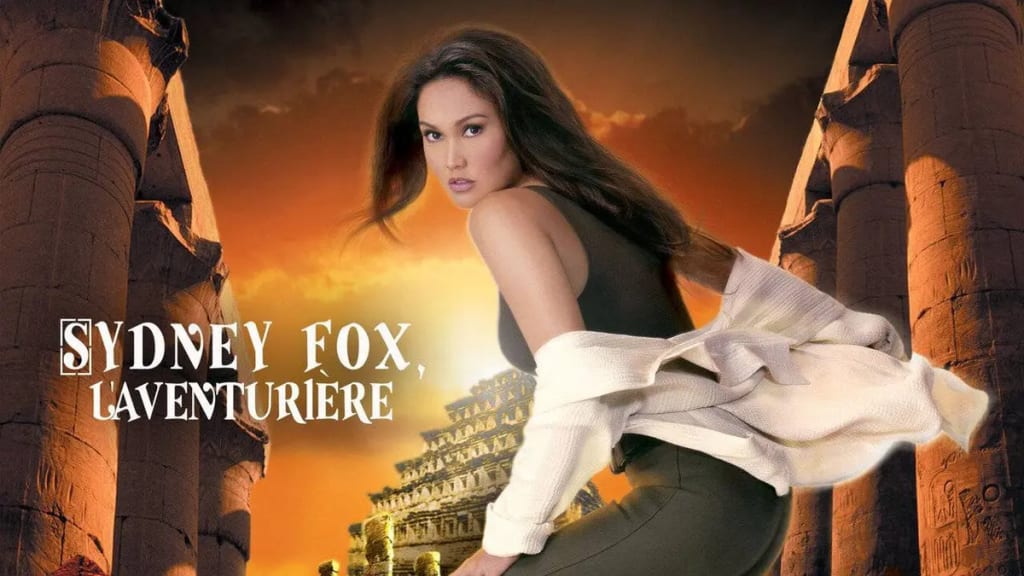
Sydney Fox: Why Tia Carrere Made Relic Hunter’s Professor an Adventure Icon
Sydney Fox could teach you about ancient history in a university classroom.
Then she could grab her jacket, cross the world and go find the missing piece herself.
That was the irresistible appeal of Relic Hunter.
Sydney was never an academic who seemed entirely comfortable leaving history inside textbooks, museums and lecture halls. A lost artifact was not simply an object to discuss. It was a mystery waiting to be solved.
Forgotten civilizations.
Vanished treasures.
Secret tombs.
Ancient curses.
Rival collectors.
Centuries-old clues that everyone else had misunderstood.
For Sydney, those were invitations.
And Tia Carrere made the character work because she never forced audiences to choose between the two sides of her.
Sydney could be an authoritative professor and a convincing action hero.
She could decipher an inscription one moment and fight her way out of a ruin the next.
She could be glamorous without becoming helpless, knowledgeable without becoming dull, and formidable without losing her sense of humor.
For three seasons and 66 episodes, Relic Hunter turned the study of history into weekly adventure.
More than two decades later, Sydney Fox remains a wonderfully specific kind of television hero:
the person who knows exactly why the treasure matters before she risks her life trying to find it.
What Was Relic Hunter?
Relic Hunter was an action-adventure television series built around Professor Sydney Fox, played by Tia Carrere.
The series ran from 1999 to 2002, producing three seasons of 22 episodes each for a total of 66 episodes. Carrere appeared throughout the complete run alongside Christien Anholt as Sydney's British assistant, Nigel Bailey.
Its premise was wonderfully straightforward.
Sydney was a university professor specializing in ancient cultures and archaeology who also worked as a globe-trotting relic hunter.
Someone would arrive with a story.
An artifact had disappeared.
A legend had been dismissed.
A family secret pointed toward something buried.
A historical record contained an inconsistency.
Or a valuable object had fallen into the hands of someone who wanted it for money or power.
Sydney and Nigel would investigate.
The university classroom would give way to airplanes, ruins, tunnels, jungles, castles, temples and archaeological sites.
History became the beginning of the adventure rather than the end of it.
Apple TV's description captures the basic idea succinctly: Sydney is a history professor and courageous explorer known for her expertise in ancient civilizations, searching for artifacts and returning them to appropriate owners.
That final part is important.
Sydney was a relic hunter.
But she was not simply a treasure hunter.
Sydney Fox Wasn't Looking for Treasure Just to Get Rich
The title could make Sydney sound like someone raiding tombs for profit.
That was rarely her motivation.
The series repeatedly established a distinction between Sydney and the rival hunters she encountered.
Other people wanted artifacts because they were valuable.
Sydney wanted to understand what they were, where they belonged and what history had been attached to them.
The series description repeatedly identifies her goal as returning artifacts to museums, communities or descendants of their original owners rather than simply keeping them.
That gave the show an ethical framework.
It was certainly television archaeology rather than a realistic archaeological procedural.
Sydney could accomplish in 44 minutes what actual historical research might require years to establish.
Ancient objects frequently possessed supernatural properties.
Timelines and legends were cheerfully rearranged for adventure.
But the underlying attitude toward history mattered.
Objects meant something because people had lived with them.
A bowl was not merely a bowl if generations had attached religious importance to it.
A flag could represent an entire political struggle.
A weapon might contain evidence capable of restoring a family's reputation.
A relic could connect a living person with an ancestor they barely understood.
Sydney cared about that connection.
The First Episode Explained the Formula Immediately
The opening episode, “Buddha's Bowl,” already contained the essential Relic Hunter structure.
Sydney and Nigel travel in search of an ancient Buddhist object while competing against people with different motives for finding it.
Later episodes sent them after everything from historic flags to supposedly magical objects, religious artifacts, weapons, lost documents and culturally significant treasures.
Season 1 alone includes stories involving Al Capone's diamond-encrusted gun, the remains of a murdered nun, a historic California flag and even an Elvis Presley guitar.
That range explains the show's personality.
Relic Hunter never restricted itself to one narrow definition of archaeology.
Ancient history could sit beside modern mythology.
Religious tradition could sit beside pop culture.
An archaeological mystery could become a supernatural story.
The show's real subject was not any specific historical era.
It was the thrill of discovering that something thought lost might still be out there.

And Every Episode Began by Making the Past Feel Alive
One of Relic Hunter's most effective storytelling devices was the historical opening.
Many episodes began in the past.
The audience would see the relic being used, stolen, hidden, lost or fought over.
Then the series would jump into the present.
That structure immediately gave an object context.
Instead of beginning with:
"Here is a valuable artifact."
The show effectively said:
"Here is what happened to it."
Now Sydney had to reconstruct the missing centuries.
It turned history into a mystery.
The past was not dead information.
It contained unfinished business.
That premise perfectly suited Sydney Fox.
She was someone professionally trained to ask:
What actually happened here?
Sydney Was a Professor First—and That Made the Action More Fun
One of the smartest decisions behind the character was keeping Sydney connected to a university.
She had an intellectual home.
She taught.
She researched.
She understood historical languages, cultural contexts and archaeological evidence.
Adventure did not substitute for knowledge.
Knowledge created the adventure.
That distinguishes Sydney from heroes who simply stumble across an ancient map and begin chasing treasure.
She is supposed to know what she is looking at.
The character has expertise.
IMDbPro summarizes the series as following a history professor and her linguistic assistant as they recover ancient artifacts while competing against rival hunters.
The academic element also made the fantasy more enjoyable.
When supernatural objects appeared, Sydney approached them with an investigator's curiosity rather than immediate unquestioning belief.
The impossible had to be examined.
The legend had to be translated.
The history had to be reconstructed.
Then, inevitably, someone tried to kill her.
Tia Carrere Made the Contradiction Completely Believable
On paper, Sydney Fox requires an unusual combination from a performer.
She has to look convincing in front of a university class.
She has to deliver historical exposition without making it sound like somebody reading an encyclopedia.
She has to carry action scenes.
She has to be funny.
She has to sell romantic tension occasionally.
She has to move naturally between contemporary locations and costume-heavy historical mysteries.
Most importantly, she has to look like she actually enjoys this life.
Tia Carrere did.
That enthusiasm became one of Sydney's defining qualities.
She rarely approached a relic as merely another job.
The possibility of discovery energized her.
Even when the situation became dangerous, there was usually a part of Sydney that seemed delighted that the mystery had become more complicated.
Carrere once described enjoying characters with toughness and attitude, and when discussing her later work on Warehouse 13, she jokingly noted that after 66 episodes of Relic Hunter she effectively knew dozens of magical icons and relics.
That familiarity showed.
By the time Relic Hunter settled into its rhythm, Carrere wore Sydney's expertise casually.
She did not need to constantly announce that Sydney was intelligent.
The character behaved like someone accustomed to being the most knowledgeable person in the room.

Sydney Could Fight—and the Show Never Treated That as Surprising
Another important element was physical confidence.
Sydney fights.
Regularly.
She punches people.
Kicks people.
Escapes restraints.
Climbs through dangerous locations.
Handles weapons when necessary.
Chases criminals.
Gets chased by criminals.
And often rescues Nigel.
The series rarely stops to explain why a female professor knows how to handle herself.
She simply does.
That mattered.
Female action heroes obviously existed long before Relic Hunter, but late-1990s and early-2000s television was still a period when a character like Sydney could feel distinctive.
She was not somebody's assistant promoted into the action.
She was not primarily waiting to be protected.
She was the person leading the expedition.
Carrere later recalled that one early concept behind the series was essentially a female Indiana Jones, and she also discussed liking the idea that girls could see women associated with careers such as archaeology and geology.
The comparison with Indiana Jones was inevitable.
But Sydney had her own energy.
Sydney Fox Was Not Simply a Female Indiana Jones
The similarities are obvious.
University academic.
Ancient artifacts.
International travel.
Dangerous ruins.
Villains competing for treasures.
Historical clues.
Occasional supernatural objects.
Action mixed with archaeology.
But Sydney is not simply Indiana Jones with the gender changed.
Their emotional rhythms are different.
Indiana Jones often behaves as if adventure is an occupational hazard he repeatedly finds himself dragged into.
Sydney frequently appears to actively enjoy the hunt.
She likes solving the mystery.
She likes proving an old account wrong.
She likes finding the hidden chamber.
She likes beating rivals to the artifact.
She seems constitutionally incapable of hearing "nobody has found this thing for 500 years" without wondering whether she could find it before dinner.
That gives her a lighter television energy.
She can be serious when history demands it, but the show understands that relic hunting is also fun.
Nigel Bailey Was the Perfect Counterweight
Sydney would not have worked nearly as well without Nigel.
Played by Christien Anholt, Nigel Bailey begins as Sydney's British teaching assistant and becomes her constant partner.
Where Sydney is instinctive, Nigel is cautious.
Where Sydney walks through the dangerous doorway, Nigel would often prefer to establish whether opening the door is legally, structurally or spiritually advisable.
Where Sydney punches the threatening stranger, Nigel may still be attempting diplomacy.
That difference created the show's central comic rhythm.
Sydney needed someone beside her who understood enough history to contribute but did not share her complete disregard for danger.
Nigel filled that role beautifully.
Carrere later recalled that her chemistry with Anholt during casting was crucial and that his ability to handle physical comedy made him especially effective as Sydney's partner.
And he was more than comic relief.
Nigel's linguistic skills frequently mattered.
He could translate.
Research.
Identify historical references.
Challenge Sydney's assumptions.
And occasionally surprise everyone with courage of his own.
The Show's Best Dynamic Was Competence Meeting Panic
Sydney and Nigel often seemed to experience the same event in completely different ways.
A hidden tunnel opens.
Sydney:
Interesting.
Nigel:
That cannot possibly be structurally safe.
Someone begins shooting.
Sydney:
Move.
Nigel:
Why is someone always shooting?
A cursed artifact appears.
Sydney:
Let's investigate.
Nigel:
Perhaps we should investigate from another country.
The formula works because Nigel is not stupid.
Quite the opposite.
His anxiety is frequently reasonable.
Sydney really does place them in absurd danger.
The joke is that Sydney's tolerance for danger is simply calibrated differently from everyone else's.
She sees uncertainty as possibility.
Nigel sees uncertainty as something probably containing snakes.
Together they created the personality of the series.
Claudia Made the University Side of the Show Work Too
For the first two seasons, Lindy Booth played Claudia, Sydney's secretary.
Claudia initially appears to belong to an entirely different television series.
She is fashion-conscious.
Social.
Often more interested in contemporary life than ancient civilizations.
She can seem hilariously ill-suited to Sydney's world.
That is why she works.
Sydney and Nigel could become so consumed by artifacts and research that Claudia reminded the audience that ordinary people might not consider crawling through a tomb a normal Tuesday.
She also gradually proved more capable than the stereotype surrounding her suggested.
The chemistry among Sydney, Nigel and Claudia became an important part of the first two seasons.
When Claudia was replaced by Karen Petrusky, played by Tanja Reichert, in Season 3, the group's rhythm inevitably changed. The cast records show Booth appearing through the first 44 episodes and Reichert taking over the third-season assistant role for the final 22.
The adventure formula remained.
But viewers attached to the original trio could feel the difference.
Relic Hunter Understood the Pleasure of the Rival Treasure Hunter
Sydney also needed people who were essentially corrupted versions of herself.
The rival relic hunter became one of the show's recurring archetypes.
They often possessed similar skills.
They knew history.
They could follow clues.
They could survive dangerous environments.
But their motivations were different.
Money.
Prestige.
Personal power.
Private collections.
Revenge.
Sydney could therefore compete against someone who understood exactly what she understood while rejecting what she believed the artifact represented.
The contest became more interesting than simply hero versus criminal.
It was often:
Who deserves to possess history?
One hunter believes knowledge belongs to whoever can sell it.
Sydney believes the object has responsibilities attached to it.
That gives even the lighter episodes a consistent moral center.
Sometimes the Relics Really Were Supernatural
Relic Hunter was never embarrassed by fantasy.
Some episodes could be explained largely through ordinary historical intrigue.
Others involved artifacts with apparently genuine supernatural abilities.
The series also occasionally ventured toward science-fiction ideas and unusually advanced ancient technologies. Descriptions of the show specifically note that many relics possessed supernatural powers or extraordinary technological properties.
That choice separated Relic Hunter from a straightforward archaeology series.
The question was not always:
Is the legend true?
Sometimes the answer was clearly:
Yes.
Now what?
That allowed the show to move freely between genres.
Adventure one week.
Mystery the next.
Fantasy.
Horror.
Historical conspiracy.
Romance.
Comedy.
The artifact became a storytelling device capable of opening almost any genre.
History Was Frequently Flexible—but the Show Knew What Kind of Entertainment It Was
Nobody should use Relic Hunter as a substitute for an archaeology degree.
The series took enormous liberties.
Historical events were compressed.
Artifacts were invented.
Legends were treated as fact when useful.
Archaeological ethics and field methods were dramatically simplified.
Sydney's ability to enter sites, remove objects and resolve provenance questions within one episode belongs firmly to television fantasy.
But accuracy was not really the show's contract with the audience.
Its promise was different.
It wanted viewers to become curious.
Who was this historical figure?
Did this civilization really exist?
Is that legend based on anything?
Could an artifact actually have disappeared this way?
What is the real history behind the fictional version?
That curiosity has value.
Adventure fiction has often introduced people to history before formal scholarship deepened the interest.
Relic Hunter understood the basic attraction:
history becomes exciting when it feels connected to a mystery.
The Series Was Also Pure Late-1990s and Early-2000s Adventure Television
Watching Relic Hunter today immediately transports you to a particular television era.
Episodes are largely self-contained.
You can miss one and still understand the next.
There is no requirement to remember twelve competing mythology threads.
No ten-hour movie disguised as a television season.
A problem begins.
Sydney investigates it.
Adventure happens.
The mystery resolves.
Next week, there is another relic.
That format now feels almost refreshing.
The series belonged to the era of syndicated genre television, when programs could build loyal audiences around a charismatic lead, a reliable premise and international-looking adventure without requiring enormous serialized narratives.
Relic Hunter aired for three seasons from 1999 through 2002, with each season supplying 22 adventures.
Sixty-six episodes means sixty-six opportunities to say:
We found another lost thing.
Let's go.
Toronto Quietly Became Much of the World
The show was largely shot in the Toronto area, even though Sydney's adventures supposedly carried her across the globe.
This was another classic feature of internationally oriented television adventure.
Careful sets.
Selected locations.
Costumes.
Establishing imagery.
A few production tricks.
Suddenly Canada could become almost anywhere.
Contemporary reporting from the production emphasized the show's elaborate sets, including historical ruins, skull-covered walls and recreated environments designed to give the series its globe-trotting visual character.
Part of the fun today is recognizing the ambitious scale the show tried to create within episodic television economics.
Every week wanted to feel like a miniature adventure film.

Tia Carrere Was Already Perfectly Equipped for This Kind of Character
By the time Relic Hunter premiered, Carrere already carried the screen presence of someone comfortable with action, comedy and glamour.
Audiences knew her from projects including Wayne's World and James Cameron's True Lies.
Relic Hunter gave her something different:
the center of the story.
Sydney was not the villain.
Not the glamorous supporting character.
Not the person assisting somebody else's adventure.
The show belonged to her.
Carrere had to establish the series' tone every week.
And Sydney gave her room to combine qualities that television sometimes separated into different characters.
Scholarship.
Humor.
Sex appeal.
Physical toughness.
Leadership.
Curiosity.
That combination is a major reason the series remains associated so strongly with its lead.
Remove Carrere and the concept still exists.
But its personality changes completely.
Sydney Made Intelligence Look Like Part of the Action
This may be the character's most enduring quality.
Sydney is exciting not despite being knowledgeable.
She is exciting because she knows things.
Understanding history gives her an advantage.
Reading the inscription correctly saves lives.
Recognizing the cultural significance of an object changes the investigation.
Knowing that a supposedly authentic story contradicts the historical record exposes a lie.
Academic knowledge becomes actionable.
That is a satisfying fantasy in its own right.
We often talk about action heroes in terms of strength.
Sydney's real superpower was frequently knowing something that the villain did not.
And when knowing the answer was insufficient, she could usually kick the villain afterward.
She Was Glamorous Without the Show Pretending Glamour Was Her Only Quality
Relic Hunter certainly understood Tia Carrere's star appeal.
Sydney's wardrobe was designed for television adventure rather than archaeological fieldwork.
The series was not shy about presenting her as glamorous.
Contemporary producers openly acknowledged that sex appeal formed part of the show's entertainment package.
But Sydney's attractiveness was never the complete justification for her presence.
She leads because she is the expert.
People come to Sydney because they need her knowledge.
Nigel follows Sydney because she knows how to conduct the hunt.
Rivals take her seriously because they know she can beat them.
The show may enjoy how Sydney looks while crossing a jungle, but the narrative does not forget why she is there.
That distinction matters.
Sydney Also Failed Just Enough to Remain Fun
A hero who always knows everything becomes exhausting.
Sydney was confident, but not infallible.
She could misinterpret evidence.
Trust the wrong person.
Underestimate danger.
Become emotionally involved.
Charge into a situation too quickly.
Her stubbornness frequently created problems alongside solving them.
That prevented intelligence from turning into omniscience.
It also gave Nigel a reason to exist beyond translation.
He could question her.
Slow her down.
Remind her that perhaps the ancient cursed chamber covered in warning symbols should not be opened immediately.
Sydney would usually open it anyway.
But at least somebody had objected.
The Artifacts Were Really Story Machines
The smartest element of the format was that the relic itself could generate an entire episode.
Ask four questions:
Who made it?
Why did it matter?
How was it lost?
Who wants it now?
That is a complete adventure engine.
The historical flashback answers part of the question.
Sydney's research answers another part.
The rival hunter complicates the present.
The final location reveals the rest.
Because the relic changed each week, the series could repeatedly use the same basic structure without telling exactly the same story.
One week might involve Buddhism.
Another organized crime.
Another medieval Christianity.
Another American history.
Another ancient royalty.
Another popular culture.
The structure stayed stable.
The world around it changed.
Why Didn't Relic Hunter Continue Beyond Three Seasons?
The show ended after its third season in 2002.
The production completed its original three-season, 66-episode run and was not renewed beyond it.
Carrere later discussed being physically tired after completing the 66 episodes and wanting to move toward other parts of her personal life. In a later convention appearance, she reportedly reflected that the series might conceivably have had more life in it, while also acknowledging how much had changed around the production by the final season.
The final episode, “So Shall It Be,” aired in May 2002 and became the 66th adventure.
There was no sprawling five-season final arc.
No modern prestige-TV conclusion.
The adventures simply stopped.
In a strange way, that fits Relic Hunter.
Sydney Fox feels like a character who presumably kept finding lost objects after the camera left.
The Show Never Received the Cultural Status Its Premise Deserved
Relic Hunter occupies an unusual position in television memory.
People who watched it often remember it instantly.
Tia Carrere.
The artifacts.
Nigel.
The university.
The fights.
The historical openings.
Yet it is rarely discussed with the same nostalgia surrounding some larger genre shows of its era.
That makes the series feel almost like one of Sydney's own relics.
Not gone.
Just waiting to be rediscovered.
The show's premise has aged remarkably well because modern audiences remain fascinated by adventure archaeology.
Indiana Jones never disappeared.
Lara Croft remains a major gaming character.
Uncharted built another enormous franchise around history, puzzles and lost civilizations.
Adventure stories about buried history still work.
And Relic Hunter offered that experience every week on television.
Sydney Fox Also Arrived During an Important Era for Female Adventure Heroes
By 1999, audiences had already seen formidable women leading action stories.
But television was still experimenting with what a female-led genre show could look like.
Xena: Warrior Princess had become a phenomenon.
Buffy the Vampire Slayer had reshaped supernatural television.
Lara Croft had become a gaming icon.
Then Sydney Fox arrived with an entirely different professional identity.
She was not chosen by destiny.
Not born into royalty.
Not a supernatural warrior.
Not a secret agent.
She was an academic.
That was refreshing.
Her knowledge was not merely backstory attached to an action character.
It was the reason she was capable of having the adventures.
Carrere later discussed the appeal of presenting young women with the idea that careers connected to fields such as archaeology could themselves be exciting.
That may be one of the show's quieter legacies.
She Made the Classroom and the Ruin Feel Like Parts of the Same Life
There is a lovely fantasy at the heart of Sydney Fox.
You do not have to choose between thinking and doing.
The scholar does not need to remain behind the desk while somebody more adventurous enters the tomb.
The same person can understand the inscription and climb the wall.
Teach the history and make some.
Know which dynasty produced the artifact and know what to do when the person holding it pulls a gun.
Sydney's two worlds reinforce each other.
The classroom tells her why the relic matters.
The expedition gives her something worth bringing back to the classroom.
Knowledge leads to experience.
Experience creates more knowledge.
That circular relationship gives the character more depth than "professor who happens to fight people."
Would Relic Hunter Work Today?
Absolutely.
But a modern version would probably look very different.
Archaeological ethics would receive more attention.
Ownership and repatriation questions could become central stories rather than background details.
Technology would radically change research.
Satellites, drones, digital archives, DNA analysis and remote sensing could transform how Sydney investigates sites.
A serialized mythology might connect multiple relics across a season.
Production values could make the international locations much more convincing.
But the central formula would require almost no change:
A brilliant professor.
A strange historical mystery.
A missing object.
A rival who wants it for the wrong reason.
A trail of clues leading somewhere dangerous.
And Sydney Fox deciding she absolutely has to see what is at the end.
That still sounds like television worth watching.
But Any Revival Would Need to Understand Why Sydney Worked
It would be easy to remake Relic Hunter as something darker.
More violent.
More serialized.
More "realistic."
That might miss the appeal entirely.
The original series had charm.
Sydney enjoyed what she did.
Nigel made the danger funny.
The artifacts encouraged curiosity.
The tone could become threatening without permanently abandoning adventure.
That balance matters.
Not every treasure hunt needs to become a meditation on trauma.
Sometimes the hidden door opens and you want to know what is behind it.
Sydney Fox understood that feeling.
Tia Carrere Was the Ingredient You Couldn't Manufacture
A format can be recreated.
A character description can be rewritten.
Ancient relics are unlimited.
But charisma is harder.
Carrere could walk into an episode and immediately make Sydney seem as if she had been doing this for years.
She carried herself like someone who belonged in front of a classroom and inside an ancient ruin.
She could deliver exposition without draining the scene of energy.
She could throw a punch without transforming Sydney into a grim action machine.
She could flirt, argue, investigate and joke without any one quality erasing the others.
Sydney Fox was larger than life.
Carrere prevented her from becoming a cartoon.
The Greatest Fantasy of Relic Hunter Wasn't the Magical Artifacts
It was the idea that knowledge could lead anywhere.
Open an old book.
Translate a forgotten line.
Notice something historians ignored.
Follow the clue.
Board a plane.
Enter the ruins.
Find the thing everyone thought was gone.
There is something irresistible about that fantasy.
History becomes unfinished.
The world still contains secrets.
And intelligence becomes the map leading toward them.
That is why Sydney Fox was such a satisfying hero.
She did not look at the past as something completed.
She saw questions.
And That Is Why Sydney Fox Still Deserves to Be Remembered
Tia Carrere played Sydney Fox for 66 episodes across three seasons.
That may sound modest compared with television series that survive for a decade.
But it was enough to create a character people still recognize more than 20 years later.
Sydney was smart without becoming detached.
Tough without becoming humorless.
Glamorous without becoming ornamental.
Confident without being infallible.
And curious almost to the point of self-preservation becoming optional.
Most importantly, she believed that history mattered.
Not because it belonged behind glass.
Because the people connected to it mattered.
The civilizations.
The families.
The stories.
The mysteries.
The lives that disappeared while their objects remained behind.
That made Sydney more than another fictional treasure hunter.
The treasure was rarely the whole point.
Finding the story was.
For three seasons, Tia Carrere made scholarship look adventurous, archaeology look dangerous and intelligence look every bit as exciting as the action.
Sydney Fox could teach you ancient history in the morning.
By afternoon, she might already be halfway across the world looking for the part the textbook got wrong.
That was Relic Hunter.
And television could use another adventure like it.
Frequently Asked Questions
Who is Sydney Fox in Relic Hunter?
Sydney Fox is the central character of Relic Hunter. She is a university professor and globe-trotting relic hunter who searches for lost historical artifacts, often attempting to return them to museums, communities or descendants connected with their original history.
Who played Sydney Fox?
Sydney Fox was played by Tia Carrere throughout all 66 episodes of Relic Hunter.
When did Relic Hunter originally air?
Relic Hunter ran from 1999 to 2002.
How many seasons of Relic Hunter were made?
The series produced three seasons.
How many episodes of Relic Hunter are there?
There are 66 episodes, with 22 episodes in each of the three seasons.
What does Sydney Fox do for a living?
Sydney is a university professor specializing broadly in ancient history, archaeology and related subjects. She also conducts international expeditions in search of lost artifacts.
Was Sydney Fox an archaeologist?
The series portrays Sydney as an archaeology and ancient-history expert as well as a professor and relic hunter. Different descriptions call her a history professor, archaeologist or professor of ancient studies, reflecting the deliberately broad expertise the series gives her.
Who is Nigel in Relic Hunter?
Nigel Bailey, played by Christien Anholt, is Sydney's British assistant and primary partner throughout the series. His linguistic and historical knowledge complements Sydney's expertise, while his more cautious personality provides much of the show's humor.
Who played Claudia in Relic Hunter?
Lindy Booth played Claudia during Seasons 1 and 2. She appeared in 44 episodes before the character was replaced by Karen Petrusky in Season 3.
Who replaced Claudia in Season 3?
Tanja Reichert joined the regular cast as Karen Petrusky for Season 3.
Was Relic Hunter inspired by Indiana Jones?
The similarities were intentional and widely recognized. Tia Carrere later recalled that the concept of a female Indiana Jones helped shape the direction that became Relic Hunter.
Is Sydney Fox based on Lara Croft?
The characters share obvious similarities as globe-trotting female adventurers connected with ancient artifacts, and comparisons were common when Relic Hunter aired. However, Sydney Fox was developed as the lead of her own syndicated television adventure series rather than as an adaptation of Tomb Raider.
Were the relics in Relic Hunter real?
Some episodes incorporated real historical figures, cultures, objects or legends, while many relics and histories were invented or heavily fictionalized for television. The series frequently mixed history with fantasy and supernatural elements.
Did relics have supernatural powers in the show?
Sometimes. Relic Hunter included fantasy and science-fiction elements, and some artifacts possessed supernatural abilities or unusually advanced properties.
Where was Relic Hunter filmed?
Much of the series was filmed in and around Toronto, with locations and sets used to represent Sydney's international adventures.
Why did Relic Hunter end?
The series completed its original three-season, 66-episode run and was not renewed afterward. Carrere later said she had also become physically tired after making 66 episodes and was ready for changes in her personal life.
What was the final episode of Relic Hunter?
The final episode was “So Shall It Be,” the 22nd episode of Season 3 and the 66th episode overall. It aired in May 2002.
What made Sydney Fox different from other treasure-hunting heroes?
Sydney's academic identity was central to the character. Her ability to interpret history, languages and artifacts frequently drove the adventure, while her goal was generally preservation or restoration rather than personal wealth.
Why is Relic Hunter still remembered?
The series combined self-contained historical mysteries, fantasy, humor and action with the chemistry of Tia Carrere and Christien Anholt. Sydney Fox also stood out as a female adventure lead whose intelligence was treated as an essential part of her heroism rather than merely background characterization.
Is Relic Hunter worth watching today?
For viewers who enjoy Indiana Jones, Tomb Raider, archaeological mysteries, supernatural artifacts and lighter episodic adventure television, Relic Hunter remains a distinctive example of late-1990s and early-2000s genre TV. Its history is highly fictionalized, but its sense of adventure remains the point.