
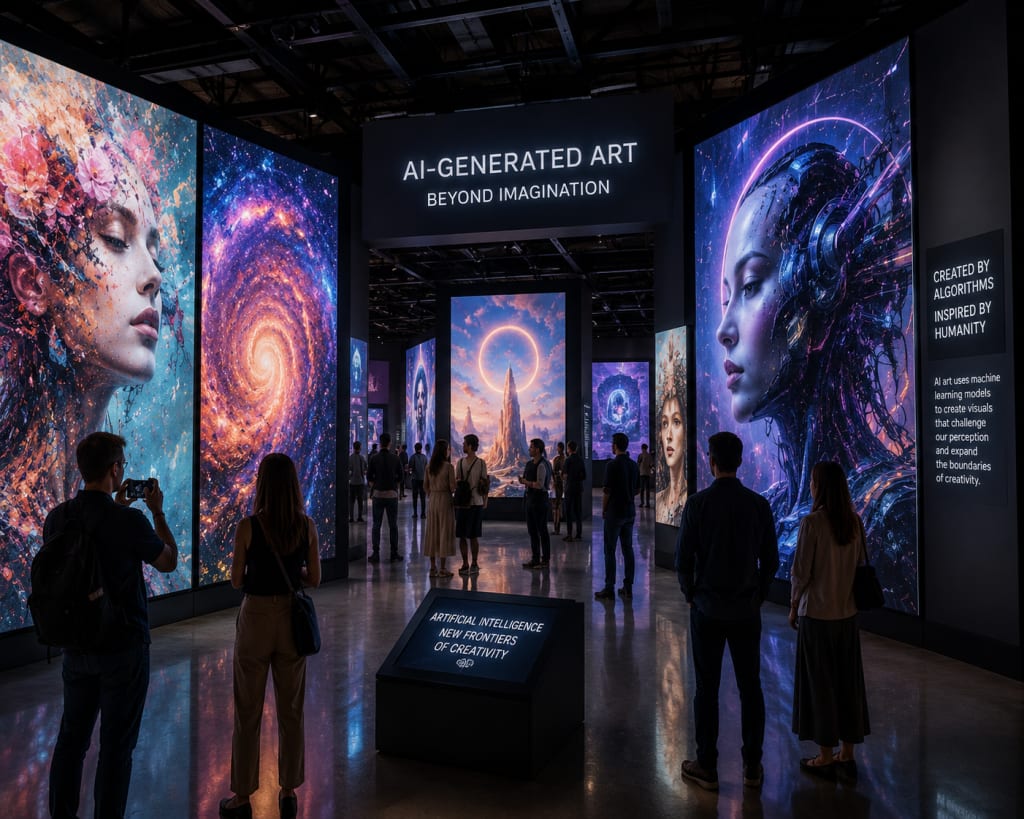
AI-Generated Art Exhibitions Trending Globally
Art has always changed when tools changed.
The camera changed painting. Film changed storytelling. Digital software changed design. Social media changed how artists build audiences. Virtual galleries changed where art could be seen. Now, artificial intelligence is creating another disruption: exhibitions where algorithms, prompts, datasets, code, machine learning systems, and human imagination collide.
Across the world, AI-generated art exhibitions are becoming one of the most debated cultural trends of the decade. Some galleries are embracing them as the next frontier of digital creativity. Some museums are experimenting carefully with AI as a tool for interpretation, installation, and audience engagement. Some collectors are curious but hesitant. Some artists are excited by the possibilities. Others are furious, arguing that generative AI has been trained on creative labor without consent and is now being used to compete with the very people whose work made it possible.
That tension is exactly why the trend is so powerful.
AI art exhibitions are not just about pretty images made by machines. They are about the future of creativity itself. Who is the artist when an image is created from a text prompt? Can a machine be creative, or is the human behind the prompt still the real creator? Should AI-generated works be displayed beside paintings, photography, sculpture, and video art? What happens when a museum uses AI trained on cultural material without clear context or consent? Can AI art be ethical? Can it be original? Can it be emotionally meaningful?
The art world has not agreed on the answers.
In fact, the debate is getting louder.
A 2026 Artsy survey found that collector demand for AI art remains cautious: 41% of galleries said AI “rarely comes up” with collectors, while 16% said collectors actively avoid AI-assisted artworks and 15% reported curiosity-driven interest where collectors ask questions but do not necessarily buy.
That data tells the real story. AI art is visible, controversial, and culturally important—but not automatically accepted by the market. It is trending because people are talking about it, fighting over it, testing it, exhibiting it, rejecting it, and trying to understand what it means.
In other words, AI-generated art exhibitions are not only an art trend.
They are a cultural stress test.
What Is an AI-Generated Art Exhibition?
An AI-generated art exhibition is an exhibition where some or all works are created, transformed, assisted, or interpreted using artificial intelligence systems.
That can mean many things.
Some exhibitions display images generated from text prompts using tools like Midjourney, DALL·E, Stable Diffusion, Firefly, or custom machine learning models. Some use AI to create video, animation, sound, poetry, interactive installations, or immersive environments. Some artists train models on their own archives. Others use public datasets, licensed material, or controversial scraped data. Some exhibitions make the AI process visible, showing prompts, outputs, failures, and iterations. Others present the final work like traditional digital art.
There are also exhibitions where AI is not the sole creator but part of a larger artistic system. An artist may create sketches, feed them into a model, refine outputs manually, print them, paint over them, project them, or combine them with physical sculpture. In these cases, AI becomes one tool among many.
This distinction matters because “AI art” is not one category.
It can be lazy, automated image generation.
It can be deeply researched computational art.
It can be conceptual critique.
It can be digital collage.
It can be interactive installation.
It can be a tool for disabled artists.
It can be a corporate gimmick.
It can be a serious artistic experiment.
This wide range is why the debate becomes so heated. People often use the same phrase—AI-generated art—to describe completely different practices.
Why AI Art Exhibitions Are Trending Now
AI art exhibitions are trending globally because generative AI has become mainstream.
A few years ago, AI-generated imagery felt like a niche technology experiment. Now anyone with a phone or laptop can create polished images in seconds. That sudden accessibility has changed public expectations. People who never studied painting, photography, or 3D modeling can generate fantasy landscapes, fashion portraits, surreal scenes, concept art, album covers, posters, and visual experiments instantly.
Galleries and museums cannot ignore that.
Some want to document the shift. Some want to attract younger digital audiences. Some want to explore new aesthetics. Some want to understand how AI changes authorship. Some want press attention. Some want to sell work in a new category. Others feel pressure to respond because artists, collectors, and visitors are already discussing AI everywhere.
The trend is also fueled by the larger digital-art ecosystem. NFT culture, immersive projection spaces, algorithmic art, generative design, video installations, and online creator platforms all prepared audiences for art that does not look like traditional painting or sculpture. AI-generated exhibitions are simply the newest and most controversial stage of that digital transformation.
But unlike earlier digital art movements, AI art touches a raw nerve: it appears to automate parts of creativity that many people believed were uniquely human.
That is why the exhibitions draw crowds.
And protests.
The Gallery World Is Curious but Cautious
Commercial galleries are not fully united behind AI art.
Artsy’s 2026 survey shows that while some galleries are exploring the category, collector demand is still limited and complicated. Many collectors are curious, but curiosity does not always become purchase. Some actively avoid AI-assisted work because of ethical concerns, copyright uncertainty, or doubts about long-term value.
This is important because hype does not always equal market confidence.
Collectors often care about authorship, provenance, uniqueness, scarcity, and historical significance. AI art can complicate all of those.
If an artwork can be generated in many variations, what makes one version valuable?
If the training data is disputed, does the work carry legal risk?
If the human artist only wrote a prompt, is that enough labor?
If the image style resembles living artists, is it derivative?
If AI tools change rapidly, will today’s outputs look outdated tomorrow?
These questions make galleries cautious. Some may show AI art because it is culturally relevant, but selling it as collectible fine art is more complicated.
The strongest AI art in the market may come from artists who are transparent about process, use ethically sourced or self-trained datasets, and integrate AI into a broader artistic practice rather than relying on one-click generation.
The art world can tolerate new tools.
It is less patient with unclear authorship.
Museums Are Experimenting—And Getting Burned
Museums are under special pressure because they carry public trust.
When a museum uses AI, visitors expect cultural care, context, accuracy, and ethical judgment. If that judgment fails, backlash can be intense.
A recent example came when the British Museum deleted AI-generated social media images after criticism. The images featured an AI-generated person named Elly Lin wearing various cultural clothing while viewing museum collections. The post was removed after negative comments, with critics objecting to the way AI-generated imagery handled cultural material and representation.
That controversy is a warning for cultural institutions.
Museums cannot treat AI-generated imagery as harmless marketing decoration. When AI blends cultural symbols, clothing, artifacts, bodies, histories, and identities, it can easily flatten meaning or reproduce stereotypes. A museum’s job is not only to show images. It is to protect context.
This is why AI governance is becoming essential in the museum world. Institutions need clear policies on when AI can be used, what datasets are acceptable, how outputs are reviewed, how cultural communities are consulted, and how AI involvement is disclosed.
Without that, AI becomes a trust risk.
A museum can lose credibility in a single post.
The Backlash Is Part of the Trend
AI-generated art exhibitions are trending partly because they are controversial.
Every exhibition becomes a debate. Supporters call it innovation. Critics call it theft. Some visitors are amazed. Others are offended. Some artists see new creative freedom. Others see a direct threat to their livelihoods.
The backlash can become severe. In one recent case, actor Jake Wood shut down an art exhibition early after abusive backlash over works that included some AI-generated imagery. Reports said the exhibition, intended to raise funds and awareness for Dementia UK, became overwhelmed by criticism and abuse after people questioned the role of AI in some pieces. Wood later clarified that only two images were based on existing AI-generated images and said he no longer uses AI in his work.
That story reveals how emotionally charged AI art has become.
For many artists, AI is not just another tool. It represents unpaid data extraction, job anxiety, style imitation, and a broader devaluation of creative labor. For some audiences, the presence of AI in an exhibition immediately raises suspicion: Did the artist really make this? Was someone else’s work scraped? Is this charity show, museum post, or gallery display using technology responsibly?
That suspicion is now part of the exhibition environment.
Curators cannot ignore it.
The Copyright Question Hanging Over AI Art
No issue shapes AI art exhibitions more than copyright.
Many generative AI models were trained on massive image datasets that may include copyrighted artwork, photography, illustration, design, and cultural material scraped from the internet. Artists argue that their work was used without permission to train systems that can now produce images in similar styles or compete with them commercially.
This creates ethical and legal uncertainty.
Even if a gallery shows AI-generated art that looks original, visitors may ask: what was the model trained on? Did the artist have the right to use that dataset? Was consent obtained? Are living artists being imitated? Could the work face future legal challenge?
Hyperallergic’s 2026 essay on ethical AI art argues that artists’ fears are understandable because generative AI can plunder creative work while making already difficult art careers more precarious.
This is why “ethical AI art” has become a major phrase in exhibition discussions.
Some artists are trying to build models only from their own work.
Some use licensed datasets.
Some disclose tools and prompts.
Some collaborate with programmers to create custom systems.
Some treat AI as critique rather than convenience.
Others ignore the issue entirely.
The exhibitions that survive serious scrutiny will likely be the ones that address training data openly.
Silence will not be enough.
Authorship: Who Is the Artist?
AI-generated exhibitions force a difficult authorship question.
If an artist writes a prompt and the AI generates the image, is the artist the creator?
What if the artist writes hundreds of prompts, curates outputs, edits images, prints them, paints over them, and creates an installation?
What if the artist trains a model on personal archives?
What if a programmer builds the system?
What if the audience interacts with the AI and changes the work?
What if the final image is mostly machine-generated but conceptually directed by a human?
These questions are not easy, because art has always involved tools and assistants. Renaissance workshops had apprentices. Photographers use cameras. Filmmakers use crews. Digital artists use software. Conceptual artists sometimes outsource fabrication. A human artist does not need to physically make every mark for a work to be art.
But AI feels different because it can generate the visual material itself.
The strongest argument for AI art as art is not that the machine is the artist, but that the human artist designs the system, concept, selection, context, and meaning. The weakest version is when a person types a generic prompt, accepts the first attractive output, and claims deep authorship without further work.
Curators must distinguish between those levels.
Not all AI-generated images deserve exhibition space.
Not all AI-assisted art is empty.
AI Art as Collaboration
Many artists describe AI not as a replacement but as a collaborator.
They use it to generate unexpected forms, explore visual possibilities, break creative habits, imagine impossible scenes, or remix personal archives. In this model, the artist is not asking AI to finish the artwork. They are using it to provoke new directions.
This can be genuinely interesting.
AI can produce strange errors, surreal transitions, impossible textures, dreamlike bodies, hybrid spaces, and visual accidents. Artists can respond to those outputs, refine them, reject them, or build installations around them.
The best AI exhibitions often show the process, not just the result. They reveal prompts, datasets, failures, variations, training methods, and human decisions. That transparency helps audiences understand that the work is not magic. It is a system shaped by choices.
When AI art is framed as collaboration, the key question becomes: what did the artist bring that the machine could not?
Taste.
Concept.
Ethics.
Context.
Selection.
Intention.
Human memory.
Political meaning.
Those are still essential.
The Problem of Sameness
One criticism of AI-generated art is that much of it looks similar.
Certain AI aesthetics have become instantly recognizable: hyper-detailed fantasy portraits, glossy surreal landscapes, impossible architecture, neon cyberpunk cities, smooth faces, over-rendered textures, cinematic lighting, and polished dreamlike scenes. At first, these images felt astonishing. Now many feel generic.
This is a major challenge for exhibitions.
A wall of technically impressive AI images can become boring quickly if the works lack concept, tension, or human specificity. Viewers may admire the surface but forget the work minutes later.
Good art is not only visual polish.
It has point of view.
AI can generate beauty at scale, but scale can cheapen beauty. When everyone can generate an ornate fantasy image in seconds, the value shifts away from image production and toward idea, process, context, and originality.
That is why the most serious AI art exhibitions may move beyond framed outputs into installation, performance, interaction, data critique, robotics, sound, and socially engaged work.
The future of AI art will not be won by the prettiest prompt.
It will be won by artists who make the tool mean something.
AI Art and Immersive Exhibitions
AI-generated art fits naturally into immersive exhibition culture.
Large projection rooms, interactive screens, motion sensors, generative soundscapes, and real-time visuals can create environments that change as visitors move through them. AI can generate images, respond to audience input, alter lighting, produce text, or transform archival material into evolving installations.
This is where AI may feel more compelling than static images.
An AI system can create a living exhibition: one that changes every hour, responds to visitors, adapts to weather data, draws from local archives, or visualizes invisible systems such as climate, migration, memory, or urban movement.
This kind of work can be powerful when conceptually strong. It uses AI’s generative nature as part of the experience rather than hiding it behind a polished picture.
The danger is spectacle without substance. Immersive AI rooms can become Instagram backdrops with weak artistic depth. Beautiful moving visuals are not automatically meaningful.
Again, the difference is curatorial intelligence.
Technology can impress.
Art must resonate.
Why Younger Audiences Are Interested
Younger audiences are often more open to AI-generated art because they are already used to digital creativity.
They make memes, filters, edits, avatars, AI selfies, game environments, 3D renders, and remix culture. They understand that images can be fluid, generated, altered, and shared instantly. For them, AI art may feel less like a threat to tradition and more like another part of the digital visual ecosystem.
That does not mean young artists are universally pro-AI. Many are deeply concerned about training data, job loss, and style theft. But younger audiences often approach AI exhibitions with curiosity because they see the technology shaping their creative world in real time.
They may ask:
Can I interact with it?
Can it respond to me?
Can I see how it was made?
Can it reveal something about identity, surveillance, climate, memory, or power?
Can it be weird?
This audience does not need AI art to imitate oil painting. They may be more interested when it does something only AI can do.
That is a valuable curatorial lesson.
Do not use AI to fake the old.
Use it to question the new.
Traditional Artists Are Not Wrong to Be Angry
The excitement around AI exhibitions should not erase artists’ anger.
Many illustrators, photographers, designers, and painters feel that generative AI systems have benefited from their labor without consent. They worry clients will replace them with cheaper machine outputs. They see living artists’ styles copied. They see online platforms flooded with AI images. They see audiences confused about what is handmade, assisted, or generated.
These concerns are not anti-technology hysteria.
They are labor concerns.
They are consent concerns.
They are economic concerns.
They are cultural concerns.
When galleries exhibit AI art without addressing these issues, they can appear careless or exploitative. When museums use AI imagery without cultural review, they can damage trust. When celebrities or brands use AI art while human artists struggle, backlash is predictable.
A responsible AI exhibition should not treat artists’ fears as outdated.
It should bring those fears into the conversation.
The debate is part of the artwork now.
Can AI Art Be Ethical?
The question of ethical AI art is one of the most important issues in contemporary culture.
A more ethical AI art practice might include:
Using licensed or self-owned training data.
Disclosing AI tools and process.
Avoiding living artists’ names as style prompts without consent.
Compensating collaborators and source communities.
Providing cultural context.
Making the human role clear.
Avoiding deceptive presentation.
Respecting copyright and moral rights.
Using AI critically rather than lazily.
Building custom datasets from personal archives.
Allowing artists to opt in rather than be scraped.
These practices do not solve every problem, but they create a more responsible foundation.
The exhibitions that lead the field will likely be those that take ethics seriously from the beginning. Audiences are becoming more informed. So are collectors. A beautiful AI image may draw attention, but ethical transparency may determine whether the work earns respect.
In 2026, “AI-generated” is not enough.
People want to know how and why.
The Collector Problem
Collectors face a unique challenge with AI art.
Traditional collecting often depends on scarcity, provenance, artist reputation, material presence, and long-term historical significance. AI-generated works complicate that because they can be reproduced, varied, and generated endlessly.
Collectors may ask:
Is this output unique?
Who owns the model?
Can similar images be generated again?
Is the dataset legally safe?
What exactly am I buying?
A print?
A file?
A model?
A prompt?
A certificate?
A performance?
An installation?
This uncertainty may explain why Artsy’s 2026 survey found curiosity but limited collector demand. (artsy.net
)
AI art may need new collecting models. Instead of buying only a static image, collectors may buy a generative system, a limited output series, a documented performance, a custom-trained model, or an installation with clear edition rules.
The market will adapt, but slowly.
Collectors like innovation.
They also like clarity.
AI Art and Cultural Representation
AI-generated exhibitions can become especially sensitive when they involve cultural identity.
If an AI model generates images of Indigenous clothing, religious symbols, historical artifacts, ethnic bodies, sacred objects, or national heritage without proper context, the result can be offensive or misleading. This was part of the criticism around the British Museum’s deleted AI-generated images.
Cultural representation cannot be treated as visual decoration.
Museums and galleries must ask whether communities are consulted, whether symbols are used respectfully, whether AI has combined elements inaccurately, and whether the work reinforces stereotypes.
AI models are especially risky here because they generate plausible-looking images without understanding cultural meaning. A machine can combine patterns, garments, bodies, and symbols into something visually convincing but historically false or disrespectful.
This is why human curatorial oversight matters more, not less.
AI can generate images.
It cannot take responsibility for them.
The Role of Curators in the AI Era
Curators are becoming more important in the AI art era.
When image generation is easy, selection and context become crucial. A curator must decide why a work matters, what process produced it, what ethical questions it raises, and how audiences should engage with it.
A strong AI art exhibition should answer:
What is the artist’s role?
What tools were used?
What data was used?
Is the dataset disclosed?
What is the conceptual purpose?
How does the work relate to art history?
Does it critique AI or celebrate it?
What are the ethical risks?
How are viewers invited to respond?
Without this context, AI exhibitions can feel like tech demos.
With strong curation, they can become serious cultural spaces.
The curator’s job is not to make AI seem magical.
It is to make the work meaningful.
AI Art as Critique of AI
Some of the most interesting AI-generated exhibitions are not celebrations of AI. They are critiques.
Artists use AI to expose bias, surveillance, labor exploitation, data extraction, synthetic beauty standards, deepfake culture, historical erasure, and algorithmic power. They reveal how machine vision sees bodies, how datasets encode prejudice, how generated images flatten culture, or how corporate AI systems reshape imagination.
This kind of work can be powerful because it uses the tool against itself.
Instead of asking, “Can AI make beautiful images?” it asks:
What does AI reveal about us?
Who controls the dataset?
Whose labor is hidden?
Whose bodies are distorted?
Whose culture is remixed?
Whose future is being automated?
These questions make AI art exhibitions more than novelty.
They make them politically and philosophically relevant.
The Difference Between AI Art and AI Aesthetic
There is a difference between AI art and AI aesthetic.
AI aesthetic is the recognizable look of machine-generated images: polished, surreal, smooth, hyper-detailed, sometimes uncanny.
AI art is work that uses AI to make a meaningful statement.
The distinction matters.
An exhibition filled with AI aesthetic may attract attention but fade quickly. An exhibition that uses AI critically, emotionally, or conceptually may last.
This is similar to photography. A camera can take a pretty picture, but photography becomes art through framing, timing, intention, subject, context, and meaning. AI tools are the same. The machine can produce output, but art requires more.
The question for AI exhibitions is not whether the image looks impressive.
The question is what the work does.
Why Some Museums Say No
Not every institution is embracing AI-generated art.
Some museums and galleries are cautious or resistant because they fear legal risk, reputational damage, ethical concerns, or backlash from artists. Others believe AI-generated imagery does not yet meet their standards for originality or cultural value. Some are willing to use AI for internal research or accessibility but not as displayed art.
This resistance is also part of the global trend.
AI art’s rise is not a simple story of acceptance. It is a story of negotiation. Museums are asking what belongs in the gallery. Artists are asking who was exploited. Collectors are asking what has value. Audiences are asking whether they are being deceived.
That debate is healthy.
Art institutions should not adopt every new technology just because it is fashionable.
They should test it, question it, and demand stronger practices.
What Visitors Should Look For
Visitors attending an AI-generated art exhibition should ask good questions.
Was AI disclosed clearly?
Did the artist explain the process?
Was the dataset ethical or licensed?
Does the work have a concept beyond being AI-made?
Does it engage with art history or social questions?
Is human labor visible?
Are cultural symbols handled responsibly?
Does the exhibition invite critical thinking?
Does the work feel emotionally meaningful?
Or does it only look impressive for a few seconds?
These questions make the viewing experience richer.
AI art can be exciting, but audiences should not surrender judgment just because the technology is new. The same standards still matter: originality, craft, idea, feeling, context, and responsibility.
The tool changed.
The need for discernment did not.
The Future of AI-Generated Art Exhibitions
AI-generated art exhibitions will continue to grow, but the trend will mature.
The first wave focused heavily on novelty: look what AI can make.
The next wave will need depth: look what artists can say with AI.
Future exhibitions may feature custom artist-trained models, live generative installations, AI-human collaborations, ethically sourced datasets, interactive audience participation, archival reinterpretations, climate visualizations, multilingual storytelling, and hybrid physical-digital works.
At the same time, there will be stronger demands for disclosure, regulation, artist consent, copyright clarity, and institutional accountability.
The exhibitions that survive will not be the ones that simply use AI.
They will be the ones that understand AI as material, subject, and problem.
That is where the real art begins.
AI-generated art exhibitions are trending globally because they sit at the center of one of the biggest cultural debates of our time: what happens to creativity when machines can generate images, sound, text, and immersive experiences at scale?
The trend is real, but complicated. Galleries are curious, but collector demand remains cautious. Artsy’s 2026 survey found that 41% of galleries say AI rarely comes up with collectors, while 16% say collectors actively avoid AI-assisted artworks and 15% see curiosity-driven interest without strong buying commitment.
Museums and artists are also learning the risks. The British Museum’s AI-generated social media backlash showed how quickly cultural institutions can lose trust when AI imagery is used without enough sensitivity or context.
Meanwhile, public backlash against AI-assisted exhibitions shows how deeply artists and audiences care about authorship, consent, labor, and transparency.
The future of AI art will not be decided by technology alone.
It will be decided by ethics, curation, human intention, and whether artists can use these tools to create work that means more than the machine’s surface beauty.
AI can generate an image in seconds.
But an exhibition still needs something older and harder to automate:
a reason to matter.
