
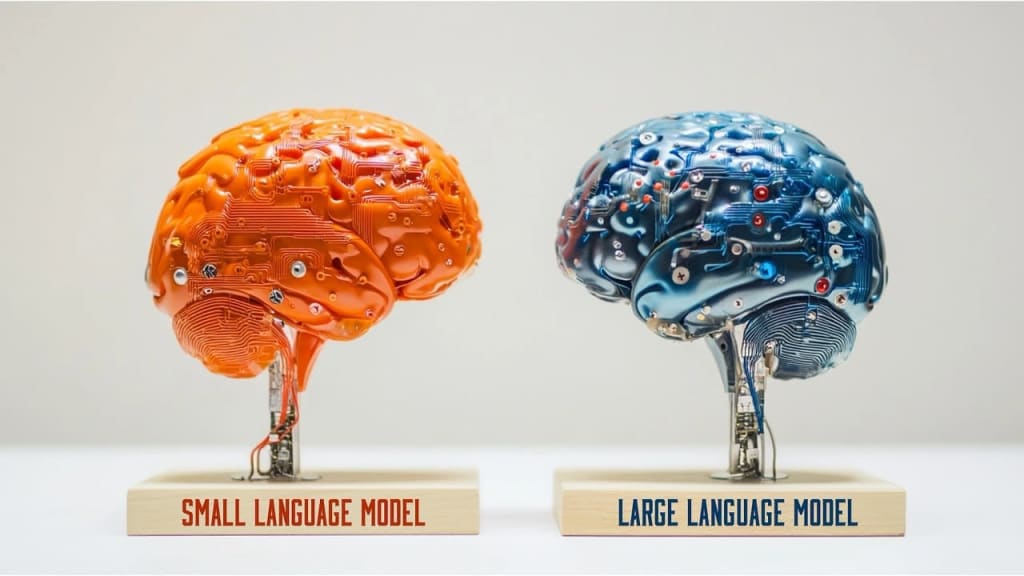
Small Language Models: Big Advantages on Small Devices
Small language models are reshaping AI deployment by doing selected jobs with fewer parameters and less compute. The opportunity is not that a tiny model beats every frontier system, but that a right-sized model can be fast, affordable and private for a narrow task. What makes an SLM different Model
Small language models are reshaping AI deployment by doing selected jobs with fewer parameters and less compute. The opportunity is not that a tiny model beats every frontier system, but that a right-sized model can be fast, affordable and private for a narrow task.
What makes an SLM different
Model size is one dimension of capability, not a complete measure of quality. Compact models can use distillation, specialized training data and quantization to run on phones, laptops or modest servers. Tasks such as extracting fields, classifying support requests and summarizing short notes may not justify an expensive remote model with broad reasoning skills.
Privacy and offline usefulness
Local processing can keep some text, audio and application data on the device, reducing exposure to remote services. Offline use may benefit travel, industrial settings and unreliable networks. But privacy is not automatic: telemetry, application permissions, device backups and the design of retrieval systems still determine where sensitive information travels.
Small Language Models: Big Advantages on Small Devices — a visual explainer.
Cost and latency trade-offs
On-device inference can reduce per-request API fees and network delay. However, a model must fit memory constraints, respect power budgets and deliver acceptable accuracy. Smaller models can hallucinate, struggle with long context and fail on unfamiliar domain language. Carefully designed benchmarks on real workloads are more useful than headline parameter counts.
Where hybrid architectures win
Applications can route simple tasks to a compact local model while escalating ambiguous or complex cases to a larger service. Rules handle strict validation, and retrieval adds up-to-date documents when needed. This division reduces unnecessary computation without pretending the smallest model is universally sufficient.
Questions and trade-offs behind the technology.
How teams should select a model
Build a test set with real inputs, edge cases and known answers. Measure error rates, speed, energy use, hardware support and updateability. If the use case involves medical, financial or legal decisions, establish domain review and explicit limits. The best SLM is the one that reliably solves a defined task, not merely the smallest one available.
What to watch next
The real test of small language models is whether specific use cases work reliably outside controlled demonstrations. Readers should compare independent evaluations, transparent failure reporting, and evidence of long-term value instead of accepting a headline or promotional demonstration as proof. The decisions discussed above also reveal who benefits, who carries the risk, and which safeguards will be needed as adoption expands.
Questions to ask before believing the hype
- What specific task was tested, and under what conditions?
- Who verified the result independently?
- What are the costs, limitations, privacy implications and alternatives?
- Does this development help ordinary users today, or is it still experimental?
Frequently Asked Questions
Do small language models work without the internet?
Many can run locally once installed, depending on hardware and application design.
Are SLMs always more accurate than large models?
No. They can excel at targeted tasks but typically offer narrower general capabilities.
The bottom line
Small Language Models deserves attention because it could reshape how people use technology. Progress will be measured by dependable services, clear safeguards and real benefits—not just spectacular product videos. Follow verified research and evaluate the limits alongside the promise.


