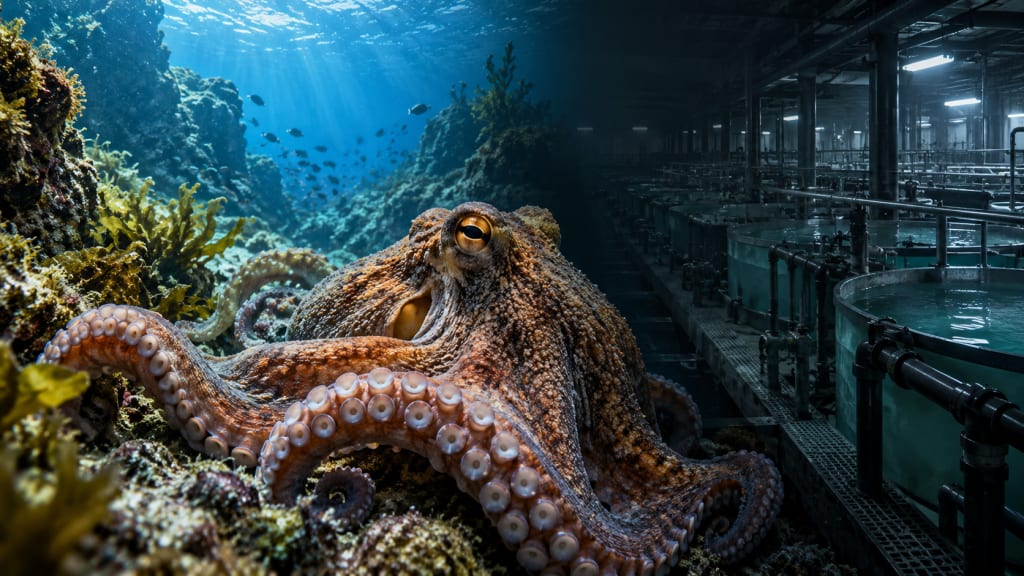
Spain’s Planned Million-Octopus Farm Is Dead—But the Real Story Is More Complicated
For years, a proposed facility in Spain's Canary Islands threatened to turn one of the ocean's most unusual animals into a new intensive aquaculture industry.
The plan was extraordinary in scale.
Spanish seafood company Nueva Pescanova wanted to build what was widely described as the world's first industrial-scale commercial octopus farm at the Port of Las Palmas in Gran Canaria.
The facility was expected to produce roughly:
3,000 tonnes of octopus per year
That would have required raising and killing approximately:
one million octopuses annually.
Scientists and animal-welfare organizations spent years raising concerns about what such a system could mean for animals known for sophisticated behavior, exploration, learning and strong evidence of sentience.
Then, in July 2026, the project ended.
Nueva Pescanova formally withdrew its application to construct the Gran Canaria farm, and the Port Authority of Las Palmas said the administrative file that had been open since 2021 would be closed.
For opponents of intensive octopus farming, it was a major victory.
But there is an important correction to some of the headlines circulating online:
Spain did not simply enact a nationwide ban on octopus farming.
The specific Nueva Pescanova project was withdrawn by the company after years of regulatory proceedings and new environmental requirements.
A separate proposal to prohibit octopus aquaculture throughout Spain exists in the Spanish parliament, but as of the latest congressional record, it has not become national law.
So the most accurate version of the story is both encouraging for campaigners and more nuanced:
The world's most prominent commercial octopus-farm proposal has been abandoned in Gran Canaria, while the larger legal and scientific debate over whether octopus farming should exist at all continues.
What Happened to the Nueva Pescanova Octopus Farm?
On July 23, 2026, Nueva Pescanova notified the Port Authority of Las Palmas that it was withdrawing its application for the proposed marine aquaculture facility.
According to Spain's EFE news agency, the company said it was no longer appropriate to continue with the application under the terms originally proposed because circumstances had changed during the lengthy approval process and because the Canary Islands' environmental authorities had imposed additional administrative requirements.
The Port Authority consequently moved to close the file that had been opened in May 2021.
That means the proposed octopus farm at the Port of Las Palmas will not be built under that application.
The withdrawal came after approximately five years of regulatory review and sustained opposition from scientists, animal-welfare groups and members of the public.
Campaign group Compassion in World Farming said more than 43,000 messages had been sent to the Las Palmas Port Authority urging officials to close the project.
Animal-welfare groups characterized the withdrawal as a major victory.
But Nueva Pescanova's stated explanation focused on the changing technical, regulatory and environmental conditions surrounding the project rather than declaring an end to octopus aquaculture as a concept.
So Did Spain Actually Ban Octopus Farming?
No—not nationally.
This distinction matters.
Spain's Congress has considered a proposed law that would prohibit captive breeding and aquaculture of octopuses for food or other productive purposes.
That proposal was introduced in June 2025 by several parliamentary groups.
However, the official congressional record currently lists the measure at the “Pleno Toma en consideración” stage, meaning it remains within the parliamentary process rather than being enacted law.
One of the original supporting parliamentary groups subsequently withdrew its signature from the initiative in September 2025, although other sponsors remained.
Therefore:
Nueva Pescanova's Gran Canaria project is finished.
But:
Spain has not yet established a blanket nationwide prohibition on all possible future octopus farming.
That is an important difference between a project being abandoned and an entire industry being outlawed.
Could Nueva Pescanova Try Again Somewhere Else?
Possibly.
The company's withdrawal applies to the specific project and administrative application in Las Palmas.
Industry reporting following the decision noted that the withdrawal did not necessarily mean Nueva Pescanova had abandoned all research into octopus aquaculture or ruled out different technical or geographical approaches in the future.
So it would be premature to say commercial octopus farming has been permanently defeated worldwide.
The Gran Canaria project was the most advanced and internationally visible proposal.
Its collapse may make future projects more difficult.
It does not make them impossible.
Why Did the Proposal Become So Controversial?
The debate was never simply about building another fish farm.
Octopuses pose a particularly difficult animal-welfare question.
They are cephalopods—a group that also includes squid and cuttlefish—and they possess nervous systems radically different from those of vertebrates.
Yet despite that evolutionary distance, research has produced substantial evidence that octopuses are capable of experiences relevant to welfare, including pain and other affective states.
A major 2026 review in Biological Reviews assessed neurological and behavioral evidence across cephalopods and concluded there is strong evidence of sentience in octopuses.
That finding builds on an earlier review commissioned by the UK government.
Researchers examined more than 300 scientific studies and concluded there was sufficient evidence to recommend treating cephalopods as sentient animals for the purposes of welfare legislation.
The evidence was influential enough that the United Kingdom subsequently included cephalopod molluscs within its Animal Welfare (Sentience) Act framework.
This does not mean every aspect of octopus consciousness is understood.
It means the scientific evidence is strong enough that serious welfare concerns cannot reasonably be dismissed.
Octopuses Are Not Typical Farm Animals
One reason industrial octopus farming raises unusual questions is the animal's natural behavior.
Octopuses commonly:
- investigate unfamiliar objects;
- manipulate their surroundings;
- seek shelter;
- solve problems;
- learn from experience;
- explore complex habitats.
Their nervous system is also extraordinary.
A large proportion of an octopus's neurons are distributed through its arms rather than being concentrated exclusively in the brain.
This creates an unusual combination of centralized and distributed control that allows the arms to perform sophisticated sensory and motor tasks.
The growing scientific understanding of cephalopod cognition is one reason researchers increasingly argue that welfare standards must account for more than simply keeping an animal alive and physically healthy.
An animal capable of exploration and flexible behavior may be affected by:
- barren environments;
- lack of hiding places;
- crowding;
- repeated handling;
- inappropriate lighting;
- inability to perform normal behaviors.
That makes intensive production particularly challenging.
 Imrul
Imrul
The Farm Was Expected to Hold Octopuses at High Density
Documents describing the Nueva Pescanova project became public in 2023.
They suggested the facility could eventually house octopuses at densities reportedly reaching approximately 10 to 15 animals per cubic meter in some stages of production.
The company told reporters at the time that exact stocking densities remained under development and argued that welfare depended on environmental conditions rather than density alone.
Opponents saw the situation differently.
Animal-welfare organizations argued that keeping animals with complex behavioral requirements in crowded, relatively barren environments could produce:
- stress;
- aggression;
- injury;
- cannibalism;
- poor overall welfare.
These concerns were particularly significant because commercial octopus farming had never previously operated at the proposed industrial scale.
There was therefore little long-term commercial evidence showing that large populations could be raised intensively while maintaining acceptable welfare.
Are Octopuses Really Solitary?
Octopuses are frequently described as solitary animals.
That description is broadly useful but should not be interpreted too rigidly.
Different species and populations show different levels of social tolerance, and scientists have documented contexts in which octopuses interact or aggregate.
Nevertheless, commercial confinement creates a situation very different from voluntary interaction in the wild.
An animal that can normally:
- leave;
- hide;
- establish a den;
- change territory;
would not have the same choices inside a high-density production tank.
That difference lies at the center of many welfare objections.
The Proposed Slaughter Method Became a Major Flashpoint
Perhaps the most controversial element of the leaked farm plans involved slaughter.
Documents indicated the octopuses would be killed using ice slurry, a mixture of cold water and ice.
Nueva Pescanova representatives argued at the time that the method was preferable to some killing techniques currently used for wild-caught octopuses and said the company was working to refine slaughter protocols.
Researchers and welfare specialists questioned whether the approach could render octopuses unconscious rapidly enough to prevent prolonged distress.
A 2025 peer-reviewed review of commercial practices involving cephalopods identified slaughter among the important welfare risks requiring better evidence and stronger best-practice standards.
Earlier researchers evaluating cephalopod sentience had also concluded that they could not identify a method that was both clearly humane and readily scalable for large commercial octopus production.
This creates a basic problem.
Even if farmers could successfully breed and grow millions of octopuses, the industry would still need a slaughter method that reliably minimizes pain and distress.
Nueva Pescanova Disagreed With Some of the Criticism
A balanced account should include the company's position.
Nueva Pescanova maintained that it was developing the project using scientific research and said its facility would follow animal-welfare and environmental standards.
Company representatives disputed some campaigners' descriptions of the proposed conditions and said research was still underway to determine appropriate stocking density, lighting and slaughter procedures.
That disagreement is important.
Campaign groups frequently described the project as inherently cruel.
Nueva Pescanova argued that welfare conditions could be scientifically managed.
The central unresolved question was whether intensive farming could realistically meet the behavioral and physiological needs of an animal with such unusual biology.
Because the project never reached commercial operation, that question was never tested at full scale.
One Million Octopuses a Year
The proposed production target helps explain why the controversy became global.
The planned facility was expected to produce around 3,000 tonnes of octopus annually, corresponding to roughly one million individual animals each year.
This was not a small experimental laboratory.
It represented the potential beginning of an entirely new intensive livestock industry.
If commercially successful, similar farms could theoretically have been copied elsewhere.
That possibility shifted the ethical question.
The debate was no longer simply:
Can humans breed octopuses in captivity?
Scientists had already made substantial progress on that technical problem.
The question became:
Should an industrial farming system be developed before the welfare problems are understood and solved?
Why Farm Octopuses in the First Place?
The commercial motivation is straightforward.
Octopus is a valuable seafood product consumed heavily in markets including:
- Spain;
- Italy;
- Portugal;
- Japan;
- South Korea;
- the United States.
Wild octopus catches are naturally limited and can fluctuate.
Aquaculture offers companies the possibility of:
- predictable supply;
- standardized size;
- controlled breeding;
- year-round production.
This is essentially the same economic logic that drove the expansion of farming for salmon, shrimp and numerous fish species.
Nueva Pescanova had worked for years on closing the breeding cycle of the common octopus, Octopus vulgaris.
The company announced in 2019 that it had successfully produced multiple generations in captivity, overcoming one of the major biological barriers to commercial aquaculture.
The proposed Gran Canaria farm was intended to turn that research into industrial production.
Farming Carnivores Creates Another Environmental Question
Octopuses are carnivores.
They naturally consume animals such as:
- crustaceans;
- molluscs;
- fish.
Industrial farming therefore requires nutritionally appropriate feed.
Campaigners raised concerns that producing feed for farmed octopuses could require fishmeal and fish oil derived from wild fisheries.
The European Commission had previously acknowledged that farming carnivorous animals such as octopuses could place additional pressure on wild fish stocks when feeds rely on marine ingredients.
Aquaculture feed technology is evolving rapidly, and fishmeal can increasingly be replaced partially with:
- plant proteins;
- insect meal;
- microbial proteins;
- agricultural by-products.
But formulating sustainable diets for a highly carnivorous species remains more complicated than feeding animals naturally adapted to lower-trophic-level diets.
So critics questioned whether farming octopuses would actually reduce pressure on marine ecosystems or simply move that pressure elsewhere in the food chain.
Could Farming Protect Wild Octopus Populations?
Supporters of aquaculture often make an important counterargument.
If humans are already eating large quantities of octopus, farming could theoretically reduce fishing pressure on wild populations.
That logic has worked to varying degrees in other aquaculture industries.
But whether it applies to octopus depends on several factors:
- how much wild fish is required for feed;
- whether farmed octopus replaces or merely supplements wild catch;
- environmental impacts of the farms;
- animal mortality;
- market demand created by cheaper supply.
So it cannot simply be assumed that farming automatically protects wild octopuses.
The complete ecological footprint would need to be measured.
Why Octopuses Became Such a Powerful Animal-Welfare Symbol
Few invertebrates attract the emotional response associated with octopuses.
Part of that comes from their behavior.
They can open containers.
They manipulate objects.
They explore.
They escape enclosures.
They camouflage themselves with extraordinary speed.
Some species collect materials for shelter.
Their arms can independently investigate the environment.
They seem, even to casual observers, remarkably active and responsive.
Scientists must be cautious about projecting human emotions onto other species.
But concern over octopus welfare is no longer based only on anecdotes about clever aquarium animals.
The scientific literature now provides substantial evidence supporting sentience and the capacity for experiences relevant to welfare.
That changes the discussion.
The question is not whether an octopus is intelligent “like a human.”
The relevant question is whether it can experience states such as:
- pain;
- distress;
- comfort;
- pleasure.
The scientific evidence increasingly supports taking that possibility seriously.
The 2026 Sentience Review Strengthened the Case
A major updated review published in January 2026 evaluated cephalopod sentience using eight criteria covering both neural architecture and behavior.
The researchers concluded that octopuses met most criteria with high or very high confidence and characterized the overall evidence for octopus sentience as strong.
The authors specifically addressed the growth of interest in octopus farming.
They argued that welfare concerns should be confronted before a large-scale industry becomes established, rather than waiting for systemic problems to emerge after industrial production becomes entrenched.
That timing is crucial.
Agricultural industries can become extremely difficult to reform once:
- infrastructure exists;
- supply chains depend on them;
- thousands of jobs are involved;
- consumers expect low prices.
The octopus-farming debate offers the unusual possibility of asking welfare questions before widespread industrialization.
This Is Why the Gran Canaria Decision Matters
No commercial octopus industry had yet become globally established.
Nueva Pescanova's facility could have provided a template.
If it demonstrated strong profits, competitors might have followed.
If the project had produced three thousand tonnes annually, global production capacity could eventually have expanded far beyond one million animals.
The abandonment of the Gran Canaria facility interrupts that pathway.
It does not legally prevent another company or country from pursuing octopus aquaculture.
But it removes what would likely have been the industry's most important commercial proof of concept.
That could influence:
- investors;
- regulators;
- retailers;
- policymakers;
- other seafood companies.
Other Jurisdictions Are Already Restricting Octopus Farming
Concern over industrial octopus aquaculture has spread beyond Spain.
Several U.S. jurisdictions have considered or adopted restrictions, and researchers note growing legislative interest in preventing octopus farming before commercial facilities are established.
The trend illustrates something unusual in food policy.
Normally, regulation responds to an existing industry.
Octopus farming has prompted policymakers to consider restrictions before significant commercial production begins.
Whether other countries ultimately follow that approach remains uncertain.
Spain Has Its Own Proposed National Ban
Spain's Parliament has also considered going further than the Gran Canaria decision.
A proposed law introduced in June 2025 seeks to amend Spain's marine aquaculture framework to prohibit captive octopus breeding and aquaculture for consumption or other productive purposes throughout the country.
Supporters of the measure cite:
- octopus sentience;
- welfare concerns;
- difficulties providing suitable captive environments;
- lack of established humane slaughter standards.
The proposal has not yet completed the legislative process.
As of the latest official Congress record available in 2026, it remains awaiting consideration by the plenary.
So headlines claiming that “Spain banned octopus farming” go further than the current legal record supports.
What Exactly Did the Environmental Regulators Do?
Another common simplification is that regulators directly rejected the project.
The official sequence was more complicated.
The project faced an environmental assessment process in the Canary Islands.
According to reporting based on the company's withdrawal notice, the Autonomous Environmental Evaluation Commission imposed new administrative requirements as part of that process.
Nueva Pescanova then concluded that continuing with the concession under the conditions and schedule that had emerged was no longer appropriate.
The company withdrew.
The Port Authority closed the file.
So:
regulatory obstacles contributed materially to the collapse of the project, but the formal final step was the company's withdrawal rather than a simple government decree saying “no octopus farm.”
Does This Mean One Million Octopuses Were “Saved”?
Campaign groups use that language because the proposed annual production system would have involved roughly one million octopuses.
Since the facility will not operate, those animals will not be raised and slaughtered there.
However, the number was a projected annual production figure—not one million individual animals already alive and waiting inside tanks.
That distinction matters for factual accuracy.
It is reasonable to say:
The abandoned facility would have farmed approximately one million octopuses per year.
It is less precise to imply that regulators physically released one million existing animals.
Commercial Octopus Farming Has Not Been Eliminated Globally
The Gran Canaria decision is important.
It is not the end of the subject.
Scientists have already demonstrated that octopus reproduction can be managed in captivity.
Global demand for octopus remains substantial.
That creates continued economic incentives for aquaculture research.
Other companies or governments could still attempt projects elsewhere.
The broader debate therefore remains:
Should commercial octopus farming be prohibited?
Should it be allowed only if specific welfare standards can be demonstrated?
Could future technology resolve current welfare problems?
Those are scientific, ethical and regulatory questions that remain open in many jurisdictions.
Could Better Technology Make Octopus Farming Acceptable?
This is one of the most difficult questions.
In principle, technology could improve some aspects of welfare.
Future farms could potentially provide:
- more complex environments;
- individual shelters;
- better water quality;
- lower stocking density;
- automated health monitoring;
- different feeding systems.
Researchers might also develop a slaughter technique that produces rapid, reliable unconsciousness.
But improving each individual problem does not necessarily prove the entire production model is acceptable.
A commercially viable system must combine:
high welfare + low mortality + scalable production + humane slaughter + environmental sustainability + economic viability.
That is a much harder target.
The scientific debate is therefore not merely about whether one engineering problem can be solved.
It is about whether all of them can be solved simultaneously at industrial scale.
The Story Is Bigger Than Octopuses
The controversy reflects a larger question about humanity's relationship with animals.
Traditionally, new livestock industries developed when humans discovered that a species could be domesticated or intensively raised.
Welfare considerations often arrived much later.
Octopus farming presents a different possibility.
Modern neuroscience allows scientists to investigate sentience before the industry exists.
Environmental assessment can evaluate ecological consequences before factories are built.
Society can therefore ask:
Just because an animal can technically be farmed, does that mean it should be?
That question extends far beyond octopuses.
The Bottom Line
Nueva Pescanova's proposed industrial octopus farm in Gran Canaria is no longer going ahead.
On July 23, 2026, the company formally withdrew its application from the Port Authority of Las Palmas after years of review and new requirements arising during the environmental-assessment process. The authority said it would close the administrative file opened in 2021.
The proposed facility was designed to produce roughly 3,000 tonnes of octopus annually, requiring approximately one million animals per year.
Its plans became internationally controversial because of concerns surrounding:
- intensive confinement;
- stocking density;
- environmental enrichment;
- mortality;
- feeding a carnivorous species;
- the use of ice slurry for slaughter.
Scientists now have strong evidence that octopuses are sentient animals capable of experiences relevant to welfare. A major 2026 scientific review reaffirmed that evidence and specifically warned that emerging industries such as octopus farming require serious welfare consideration before systemic problems become established.
But one correction is essential.
Spain has not yet passed a nationwide ban on octopus farming.
A bill proposing such a prohibition is still within the Spanish parliamentary process.
And Nueva Pescanova's withdrawal ends this specific Gran Canaria project, not necessarily all future research into octopus aquaculture.
So the most accurate takeaway is not:
“Spain permanently banned octopus farming.”
It is:
The world's most advanced proposal for an industrial octopus farm has collapsed before commercial production began.
For animal-welfare advocates, that outcome is significant because it happened at the beginning of a potential new industry rather than decades after it became established.
And perhaps that is what makes the story unusual.
Humans have often discovered the welfare consequences of intensive animal production only after billions of animals have passed through those systems.
With octopuses, the debate arrived first.
The tanks were planned.
The production numbers existed.
The breeding technology was developing.
But the industry itself never reached commercial operation in Gran Canaria.
Whether that becomes a temporary setback for octopus aquaculture or the moment when large-scale farming of these animals effectively lost its social license remains to be seen.
For now, one thing is certain:
the roughly one million octopuses per year envisioned for that particular farm will not be raised in tanks at the Port of Las Palmas.
And the global debate about whether octopus farming should exist at all has only become more important.
Frequently Asked Questions
Did Spain ban octopus farming?
No nationwide ban has yet been enacted.
Nueva Pescanova withdrew its specific Gran Canaria project. A separate proposal to ban octopus aquaculture throughout Spain remains in the parliamentary process.
Was the Gran Canaria octopus farm cancelled?
Yes.
Nueva Pescanova formally withdrew its application in July 2026, and the Port Authority of Las Palmas moved to close the project file.
When was the octopus-farm project abandoned?
Nueva Pescanova submitted its withdrawal on July 23, 2026.
Who wanted to build the farm?
Spanish seafood company Nueva Pescanova.
Where would the farm have been located?
At the Port of Las Palmas in Gran Canaria, Canary Islands, Spain.
Was it going to be the world's first commercial octopus farm?
It was widely described as the world's first proposed industrial-scale commercial octopus-farming facility.
How many octopuses would it have farmed?
Approximately one million octopuses per year according to project documents reported publicly.
How much octopus would it have produced?
Approximately 3,000 tonnes annually.
Were one million octopuses already being held there?
No.
The million figure represented projected annual production if the facility became operational.
Why did Nueva Pescanova withdraw?
The company cited changed circumstances during the authorization process and new administrative requirements linked to the Canary Islands' environmental review.
Did regulators formally reject the farm?
Not exactly.
Regulatory and environmental requirements complicated the project, after which Nueva Pescanova withdrew the application itself.
Did animal-rights campaigns influence the decision?
Campaign organizations spent years opposing the project and generated substantial public pressure, including tens of thousands of communications to the port authority. The company's formal explanation, however, emphasized regulatory, technical and business considerations.
Are octopuses sentient?
Current scientific evidence strongly supports octopus sentience.
A major 2026 review found strong evidence based on neurological and behavioral criteria.
Can octopuses feel pain?
The evidence strongly supports the capacity for pain and other welfare-relevant experiences, which is one reason cephalopods have increasingly been recognized in animal-welfare policy.
Are octopuses intelligent?
They demonstrate sophisticated learning, problem-solving, exploration and behavioral flexibility.
Why does octopus intelligence matter for farming?
Complex animals may require environments that allow behavioral choice, exploration and shelter. Intensive confinement can therefore create welfare challenges beyond basic nutrition and survival.
Are octopuses solitary?
Many octopus species generally live independently outside breeding and other interactions, although social behavior varies among species and circumstances.
Why could crowding be a problem?
Limited space may increase stress, aggression, injury and competition, particularly when animals cannot retreat or establish shelters.
How would the farm have killed the octopuses?
Project documents described an ice-slurry slaughter system.
Why was ice-slurry slaughter controversial?
Welfare experts questioned whether cooling octopuses in ice slurry would render them unconscious quickly enough to prevent prolonged pain or distress.
Is there a proven humane commercial slaughter method for octopuses?
Researchers have identified this as a major unresolved issue. Methods suitable for individual laboratory euthanasia are not necessarily practical for commercial-scale food production.
Why did Nueva Pescanova defend the method?
Company representatives argued that their proposed approach compared favorably with some methods used for wild-caught octopuses and said they were researching improved slaughter protocols.
What species would have been farmed?
The common octopus, Octopus vulgaris.
Can octopuses actually be bred in captivity?
Yes.
Nueva Pescanova and researchers succeeded in closing the reproductive cycle, producing multiple generations under controlled conditions.
Why is octopus farming technically difficult?
Octopuses have complex life cycles, specialized diets, demanding larval stages and behavioral requirements that historically made reliable commercial breeding difficult.
Why would companies want to farm octopus?
Aquaculture could provide a predictable supply for strong global seafood demand while reducing dependence on fluctuating wild catches.
Could octopus farming reduce pressure on wild populations?
Potentially, but the overall effect would depend on feed sources, market growth, whether farmed production actually substitutes for wild catches and other ecological impacts.
What would farmed octopuses eat?
Commercial diets would need high-quality protein and other nutrients appropriate for a naturally carnivorous animal.
Why is fishmeal a concern?
Fishmeal and fish oil are often produced from wild-caught marine species. Heavy reliance on those ingredients could shift fishing pressure rather than eliminate it.
Has the EU acknowledged that issue?
Yes. The European Commission has previously acknowledged that farming carnivorous animals such as octopuses may increase pressure on wild fish stocks.
Does the EU ban octopus farming?
There is no general EU-wide prohibition on octopus farming.
Does Spain have a proposed ban?
Yes.
A bill proposing to prohibit octopus aquaculture across Spain was introduced in June 2025.
Has that Spanish bill become law?
No. The latest official congressional record shows it remains under parliamentary consideration.
Could another Spanish company propose an octopus farm?
Unless and until legislation prohibits the practice, future proposals would depend on applicable licensing, environmental and aquaculture rules.
Could Nueva Pescanova revive the project?
The withdrawn Las Palmas application is finished, but the company has not necessarily renounced every possible future form of octopus-aquaculture research or development.
Does the UK recognize octopuses as sentient?
Yes.
Cephalopod molluscs are recognized within the UK's Animal Welfare (Sentience) Act framework.
Why were octopuses included in UK sentience law?
A government-commissioned review of more than 300 studies concluded there was strong scientific evidence supporting cephalopod sentience.
Are octopuses protected everywhere?
No.
Legal protections differ significantly between countries and between contexts such as research, fishing, farming and slaughter.
Does sentience automatically mean farming an animal is illegal?
No.
Many recognized sentient animals are farmed. Sentience instead creates important welfare questions about how animals are housed, handled and killed.
Why is octopus farming different from ordinary fish farming?
Octopuses have distinctive behavioral, cognitive and ecological characteristics, and industrial farming methods for them have not been established over long periods.
Was the project already operating commercially?
No.
The Gran Canaria facility never entered the proposed commercial production phase.
Why is the cancellation historically important?
It stopped what could have become the first major industrial demonstration of commercial octopus farming before that production model became widely established.
Does this mean commercial octopus farming is finished forever?
No.
Other companies or countries could still attempt it unless prohibited by law.
What is the most accurate summary of the story?
Nueva Pescanova abandoned its planned Gran Canaria octopus farm in July 2026 after a long regulatory process and new environmental requirements. The proposed facility would have raised roughly one million octopuses a year, but Spain has not yet enacted a nationwide ban on octopus farming.
That distinction is important.
The farm is gone.
The broader debate is not.