Lopburi Monkey Buffet Festival: Thailand’s Wildest Feast
Every year, in the historic Thai city of Lopburi, the dining tables are not reserved for humans.
They are prepared for monkeys.
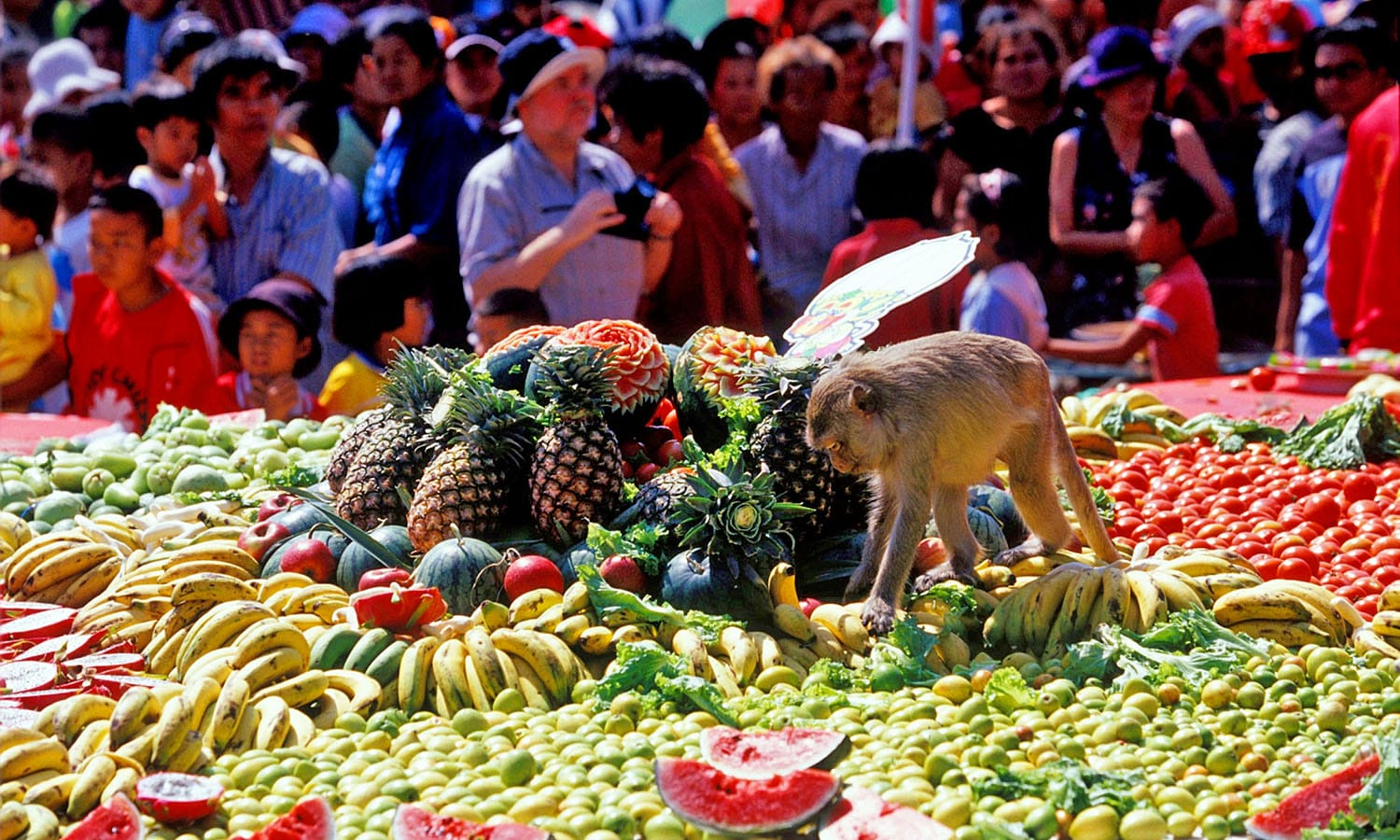
Bright fruits are stacked in pyramids. Vegetables are arranged like banquet decorations. Watermelons, bananas, pineapples, cucumbers, dragon fruit, and sweets are placed in front of ancient temple ruins. Tourists raise their cameras. Locals watch with a mixture of amusement, pride, and nervous familiarity. Then the guests of honor arrive: hundreds of long-tailed macaques, climbing, jumping, grabbing, peeling, fighting, feasting, and turning the city into one of the world’s strangest dining rooms.
This is the Lopburi Monkey Buffet Festival, one of Thailand’s most unusual cultural celebrations and one of the most photographed animal festivals in the world.
On the surface, it looks like pure chaos. Monkeys leap onto tables, steal fruit from each other, climb on statues, snatch food, run across temple stones, and behave exactly as monkeys are expected to behave when given a free buffet. But behind the comedy is a deeper story about culture, tourism, local identity, and the complicated relationship between humans and wild animals.
The festival began in 1989, when local businessman and hotelier Yongyuth Kitwattananusont helped launch the event with support from tourism authorities as a way to thank the macaques and attract visitors to Lopburi. Over time, it grew from a creative tourism idea into an internationally known spectacle.
The logic was simple but brilliant: Lopburi was already famous for its monkeys, especially around the ancient Khmer-style temple Phra Prang Sam Yot. Instead of treating the macaques only as a nuisance, the city turned them into celebrities. The monkeys became part of Lopburi’s brand, and the festival became a symbol of gratitude toward the animals that helped bring tourists, photographers, and global attention to the town.
But like many human-wildlife relationships, the truth is not perfectly cute.
Lopburi’s macaques are beloved, photographed, fed, worshipped by some, feared by others, and increasingly difficult to manage. In recent years, authorities have had to deal with growing monkey-human conflict, including aggressive behavior, food stealing, property damage, and population-control efforts. Reuters reported in 2024 that authorities rounded up and sterilized monkeys after years of problems, reducing the number roaming freely in parts of the city and placing many in captivity.
That makes the Monkey Buffet Festival more fascinating, not less.
It is not just a funny tourist event.
It is a living symbol of the delicate balance between celebration and coexistence, tradition and control, wildlife and urban life.
The City Where Monkeys Became Celebrities
Lopburi is one of Thailand’s oldest cities, located north of Bangkok. It has ancient ruins, Buddhist temples, Khmer architecture, royal history, and a long association with monkeys. Visitors often recognize it by images of macaques sitting on temple walls, crossing streets, climbing buildings, and casually treating the city like their personal playground.
The monkeys most associated with Lopburi are long-tailed macaques, also known as crab-eating macaques. They are intelligent, social, adaptable, and bold. They can live close to humans, learn quickly, and exploit urban environments with impressive confidence.
In Lopburi, they are not hidden in forests. They are part of daily street life.
They sit on power lines. They climb shopfronts. They raid food stalls. They pose on ruins. They jump onto vehicles. They inspect bags. They appear in tourist photos. They behave like both mascots and mischief-makers.
That dual identity is what makes them so powerful in the city’s imagination.
To tourists, they are charming and exotic.
To many locals, they are familiar and culturally important.
To shopkeepers and residents dealing with daily damage, they can be exhausting.
To the city’s economy, they are a major attraction.
Lopburi did not become famous only because monkeys exist there. It became famous because the city embraced them as part of its identity. The Monkey Buffet Festival is the clearest expression of that embrace.
It is the day when the city says, with fruit and spectacle: these monkeys are not just animals living among us.
They are part of who we are.
What Happens During the Monkey Buffet Festival?
The festival usually takes place in late November, often around the last Sunday of the month. Tourism listings for the 2025 event placed it on 29 November 2025, describing it as the Lopburi Monkey Festival or Lopburi Monkey Banquet.
During the celebration, large quantities of fruit, vegetables, and sweets are arranged for the macaques. Tables may be placed near temples or important local sites. Colorful displays are prepared not only to feed the monkeys but to create a visual feast for photographers and visitors.
Then the macaques take over.
They do not politely line up.
They do not wait for a blessing.
They do not follow table manners.
They climb onto the buffet, grab what they want, leap away, return, fight, share, steal, and inspect everything with chaotic curiosity. Bananas vanish quickly. Watermelons are attacked. Pineapples are dragged. Sweets attract attention. The tables become a blur of tails, hands, teeth, and fruit juice.
For tourists, this is the magic of the festival. It is unpredictable. It is funny. It is wild but organized enough to be watchable. The monkeys behave like monkeys, and that is exactly why people travel to see it.
The event also often includes cultural performances, decorations, ceremonies, and tourism activities. The buffet is the main attraction, but the festival is also a way to bring visitors into the broader Lopburi experience.
A normal zoo visit separates humans and animals.
The Lopburi festival collapses that distance.
You are not watching monkeys behind glass.
You are watching an entire city negotiate space with them.
Why Are Monkeys Honored in Lopburi?
The festival is often described as an act of gratitude.
In local culture and tourism storytelling, the macaques are associated with good fortune, religious symbolism, and the city’s identity. Some explanations connect the monkeys to Hanuman, the monkey warrior figure from the Hindu epic Ramayana, which has strong cultural influence across Southeast Asia. Travel and tourism sources often describe the macaques as linked to sacred or mythological ideas, helping explain why they are treated with unusual tolerance and symbolic respect.
At the same time, the practical reason is also clear: monkeys bring tourists.
People visit Lopburi specifically to see them. They take photos, book tours, eat at local restaurants, buy goods, and share images online. The monkeys are part of the city’s economy.
The Monkey Buffet Festival turns that relationship into public theater. Instead of hiding the fact that the animals help the town financially, the city celebrates it openly. The feast says: these monkeys have brought attention and income, so they deserve thanks.
That makes the festival both spiritual and commercial.
It is a cultural offering.
It is also a tourism strategy.
That combination may sound strange, but many festivals work this way. Religious symbolism, local identity, entertainment, and economic benefit often overlap. In Lopburi, the overlap happens with monkeys eating fruit from giant tables.
A Festival Built for Photographs
The Monkey Buffet Festival is almost impossibly photogenic.
Ancient ruins provide dramatic backdrops. The fruit is colorful. The monkeys are expressive. The action is fast. Every few seconds, something funny happens: a monkey sits inside a fruit pile, another steals food, another stares directly into a camera, another leaps across a table, another runs off with something bigger than its own head.
That visual energy helped the festival become globally famous.
Before social media, newspapers, travel magazines, and photographers spread images of Lopburi’s monkeys. Now Instagram, TikTok, Facebook, YouTube, and travel blogs do the job even faster. A single clip of monkeys raiding a buffet can travel around the world in minutes.
This is one reason the festival remains so popular. It is not only a local event; it is content-friendly.
Tourists want experiences that feel unique and shareable. The Monkey Buffet Festival gives them exactly that: an image that instantly explains itself.
Monkeys.
Fruit.
Temple.
Chaos.
Thailand.
No long caption needed.
The Economic Power of the Macaques
For Lopburi, monkeys are not only wildlife. They are economic assets.
The festival brings tourists to the city, supporting hotels, restaurants, transportation, guides, vendors, and local businesses. Visitors may come for the monkeys but stay to explore the historic ruins, temples, markets, and local culture.
This is why the monkeys became “celebrities.” They gave Lopburi a unique identity in a crowded tourism market. Many cities have temples. Many cities have history. Fewer cities have a world-famous monkey banquet.
Tourism thrives on distinctiveness. Lopburi’s macaques gave the city a story no other place could easily copy.
That is the genius of the festival. It transformed a local reality into a global attraction.
But economic dependence on wildlife can be complicated. When animals become tourist symbols, communities may tolerate behaviors that would otherwise be unacceptable. Feeding can change animal habits. Crowds can increase stress. Easy food can support population growth. Monkeys can become bolder around humans.
The same animals that bring tourism can also create daily problems.
That is the tension Lopburi continues to face.
The Other Side: Monkey Mayhem in Lopburi
The festival’s cheerful image does not tell the whole story.
In recent years, Lopburi has faced serious problems with its macaque population. After tourism patterns changed during the COVID-19 pandemic, monkeys that had depended partly on food from visitors became more aggressive in searching for food. Residents reported monkeys stealing items, raiding homes, damaging property, and fighting in the streets.
In 2024, Thai authorities launched stronger measures to control the situation. AP reported that officials planned to round up around 2,500 monkeys and place them in large enclosures while keeping a smaller population roaming under control. The campaign initially focused on aggressive alpha males after incidents involving injuries and public concern.
Reuters later reported that authorities had captured and sterilized many monkeys, with the population reduced from around 3,000 roaming individuals to about 1,600 in captivity for neutering and management. The clampdown brought relief to some residents and businesses but also raised concerns among animal-rights groups about conditions in captivity and the future of Lopburi’s monkey identity.
This is where the story becomes more complex.
The festival presents harmony.
Daily life sometimes reveals conflict.
Both are true.
Lopburi’s relationship with macaques is not a simple fairy tale. It is a real urban wildlife challenge involving culture, economy, public safety, animal welfare, and long-term population management.
Is the Festival Good for the Monkeys?
This is a question worth asking carefully.
On one hand, the festival honors the macaques and recognizes their cultural and economic importance. It celebrates them rather than treating them only as pests. It creates awareness and supports tourism tied to wildlife appreciation.
On the other hand, feeding wild animals large amounts of fruit and sweets can affect behavior and health. It may reinforce dependence on human food. It may encourage monkeys to approach people aggressively. It may contribute to the idea that macaques are entertainment props rather than wild animals with complex needs.
The best version of the festival would balance celebration with responsible wildlife management.
That means controlled feeding, appropriate foods, veterinary awareness, population control through humane methods, public education, tourist safety, and habitat planning. It also means being honest about the tension between the monkeys as cultural icons and the monkeys as real animals living under urban pressure.
A festival can honor wildlife.
But respect must go beyond one day of fruit.
It must include long-term care.
Human-Wildlife Coexistence Is Never Simple
The story of Lopburi is often described as humans and monkeys living in harmony. That is partly true, but harmony does not mean the absence of conflict.
True coexistence is messy.
It involves rules, boundaries, adaptation, patience, damage control, compassion, and sometimes difficult decisions. In Lopburi, people have learned to live around macaques, but they also face real costs. Monkeys can injure people, steal food, damage buildings, and affect business. At the same time, harsh removal or poor captivity conditions can harm the animals and damage the city’s identity.
This is the challenge many cities face as wildlife adapts to urban spaces. Monkeys in Thailand, boars in Europe, coyotes in North America, foxes in London, leopards near Indian cities, and macaques in many Asian towns all show that wildlife does not always stay where humans expect it to.
Animals follow food, shelter, opportunity, and survival.
Cities create all four.
Lopburi’s Monkey Buffet Festival is therefore more than a quirky event. It is a case study in urban wildlife coexistence.
It asks: how can a city benefit from animals without letting the relationship become harmful to both sides?
Why Tourists Love the Festival
Tourists love the festival because it feels spontaneous even though it is planned.
Most festivals are human performances. People dance, sing, parade, dress up, cook, worship, compete, or celebrate. At the Monkey Buffet Festival, the main performers are animals who do not care about the script.
That unpredictability is irresistible.
A monkey may politely eat fruit.
Another may start a fight.
Another may climb onto a visitor.
Another may steal a decoration.
Another may sit like a tiny king above a pile of bananas.
No organizer can fully choreograph that.
For travelers, the festival offers a rare combination: cultural tradition, animal behavior, historical setting, comedy, and spectacle. It is not a polished theme-park experience. It feels alive.
That is why people remember it.
A person may forget another temple tour.
They will not forget watching macaques raid a fruit banquet in front of ancient ruins.
The Role of Phra Prang Sam Yot
Much of Lopburi’s monkey fame centers around Phra Prang Sam Yot, a historic temple with three distinctive prangs, or towers. The site has become closely associated with the city’s macaques, who often gather around the temple and nearby streets.
The combination of ancient architecture and mischievous monkeys creates a powerful visual identity. The temple gives the animals a dramatic stage. The monkeys give the ruins movement and personality.
This is part of what makes Lopburi different from ordinary wildlife tourism. Visitors are not going into a forest to find animals. They are seeing animals occupy a human historical space. The macaques have become part of the temple’s living atmosphere.
There is beauty in that.
There is also risk, because large monkey populations can affect heritage sites, public safety, and visitor experience. Managing the area requires balancing conservation of architecture, wildlife behavior, tourism access, and local life.
Again, Lopburi’s charm comes from a difficult balance.
The festival is joyful because the balance exists.
It is controversial because the balance is fragile.
The Symbolism of Feeding
Feeding animals can carry deep symbolic meaning.
In many cultures, giving food is an act of gratitude, blessing, compassion, or respect. Feeding temple animals, sacred animals, or animals associated with good luck can become part of religious or cultural life.
In Lopburi, the monkey buffet expresses thanks. The macaques are not just pests to be controlled or attractions to be monetized. The banquet recognizes them as beings that matter to the city’s identity.
This is why the festival has emotional power. It reverses the usual human-animal hierarchy. For one day, humans become hosts and monkeys become honored guests.
That reversal is funny, but also meaningful.
The monkeys do not need tickets.
They do not need permission.
They own the buffet.
For a few hours, the city’s famous troublemakers become royalty.
The Festival as Soft Power
The Monkey Buffet Festival also functions as soft power for Thailand.
Thailand is already known globally for beaches, temples, food, hospitality, festivals, and cultural richness. Lopburi’s monkey festival adds another layer: playful, unusual, memorable, and highly shareable.
International media often covers the event because it feels unique. This gives Thailand free cultural visibility. People who may not know much about Lopburi suddenly learn about the city. Some may add it to travel plans. Others may become curious about Thai festivals more broadly.
This is how local traditions become global symbols.
A monkey feast in one city becomes part of Thailand’s international image.
Of course, that also creates pressure. Once a festival becomes famous, it must satisfy tourists while still serving local meaning. If it becomes too commercial, locals may feel it loses authenticity. If it ignores animal welfare, critics may push back. If monkey conflict grows too severe, the city’s identity becomes harder to manage.
Soft power works best when the reality behind the image remains healthy.
A Funny Festival With Serious Lessons
It is easy to laugh at the Monkey Buffet Festival.
And honestly, people should laugh. It is funny. Monkeys eating fruit from decorated tables is objectively delightful.
But the festival also carries serious lessons.
It teaches that animals can shape a city’s identity.
It shows how tourism can grow from local ecology.
It reveals how feeding wildlife can create both connection and dependency.
It demonstrates that cultural respect for animals does not automatically solve management problems.
It reminds us that humans are not separate from nature, even in cities.
And it proves that coexistence is not a single event, but an ongoing negotiation.
The festival is charming because it celebrates connection.
The city’s recent monkey-control efforts are sobering because connection without boundaries can become conflict.
That is the full story.
Not just monkeys eating bananas.
A city trying to live with the animals that made it famous.
The Future of the Monkey Buffet Festival
The future of the festival will likely depend on how Lopburi manages its macaque population.
If authorities can maintain a healthier balance—protecting residents, ensuring animal welfare, controlling population growth, and preserving the city’s tourism appeal—the festival can continue as a joyful symbol of coexistence.
If conflict grows again, the event may face harder questions.
Should the festival reduce feeding?
Should foods be healthier?
Should tourist access be better controlled?
Should only managed monkey groups participate?
Should the event include more education about wildlife behavior?
Should revenues support humane population control and habitat care?
These questions do not make the festival less valuable. They make it more mature.
A modern wildlife festival cannot only entertain. It must also educate and protect.
Lopburi has the chance to show the world how a famous animal festival can evolve responsibly.
Why Lopburi Still Captures the Imagination
Despite the challenges, Lopburi remains unforgettable because it feels like a place where the boundary between human city and animal kingdom is unusually thin.
In most cities, wildlife appears at the edges. In Lopburi, macaques are central characters.
They are part of the streets.
Part of the temples.
Part of the economy.
Part of the jokes.
Part of the problems.
Part of the pride.
The Monkey Buffet Festival captures that identity in one spectacular image: humans laying out a banquet for monkeys beneath ancient ruins.
It is absurd.
It is beautiful.
It is complicated.
It is exactly the kind of story the world loves because it reminds us that culture is not always neat. Sometimes it is loud, sticky, fruit-covered, and climbing across a temple wall.
Final Verdict
The Lopburi Monkey Buffet Festival is one of Thailand’s most unusual and memorable cultural events. Every year, the city prepares a lavish feast of fruits, vegetables, and sweets for its famous long-tailed macaques, transforming local wildlife into honored guests and global celebrities.
The festival began in 1989 as a creative way to thank the monkeys and promote tourism, and it has since become a world-famous symbol of Lopburi’s identity. Tourists travel to watch the macaques climb across banquet tables, raid fruit displays, and turn an ordinary meal into a wild public performance.
But the festival also tells a more complex story. Lopburi’s monkeys are loved, celebrated, and economically important, but they have also caused real conflict for residents. Recent population-control campaigns, including capture and sterilization efforts, show that coexistence requires more than symbolism.
That is what makes the festival so fascinating.
It is not just a funny monkey party.
It is a living example of how culture, tourism, wildlife, and urban life can become deeply tangled.
Lopburi honors its monkeys because they helped make the city famous.
The challenge now is making sure both the people and the monkeys can continue to thrive.