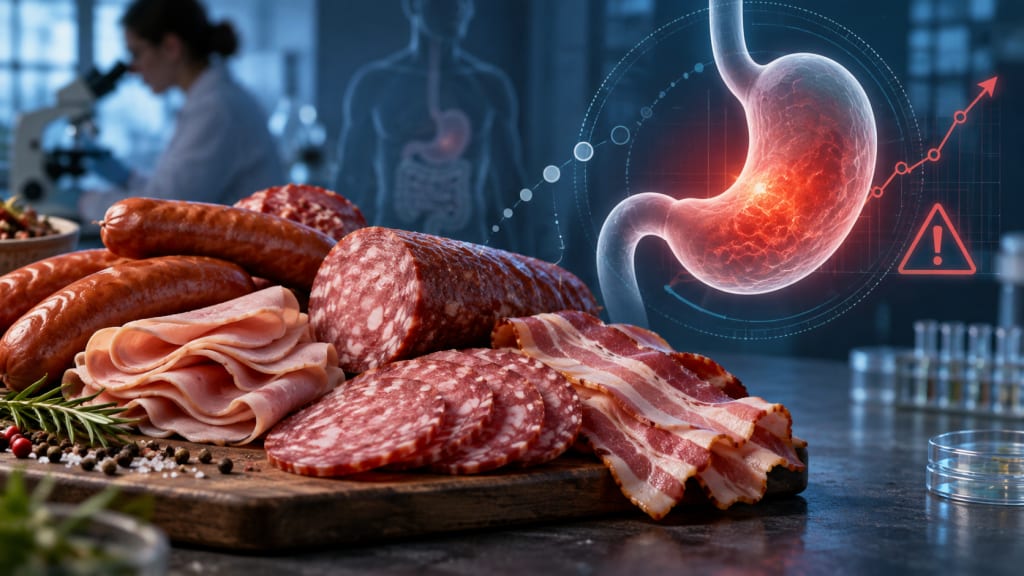
Massive 14-Year Study Links Processed Meat to Higher Stomach Cancer Risk
Bacon, ham, salami and sausages have long been under scrutiny because of their connection with colorectal cancer.
Now one of Europe's largest long-term nutrition studies has added concerning evidence about two other cancers.
Researchers following more than 450,000 people for an average of 14.1 years found that higher processed meat consumption was associated with increased risks of both gastric cancer and esophageal adenocarcinoma.
For every additional 30 grams of processed meat eaten per day, the study found:
- a 9% higher relative risk of gastric cancer;
- a 13% higher relative risk of esophageal adenocarcinoma.
The research, published in the International Journal of Cancer in 2026, analyzed participants in the long-running European Prospective Investigation into Cancer and Nutrition, better known as EPIC.
But there is an important distinction that dramatic headlines can easily miss.
The study found a prospective association between processed meat intake and cancer risk. It did not prove that eating a particular sausage directly caused an individual person's cancer.
Nor does a 9% increase mean that 9 out of every 100 processed-meat eaters will develop stomach cancer.
The percentages describe relative risk, not absolute probability.
Still, the results are important because they add to an already substantial body of evidence suggesting that processed meats may affect cancer risk beyond the colon.
And one particularly interesting result stood out:
Unprocessed red meat was not significantly associated with either gastric cancer or esophageal adenocarcinoma in this study.
The signal was concentrated much more clearly around processed meat.
What Did the New Study Actually Examine?
The research was led by Catalina Bonet and colleagues using data from the EPIC cohort, one of the world's largest prospective studies examining diet, lifestyle and chronic disease.
The final analysis included:
450,112 adults
including:
- 131,426 men;
- 318,686 women.
Participants were followed for an average of 14.1 years.
During that period, researchers identified:
- 876 gastric cancers;
- 215 esophageal adenocarcinomas.
Among the gastric cancers:
- 233 occurred in the gastric cardia, the upper part of the stomach nearest the esophagus;
- 329 were non-cardia cancers;
- the remaining cases had overlapping or uncertain anatomical location.
Histologically:
- 624 were intestinal-type gastric cancers;
- 208 were diffuse-type gastric cancers.
The researchers then compared cancer incidence with reported consumption of:
- red meat;
- processed meat;
- white meat.
The Central Finding: 30 Grams More Processed Meat Was Linked to Higher Risk
The most widely reported result concerned an additional 30 grams per day of processed meat.
After statistical adjustment, researchers calculated a hazard ratio of 1.09 for gastric cancer.
That translates to approximately a 9% higher relative risk for every 30 g/day increase.
For esophageal adenocarcinoma, the hazard ratio was 1.13, corresponding to an estimated 13% higher relative risk.
The gastric cancer result had a 95% confidence interval of 1.02 to 1.17.
For esophageal adenocarcinoma, the confidence interval was 1.00 to 1.27, meaning that estimate was statistically much less precise and sat right at the conventional boundary of statistical significance.
So the gastric finding is more statistically robust than a headline containing two simple percentages might suggest.
What Does 30 Grams of Processed Meat Look Like?
Thirty grams is roughly one ounce.
Depending on the product, that might resemble:
- a small amount of sausage;
- a modest serving of sliced ham;
- several thin slices of cured meat;
- roughly one to a few bacon slices depending on thickness and cooking.
It is better not to translate 30 grams into one universal number of bacon slices because products vary substantially in weight.
The study also modeled consumption statistically.
It did not experimentally assign people exactly 30 grams of bacon every day for 14 years.
The correct interpretation is:
People whose usual processed-meat intake was higher tended to have higher cancer risk, with the statistical model estimating the change per additional 30 grams per day.
 Imrul
Imrul
The Highest Consumers Showed Larger Differences
The researchers did not only analyze intake as a continuous 30-gram increment.
They also divided participants into consumption quartiles.
Compared with the lowest processed-meat group, people in the third and fourth quartiles had substantially higher gastric cancer risk.
For gastric cancer:
- third quartile: 38% higher relative risk;
- highest quartile: 46% higher relative risk.
For esophageal adenocarcinoma:
- third quartile: approximately 70% higher relative risk;
- highest quartile: more than twice the relative risk of the lowest group.
The hazard ratio for the highest versus lowest processed-meat quartile for esophageal adenocarcinoma was 2.22, although the confidence interval was wide because only 215 cases occurred.
That dose-pattern strengthens the case that the association deserves further investigation.
But observational data still cannot establish causality by itself.
What Counts as Processed Meat?
Processed meat is not simply "meat that came in packaging."
The World Cancer Research Fund defines processed meat as meat altered through methods such as:
- curing;
- salting;
- smoking;
- fermentation;
- other preservation processes.
Common examples include:
- bacon;
- ham;
- salami;
- pepperoni;
- chorizo;
- hot dogs;
- frankfurters;
- some sausages;
- corned beef;
- beef jerky;
- many deli and luncheon meats.
A fresh pork chop is therefore red meat but not necessarily processed meat.
A cured pork product such as bacon is both red meat and processed meat.
That distinction becomes important when interpreting the new study.
The Study Did Not Find the Same Association With Unprocessed Red Meat
One of the more interesting findings was what researchers didn't find.
A 40-gram-per-day increase in red meat intake was not associated with higher overall gastric cancer risk.
Nor was it significantly associated with esophageal adenocarcinoma.
For gastric cancer, the adjusted hazard ratio per 40 g/day was approximately 0.99 before mutual adjustment and 0.98 when the different meat categories were considered simultaneously.
For esophageal adenocarcinoma, the corresponding estimates also showed no significant positive relationship.
The authors summarized the result directly:
No association was observed between red meat intake and either overall gastric cancer or its analyzed subtypes in this cohort.
That does not prove red meat has no health risks.
There is already strong evidence linking high red meat consumption with colorectal cancer risk, and the World Cancer Research Fund recommends limiting intake.
It simply means this specific study did not detect a meaningful association between unprocessed red meat and these two upper gastrointestinal cancers.
Processed Meat Was Associated With Intestinal-Type Gastric Cancer
The researchers also divided stomach cancers according to microscopic appearance.
For intestinal-type gastric cancer, every 30 g/day increase in processed meat intake was associated with approximately an 11% higher relative risk.
Participants in the highest intake quartile had about a 41% higher risk than those in the lowest quartile.
The results for diffuse-type gastric cancer were less straightforward.
The highest quartile had a significantly elevated risk compared with the lowest quartile, but the continuous 30 g/day estimate had a confidence interval that included no effect.
This is another reason the results should not be compressed into the claim that processed meat affects every gastric cancer subtype equally.
Cardia and Non-Cardia Stomach Cancer Are Not Identical Diseases
The stomach can be divided broadly into:
Cardia: the upper stomach where it joins the esophagus.
Non-cardia: the remaining lower and middle portions.
The two regions have partly different risk patterns.
For example, excess body weight and gastroesophageal reflux are especially relevant to cancers near the gastric cardia, whereas chronic Helicobacter pylori infection is a major driver of non-cardia stomach cancer.
In the EPIC study, point estimates for processed meat tended to be higher for both cardia and non-cardia cancers among higher consumers, but several subtype confidence intervals crossed the null value.
The authors therefore cautioned against overstating the site-specific findings.
The clearest result remained the association with gastric cancer overall.
An Unexpected White Meat Finding Also Appeared
The research contained one result that received much less attention.
White meat consumption was not associated with overall gastric cancer risk across the entire cohort.
However, a 20 g/day increase in white meat was associated with approximately 12% higher risk of non-cardia gastric cancer.
The association appeared especially strong among women, where the model estimated a 20% increase per additional 20 g/day.
The authors treated this finding cautiously.
Previous research on white meat and gastric cancer has been inconsistent, and they explicitly concluded that the result requires further validation.
It would therefore be premature to interpret this study as evidence that chicken broadly increases stomach cancer risk.
What About Men and Women?
The researchers also analyzed participants by sex.
Among men, processed meat was the only meat category clearly associated with overall gastric cancer.
Men in the highest processed-meat quartile had a 56% higher relative risk than those in the lowest quartile.
Among women, the highest processed-meat group had approximately 50% higher gastric cancer risk, while white meat also showed a positive association.
For esophageal adenocarcinoma, the association with processed meat was clearer in men.
But only 46 esophageal adenocarcinoma cases occurred among women, making estimates for women particularly uncertain.
This is an example of why subgroup findings need more caution than headline statistics.
Why Might Processed Meat Increase Cancer Risk?
The study cannot prove the biological mechanism.
But several plausible pathways are already known.
Researchers highlighted:
- N-nitroso compounds;
- heme iron;
- nitrites and nitrates;
- salt;
- high-temperature cooking products;
- oxidative stress;
- DNA damage.
These mechanisms have also been investigated extensively in relation to colorectal cancer.
Nitrates, Nitrites and N-Nitroso Compounds
Some processed meats use nitrates or nitrites in curing.
These compounds can contribute under certain biological conditions to the formation of N-nitroso compounds, including nitrosamines.
Some N-nitroso compounds are carcinogenic.
The study authors note that heme iron can also promote endogenous nitrosation, potentially increasing formation of these compounds inside the digestive tract.
The resulting chemistry may contribute to:
- oxidative stress;
- DNA damage;
- formation of DNA adducts;
- biological changes involved in carcinogenesis.
The World Cancer Research Fund similarly identifies N-nitroso compounds as one plausible mechanism connecting processed meat to cancer.
Heme Iron May Also Play a Role
Heme iron is abundant in red and processed meats.
It gives meat much of its characteristic color and provides a readily absorbed form of dietary iron.
Nutritionally, iron is essential.
But high concentrations of heme iron in the digestive tract can also promote chemical reactions capable of generating potentially damaging compounds.
The researchers specifically cite heme iron as one candidate mechanism for the observed upper gastrointestinal cancer associations.
This does not mean dietary iron itself should be considered a poison.
Cancer biology depends on dose, chemical form, surrounding diet and many interacting factors.
Salt Could Matter Particularly in the Stomach
Processed meats can contain large quantities of salt because salting has historically been used to preserve meat.
High salt exposure can damage or irritate the gastric lining and promote inflammation.
The study authors therefore identified salt as another potential contributor to the association between processed meat and stomach cancer.
The National Cancer Institute already lists diets high in salted, smoked or poorly preserved foods among dietary patterns associated with stomach cancer.
The American Cancer Society similarly notes that frequent consumption of processed, grilled or charbroiled meats appears to increase non-cardia stomach cancer risk.
High-Temperature Cooking Creates Additional Compounds
Cooking meat at very high temperatures can produce chemicals including:
- heterocyclic amines;
- polycyclic aromatic hydrocarbons.
These compounds can form when meat is:
- grilled;
- charred;
- barbecued;
- fried at high temperatures.
The EPIC researchers identified cooking practices as another plausible factor influencing gastric and esophageal cancer risk.
The World Cancer Research Fund also notes that high-temperature cooking can generate heterocyclic amines and polycyclic aromatic hydrocarbons with carcinogenic potential in experimental research.
But the EPIC study did not establish that cooking temperature was the specific reason processed meat consumers had higher risk.
Several mechanisms may operate together.
What About Helicobacter pylori?
One of the biggest limitations of the study concerns a bacterium called Helicobacter pylori.
Chronic H. pylori infection is one of the most important known causes of gastric cancer.
The International Agency for Research on Cancer has classified H. pylori as a human carcinogen since 1994.
The new EPIC analysis did not have individual H. pylori infection data available for adjustment.
The authors explicitly identify this as a potential confounding factor.
That matters because if processed-meat consumption somehow differed systematically between people with and without H. pylori, part of the observed association could theoretically reflect that difference.
The authors note that prior large studies found adjustment for H. pylori did not materially change the relationship between meat intake and gastric cancer, but the missing infection data remains an important limitation of this analysis.
Interestingly, H. pylori Behaves Differently With Esophageal Adenocarcinoma
Cancer epidemiology is rarely simple.
Although H. pylori strongly increases the risk of certain stomach cancers, infection has been associated in several studies with lower risk of esophageal adenocarcinoma.
One proposed explanation is that long-standing gastric changes may reduce acid production and therefore decrease acid reflux into the esophagus.
The precise mechanism remains uncertain.
This illustrates why studying diet and upper gastrointestinal cancers requires careful adjustment for multiple interacting biological factors.
 Imrul
Imrul
Processed Meat Is Already Classified as Carcinogenic to Humans
The new research does not arrive in isolation.
In 2015, the International Agency for Research on Cancer classified consumption of processed meat as carcinogenic to humans, Group 1.
That classification was based on sufficient evidence that processed meat causes colorectal cancer.
However, the meaning of Group 1 is frequently misunderstood.
Processed meat is in the same evidence category as tobacco and asbestos.
That does not mean eating bacon is as dangerous as smoking cigarettes.
IARC categories describe the strength of evidence that something can cause cancer, not the size of the risk.
IARC specifically notes that processed meat's established causal link is with colorectal cancer.
For stomach cancer, an association had previously been observed, but the evidence was considered less conclusive.
The 2026 EPIC findings add another large prospective study to that developing evidence base.
This Study Does Not Suddenly Establish Processed Meat as a Proven Cause of Stomach Cancer
This distinction is essential.
The authors themselves use the language of association.
The study is observational.
Participants were not randomly assigned to:
"eat processed meat every day"
versus:
"never eat processed meat."
Such a decades-long randomized cancer trial would be extremely difficult and ethically problematic.
Instead, researchers observed existing diets and followed outcomes.
That means hidden differences between high and low processed-meat consumers can influence the results.
Researchers adjusted statistically for several important factors, including:
- age;
- study center;
- sex;
- total energy intake;
- education;
- smoking;
- body mass index;
- alcohol consumption.
They also adjusted the different categories of meat for one another.
Those adjustments make the results more informative.
They cannot eliminate every possible confounder.
Diet Was Measured Primarily at the Beginning
Another limitation was dietary measurement.
Food intake was assessed through food-frequency questionnaires.
People can misremember what they eat.
Portion sizes are difficult to estimate.
Dietary questionnaires can therefore contain substantial measurement error.
The researchers acknowledge this directly.
Furthermore, diet was assessed at baseline.
A participant who reported eating bacon frequently at enrollment might have dramatically changed their diet five years later.
Yet the analysis largely assumes that baseline intake represents long-term dietary behavior.
The authors acknowledge that this assumption could dilute or distort the true associations.
The Long Follow-Up Is Also a Major Strength
The same 14-year duration that creates challenges around changing diets provides an important advantage.
Cancer develops over many years.
A short study can accidentally capture people who changed their diet because an undiagnosed disease was already developing.
Following participants prospectively for more than a decade helps reduce some forms of reverse causation.
The researchers also repeated analyses after excluding gastric cancers diagnosed within the first two years.
The main findings remained broadly consistent.
The large sample size and prospective design are among the study's major strengths.
What Does a 9% Increase in Risk Actually Mean?
Relative-risk statistics can sound more frightening than they are.
Suppose, purely as an illustration, that a person's baseline risk of a disease were 1%.
A 9% relative increase would not raise the risk to 10%.
It would raise it from 1% to approximately 1.09%.
If baseline risk were 5%, a 9% relative increase would raise it to approximately 5.45%.
The actual absolute risk of stomach cancer varies considerably according to:
- age;
- sex;
- geography;
- H. pylori infection;
- genetics;
- smoking;
- obesity;
- other medical factors.
So the 9% figure cannot be converted into one universal individual probability.
The Number of Cancer Cases Was Small Compared With the Size of the Cohort
Among 450,112 participants over approximately 14 years, researchers identified 876 gastric cancers and 215 esophageal adenocarcinomas.
That does not make the associations unimportant.
Cancer is relatively uncommon compared with everyday health outcomes, and large cohorts are precisely what scientists need to detect moderate differences in risk.
But it does illustrate why saying:
"Processed meat gives you stomach cancer"
would be inaccurate.
Most participants—even among higher-intake groups—did not develop gastric cancer during follow-up.
Cancer risk is probabilistic.
What Is Gastric Cancer?
Gastric cancer is another term for stomach cancer.
Most stomach cancers are adenocarcinomas arising from gland-forming cells in the stomach lining.
Risk varies substantially around the world.
Established or suspected risk factors include:
- chronic H. pylori infection;
- older age;
- male sex;
- tobacco use;
- certain inherited syndromes;
- excess body weight for some gastric sites;
- diets high in heavily salted or preserved foods.
Diet is therefore only one piece of a much larger risk profile.
What Is Esophageal Adenocarcinoma?
Esophageal cancer has two major histological forms:
- squamous cell carcinoma;
- adenocarcinoma.
The new EPIC research specifically examined esophageal adenocarcinoma, or EAC.
EAC often develops in the lower portion of the esophagus near the stomach.
One of its strongest established risk factors is chronic gastroesophageal reflux disease, especially long-lasting and severe reflux.
Barrett's esophagus and excess body weight are also important factors.
The processed-meat finding therefore adds a possible dietary component to a disease already known to have several major non-dietary drivers.
Why the 13% Esophageal Result Needs Extra Caution
The study identified only 215 cases of esophageal adenocarcinoma.
That is far fewer than the 876 gastric cancers.
As a result, statistical estimates were less precise.
The hazard ratio of 1.13 per additional 30 g/day of processed meat had a 95% confidence interval running from 1.00 to 1.27.
In other words, the result sits at the edge of conventional statistical significance.
The quartile analysis did show a stronger dose pattern, particularly among the highest consumers, which supports taking the association seriously.
But describing the 13% number as incontrovertible proof would go beyond the data.
Previous Research Has Been Inconsistent
This is another reason the new study matters.
Earlier studies of processed meat and gastric cancer have not all produced the same result.
The authors cite an umbrella review of prospective evidence that found approximately a 17% higher gastric cancer risk associated with processed meat, but judged the methodological quality of the contributing evidence to be weak.
For esophageal adenocarcinoma, earlier reviews have likewise produced mixed conclusions.
A previous umbrella review described the processed-meat association as suggestive rather than definitive.
The new EPIC analysis strengthens the evidence because of its:
- large population;
- prospective design;
- long follow-up;
- analysis of gastric cancer subtypes.
But it is another piece of evidence, not the final word.
Does This Change Existing Dietary Advice?
Probably less than the headlines suggest.
Cancer-prevention organizations already advise limiting processed meat.
The World Cancer Research Fund recommends eating very little, if any, processed meat because the evidence connecting it with colorectal cancer is already convincing.
The organization recommends that people who eat red meat limit it to about:
350–500 grams cooked weight per week, or roughly three portions.
Processed meat should be consumed much less frequently.
The new gastric and esophageal findings provide an additional reason to take that recommendation seriously.
Does This Mean You Should Never Eat Bacon Again?
Cancer-prevention evidence is usually about long-term dietary patterns, not one breakfast.
Eating bacon once does not suddenly raise your stomach cancer risk by 9%.
The EPIC estimate concerned an additional 30 grams per day in habitual intake.
Daily exposure over years is very different from occasional consumption.
For someone who eats processed meat every morning or at several meals each week, reducing frequency is likely more meaningful than worrying about a single isolated serving.
Healthy Eating Is About Replacement, Not Just Removal
If a person decides to reduce processed meat, the replacement matters.
Removing sausage from breakfast and replacing it with another highly processed, calorie-dense food may not improve the overall diet substantially.
Healthier protein alternatives can include:
- beans;
- lentils;
- chickpeas;
- tofu;
- fish;
- eggs;
- nuts;
- seeds;
- minimally processed poultry.
The World Cancer Research Fund specifically highlights fish, poultry and plant protein sources as alternatives to frequent red and processed meat consumption.
 Imrul
Imrul
Plant Proteins Offer a Particularly Useful Swap
Legumes such as beans, lentils and chickpeas provide:
- protein;
- fiber;
- minerals;
- numerous plant compounds.
Increasing these foods can simultaneously reduce processed-meat intake and increase consumption of foods emphasized in cancer-prevention dietary patterns.
The World Cancer Research Fund recommends making:
- whole grains;
- vegetables;
- fruit;
- beans
a major part of the usual diet.
This illustrates an important principle:
Cancer prevention is rarely about one "bad" food.
Dietary patterns matter.
What If You Already Have Cancer?
People currently undergoing cancer treatment should not radically restrict important protein sources without discussing changes with their healthcare team.
Nutrition needs can be different during treatment.
Some patients struggle to maintain:
- weight;
- muscle mass;
- protein intake;
- appetite.
World Cancer Research Fund guidance notes that meat can still provide protein, iron, zinc and vitamin B12 for people living with cancer and recommends individualized advice when nutritional needs are complicated.
Population-level prevention advice should not replace oncology nutrition guidance for an individual patient.
Processed Meat Is Not the Largest Stomach Cancer Risk Factor for Everyone
The new study should not distract from other major risk factors.
For non-cardia gastric cancer, chronic H. pylori infection remains enormously important.
The NCI identifies H. pylori as a major cause of stomach cancer and notes that treating the infection can reduce risk.
Smoking also increases gastric cancer risk.
So do some inherited syndromes and precancerous stomach conditions.
For an individual with persistent gastrointestinal symptoms, family history or known H. pylori exposure, discussing those factors with a clinician is much more useful than focusing exclusively on bacon.
Cancer Prevention Is Cumulative
Cancer does not usually arise from one isolated exposure.
Risk accumulates through combinations of:
- genetics;
- aging;
- infections;
- smoking;
- body weight;
- alcohol;
- diet;
- environmental exposure;
- chance biological errors.
Reducing processed meat is therefore best understood as one modifiable part of a broader prevention strategy.
Other widely supported recommendations include:
- avoiding tobacco;
- maintaining a healthy weight;
- staying physically active;
- eating more plant foods;
- limiting alcohol;
- participating in appropriate screening.
The World Cancer Research Fund estimates that a substantial share of cancers could be prevented through modifiable lifestyle and environmental changes.
Does “Processed” Mean Ultra-Processed?
Not necessarily.
These terms are often confused.
Processed meat refers specifically to meat altered by processes such as curing, smoking, salting or fermentation.
Ultra-processed food is a much broader food-classification category that can include:
- packaged sweets;
- soft drinks;
- some breads;
- snacks;
- desserts;
- ready-made meals.
A food can be ultra-processed without containing meat.
And meat can be processed through traditional methods without fitting every common definition of ultra-processed food.
The cancer evidence discussed in the EPIC paper concerns processed meat specifically, not every processed food product.
What Should Consumers Take Away From the Research?
The practical takeaway is straightforward.
You do not need to panic about one sausage.
But if processed meat is part of your everyday diet, this study adds another reason to reduce it.
The strongest evidence already links processed meat with colorectal cancer.
The new EPIC results suggest habitual intake may also contribute to risks involving:
- the stomach;
- the lower esophagus.
The science is not equally definitive for every cancer site.
But reducing frequent processed meat is one dietary change supported by several major cancer-prevention organizations even before this latest study.
The Most Important Correction to the Viral Claim
A viral summary might read:
“Massive study proves a direct link between processed meat and stomach cancer.”
That is too strong.
A more accurate version is:
A large prospective European study found that higher processed-meat consumption was associated with a higher incidence of gastric cancer and esophageal adenocarcinoma over approximately 14 years, even after adjustment for several major lifestyle factors.
That wording may sound less dramatic.
But it reflects the evidence much more faithfully.
Prospective cohort studies can identify strong patterns.
They cannot independently prove direct causation.
The Bottom Line
A 2026 study published in the International Journal of Cancer followed 450,112 European adults for an average of 14.1 years and found a significant association between processed meat intake and gastric cancer.
During follow-up, researchers documented:
- 876 gastric cancers;
- 215 esophageal adenocarcinomas.
For each additional 30 grams of processed meat consumed per day, researchers estimated:
- 9% higher relative risk of gastric cancer;
- 13% higher relative risk of esophageal adenocarcinoma.
Higher processed-meat quartiles also showed stronger associations, with the highest consumers experiencing roughly 46% higher gastric cancer risk and more than twice the relative risk of esophageal adenocarcinoma compared with the lowest intake group.
The study did not find a comparable association between unprocessed red meat and these cancers.
That difference puts particular attention on characteristics associated with processed meat, including:
- curing;
- nitrates and nitrites;
- N-nitroso compounds;
- high salt levels;
- heme iron;
- certain high-temperature cooking products.
But the results should not be oversold.
This was an observational study.
Dietary information relied partly on questionnaires.
Food intake could change during the long follow-up.
Researchers lacked individual H. pylori infection data, despite the bacterium being a major cause of gastric cancer.
So the study strengthens the evidence that processed meat may contribute to stomach and esophageal cancer risk.
It does not prove that one slice of bacon directly causes cancer.
Fortunately, the practical response does not require waiting for perfect scientific certainty.
Processed meat is already classified by IARC as carcinogenic to humans because of its established causal relationship with colorectal cancer, while stomach cancer has previously shown an association that was considered less conclusive.
World Cancer Research Fund guidance already recommends eating little, if any, processed meat.
The new EPIC results give that advice another possible reason.
Not because a sausage is poison.
Not because occasional bacon guarantees cancer.
But because when dietary habits are repeated day after day and year after year, small changes in risk can matter across entire populations.
And with more than 450,000 people followed for over a decade, this study suggests that processed meat's cancer story may extend further up the digestive tract than scientists once thought.
Frequently Asked Questions
Did a study really track 450,000 people for processed meat and stomach cancer?
Yes. The 2026 EPIC analysis included 450,112 participants followed for an average of 14.1 years.
Where was the study published?
It was published in the International Journal of Cancer, Volume 159, Issue 5, pages 1176–1187.
Who led the study?
Catalina Bonet was the first author, with Paula Jakszyn listed as corresponding author, alongside an international research team working with EPIC data.
How many stomach cancers occurred during the study?
Researchers identified 876 gastric cancer cases during follow-up.
How many esophageal adenocarcinomas occurred?
There were 215 cases of esophageal adenocarcinoma.
How much processed meat was associated with higher risk?
The statistical model examined each additional 30 grams per day of processed meat intake.
How much did stomach cancer risk increase?
Each additional 30 g/day was associated with approximately a 9% higher relative risk of gastric cancer.
How much did esophageal adenocarcinoma risk increase?
Each additional 30 g/day was associated with approximately a 13% higher relative risk, although this estimate was less precise than the gastric cancer result.
Does a 9% risk increase mean 9% of meat eaters will get stomach cancer?
No. It describes a relative increase compared with baseline risk, not an absolute 9-percentage-point increase.
Is 30 grams equal to one slice of bacon?
Not consistently. Bacon slices vary considerably in size and thickness. Thirty grams is roughly one ounce and could represent more than one typical slice.
What foods count as processed meat?
Examples include bacon, ham, hot dogs, salami, chorizo, corned beef, pepperoni, beef jerky and many sausages or deli meats.
Is fresh beef processed meat?
No. Fresh beef is red meat, but it is not considered processed meat unless it has been cured, smoked, salted, fermented or otherwise processed for preservation or flavor.
Is bacon processed meat?
Yes. Bacon is processed through curing and often smoking.
Are sausages processed meat?
Many are, but classification depends on how they are produced. Cured, smoked or preserved sausages are generally processed meat.
Is processed chicken still processed meat?
Yes, some poultry products can qualify as processed meat if they have been cured, smoked, preserved or contain preservatives such as nitrites.
Did red meat increase stomach cancer risk in the new study?
No significant association was found between unprocessed red meat intake and overall gastric cancer in this EPIC analysis.
Did red meat increase esophageal adenocarcinoma risk?
No significant association with red meat was detected.
Does that mean red meat is completely safe?
No. Other research links high red meat consumption with colorectal cancer, which is why cancer-prevention organizations still recommend limiting it.
Did the study find anything about chicken or white meat?
Yes. White meat was unexpectedly associated with higher non-cardia gastric cancer risk in some analyses, especially among women. Researchers said the finding needs further confirmation.
Does this prove chicken causes stomach cancer?
No. The white-meat finding was unexpected, inconsistent with some earlier research, and requires additional study.
What is gastric cancer?
Gastric cancer is stomach cancer. Most cases are adenocarcinomas arising from cells lining the stomach.
What is esophageal adenocarcinoma?
It is a cancer arising from glandular cells of the esophagus, usually in its lower portion near the stomach.
What is the biggest risk factor for esophageal adenocarcinoma?
Long-standing gastroesophageal reflux disease is one of the strongest established risk factors.
What is a major cause of stomach cancer?
Chronic infection with Helicobacter pylori is one of the major established causes of gastric cancer, especially non-cardia disease.
Did the processed-meat study account for H. pylori infection?
No. Individual H. pylori status was unavailable, and the authors identified this as a limitation.
What factors did researchers adjust for?
Models accounted for factors including age, study center, sex, energy intake, education, smoking, body mass index and alcohol consumption.
Why can't the study prove cause and effect?
It was observational. Researchers observed participants' existing diets rather than randomly assigning processed meat exposure, so unmeasured differences between people could influence the results.
What is a hazard ratio?
A hazard ratio compares the rate at which an outcome occurs between groups or across exposure levels over time.
A hazard ratio of 1.09 indicates approximately a 9% higher relative rate in the model.
Is processed meat classified as a carcinogen?
Yes. IARC classifies processed meat as carcinogenic to humans, Group 1, based on sufficient evidence that it causes colorectal cancer.
Does Group 1 mean processed meat is as dangerous as smoking?
No. IARC categories indicate the strength of evidence that something can cause cancer, not how dangerous the exposure is or how large the risk is.
Has processed meat already been linked to stomach cancer?
Previous studies have found associations, but IARC historically described the stomach cancer evidence as less conclusive than the evidence for colorectal cancer.
Why might processed meat cause cancer?
Proposed mechanisms include formation of N-nitroso compounds, heme-iron-related reactions, high salt exposure, oxidative stress and carcinogens produced during high-temperature cooking.
Are nitrates and nitrites the problem?
They are one plausible part of the mechanism because they can contribute to formation of N-nitroso compounds under certain conditions. They are not the only possible explanation.
Does cooking meat at high temperature matter?
High-temperature grilling, barbecuing or charring can create heterocyclic amines and polycyclic aromatic hydrocarbons, compounds of concern in cancer research.
Does salt matter for stomach cancer?
High consumption of salty and preserved foods has long been associated with stomach cancer risk, and processed meats can contain substantial salt.
Should I completely eliminate processed meat?
World Cancer Research Fund recommends consuming very little, if any, processed meat for cancer prevention.
How much red meat does WCRF recommend?
For people who eat red meat, WCRF recommends keeping intake to roughly 350–500 grams of cooked red meat per week, or around three portions.
What can I eat instead of processed meat?
Options include fish, eggs, beans, lentils, chickpeas, tofu, nuts, seeds and minimally processed poultry.
Is fish a better alternative?
For most people, fish can be a useful protein replacement for processed red meat as part of a balanced diet.
Are beans and lentils good replacements?
Yes. They provide protein and fiber and fit well within dietary patterns emphasizing whole grains, vegetables, fruit and legumes.
If I ate processed meat for years, should I panic?
No. Risk factors alter probability; they do not determine destiny. Reducing future consumption can still be a reasonable health choice.
Can changing my diet guarantee I will avoid stomach cancer?
No. Gastric cancer can arise from many factors, including infection, genetics, smoking and age. Diet can modify risk but cannot guarantee prevention.
Should people be tested for H. pylori?
Testing may be appropriate for people with certain symptoms, histories or risk factors. A healthcare professional can determine whether testing and treatment are appropriate.
Does treating H. pylori lower stomach cancer risk?
NCI notes that treatment of chronic H. pylori infection can reduce the risk of certain gastric cancers.
What symptoms of stomach cancer should not be ignored?
Persistent unexplained symptoms such as difficulty swallowing, unexplained weight loss, persistent abdominal discomfort, vomiting, early fullness or gastrointestinal bleeding warrant medical evaluation. These symptoms have many non-cancer causes, but persistent or concerning changes should not be self-diagnosed through diet alone.
What is the main takeaway from the 450,000-person meat study?
The study strengthens evidence that habitual processed-meat intake is associated with higher gastric cancer risk and may also increase esophageal adenocarcinoma risk.
The signal was not seen for unprocessed red meat in the same analysis.
But the research remains observational.
The scientifically responsible conclusion is not that one slice of bacon causes cancer.
It is that regularly eating more processed meat appears to shift long-term cancer risk in an unfavorable direction—and reducing that exposure is consistent with cancer-prevention advice that already existed before this study.