The History of the AK-47: Patriotism, Genius, and a Lifetime of Regret
In the final months of 2013, inside a hospital room in Russia, 94-year-old Mikhail Kalashnikov lay weak in body but restless in mind. Age had reduced him physically, but it could not silence the question that had followed him for decades. Near the end of his life, he wrote a letter to the head of the Russian Orthodox Church. It was not a technical reflection, nor a political defense. It was a confession of sorts. In that letter, he asked for forgiveness for creating a weapon that had taken so many human lives.
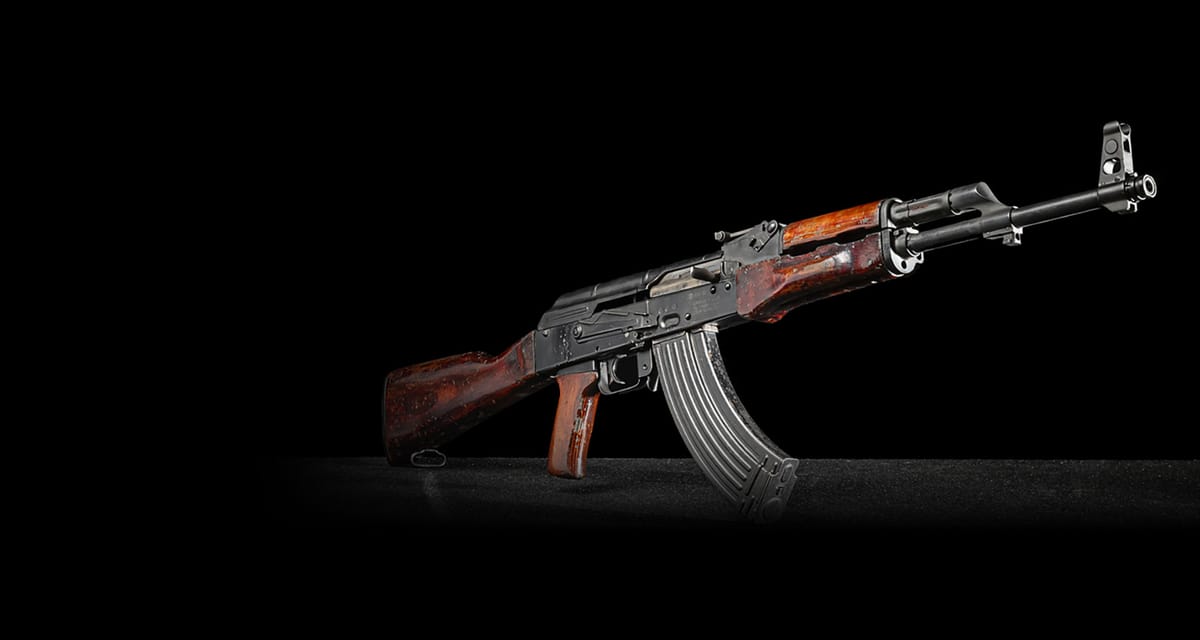
That weapon was the AK-47.
For more than half a century, the rifle had traveled across continents, wars, revolutions, insurgencies, and terrorist networks. It had become one of the most recognizable objects on Earth. To some, it symbolized resistance and liberation. To others, it represented bloodshed, chaos, and death. It appeared in the hands of soldiers, rebels, child fighters, revolutionaries, militants, and criminals. It found its way into deserts, jungles, mountains, cities, and failed states. It became more than a firearm. It became a global symbol of violence.
Yet the story behind the AK-47 is not only a story about war. It is also the story of a young soldier, a wounded patriot, a brilliant designer, and, in the end, an old man haunted by what his creation had become.
The story begins in 1941, during the darkest days of the Second World War. Nazi Germany had launched its brutal invasion of the Soviet Union, and the Eastern Front had become one of the bloodiest theaters in human history. Among the Soviet soldiers fighting back was a young tank commander named Mikhail Kalashnikov. He was not yet an inventor of global significance. He was simply one more young man trying to survive the violence that had engulfed his homeland.
But on the battlefield, he saw something that stayed with him. Soviet troops were often armed with older rifles that could not match the speed and efficiency of the German weapons they faced. In particular, German forces had begun using faster, more effective firearms that gave them a major tactical advantage in close and mid-range combat. Kalashnikov saw firsthand that bravery alone was not enough. A soldier could be courageous, loyal, and determined, and still lose if the weapon in his hands was too slow, too delicate, or too outdated.
Then came the moment that changed everything.
Kalashnikov was seriously wounded in battle. While recovering in a military hospital, he began thinking obsessively about what his country needed. The Soviet Union was fighting for survival, and he believed its soldiers deserved a weapon that could endure the reality of war. It had to work in mud, dust, snow, rain, and filth. It had to be easy to use, simple to repair, cheap to manufacture, and reliable in the hands of an ordinary conscript. In other words, it had to be a weapon built not for perfection in theory, but for survival in real life.
That idea became his mission.
After years of experimentation and refinement, the design that would become the AK-47 emerged in 1947. The name itself was straightforward. “A” stood for “Avtomat,” meaning automatic. “K” stood for Kalashnikov. And “47” marked the year of its final development. There was nothing glamorous in the name, and that was fitting. The weapon’s power came not from elegance, but from simplicity.
That simplicity was its genius.
Unlike many rifles of its era, the AK-47 was designed with comparatively few moving parts. It was not a fragile machine that demanded perfect conditions. It was built to function under abuse. It could be dropped in mud, carried through sand, soaked in water, and still keep firing. It could be disassembled and reassembled with relative ease. It did not require a highly trained professional to operate it effectively. That made it not only a weapon of war, but a weapon of mass usability.
And that was precisely why it changed the world.
To understand why the AK-47 became legendary, it helps to compare it with one of its most famous rivals: the American M16. During the Vietnam War, this difference became painfully clear. The M16 was lighter and more modern in some respects, but early versions had serious reliability issues in harsh environments. Dirt, moisture, and poor maintenance could cause it to jam at exactly the wrong moment. The AK-47, by contrast, became famous for enduring almost anything. A Vietnamese fighter could pull it from mud and fire it. That reputation for indestructibility became part of the weapon’s mythology.
Reliability made the AK-47 feared. Simplicity made it unstoppable.
The Soviet Union quickly realized it had something powerful on its hands. But instead of tightly controlling the rifle, it did something that changed history forever: it spread the design widely. Soviet allies and client states such as China, Poland, Romania, and others were given licenses or access to produce their own versions. The result was a vast flood of Kalashnikov-pattern rifles into the world market. Production expanded across borders, and because the design was relatively easy and inexpensive to manufacture, the price dropped dramatically.
Soon, the AK-47 was everywhere.
It moved through Cold War proxy conflicts and revolutionary wars. It appeared in Africa, Asia, the Middle East, and Latin America. Governments armed their allies with it. Guerrilla groups embraced it. Liberation movements carried it as a badge of rebellion. In some regions, it became so common that it was said a person could obtain one for the price of livestock. Whether exaggerated or not, the point was clear: the AK-47 had become accessible on a scale few weapons ever had.
Its global spread accelerated even more during the Soviet-Afghan War. In one of history’s bitter ironies, the United States and its allies helped arm Afghan mujahideen fighting Soviet forces, and Kalashnikov-style rifles were among the weapons widely used in the conflict. After the collapse of the Soviet Union, arms stockpiles leaked, black markets flourished, and countless AK-pattern rifles spread even further into unstable regions, war zones, insurgencies, and extremist networks.
That is how a rifle designed to defend one homeland became the weapon of every conflict.
Over time, the AK-47 stopped being just a Soviet rifle. It became the rifle of global disorder.
Today, there are believed to be tens of millions of AK-pattern rifles in circulation worldwide. Some estimates put the number close to 100 million when all variants are included. It is one of the most widely distributed firearms in history. Its silhouette is instantly recognizable, even to people who know almost nothing about weapons. It has appeared in propaganda posters, recruitment videos, news footage, revolutionary murals, and militant flags. In Mozambique, the rifle is even featured on the national flag, where it stands as a symbol of independence and resistance. Yet in countless other places, it symbolizes massacre, terror, and civil collapse.
That contradiction sits at the center of the AK-47’s legacy.
For one side, it is the rifle of anti-colonial struggle, self-defense, and liberation. For another, it is the gun of warlords, terrorists, child soldiers, and mass killings. Both truths exist at the same time. History rarely gives us clean symbols. The AK-47 may be one of the clearest examples of that.
And through it all, Mikhail Kalashnikov spent much of his life defending his intentions.
He insisted again and again that he had not created the rifle for criminals or terrorists. He had built it, he said, to protect his country. From his point of view, he was a soldier and a patriot responding to a desperate national crisis. He was not trying to create chaos. He was trying to help the Soviet Union survive a war of annihilation. In that sense, he saw himself not as a merchant of death, but as a defender of his people.
That argument is not without force.
If another engineer had not designed the AK-47, someone else would still have designed another weapon. War does not wait for morality to resolve itself. States arm. Armies adapt. Technology advances. Inventors often work inside systems larger than themselves, and the uses of their creations can far exceed their original intentions. A knife can be used in a kitchen or in a murder. A chemical formula can become medicine or poison. A machine can build or destroy. Technology, in itself, has no conscience.
But human beings do.
And in Kalashnikov’s final years, that seemed to matter more to him than the old arguments ever had.
As the decades passed, he saw what the rifle had become in the modern world. It was no longer only in the hands of disciplined soldiers defending borders. It was in the hands of teenage militants, drug cartels, extremist groups, mercenaries, and militias. It was part of civil wars, ethnic massacres, insurgencies, terrorism, and endless local conflicts. It had become the preferred weapon not just of armies, but of chaos itself.
That weighed on him.
Near the end of his life, the moral burden he had carried for so long appeared to break through his public defenses. Reports about his final years often return to the same image: an old man unable to sleep, wondering how many mothers had lost sons, how many wives had lost husbands, how many lives had been shattered by the weapon that bore his name. For much of his life, he had argued that responsibility belonged to politicians, governments, and those who misused the weapon, not to the man who designed it. But age has a way of stripping away the language people use to protect themselves.
Eventually, what remained was not political logic, but sorrow.
Mikhail Kalashnikov died on December 23, 2013.
By then, history had already sealed his place. He had created one of the most effective and influential rifles ever made. He had changed warfare. He had designed a machine so practical and durable that it outlived empires and crossed every border. He had become both a national hero and a global symbol of destruction.
That is what makes the story of the AK-47 so compelling. It is not just about engineering. It is about the tragic gap between intention and consequence.
Kalashnikov may well have been sincere when he said he wanted to defend his homeland. He may have believed, at the time of creation, that he was serving justice, security, and survival. But history did not preserve his invention inside that original purpose. Once released into the world, the weapon became something larger than its maker. It entered markets, ideologies, revolutions, black networks, wars, and criminal economies. It became a tool in the hands of anyone who wanted a cheap, reliable machine for killing.
And that is perhaps the darkest truth of all: human beings often create things for one reason, only to watch history give them another meaning entirely.
The AK-47 is, in purely mechanical terms, a brilliant design. Its reliability, simplicity, and ruggedness are extraordinary. It solved the problem it was created to solve. It gave soldiers a weapon that could function in the harshest conditions with minimal maintenance. In that sense, it was a masterpiece of practical engineering.
But machines do not remain inside engineering textbooks. They enter human hands.
And once that happens, the story changes.
A perfectly designed machine can still become a perfectly efficient vehicle for human cruelty. A tool meant to defend can become a tool used to terrorize. A patriotic invention can become a global curse. The AK-47 is one of history’s clearest examples of that transformation. It is both a triumph of design and a monument to bloodshed.
That is why the story of Mikhail Kalashnikov lingers long after the technical details fade. In the end, he was not remembered only as an inventor. He was remembered as a man forced to confront the afterlife of his own genius.
And perhaps that leaves us with a question larger than the rifle itself.
Is an inventor responsible for the evil done with what he creates? Or is he simply a patriot, an engineer, or a scientist whose work was later twisted by the world? Is Mikhail Kalashnikov to be condemned as a maker of death, or understood as a man whose creation slipped beyond his control and became part of history’s darkest machinery?
There may never be a simple answer.
But maybe that is exactly why the history of the AK-47 still matters. Because it is not only the story of a weapon. It is the story of the human cost of invention, the burden of unintended consequences, and the tragedy of a man who wanted to protect his country, only to spend his final years asking forgiveness from God.