
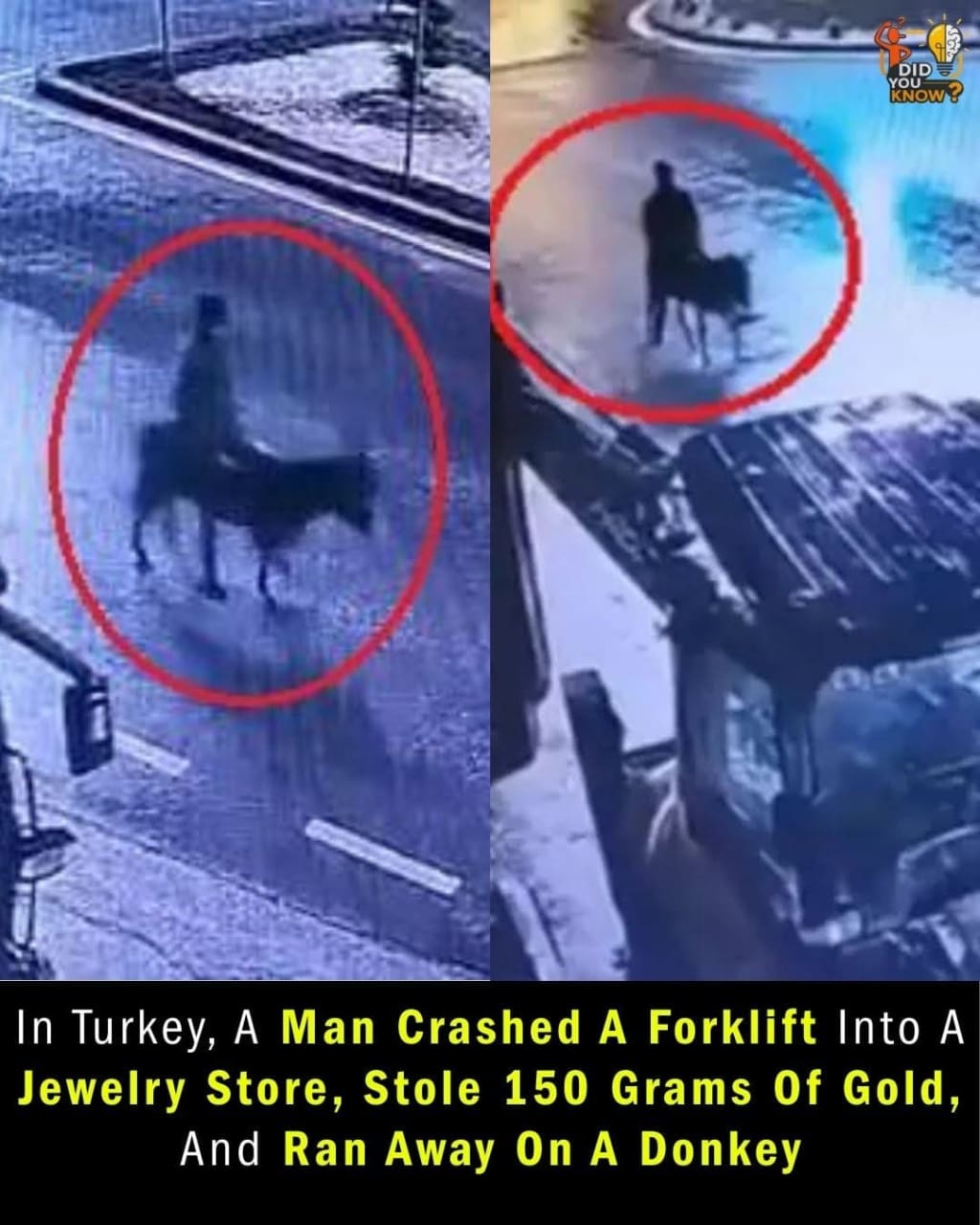
Jewelry Thief Escapes on Donkey After Bizarre Gold Shop Raid
Some crime stories attract attention because of the amount stolen. Some become famous because of the planning, the speed, or the boldness of the act. Others spread because they sound almost too strange to be real.
This was one of those stories.
A jewelry shop robbery in Kayseri, central Turkey, gained global attention after reports said a suspect broke into a shop, grabbed gold jewelry, and escaped in a way nobody expected: on a donkey.
The details were unusual from the beginning. According to reports, the suspect allegedly used a forklift to force open the store’s shutters before entering the jewelry shop. Once inside, valuables were taken quickly, including rings, necklaces, and bracelets. But instead of jumping into a car, motorbike, or waiting getaway vehicle, the suspect reportedly fled the area riding a donkey.
The image was instantly memorable. A gold shop robbery is serious. A break-in involving a forklift is dramatic. But an escape on a donkey turned the incident into the kind of bizarre story people share, discuss, and joke about online within minutes.
Yet behind the viral reaction is a real event with real consequences. A business was targeted. Valuable property was stolen. Police had to investigate. A suspect was arrested. The stolen gold was recovered. For the shop owner, this was not just an amusing headline. It was a frightening and costly security breach.
That is what makes the story worth examining. It is strange enough to go viral, but serious enough to raise important questions about retail security, public awareness, surveillance, and how quickly theft can unfold.
The escape may have been unusual, but the lesson is familiar: in modern retail crime, preparation, speed, and security response matter more than ever.
A Robbery That Sounded Like a Movie Scene
The incident reportedly began in the early hours when the jewelry shop was closed. Instead of using a simple tool to break a window, the suspect allegedly used a forklift to force entry through the shop’s shutters. This made the robbery immediately dramatic because it suggested planning, access to heavy equipment, and a willingness to create visible damage.
Jewelry shops are often protected by shutters, reinforced glass, cameras, alarms, and locked display cases. These protections exist because gold and jewelry are high-value items that can be taken quickly and resold or hidden. A thief targeting such a shop usually wants speed. The goal is often to get inside, grab valuables, and disappear before police or security can respond.
In this case, the use of a forklift made the robbery especially strange. A forklift is not exactly quiet, subtle, or easy to hide. It is large, slow, and highly visible. But it can also create force quickly, especially against doors, shutters, or barriers. That combination made the break-in both unusual and dangerous.
Once inside, the suspect reportedly smashed or overturned a display area and collected gold jewelry from the shop. Reports said around 150 grams of gold jewelry were stolen. That amount may not sound huge compared with million-dollar heists, but gold carries high value in small quantities. Rings, bracelets, and necklaces can be easy to carry, hide, or move.
Then came the detail that turned the story from a local crime report into an international curiosity.
The suspect did not speed away in a luxury car.
He did not vanish on a motorcycle.
He did not run into a waiting van.
He reportedly escaped on a donkey.
That unexpected choice became the defining image of the case.
Why the Donkey Escape Went Viral
The internet loves contrast, and this story had plenty of it.
A jewelry robbery is usually associated with speed, danger, and modern escape methods. People imagine motorcycles, stolen cars, masked gangs, or highly coordinated crews. A donkey does not fit that image. It feels slow, old-fashioned, rural, and almost comic. That contrast is why the story spread so quickly.
The escape method looked absurd next to the seriousness of the crime. A suspect allegedly breaks into a jewelry shop with heavy machinery, grabs gold, and then rides away on an animal. It sounds like a scene from a dark comedy or cartoon crime caper.
But viral stories often simplify reality. People focus on the funniest or strangest detail and forget the rest. In this case, the donkey became the headline, but the robbery itself remained serious.
The shop was damaged. Gold was stolen. Police resources were used. The business owner faced shock and disruption. The animal was pulled into a human crime story. Local authorities had to investigate, identify the suspect, recover the jewelry, and process the case.
Still, the donkey escape became the part people remembered because it was visual, unexpected, and easy to retell.
That is how viral news works. A strange detail can turn a local incident into a global conversation.
The Role of CCTV in Solving the Case
One of the most important parts of the story was surveillance footage. Reports said police reviewed security camera footage while investigating the incident. That footage helped identify the suspect and track the sequence of events.
CCTV has become essential in retail security, especially for high-risk businesses such as jewelry stores, electronics shops, pharmacies, and convenience stores. Cameras do more than record crime. They help establish timelines, identify suspects, confirm methods, and support police investigations.
In this case, the unusual getaway made the footage even more important. A person riding away on a donkey is not a typical escape pattern. Surveillance likely helped authorities understand where the suspect went, what equipment was used, and how the stolen goods were handled after the break-in.
For businesses, this shows why cameras must be placed strategically. It is not enough to have one camera facing the counter. Good coverage should include entry points, display areas, exterior shutters, side streets, storage zones, and possible escape routes. Footage should be clear enough to identify faces, clothing, vehicles, tools, and movement.
CCTV cannot always prevent a crime, but it can reduce the chance that a thief disappears without a trace.
The Kayseri case became a reminder that even strange crimes can be solved faster when security footage is available and usable.
The Gold Was Reportedly Recovered
A key detail in the case is that the stolen gold was later recovered. Reports said the jewelry was found buried in the ground, hidden in a bag. Police reportedly recovered the valuables and returned them to the owner.
This recovery is significant because stolen jewelry can be difficult to trace once it enters illegal markets. Gold can be melted, reshaped, sold in pieces, or moved quickly. Unlike large items with serial numbers, jewelry is often easier to conceal and harder to identify after alteration.
Recovering the gold quickly likely reduced the financial damage to the shop owner. It also strengthened the case against the suspect.
The fact that the goods were reportedly buried also adds another unusual layer to the story. Instead of fleeing far away with the jewelry, the suspect allegedly hid the gold nearby. This may suggest panic, poor planning, or an attempt to retrieve the items later. Whatever the reason, it made the case even more bizarre.
A dramatic break-in, a donkey escape, buried gold, and a police recovery — the story had every ingredient needed to become viral.
But beneath the unusual details, the recovery also shows the importance of fast investigation. In theft cases involving gold, time matters. The faster police can identify the suspect and locate the goods, the better the chance of returning stolen property before it disappears.
A Serious Crime Behind a Strange Headline
It is easy to laugh at the image of a thief escaping on a donkey. Many people did. The story naturally invites jokes. But there is a serious side that should not be ignored.
Jewelry shops are often family businesses. They may hold inventory worth far more than what is visible in a single display case. A break-in can cause financial loss, emotional stress, insurance complications, repair costs, and fear among employees and owners.
Even when stolen goods are recovered, the business still suffers. Shutters may need repair. Glass may need replacing. Security systems may need upgrading. Staff may feel unsafe. Customers may hesitate to visit. The owner may lose business during cleanup and investigation.
There is also the psychological impact. A shop owner who sees footage of someone breaking into their business may feel violated. The store is not only a commercial space. It may represent years of work, savings, trust, and family effort.
This is why unusual crime stories should be handled carefully. The strange escape method made the incident memorable, but the crime itself still caused harm.
The donkey may have made people laugh. The robbery did not.
Why Jewelry Stores Are Frequent Targets
Jewelry stores are attractive targets for thieves because gold, diamonds, watches, and other valuables are compact and valuable. A thief does not need to carry large boxes to steal significant money. A handful of rings or bracelets can be worth a lot.
Gold is especially tempting because it has universal value. It can be sold, hidden, melted, or transported more easily than many other stolen goods. In many cultures, gold jewelry is also widely bought, gifted, and stored as wealth, making it a familiar target.
Jewelry stores often face several types of crime:
Smash-and-grab robberies
After-hours break-ins
Distraction thefts
Fake customer scams
Employee theft
Armed robberies
Vehicle-ramming attacks
Organized retail theft
Burglars may target stores at night because there are fewer witnesses. Robbers may target busy hours because display cases are open and staff are present. Some criminals use speed and surprise. Others rely on deception.
The Kayseri case appears to fit the after-hours break-in pattern, but with an unusual method of entry and escape.
For jewelry businesses, the lesson is clear: security must be layered. No single measure is enough.
Layered Security Matters
A jewelry shop cannot depend only on a lock, a shutter, or a camera. Effective protection requires multiple layers that slow criminals down, alert authorities, capture evidence, and reduce losses.
Layered security may include:
Strong shutters
Reinforced doors
Laminated or security-rated glass
Alarm systems
Motion sensors
CCTV cameras
Safe storage for high-value items
Display case locks
Fogging security systems
Panic buttons
Good lighting
Physical barriers
Regular security audits
Staff training
Insurance coverage
The purpose of layered security is not always to make crime impossible. That may be unrealistic. The purpose is to make crime harder, slower, riskier, and less rewarding.
A thief wants speed. Every extra barrier adds time. Every alarm increases pressure. Every camera increases identification risk. Every safe reduces available loot. Every good police response plan improves recovery chances.
The unusual use of a forklift in this case shows why businesses must think beyond ordinary break-in methods. Criminals may use vehicles, tools, heavy objects, or equipment to force entry. Stores with high-value inventory need protection against impact as well as lock-picking or glass-smashing.
Security is not only about stopping a person. It is about stopping force, speed, and opportunity.
The Importance of Exterior Protection
Many businesses focus heavily on interior security, but exterior protection can be just as important. If a thief can easily reach the front shutter with heavy equipment or a vehicle, the store remains vulnerable.
Exterior protection may include bollards, barriers, reinforced shutters, secure parking layouts, lighting, and camera coverage. These measures can reduce the risk of vehicle-assisted break-ins.
In some cities, criminals have used cars, trucks, or construction equipment to ram storefronts. This method is crude but effective if the building is not protected. A strong door may not matter if the entire front structure can be forced open.
Businesses located on open streets, quiet roads, industrial zones, or areas with limited night traffic may need extra protection. A thief operating at night may have enough time to make noise, cause damage, and escape before anyone reacts.
The Kayseri case shows that unusual tools can become part of a robbery. If a forklift or similar machine can be used to force entry, the store’s exterior security becomes critical.
For jewelry shops, security should begin outside the front door.
Public Awareness and Witness Response
The story also highlights the importance of public awareness. Witnesses and nearby residents may notice suspicious behavior before a crime fully unfolds. Heavy machinery moving near a closed jewelry store at unusual hours should raise concern. Loud noise, broken glass, forced shutters, or unusual movement near a shop can be warning signs.
However, public awareness does not mean confronting criminals. That can be dangerous. The safest response is to observe from a distance, contact authorities, and provide clear information.
Useful details may include:
Location
Time
Description of suspect
Direction of travel
Vehicle or animal used
Tools or equipment seen
Clothing
Number of people involved
Photos or video if safe to capture
Witnesses can play a major role in investigations, but safety comes first. A person stealing from a jewelry shop may be desperate, armed, or unpredictable. No stolen property is worth risking a life.
In unusual cases like this, accurate witness reports can help police move faster. A donkey escape may sound funny, but if reported quickly, it becomes a useful detail for tracking.
Why Strange Crime Stories Spread So Quickly
The modern internet turns unusual incidents into global entertainment. A local robbery in Turkey can become a viral story within hours because it contains a surprising twist. People do not need to understand the full context to react to the image of a thief escaping on a donkey.
Strange crime stories spread because they combine several elements:
Shock
Humor
Visual detail
Simple storytelling
Low explanation needed
Unexpected contrast
Shareable headlines
The Kayseri robbery had all of these. The headline practically writes itself. A jewelry thief. A forklift. Gold. A donkey. Police recovery. Arrest. It feels like a complete short story.
But viral attention can distort the seriousness of events. Online audiences may treat the incident like a joke while the victim deals with real damage. The public may focus on the animal escape while ignoring the business impact. News outlets may emphasize the bizarre detail because it attracts clicks.
This does not mean such stories should not be reported. They are newsworthy because they are unusual. But responsible coverage should balance humor with facts.
A strange escape method does not make the crime harmless.
The Donkey as the Unlikely Getaway Vehicle
The donkey became the symbol of the story because it felt so unexpected. Donkeys are usually associated with farming, rural transport, patience, and slow movement. They are not associated with high-speed criminal escape.
That is what made the image memorable.
In practical terms, a donkey is not an ideal getaway vehicle. It is slower than a car, easier to track in many environments, and highly visible on modern streets. A suspect riding a donkey after a robbery is likely to stand out, especially if security cameras are nearby.
That may be one reason the case seemed so absurd to the public. The escape method did not match the crime. A forklift-assisted jewelry break-in suggested force and planning, while the donkey escape suggested improvisation or poor judgment.
This contrast made the story feel almost fictional.
However, in some environments, animals may still be used for transportation, especially in rural or semi-urban areas. What seems strange to a global audience may have local context. Still, as a getaway method after a gold shop robbery, it was unusual enough to attract worldwide attention.
The donkey did not make the suspect harder to notice. It made the story impossible to forget.
What Business Owners Can Learn
Business owners, especially those dealing with high-value goods, can take several lessons from this incident.
First, criminals may use unexpected methods. Security planning should not assume that thieves will only use small tools or simple break-ins. Heavy equipment, vehicles, and forceful entry methods must be considered.
Second, surveillance matters. Clear footage can help identify suspects, reconstruct events, and recover stolen goods.
Third, exterior defenses are important. If a shopfront can be forced open by machinery or a vehicle, the store remains vulnerable even with interior cameras.
Fourth, valuables should not remain easily accessible after hours. High-value inventory should be stored in secure safes or protected areas when the shop is closed.
Fifth, alarms should trigger fast response. A break-in can unfold within minutes. Delayed alerts reduce the chance of preventing loss.
Sixth, staff should be trained in emergency procedures. Even if the robbery occurs after hours, employees need to know how to handle footage, contact police, preserve evidence, and communicate with insurers.
Seventh, unusual incidents should be reviewed seriously. It is easy to dismiss a bizarre robbery as a one-off case, but strange methods can inspire copycats or reveal weaknesses.
The main lesson is simple: if something valuable is easy to reach, someone may eventually try to reach it in a way nobody expected.
How Jewelry Shops Can Reduce Risk
Jewelry shops can reduce risk by combining physical security, technology, staff training, and smart daily routines.
High-value items should be moved to safes after business hours whenever possible. Display cases should be locked and reinforced. Entry points should be protected with strong shutters and alarms. Cameras should cover both inside and outside areas. Lighting should make it difficult for thieves to operate unseen.
Business owners should also review nearby access points. Can a vehicle drive directly into the storefront? Can heavy equipment reach the shutters easily? Are there blind spots near the entrance? Is the street poorly lit at night? Are neighboring shops closed early, leaving the area empty?
Security planning should also include communication. Staff must know who to call, what to do after an alarm, how to preserve CCTV footage, and how to avoid contaminating evidence.
Insurance is another key part of protection. Even with strong security, no business is fully risk-free. Proper coverage can help a shop recover financially after theft, damage, or business interruption.
A jewelry store’s security should be reviewed regularly because criminal methods change. What worked five years ago may not be enough today.
The Role of Police Investigation
The reported arrest and recovery of the gold show the importance of police response in retail theft cases. Investigators often rely on surveillance footage, witness statements, physical evidence, movement tracking, and local knowledge.
In this case, the unusual escape method may have helped make the suspect easier to identify. A donkey is not a common getaway detail. It creates a unique trail, especially when paired with CCTV footage and the use of heavy machinery.
Police reportedly recovered the stolen gold from where it had been hidden. That recovery would have required quick investigation and likely careful review of the suspect’s movements after the break-in.
For the public, this part of the story matters because it shows that even bizarre crimes can be solved through basic investigative work: footage, tracking, identification, arrest, and recovery.
For criminals, the lesson is obvious: unusual does not mean clever.
A strange escape may attract attention, not reduce it.
The Difference Between Viral Fame and Criminal Consequences
One of the odd realities of modern crime stories is that suspects can become viral figures before legal proceedings are complete. People may turn them into memes, jokes, or internet characters. But viral attention does not erase criminal consequences.
A suspect accused of theft, property damage, break-in, or related crimes can face serious legal penalties. The fact that the escape was unusual does not make the act less serious.
This distinction is important. Social media may frame the story as funny, but courts and victims deal with real harm. Property was damaged. Gold was taken. Police were involved. A business was disrupted.
The public can find the donkey detail amusing while still recognizing that the act itself was wrong.
That balance is important in writing about unusual crime. The story may be bizarre, but it should not glorify theft.
Why the Story Feels Symbolic
The robbery became memorable because it felt like a collision between old and new.
A jewelry shop represents modern commerce and stored wealth. A forklift represents industrial force. CCTV represents surveillance and modern policing. Gold represents traditional value. A donkey represents old-world transport. All of these elements appeared in one strange incident.
That combination gave the story a symbolic quality.
It felt like a modern crime committed with mismatched tools: heavy machinery for entry, animal transport for escape, buried gold for concealment, digital footage for investigation.
The result was almost surreal.
This is why people responded so strongly. The story did not fit the usual template. It mixed seriousness with absurdity in a way that made it instantly shareable.
In a world filled with repetitive crime headlines, the donkey made this one stand out.
How Media Should Cover Unusual Crime Stories
Unusual crime stories create a challenge for media outlets. They must attract readers without turning real harm into pure entertainment.
A responsible article should include:
What happened
Where it happened
What was allegedly stolen
Whether anyone was hurt
Whether police made an arrest
Whether property was recovered
What security lessons can be learned
What remains unclear
It should avoid presenting the suspect as a folk hero or making the crime seem harmless. It should also avoid unnecessary speculation.
In this case, the donkey escape is the hook, but the complete story includes a break-in, stolen gold, damaged property, police investigation, arrest, and recovery. That full context matters.
Readers can enjoy the strange detail while still understanding the seriousness of the event.
The Broader Problem of Retail Theft
Retail theft is a growing concern in many places, especially for businesses selling high-value, easy-to-carry goods. Jewelry stores, luxury boutiques, electronics retailers, and phone shops are common targets because thieves can take valuable items quickly.
Not all retail theft looks the same. Some cases involve organized groups. Some involve individual suspects. Some are carefully planned. Others appear chaotic. Some use weapons. Others use speed, deception, or force.
The Kayseri case stands out because of its unusual escape, but the underlying issue is familiar: businesses must protect valuable inventory against determined theft attempts.
Retail theft affects more than shop owners. It can raise insurance costs, reduce business confidence, increase prices, create fear among employees, and change how stores operate. Some shops respond by locking more items behind glass, adding guards, limiting entry, or reducing hours.
That can make shopping feel less open and more controlled.
Security is necessary, but it also changes the customer experience. This is why preventing theft matters not only for business owners but also for communities.
Public Spaces and the Speed of Crime
One lesson from many retail theft cases is how quickly crime can unfold. A person can force entry, grab items, and leave in minutes. By the time someone notices, the suspect may already be gone.
This speed creates challenges for police and business owners. Prevention becomes more important than reaction. If a store’s security only works after the thief is inside, the loss may already be happening.
Public awareness can help, but it cannot replace proper security. Busy areas may still have theft because people are distracted, afraid to intervene, or unsure what is happening. Quiet areas may be even more vulnerable because there are fewer witnesses.
The Kayseri incident reportedly happened under circumstances where CCTV became crucial. That is a reminder that public spaces need both human awareness and technological support.
Crime prevention works best when communities, businesses, and authorities all play a role.
Why the Case Became a Cautionary Tale
The story is easy to retell as a funny crime headline, but it also works as a cautionary tale.
For criminals, it shows that strange plans can fail quickly. An unusual getaway method may attract more attention, not less. CCTV can turn a bizarre escape into evidence. Hidden goods can still be found. A viral moment can become a legal problem.
For business owners, it shows that security must account for unexpected methods. A thief may not arrive with ordinary tools. Heavy equipment, vehicles, or unusual timing can defeat weak defenses.
For the public, it shows that viral stories often have serious consequences behind them. The image may be funny, but the victim’s loss is real.
For police, it shows the value of surveillance, fast investigation, and public reporting.
The case became famous because of the donkey, but it remains important because of the lessons around security and responsibility.
The Human Side of the Shop Owner’s Experience
Whenever a robbery becomes viral, the victim can disappear from the story. People remember the thief, the donkey, the forklift, the gold, and the footage. They may forget the person who owned the shop.
For a jewelry shop owner, a break-in can feel deeply personal. A jewelry business often depends on trust, reputation, and careful handling of valuable goods. Inventory may represent years of investment. Each piece may have financial and cultural value. Gold jewelry is not only merchandise; for many customers, it is tied to weddings, savings, family gifts, and important life events.
Seeing a shop damaged and valuables taken can be devastating.
Even after recovery, the owner may worry about future attacks. They may need to invest in stronger security, file insurance claims, repair damage, and reassure customers. The emotional cost can last longer than the news cycle.
This is why the story should not be reduced only to a joke. It is unusual, yes. But it also involves a real business and real harm.
What Makes This Story So Memorable
The robbery is memorable because every part of it feels unexpected.
The entry method was unusual.
The target was valuable.
The escape was strange.
The stolen goods were hidden.
The suspect was reportedly caught.
The gold was recovered.
The animal detail made the story unforgettable.
Most crime stories follow familiar patterns. This one did not. It had the structure of a serious theft but the imagery of a surreal comedy. That combination made it perfect for headlines and social media.
People may forget the exact location or the amount of gold, but they will remember the phrase “jewelry thief escapes on donkey.”
That is the power of a strange detail. It turns an incident into a story.
The jewelry shop robbery in Kayseri became a viral story because of its bizarre escape method. A suspect allegedly used a forklift to break into a jewelry store, stole around 150 grams of gold, and fled on a donkey before police later arrested him and recovered the buried valuables.
It is the kind of story that sounds almost fictional. The image of a thief escaping with gold on a donkey is unexpected, strange, and easy to share. That is why it spread so quickly.
But behind the humor is a serious reminder. Retail theft can happen quickly. Jewelry stores remain high-risk targets. Security systems matter. CCTV can be crucial. Exterior protection is just as important as interior alarms. Business owners must prepare for unusual methods, not only ordinary break-ins.
The donkey made the story famous, but the lesson goes beyond the animal escape.
For shop owners, it is a warning to review security before something happens.
For the public, it is a reminder to report suspicious activity safely.
For readers, it is proof that real life can still produce stories stranger than fiction.
The escape was something nobody expected.
And that is exactly why the world paid attention.
FAQs About the Jewelry Thief Who Escaped on a Donkey
Where did the jewelry shop robbery happen?
The robbery reportedly happened in Kayseri, central Turkey.
Did the thief escape on a horse or a donkey?
Reports describe the escape as happening on a donkey, not a horse.
What did the suspect allegedly steal?
The suspect allegedly stole around 150 grams of gold jewelry, including items such as rings, necklaces, and bracelets.
How did the suspect break into the jewelry shop?
Reports said the suspect allegedly used a forklift to force open the shop’s shutters before entering and taking valuables.
Was the suspect arrested?
Yes. Reports said police arrested a 26-year-old suspect after reviewing security footage and investigating the incident.
Was the stolen gold recovered?
Yes. The stolen gold was reportedly found buried in a bag and was recovered by police.
Why did this story go viral?
The story went viral because of the unusual escape method. A jewelry thief fleeing on a donkey was unexpected and quickly caught public attention online.
What can jewelry stores learn from this incident?
Jewelry stores can learn the importance of layered security, strong exterior protection, CCTV coverage, alarms, safe storage, and fast police reporting.
Is this story funny or serious?
It is both unusual and serious. The donkey escape made people laugh, but the robbery caused real damage and involved stolen property.
Why are jewelry shops often targeted?
Jewelry shops are targeted because gold and jewelry are compact, valuable, and easier to carry than many other high-value goods.


