BookTok Dominates 2026: How TikTok Shapes Reading Culture
Reading used to be imagined as a quiet, private act.
A person alone with a book. A bedroom lamp. A library corner. A coffee shop table. A paperback folded open on a train. A novel carried in a tote bag. A story consumed in silence, away from the noise of the world.
But in 2026, reading is no longer only private.
It is performative, emotional, social, aesthetic, commercial, and algorithmic.
It is filmed in bedroom libraries with color-coded shelves. It is reviewed through tears. It is ranked by tropes. It is recommended through fifteen-second confessionals. It is turned into playlists, mood boards, fantasy maps, annotation tabs, “reading vlogs,” bookstore hauls, sprayed-edge collector editions, and viral quotes. It is discussed with the intensity of fandom and sold with the speed of social media.
This is the age of BookTok.
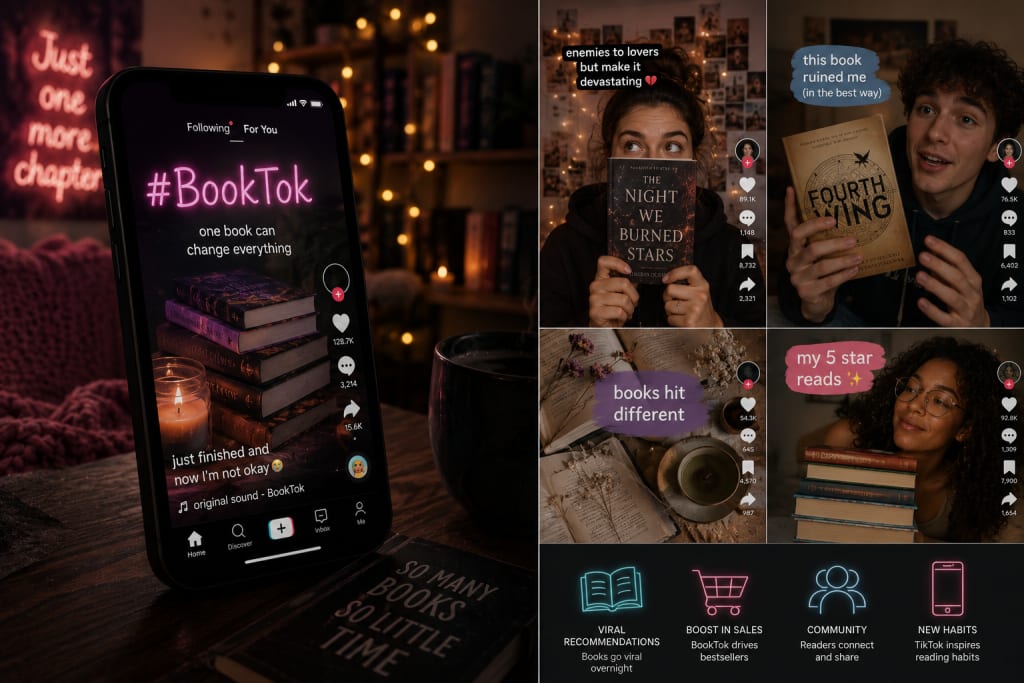
BookTok, TikTok’s massive community of readers, authors, reviewers, booksellers, and publishing professionals, has become one of the most powerful forces in modern reading culture. What began as readers sharing emotional reactions to books has transformed into a global engine for discovery, sales, genre trends, literary fandom, and publishing strategy.
By 2026, BookTok is no longer a cute online niche. It is a market force. TikTok reported in March 2026 that more than 50 million books recommended by the #BookTok community were sold across Europe in 2025, generating around €800 million in revenue across key book markets, based on analysis from NielsenIQ BookData and Media Control. The same report said more than a third of 16- to 39-year-olds discover new books through BookTok.
The UK has gone even further. TikTok announced an official partnership with the National Literacy Trust for the National Year of Reading 2026, launching the UK’s first official #BookTok bestseller list and inviting readers into what it called the “World’s Biggest Book Club.” The Guardian reported that the official BookTok chart would combine verified retail sales data with social media engagement, showing how seriously the industry now treats TikTok’s influence on book buying.
That is the real story of 2026: BookTok has moved from cultural trend to publishing infrastructure.
It is no longer just where readers talk.
It is where books become events.
What Is BookTok?
BookTok is the book-focused community on TikTok, built around videos where users recommend, review, react to, rank, criticize, and emotionally process books. It includes everything from romance recommendations and fantasy theories to literary fiction debates, horror lists, manga hauls, author updates, bookstore tours, annotation guides, reading challenges, and crying reactions after devastating endings.
The format is simple but powerful. A creator holds up a book and says, “This destroyed me.” Another posts, “Books with morally grey men who would burn the world for her.” Someone else films themselves sobbing after a final chapter. A reader shares five dark academia novels for rainy nights. A fantasy fan explains why a romantasy series ruined their sleep schedule. A bookseller films a table labeled “As Seen on BookTok.”
The emotional directness is what makes BookTok different from traditional literary criticism.
BookTok does not usually begin with detached analysis. It begins with feeling. Did the book make you cry? Did it make you scream? Did it ruin your life in the best way? Did the romance deliver? Did the twist shock you? Did the villain become your favorite character? Did the ending leave you staring at the wall?
This has made reading feel more communal, especially for younger audiences. BookTok has helped turn reading into something social, expressive, and identity-driven. The platform’s culture rewards passion over formality, which makes books feel less intimidating to people who may not see themselves as traditional “literary” readers.
That is one of BookTok’s biggest achievements. It has made reading look alive.
Why BookTok Became So Powerful
BookTok became powerful because it solved a discovery problem.
For years, readers had too many options and too little guidance. Bookstores, bestseller lists, literary reviews, publisher ads, celebrity book clubs, Goodreads ratings, and Amazon recommendations all helped, but none captured the emotional speed of a trusted peer saying, “You need this book.”
TikTok’s algorithm changed that.
Instead of waiting for readers to search for books, BookTok pushes books into their feeds through mood, genre, emotion, and identity. A person who watches one romance recommendation may quickly see more. A fantasy reader gets romantasy videos. A horror fan gets disturbing book lists. A sad-girl literary fiction reader gets melancholy novels with beautiful covers. A thriller fan gets “books with twists I never saw coming.”
BookTok does not sell books like traditional ads. It sells desire.
The platform turns books into emotional promises:
This book will break your heart.
This book has the best enemies-to-lovers tension.
This book feels like autumn.
This book is for girls who love morally grey characters.
This book will make you believe in romance again.
This book is so disturbing I had to put it down.
Those promises are easy to understand and easy to share. They are also more powerful than jacket copy because they feel personal. Readers trust other readers more than they trust marketing departments.
That trust is why BookTok can revive older titles, launch debut authors, turn niche subgenres into mainstream categories, and send readers to bookstores with specific books already in mind.
BookTok and the Sales Explosion
The numbers behind BookTok’s influence are now impossible to ignore.
TikTok’s March 2026 newsroom report said BookTok-recommended titles sold more than 50 million copies across Europe in 2025, generating €800 million in revenue across major markets. In the UK, the first monthly BookTok bestseller list launched in April 2026, with Heated Rivalry by Rachel Reid taking the top spot, followed by titles including Chloe Walsh’s Taming 7 and Sarah J. Maas’s House of Earth and Blood.
This matters because BookTok’s influence is measurable in ways that older word-of-mouth often was not. Publishers can see spikes. Booksellers can track demand. Retailers can build tables around trending titles. Authors can watch backlist books suddenly surge years after publication.
The Guardian reported in 2025 that romantasy and BookTok helped drive a huge rise in science fiction and fantasy sales in the UK, with science fiction and fantasy sales rising 41.3% between 2023 and 2024. That growth helped confirm what many booksellers already knew: BookTok does not only create buzz. It moves units.
Romance, fantasy, young adult, and emotionally intense fiction have benefited especially. These genres are highly “clip-friendly.” Their hooks can be explained quickly: forbidden love, arranged marriage, enemies to lovers, fae courts, dragon riders, secret societies, fake dating, dark academia, found family, morally grey heroes, and devastating endings.
BookTok thrives on instant emotional clarity.
That does not mean every BookTok success is shallow. It means the platform rewards books that can be described through feeling and identity in seconds.
The Rise of the Trope Economy
One of BookTok’s biggest cultural changes is the rise of the trope economy.
Readers no longer only search by genre. They search by emotional pattern.
Instead of asking for “a romance novel,” they ask for:
Enemies to lovers.
Friends to lovers.
Grumpy sunshine.
Fake dating.
Marriage of convenience.
One bed.
Morally grey hero.
Touch her and die.
Found family.
Slow burn.
Second chance romance.
Secret royal identity.
Academic rivals.
Forced proximity.
This is more than internet slang. It has changed how books are marketed, packaged, discussed, and even written. A January 2026 publishing-trend essay described this shift as a move away from traditional genre labels and into a “trope economy,” where readers search for specific emotional setups rather than broad categories.
The trope economy works because it gives readers confidence. They know what kind of emotional experience they want. BookTok helps them find it quickly.
For publishers, this is extremely useful. A book can be marketed not only as fantasy or romance, but as “enemies-to-lovers romantasy with political intrigue and a morally grey prince.” That description is more searchable, more shareable, and more emotionally precise than a generic genre label.
But there is a downside. When tropes become too dominant, books risk being reduced to ingredients. A novel becomes a checklist: spice level, trope count, character archetype, cliffhanger, emotional damage. That can flatten reading. It can make readers impatient with books that do not deliver the expected emotional beats fast enough.
Still, the trope economy is not going away. It has become one of BookTok’s defining languages.
Romantasy: BookTok’s Crown Jewel
If one genre symbolizes BookTok’s dominance, it is romantasy.
Romantasy blends romance and fantasy, usually combining emotional relationship arcs with magical worlds, political conflict, supernatural beings, adventure, danger, and high-stakes intimacy. It is not new, but BookTok turned it into a publishing powerhouse.
Authors like Sarah J. Maas and Rebecca Yarros became central to the movement. Series such as A Court of Thorns and Roses and Fourth Wing became more than books; they became fandom ecosystems. Readers discussed characters, theories, maps, ships, fan art, bonus chapters, special editions, and reading orders. Bookstores created romantasy tables. Publishers chased the next breakout series.
A 2026 publishing-trend report noted that romantasy’s rise is tied not only to content but also to aesthetics: decorated edges, foil covers, internal illustrations, reversible dust jackets, and collectible editions that turn books into desirable physical objects.
That is important. BookTok is not only changing what people read. It is changing how books look.
The physical book has become a fashion object, shelf object, collectible, and identity marker. Sprayed edges, illustrated hardcovers, foiled covers, book boxes, exclusive editions, and matching series sets now matter enormously because BookTok is visual. A beautiful book photographs well. A beautiful shelf becomes content.
Romantasy succeeds because it gives BookTok everything it loves: emotion, romance, fantasy worlds, fan theories, collectible aesthetics, and characters readers can obsess over.
The Book as Lifestyle Object
BookTok has helped turn books into lifestyle objects.
A book is no longer only something to read. It is something to display, annotate, film, collect, color-coordinate, smell, gift, and use as part of an aesthetic.
This shift can be seen in the rise of reading corners, bookshelf tours, annotation supplies, reading journals, book carts, cozy lamps, themed candles, literary merch, and even reading sheds. Good Housekeeping reported in April 2026 that “reading sheds” were becoming a home trend promoted by the BookTok community, with people converting backyard sheds into cozy book-filled retreats.
This lifestyle layer is one reason BookTok became so powerful. It does not only recommend stories. It sells a way of being.
The BookTok reader is not just someone who reads. They may be someone with a cozy chair, tabs in five colors, a matcha latte, a fantasy map open beside them, a candle named after a fictional kingdom, and a carefully curated shelf arranged by color or mood.
Some critics see this as consumerism. They are not entirely wrong. BookTok can encourage overbuying, book hoarding, special-edition chasing, and treating books more like décor than literature.
But it has also made reading desirable. For many people, especially younger readers, that matters. A culture where books look exciting, social, and beautiful is better than one where reading feels like homework.
The challenge is balance: let books be beautiful without forgetting that they are meant to be read.
Emotional Reading Replaces Traditional Criticism
BookTok’s review style is emotional, not academic.
A creator may not discuss structure, prose, historical context, symbolism, or narrative technique. Instead, they may say:
“I screamed.”
“I sobbed at 3 a.m.”
“This book ruined me.”
“I will never recover.”
“He is the blueprint.”
“The tension was insane.”
“The ending destroyed my soul.”
Traditional critics sometimes dismiss this language as shallow. But it has its own power. Emotional reviews are accessible. They tell potential readers what the book feels like. That is often what people want most before choosing a novel.
BookTok is not replacing literary criticism in universities, newspapers, or journals. It is replacing casual recommendation culture. It is the new friend at the bookstore saying, “Trust me, read this.”
That said, emotional reviewing has limitations. A book can go viral because of one scene, one quote, one trope, or one intense reaction, while its craft receives little discussion. Some readers may be disappointed when the emotional promise of the video does not match the book’s actual pacing or style.
BookTok can create inflated expectations. It can turn good books into impossible experiences. When a reader hears “this is the best book ever written” twenty times, even a strong novel may feel underwhelming.
But the emotional review is still the heart of BookTok. It is why the platform feels human.
BookTok and Backlist Magic
One of BookTok’s most fascinating powers is its ability to revive older books.
Traditional publishing often focuses heavily on new releases. Bookstores have limited display space. Media coverage moves quickly. A book may get a few months of attention, then fade unless it wins awards or enters school curricula.
BookTok changed that.
An older book can go viral years after publication because a creator discovers it, posts an emotional reaction, and triggers a wave of new readers. This has happened with novels by Colleen Hoover, Madeline Miller, Taylor Jenkins Reid, Hanya Yanagihara, and many others. Backlist revival is one of BookTok’s most commercially important effects.
This is good news for authors because a book’s life can extend far beyond launch week. It is also good for readers because discovery becomes less tied to publisher release schedules.
A novel does not have to be new to feel new on BookTok.
That has changed publishing strategy. Publishers now monitor old titles for viral potential, redesign covers, create BookTok stickers, release special editions, and push backlist titles when they begin trending.
The old model was launch, peak, decline.
The BookTok model is launch, sleep, viral resurrection.
The Power of BookTok Creators
BookTok creators are now a serious part of the publishing ecosystem.
They can launch trends, influence bestseller lists, sell out stock, shape cover redesigns, attract publisher partnerships, and turn unknown authors into visible names. Some creators receive advance reader copies, paid sponsorships, event invitations, affiliate links, and brand collaborations.
This has created a new kind of literary influencer.
The most successful creators are not always professional critics. Their influence comes from trust, consistency, taste, emotional honesty, and community. Viewers return because they feel the creator understands their reading mood.
This creator power has changed publisher marketing. A campaign that once focused on newspaper reviews, bookstore placement, and author interviews may now include TikTok seeding, influencer mailers, aesthetic unboxings, trope-based copy, creator partnerships, and quote-friendly packaging.
There is a risk, of course. Sponsored content can blur authenticity. Readers may wonder whether a recommendation is genuine or paid. The best creators handle this with transparency. The worst turn their feeds into nonstop ads.
BookTok’s power depends on trust. If that trust weakens, the platform’s recommendation culture becomes less effective.
The Official BookTok Bestseller List
The launch of official BookTok bestseller lists marks a major institutional shift.
When TikTok and publishing data companies create official charts, they formalize what was once organic. The UK’s first official BookTok bestseller list launched in 2026, combining sales and platform engagement to track which titles are resonating in the #BookTok community.
This is both exciting and complicated.
On one hand, it gives BookTok cultural recognition. It shows that online reading communities matter. It creates visibility for books that may not dominate traditional bestseller lists. It can help readers discover what is truly moving through the community.
On the other hand, official charts can make BookTok feel more commercial. Once there is a list to hit, publishers and authors may optimize for it. Content may become more strategic. Campaigns may chase engagement metrics. The line between reader excitement and marketing machine may blur.
That is the classic lifecycle of any grassroots movement. It begins with passion, then the industry arrives.
BookTok in 2026 is living through that transition.
BookTok and Young Readers
One of BookTok’s most positive effects is that it has made reading socially attractive for young people.
For years, educators and parents worried that social media was pulling young people away from books. BookTok complicates that story. It uses social media to pull many readers back toward books.
TikTok’s 2026 European sales report said more than a third of 16- to 39-year-olds discover new books through BookTok. The platform’s UK partnership with the National Literacy Trust for the National Year of Reading 2026 shows how literacy organizations are trying to harness BookTok’s energy rather than fight it.
This is important. Instead of presenting reading as a duty, BookTok presents it as pleasure, identity, and belonging. Young readers see other people getting excited about books, and that excitement becomes contagious.
BookTok also lowers the barrier to entry. A teenager may not know where to start in a bookstore, but a TikTok video can say, “Read these five fantasy books if you loved this show,” or “Start here if you want to get into romance.”
That kind of guidance can be transformative.
The best thing BookTok has done is make books feel less lonely.
The Criticism: Is BookTok Narrowing Reading Culture?
BookTok is powerful, but it is not perfect.
One criticism is that it narrows reading culture around certain genres and aesthetics. Romance, romantasy, YA, thrillers, and emotionally intense fiction dominate many BookTok spaces. Literary fiction, nonfiction, poetry, translated literature, history, essays, experimental writing, and older classics can thrive too, but they often require more niche communities.
A 2024 academic study on BookTok and diversity found that online spaces can be homogeneous and that TikTok does not necessarily escape those patterns. The study analyzed creators, authors, and main characters in BookTok books to explore representation across race, gender, and sexual orientation.
This matters because algorithms reward what already performs well. If certain genres, authors, covers, bodies, identities, or emotional styles go viral more easily, they can dominate the feed. Readers may believe they are seeing “what everyone is reading,” when they are really seeing what the algorithm has learned to show them.
BookTok can expand reading culture, but it can also create echo chambers.
The solution is not to reject BookTok. It is to diversify it. Follow creators with different tastes. Seek translated books. Explore nonfiction. Read authors outside the viral core. Use BookTok as a doorway, not a cage.
The “Spice” Debate
BookTok has also changed how romance and fantasy romance are discussed, especially through the language of “spice.”
Spice refers to sexual content, usually ranked by intensity. Readers ask whether a book is “closed door,” “slow burn,” “spicy,” “extra spicy,” or explicit. This has made it easier for readers to find the level of romantic heat they want.
But it has also created debate.
Some readers love the clarity. Others worry that romance is being reduced to spice level, with character development and prose ignored. Some younger readers may encounter adult content through BookTok without fully understanding age categories. Some books are marketed with adult tropes to audiences that may be younger than intended.
This is a larger issue in a platform where YA, new adult, and adult romance content can blur. BookTok moves faster than bookstore shelving. A book can trend without context. Readers may not always know what they are picking up.
Responsible creators often include content warnings, age recommendations, and honest descriptions. That is useful. But the wider BookTok culture still struggles with how to balance excitement, recommendation, and reader safety.
BookTok and the Bookstore Revival
One of the most charming effects of BookTok is its impact on physical bookstores.
At first glance, TikTok might seem like a threat to bookstores. It is digital, fast, and algorithm-driven. But BookTok has often sent readers into stores rather than away from them. Bookstores now create BookTok tables, viral shelves, staff recommendation videos, and TikTok accounts of their own.
A reader may discover a book on TikTok, then go buy a physical copy because the book itself has become desirable. Special editions, sprayed edges, and beautiful covers make physical books feel collectible.
This is part of why BookTok differs from some digital entertainment trends. It does not only keep people on screens. It often moves them toward physical objects, bookstores, libraries, book clubs, and reading spaces.
In 2026, the bookstore is not dead. It is becoming more social-media aware.
The front table now speaks TikTok.
The Audiobook and E-Book Layer
BookTok is often associated with physical books because they photograph well. But its influence extends to e-books and audiobooks too.
Readers may discover a title on TikTok and then listen to it on audio, borrow it digitally from a library, buy it on Kindle, or read it through subscription platforms. Romance, fantasy, and thriller audiences often move fluidly between formats.
Audiobooks especially benefit from fandom culture. A beloved narrator can become part of the recommendation. A dramatic scene can be clipped or quoted. A long fantasy book becomes more approachable when consumed during commutes, walks, chores, or workouts.
This is another way BookTok reshapes reading culture. It expands what “reading” means. Listening to a book is part of the community. Annotating a hardcover is part of the community. Reading on Kindle at 2 a.m. is part of the community. Watching a reaction video after finishing is part of the community.
BookTok makes reading multi-format and socially layered.
Authors Writing for the BookTok Age
Authors are now aware of BookTok from the beginning.
Some write tropes more explicitly. Some craft quote-worthy lines. Some design emotional cliffhangers. Some build worlds with fandom potential. Some share behind-the-scenes writing processes on TikTok before publication. Some self-published authors use the platform to build direct relationships with readers.
This can be empowering. Authors no longer depend entirely on traditional gatekeepers. A compelling video can sell a book. A self-published romance or fantasy author can find readers directly. A niche story can reach its exact audience.
But there is also pressure. Authors may feel pushed to write “BookTok-able” books: fast hooks, high emotion, clear tropes, aesthetic covers, and dramatic scenes. This can be creatively limiting if every book is shaped for virality.
The best authors will use BookTok as connection, not command. They will understand the community without reducing their work to algorithmic bait.
A book should be shareable.
But it should still be a book.
The Commercialization Problem
BookTok’s biggest challenge in 2026 is commercialization.
As money flows in, the platform changes. Publishers sponsor creators. Retailers build campaigns. Authors chase trends. Official charts formalize influence. TikTok Shop sells books directly. Viral shelves become planned displays. Special editions become scarcity marketing.
This is not automatically bad. Publishing is a business, and authors deserve to sell books. But readers can feel when a community becomes too engineered.
The magic of early BookTok came from sincerity. Someone cried over a book and told others to read it. That kind of enthusiasm cannot be manufactured forever.
The future of BookTok depends on whether it can keep authentic reader passion at the center while the industry builds around it.
If BookTok becomes only marketing, readers will move elsewhere.
If it stays emotionally honest, it will remain powerful.
BookTok as Community, Not Just Algorithm
At its best, BookTok is not only an algorithm. It is a community.
Readers find people who love what they love. They join buddy reads. They discuss endings. They defend favorite characters. They argue about adaptations. They share grief after finishing a series. They make fan art, playlists, edits, theories, and jokes. They celebrate bookshops, libraries, authors, and reading rituals.
This community aspect is why BookTok has lasted. A viral video can sell a book once. A community keeps people reading.
TikTok’s “World’s Biggest Book Club” framing reflects this shift from discovery platform to social reading infrastructure. The phrase may be marketing, but it captures something real: readers want to feel part of something larger than their own nightstand.
Reading has always created imagined communities. BookTok makes those communities visible.
What BookTok Means for Literary Culture
BookTok has changed literary culture in several major ways.
It has made emotional response central.
It has made tropes a dominant discovery tool.
It has revived backlist books.
It has boosted romance, romantasy, YA, fantasy, and thrillers.
It has turned books into aesthetic objects.
It has given creators influence once held mainly by critics, booksellers, and publishers.
It has made reading more social for young audiences.
It has pushed publishers to rethink marketing.
It has created new pressures around virality, sameness, and commercialization.
Whether one loves or hates BookTok, its impact is undeniable.
The old literary world was built around reviews, awards, bookstores, libraries, classrooms, critics, and publisher campaigns. Those things still matter. But BookTok has added another force: the emotional algorithmic crowd.
A book can now become a bestseller because thousands of ordinary readers feel something intensely and film themselves saying so.
That is messy, powerful, and very 2026.
Final Verdict
BookTok dominates 2026 because it has changed how books are discovered, bought, discussed, displayed, and emotionally experienced. It has turned reading into a social, visual, and participatory culture. It has given ordinary readers enormous influence. It has helped sell millions of books, revive backlists, fuel romantasy, create official bestseller lists, and make reading feel fashionable again.
The numbers prove its power. More than 50 million BookTok-recommended books sold across Europe in 2025, generating €800 million in revenue, according to analysis cited by TikTok from NielsenIQ BookData and Media Control. The launch of official BookTok charts in the UK shows that the publishing industry is no longer treating the platform as a side conversation. It is now part of the business.
But BookTok’s real influence is cultural, not just commercial.
It has made reading emotional, communal, aesthetic, and contagious. It has given young people a way into books that feels less like homework and more like belonging. It has created a language of tropes, moods, tears, shelf tours, annotations, special editions, and fandom. It has made books feel alive inside the fastest-moving media platform of the decade.
The risks are real: sameness, overconsumption, paid hype, narrow algorithms, and books reduced to tropes. But the revival of reading energy is also real.
BookTok did not save reading because reading was never dead.
It did something different.
It made reading visible again.