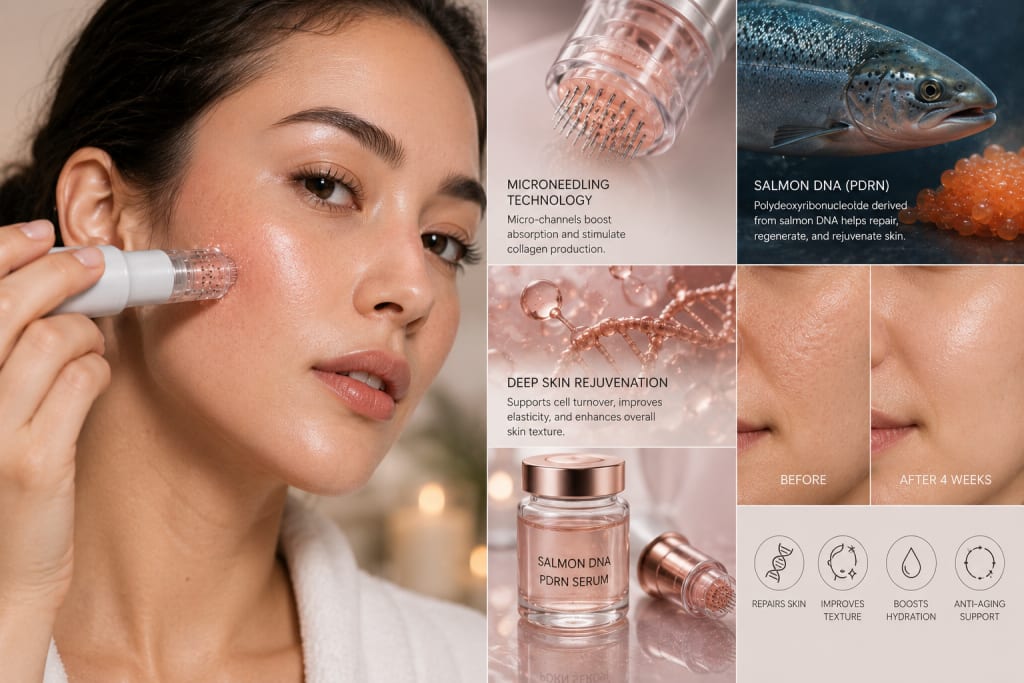
Salmon DNA Microneedling: The Skincare Trend Everyone’s Talking About
Skincare trends usually arrive with a glamorous name, a celebrity mention, and a promise of impossible glow.
But every now and then, one trend appears with a name so strange that people cannot stop talking about it.
That is exactly what happened with salmon DNA microneedling.
Also called the salmon sperm facial, PDRN facial, polynucleotide treatment, or salmon DNA skin booster, this beauty trend has become one of the most talked-about skin treatments in clinics, celebrity interviews, K-beauty conversations, and social media skincare circles. The name sounds shocking at first, almost like a beauty myth invented to go viral. But behind the odd nickname is a real category of regenerative skincare ingredients: PDRN and polynucleotides, usually derived from purified salmon DNA fragments.
The appeal is obvious. Beauty lovers are always looking for skin that looks smoother, calmer, bouncier, and more hydrated without the obvious “done” look of heavy filler. Salmon DNA treatments promise something softer: improved skin quality, glow, elasticity, healing support, and a fresher complexion over time.
The trend has been boosted by celebrity curiosity and K-beauty influence. Jennifer Aniston famously joked about trying a salmon sperm facial, while dermatologists explained that the treatment is usually associated with microneedling and DNA-rich ingredients that may help hydration, texture, and wrinkles. People also noted that experts caution the trend may not suit everyone and that some versions lack FDA approval in the United States.
More recently, PDRN has moved beyond clinic treatments into Korean skincare products, with woman&home reporting that salmon DNA-derived PDRN is now appearing in serums and creams designed to support hydration and a calmer-looking skin barrier.
So why is everyone suddenly obsessed with salmon DNA microneedling?
Because it sits at the center of three major beauty movements: regenerative skincare, K-beauty innovation, and natural-looking skin rejuvenation.
It is not about freezing the face. It is not about changing facial structure. It is about making the skin itself look healthier.
And in 2026, that is the new luxury.
What Is Salmon DNA Microneedling?
Salmon DNA microneedling is a cosmetic skin treatment that combines two ideas.
The first is microneedling, a procedure where tiny needles create controlled micro-injuries in the skin. This stimulates the skin’s natural repair response and can support collagen production, texture improvement, and better absorption of topical ingredients.
The second is the use of PDRN or polynucleotides, DNA-derived molecules often sourced from salmon. These ingredients are associated with tissue repair, hydration, anti-inflammatory effects, and skin regeneration in aesthetic medicine.
In simple words, microneedling opens controlled channels in the skin, while salmon DNA-derived ingredients are applied or delivered to support repair and glow.
A 2024 review on polynucleotides in aesthetic medicine found that polynucleotides have been used to improve skin texture, reduce wrinkle depth, and enhance facial appearance. A more recent dermatology review notes that people with hypersensitivity to fish or fish products should be cautious with salmon-sourced DNA products, even though these materials are purified during extraction.
That safety detail matters. The trend may sound playful online, but it is still a skin procedure. It should be done carefully, ideally by a trained and licensed professional.
Why Salmon DNA?
The phrase “salmon DNA” sounds bizarre, but the science behind the ingredient is less strange than the name.
PDRN stands for polydeoxyribonucleotide. Polynucleotides are DNA fragments that can act as biological signaling molecules. In aesthetic medicine, they are used with the goal of supporting tissue repair, hydration, elasticity, and overall skin quality.
Salmon is commonly used because salmon DNA is considered highly compatible for these purified preparations, and it can be processed into medical or cosmetic-grade ingredients. The key point is purification. A proper treatment is not raw salmon material. It is processed and purified DNA-derived material.
A dermatology-focused narrative review explains that salmon-sourced PN/PDRN products are purified by filtration during extraction, while still advising caution for people with fish hypersensitivity.
This is why the nickname “salmon sperm facial” is both attention-grabbing and misleading. It makes the treatment sound shocking, but professional treatments use purified compounds, not the crude ingredient implied by the viral name.
The trend went viral because the name is weird.
The treatment gained staying power because the regenerative skincare idea is compelling.
What Does It Claim to Do?
Salmon DNA microneedling is usually marketed for skin quality rather than dramatic facial reshaping.
Common claimed benefits include:
Improved hydration.
Smoother skin texture.
Better glow.
Reduced appearance of fine lines.
Support for skin repair.
Improved elasticity.
Calmer-looking skin.
More even tone.
Support after acne scarring or dullness.
Some clinics also use polynucleotides around delicate areas like the under-eyes, where patients may want rejuvenation without the puffiness or volume change sometimes associated with filler. However, under-eye treatments require special caution because the area is delicate and more prone to bruising, swelling, and visible lumps.
A 2026 expert-perspective review on polynucleotides reported a favorable safety profile in the literature and described polynucleotides as promising for sensitive or barrier-compromised skin, while still acknowledging that clinical protocols depend on technique, anatomy, and product choice.
But expectations should stay realistic.
Salmon DNA microneedling is not a facelift. It is not a filler replacement when volume loss is the concern. It does not erase deep wrinkles overnight. It is more about gradual skin improvement than instant transformation.
The best way to think of it is: skin conditioning, not face changing.
Why It Became So Popular
The popularity of salmon DNA microneedling comes from timing.
For years, beauty culture focused heavily on injectables, contouring, filler, Botox, and dramatic before-and-after transformations. But many skincare lovers are now moving toward subtler treatments that improve the skin itself.
The new beauty ideal is not necessarily looking “done.”
It is looking rested, hydrated, expensive, and naturally luminous.
Salmon DNA microneedling fits that perfectly. It sounds futuristic, but the result people want is very soft: better glow, better bounce, better texture.
The K-beauty connection also matters. Korean skincare has built global trust around innovation, barrier repair, hydration, and glass-skin aesthetics. PDRN has been popular in Korean aesthetic medicine and is now appearing in topical skincare products as well. woman&home recently reported that Korean skincare products containing salmon DNA-derived PDRN were used to prep skin for a radiant cover-shoot glow, with dermatology commentary noting that PDRN can help hydration and less reactive-looking skin over time when combined with barrier-supporting ingredients.
That is exactly the kind of language modern skincare consumers love: barrier, hydration, repair, glow, calmness.
Salmon DNA sounds dramatic.
The beauty goal is actually understated.
The Celebrity Effect
Celebrity curiosity helped push salmon DNA treatments into mainstream conversation.
Jennifer Aniston’s comments about trying a salmon sperm facial brought the treatment into pop-culture awareness, especially because the name sounded so unusual. People reported that dermatologists connected the treatment to microneedling and DNA-rich ingredients, while also noting that Aniston herself joked about not noticing dramatic results immediately.
That honesty is useful. It reminds people that trendy treatments do not always produce instant miracles.
Other celebrities and public figures have discussed polynucleotide or salmon DNA-style treatments, especially before events or weddings. Recent reporting on Irish presenter Laura Fox noted that a polynucleotide treatment left her bruised and swollen temporarily, showing the very real downtime that can come with under-eye or facial treatments.
That is the less glamorous side of the trend. The final glow may be appealing, but the treatment period can include redness, swelling, bumps, bruising, sensitivity, and healing time.
Beauty trends often show the after.
Responsible skincare writing should also mention the during.
Microneedling: The Other Half of the Trend
Salmon DNA gets the headlines, but microneedling is just as important.
Microneedling has been used for years to improve skin texture, acne scars, fine lines, and overall rejuvenation. The procedure creates tiny controlled punctures in the skin, prompting a repair response. It can also help certain topical ingredients penetrate more effectively.
When paired with PDRN or polynucleotide solutions, the idea is that the skin is stimulated mechanically and supported biologically.
Some clinics describe this as regenerative treatment. The term sounds luxurious, but the basic concept is simple: create controlled injury, then support repair.
However, microneedling is not risk-free. Poor technique, unclean tools, wrong needle depth, active acne, compromised skin barrier, or aggressive aftercare can cause irritation, infection, pigmentation problems, scarring, or flare-ups.
This is why salmon DNA microneedling should not be treated like a casual facial. It is closer to a cosmetic procedure than a spa mask.
The person performing it matters.
The product quality matters.
Aftercare matters.
Salmon DNA Microneedling vs Injectable Polynucleotides
These two treatments are often confused.
Salmon DNA microneedling usually refers to applying PDRN/polynucleotide solutions during or after microneedling so the ingredients work with the skin’s repair channels.
Injectable polynucleotides involve injecting polynucleotide products directly into the skin or under-eye area as a skin booster.
The injectable version may be more common in aesthetic clinics in some countries, especially in Europe and Asia. The microneedling version may be marketed as a facial or regenerative treatment.
Regulation also varies by country. One U.S.-focused clinic website notes that PDRN is not FDA-approved as an injectable in the United States and that topical application during microneedling is performed off-label by licensed practitioners.
This distinction is important because social media often uses the same nickname for very different treatments. A cream, serum, microneedling facial, mesotherapy treatment, and injectable skin booster are not the same thing.
Before booking, patients should ask exactly what product is being used, whether it is topical or injectable, who is performing it, what training they have, what side effects are expected, and whether the product is approved or legally used in that location.
A viral name is not enough.
Details matter.
What Happens During the Treatment?
A typical salmon DNA microneedling session may begin with cleansing and skin assessment. A numbing cream may be applied if deeper microneedling is planned. Then the provider uses a microneedling pen or device to create tiny punctures across the treatment area. The PDRN or polynucleotide solution may be applied during or after the needling process.
The skin may look red immediately afterward, almost like a sunburn. Some people experience tightness, warmth, swelling, pinpoint bleeding, or sensitivity. Depending on depth and skin type, downtime can range from mild redness for a day to several days of visible irritation.
Under-eye polynucleotide treatments can involve swelling, bruising, small bumps, or lumpiness during early healing, especially when injected. Recent celebrity coverage of a polynucleotide treatment noted visible bruising and swelling shortly after treatment, which is a reminder that “skin booster” does not always mean no downtime.
Aftercare usually involves avoiding harsh actives, exfoliation, retinoids, strong acids, heavy makeup, intense exercise, swimming, and sun exposure for a short period. Sunscreen becomes especially important because the skin may be more vulnerable during healing.
The glow is usually not instant in the way makeup is instant. The skin needs time to calm, repair, and gradually improve.
How Long Does It Take to See Results?
Results vary.
Some people may notice a hydrated glow once redness settles. Others may need several sessions before seeing meaningful changes in texture, fine lines, or firmness. Many clinics recommend a course of treatments spaced several weeks apart, followed by maintenance sessions.
Polynucleotides are often promoted as gradual skin-quality boosters. That means they may not deliver the dramatic before-and-after effect associated with filler or laser resurfacing. Instead, they may support subtle improvement over time.
A 2026 review of polynucleotide evidence notes that studies report varying degrees of efficacy and safety, with some showing improvements in elasticity and hydration while others report limited or no benefits.
That is an important point. The ingredient is promising, but not magic. The final result depends on the patient’s skin condition, treatment method, product quality, number of sessions, aftercare, age, lifestyle, and expectations.
Anyone promising a complete transformation from one session should be treated with caution.
Who Might Like This Treatment?
Salmon DNA microneedling may appeal to people who want overall skin quality improvement rather than obvious facial alteration.
It may be attractive for those concerned with dullness, mild texture issues, dehydration, early fine lines, mild acne scarring, or skin that looks tired and stressed. It may also appeal to people who enjoy regenerative or K-beauty-inspired treatments and prefer a softer approach than filler.
It may be especially interesting for people who want glow and skin resilience before events, though timing is important. Because redness, swelling, or bruising can happen, it is not wise to try it for the first time right before a wedding, party, or photoshoot.
The treatment is less ideal for people expecting dramatic lifting, major wrinkle correction, severe acne-scar remodeling, or instant under-eye hollow correction. Those concerns may require other treatments or a combination plan.
A 2026 clinical explainer notes that salmon DNA-style polynucleotide treatments are not ideal for people with fish allergies, pregnant patients, or those expecting dramatic lifting, because polynucleotides improve tissue quality rather than replace structural or volumizing treatments.
That is a realistic way to think about it.
It is a glow-and-repair treatment.
Not a face reshaping treatment.
Who Should Be Careful?
People with fish or fish-product allergies should be cautious because many PN/PDRN products are salmon-derived. A dermatology review specifically warns that individuals with hypersensitivity to fish or fish products should be careful with salmon-sourced DNA drugs, while noting that purification may reduce but not necessarily eliminate concern.
People who are pregnant or breastfeeding should consult a qualified medical professional before considering cosmetic procedures, as many elective aesthetic treatments are postponed during pregnancy.
People with active acne, skin infections, eczema flares, psoriasis flares, open wounds, cold sores, keloid tendency, immune suppression, or recent isotretinoin use should discuss risks carefully with a dermatologist.
Darker skin tones may need extra caution with aggressive microneedling because inflammation can trigger post-inflammatory hyperpigmentation if performed improperly.
People prone to herpes simplex outbreaks may need preventive advice if treating areas around the mouth.
And anyone with unrealistic expectations should pause. Salmon DNA microneedling can support skin quality, but it will not replace sleep, sunscreen, barrier care, acne treatment, pigmentation management, or professional medical dermatology when needed.
Is It Safe?
When performed by trained professionals using appropriate sterile technique and reputable products, polynucleotide treatments are generally discussed as having a favorable safety profile in the aesthetic literature. A 2026 expert review reported no literature cases of granuloma or vascular occlusion to date and described polynucleotides as biocompatible and tolerable.
But safety depends on context.
Microneedling can cause problems if done too aggressively or with poor hygiene. Injectables carry different risks than topical microneedling. Unregulated products, counterfeit products, or unqualified providers increase danger. The under-eye area is particularly delicate and should only be treated by skilled professionals.
Possible side effects include redness, swelling, tenderness, bruising, dryness, flaking, bumps, temporary sensitivity, infection, allergic reaction, pigmentation changes, and poor healing.
The trend may be viral, but your skin is personal. A treatment that works beautifully for one person may irritate another.
A good provider should evaluate your skin first, explain risks, discuss alternatives, and give aftercare instructions.
If they only talk about glow and never talk about risk, that is a red flag.
The K-Beauty Connection
Salmon DNA microneedling gained part of its popularity through Korean aesthetic medicine and K-beauty culture.
Korean skincare has long emphasized hydration, barrier support, gentle layering, and luminous skin. PDRN and polynucleotide treatments fit neatly into that philosophy because they are associated with repair, calmness, and skin quality rather than aggressive resurfacing alone.
Now the ingredient is also appearing in topical skincare products. woman&home reported that PDRN is moving into creams and serums, with Korean skincare products containing PDRN, hyaluronic acid, and hydrolyzed collagen used for a cover-shoot glow.
This may be the next big phase of the trend: not everyone will book microneedling or injectables, but many people may try PDRN serums or creams.
Topical products are not the same as procedures. They may be gentler and easier to use, but they may not penetrate as deeply or produce the same result as professional treatments. Still, they make the ingredient more accessible to everyday skincare consumers.
That is how many beauty trends mature.
First, the clinic treatment goes viral.
Then the ingredient enters at-home skincare.
Salmon DNA vs Exosomes vs PRP
Salmon DNA microneedling is often compared with other regenerative skincare treatments such as PRP, exosomes, and growth-factor serums.
PRP, or platelet-rich plasma, uses a patient’s own blood components. It is often paired with microneedling or injections to support healing and rejuvenation.
Exosome treatments use cell-derived signaling vesicles, though regulation and product quality vary widely, and the category can be confusing for consumers.
Salmon DNA/PDRN/polynucleotides use purified DNA fragments, usually salmon-derived, associated with tissue repair and hydration support.
Each category has different evidence, regulation, cost, risk profile, and ideal use case. None should be treated as automatically superior for everyone. A good dermatologist or aesthetic doctor can recommend based on skin goals, medical history, budget, and tolerance for downtime.
The common trend is clear: beauty is moving toward bio-stimulating and regenerative language. Consumers want treatments that encourage the skin to behave better, not just cover or fill.
Salmon DNA is one of the most viral names inside that larger movement.
Why the Name Went Viral
Let’s be honest: the phrase “salmon sperm facial” is unforgettable.
It is weird, funny, slightly shocking, and easy to turn into a headline. That is why the treatment spread so quickly online. People clicked because the name sounded unbelievable.
But the name also creates confusion. Some people imagine the treatment is crude, gimmicky, or unhygienic. In reality, professional products use purified DNA-derived compounds. The sensational nickname is mostly a marketing and media shortcut.
This is common in beauty culture. A strange name makes an ingredient famous. Then dermatologists and cosmetic chemists have to explain what it actually means.
The danger is that viral names can make serious procedures sound casual. Salmon DNA microneedling still involves needles and active skin repair. It is not something to copy from a TikTok video at home with random products.
The name may be funny.
The procedure should be taken seriously.
Can You Do It at Home?
No, not in the professional sense.
At-home microneedling or dermarolling carries risks, especially if people use poor-quality devices, press too deeply, fail to sterilize properly, or apply unsuitable products into compromised skin. Combining at-home needling with random “salmon DNA” serums from questionable sources is not a good idea.
If you want to try the trend at home, the safer route is topical PDRN skincare from reputable brands, used on intact skin according to instructions. That is different from microneedling, but it may still offer hydration and barrier-supporting benefits depending on the formula.
Professional microneedling should be performed in a clean clinical environment by someone trained in skin anatomy, needle depth, contraindications, and aftercare.
The internet loves DIY beauty.
Your skin barrier does not always love it back.
The Cost Factor
Cost varies widely by country, city, clinic, product, and whether the treatment is microneedling-based or injectable.
Topical PDRN skincare may be relatively affordable.
Microneedling facials with PDRN usually cost more than standard facials because they involve professional treatment and specialized products.
Injectable polynucleotide treatments can cost significantly more, especially for under-eye or full-face courses.
Because multiple sessions may be recommended, consumers should think about total course cost, not just one appointment. A treatment that requires three sessions plus maintenance may be much more expensive than it first appears.
Also, cheaper is not always better. With procedures involving needles, product quality and provider skill matter more than bargain pricing.
A low-cost treatment with poor technique can become expensive if it causes complications.
What to Ask Before Booking
Before booking salmon DNA microneedling, ask practical questions.
What exact product is being used?
Is it PDRN, PN, polynucleotide, or something else?
Is it topical during microneedling or injected?
Is the product legally approved or appropriately used in this country?
Who performs the treatment?
What training and license do they have?
What are the risks for my skin type?
How much downtime should I expect?
How many sessions are recommended?
What should I avoid before and after?
What happens if I react badly?
Should I avoid it if I have fish allergy?
These questions are not rude. They are smart.
A trustworthy provider will answer clearly.
A trendy clinic that avoids details is not worth your face.
The Beauty Ideal Behind the Trend
Salmon DNA microneedling is popular because beauty culture is shifting from “perfect face” to “healthy skin.”
People still want anti-aging results, but many want them to look subtle. They want firmness without obvious filler. Smoothness without frozen expression. Glow without heavy makeup. Freshness without looking drastically altered.
This is why treatments like microneedling, polynucleotides, lasers, skin boosters, LED therapy, barrier repair, and collagen-stimulating procedures are so popular. They promise improvement from within the skin rather than dramatic external change.
The phrase “skin quality” is everywhere now.
Salmon DNA microneedling is a skin-quality treatment. That is its real appeal.
It is not about looking like someone else.
It is about looking like your skin had a long sleep, drank water, healed faster, and caught the light better.
That is a powerful promise.
Does the Evidence Match the Hype?
The evidence is promising, but the hype is bigger than the evidence.
Research reviews suggest polynucleotides can improve skin texture, wrinkle depth, facial appearance, hydration, and elasticity in some contexts. But evidence quality, product types, treatment methods, study designs, and outcomes vary. Some studies show meaningful benefit; others are more limited.
Microneedling itself has a stronger established role in collagen stimulation and texture improvement, but combining it with PDRN is still an area where protocols and claims vary by clinic and country.
In short: this is not nonsense, but it is also not magic.
The most realistic claim is that salmon DNA/PDRN/polynucleotide treatments may support skin repair, hydration, texture, and overall skin quality when used appropriately. They are not guaranteed to reverse aging, erase scars, or transform the face.
Beauty trends often exaggerate. Science moves slower.
The sweet spot is cautious optimism.
Final Verdict
Salmon DNA microneedling is one of the most talked-about skincare trends because it combines viral shock value with a real beauty movement: regenerative, skin-quality-focused treatments. Behind the dramatic “salmon sperm facial” nickname are purified DNA-derived ingredients such as PDRN and polynucleotides, often used with microneedling or as skin boosters to support hydration, repair, texture, and glow.
The trend has been fueled by K-beauty innovation, celebrity curiosity, and a wider shift away from obvious cosmetic alteration toward healthier-looking skin. Reviews of polynucleotides in aesthetic medicine suggest they may help improve skin texture, wrinkle depth, hydration, elasticity, and facial appearance, though results vary and expectations should remain realistic.
But this is not a casual DIY beauty hack. Microneedling involves controlled skin injury, and polynucleotide products should be used carefully. People with fish allergies, active skin issues, pregnancy, or sensitive medical histories should be especially cautious and consult qualified professionals.
The smartest way to view salmon DNA microneedling is not as a miracle facial, but as a promising skin-support treatment in the growing world of regenerative aesthetics.
The name may sound strange.
The goal is simple.
Calmer, smoother, bouncier, glowier skin—with a little help from one of beauty’s most unexpected ingredients.