A Voice That Never Stood Still: A Tribute to Asha Bhosle
India woke today to the kind of news that feels impossible even when it arrives in plain language. Asha Bhosle, whose voice had long ago slipped past celebrity and into the emotional fabric of ordinary life, died in Mumbai on Sunday, April 12, 2026, at the age of 92. Reuters and AP reported that she had been hospitalized with a chest infection and exhaustion, and that her funeral is expected in Mumbai on Monday, April 13.
To call her a singer is true, but hopelessly incomplete. Asha Bhosle was not merely a playback legend or a beloved public figure. She was one of the rare artists whose work altered the sound of an entire culture. Over a career that stretched across roughly eight decades, she recorded thousands of songs across styles, moods, and generations, leaving behind a body of work so vast that it can feel less like a catalog and more like an inhabited world. AP described her as one of India’s most versatile performers, while Reuters called her musical journey “extraordinary.” Both are right, though neither word fully captures the reach of what she became.
What made Asha Bhosle special was not simply longevity, though few artists anywhere have endured with such force. It was motion. Her voice never stood still long enough to become a museum piece. It flirted, teased, seduced, consoled, sparkled, smoldered, laughed, and broke hearts without asking permission from genre purists or guardians of respectability. In an industry that often tried to sort women into types, she slipped through categories with a smile and made reinvention sound effortless.
She came from a family marked by music and discipline. Born in 1933, trained by her father Dinanath Mangeshkar, and growing up alongside siblings who would each come to occupy a place in India’s cultural memory, Asha Bhosle entered music young. But inheritance alone does not produce legend. What she built was distinctly her own. Even standing in the shadow of enormous familial talent, including her elder sister Lata Mangeshkar, she fashioned a separate identity—bolder in rhythm, more mischievous in phrasing, more willing to lean into modernity, cabaret, jazz accents, nightclub glamor, and emotional ambiguity.
That courage matters more now, on the day of mourning, than it did in the simpler language of awards nights and retrospectives. Asha Bhosle did not protect her image by being cautious. She expanded it by being curious. She lent her voice to heroines, heartbreakers, dancers, dreamers, and women who were not trying to appear pure enough for public approval. She could sing with velvet softness one moment and with dangerous electricity the next. The range was not technical alone. It was psychological. She understood that a song is often a personality before it is a melody, and she could inhabit personalities with uncommon ease.
That is why so many listeners, across generations, feel as though they “know” her without ever having met her. She was there in love songs and in rain songs, in reckless songs, in songs of waiting, in songs that dressed desire in silk and songs that gave sorrow the dignity of restraint. For many Indians, and for countless listeners across the diaspora, her voice did not arrive as history. It arrived as atmosphere. It played in kitchens, taxis, wedding halls, cassettes, radio shows, late-night TV reruns, festival mornings, and private ache. She did not belong to one decade because she never allowed one decade to finish defining her.
There are singers who become symbols of excellence. Then there are singers who become companions to national memory. Asha Bhosle belonged in the second group. People did not just admire her. They carried her. Her songs were often woven into life’s small rituals so intimately that many listeners likely do not remember the first time they heard her. That is one of the deepest forms of fame: not spectacle, but absorption. An artist’s work becomes so thoroughly naturalized in public feeling that it starts to seem as though it was always there, waiting for us.
And yet her achievement was never merely popular in the casual sense. Reuters noted that she received some of India’s highest honors, including the Dadasaheb Phalke Award and the Padma Vibhushan, and was recognized internationally as well, including Grammy nominations. Such distinctions matter because they acknowledge what listeners already knew: this was not a performer who succeeded by charm alone. She possessed discipline, adaptability, timing, and a level of interpretive intelligence that allowed her to remain relevant while styles, technologies, and audiences changed around her.
Her collaborations, especially with composer R. D. Burman, belong to the permanent architecture of Indian film music. Together they helped create songs that still sound alive rather than embalmed. That aliveness is the thread running through any attempt to describe her legacy. Even now, on a day marked by obituary language, it feels wrong to speak of her art in the past tense. Her recordings refuse the stillness that death usually imposes on reputation. Put on the right Asha Bhosle song, and you do not hear a relic. You hear pulse. You hear wit. You hear timing so alive it can still startle.
Public tributes today reflected that breadth of feeling. Reuters reported that Prime Minister Narendra Modi praised her timeless contribution to India’s cultural heritage, while Shah Rukh Khan described her voice as one of the pillars of Indian cinema. Those tributes are fitting, but the larger memorial will come from elsewhere too: from old vinyl collections taken down gently; from streaming queues that suddenly turn devotional; from families forwarding favorite songs to one another; from listeners who realize that grief sometimes first arrives not as tears, but as the unbearable freshness of a familiar voice.
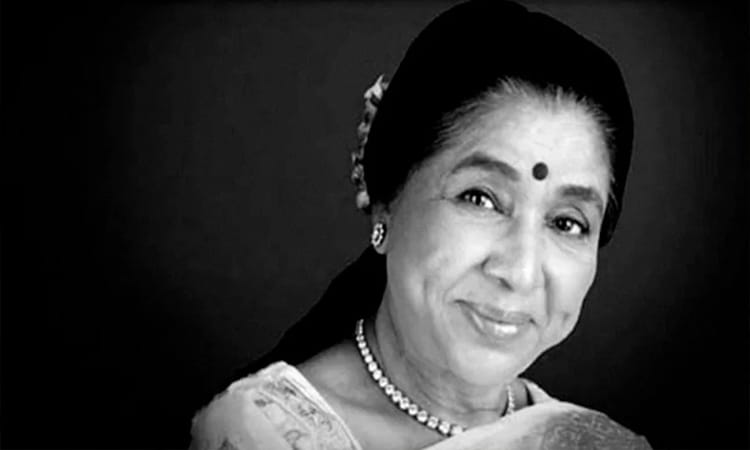
There is something especially moving about losing an artist who seemed to outrun time by sheer force of spirit. Even in later life, Asha Bhosle carried a brightness that made the word “legend” feel less like distance and more like personality. The public images and memories shared today do not show a remote institution. They show warmth, mischief, glamour, appetite for life, and the ease of someone who knew exactly who she was. That combination—greatness without stiffness—is rarer than we admit.
What remains now is not silence. That may be the strangest and most consoling thing about the death of a singer. She is gone, but she has left behind one of the least silent legacies imaginable. Thousands of recordings remain, crossing languages, decades, actresses, moods, and moments in Indian cinema and beyond. AP says she recorded approximately 12,000 songs; whatever exact number one chooses, the scale itself is astonishing. Few artists have given so much of their voice to the world and still somehow kept its personality intact.
So how should one mourn Asha Bhosle? Not only with sadness, though sadness is deserved. Not only with praise, though praise is easy. Perhaps the better tribute is attention. To go back and listen carefully. To hear again how playful she could be without becoming frivolous, how sensual without becoming crude, how expressive without ever losing musical precision. To notice how she could bend a line just enough to make it feel conversational, then lift it into something unforgettable. To recognize, in other words, not just that she was beloved, but why.
Endings like this invite large phrases: end of an era, irreplaceable loss, voice of generations. All of them apply. But perhaps the simplest truth is the strongest. Asha Bhosle made life sound larger. She gave glamour to longing, energy to melancholy, and sophistication to feeling. She proved that versatility need not dilute identity; it can deepen it. She leaves behind not just songs, but moods, gestures, silhouettes of emotion that listeners will continue to inhabit for years to come.
Today India mourns her. Tomorrow it will continue to sing with her. And long after the official tributes fade, after the headlines move on, after the ceremonies are over, Asha Bhosle will remain where the greatest artists always remain: in the human voice of memory, arriving without warning, carrying half a century in a single line.