
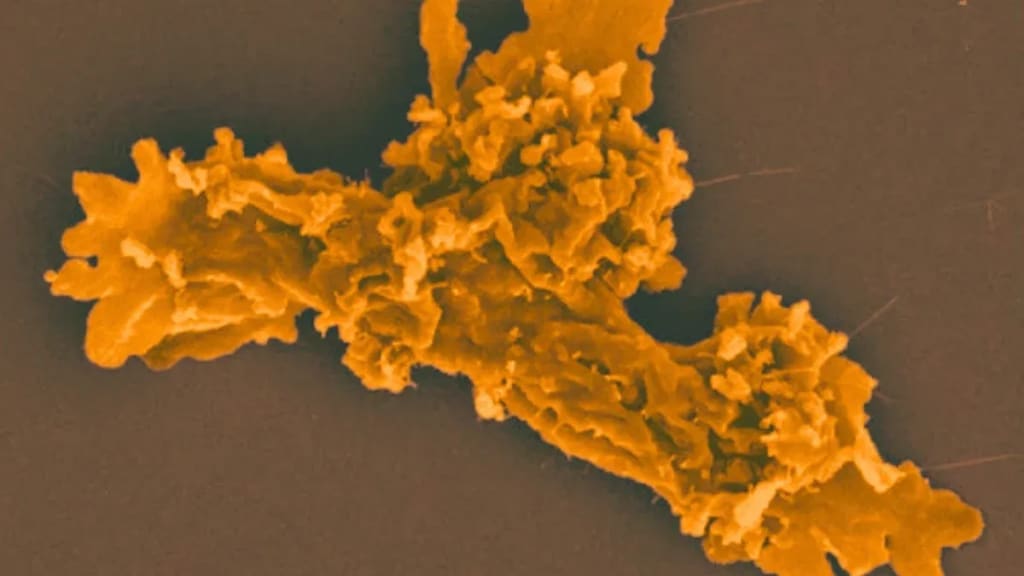
Scientists Found a “Fire Amoeba” That Reproduces at 145°F—and It Just Broke a Fundamental Limit of Complex Life
Imagine dropping a living cell into water hot enough to cause a serious burn within seconds.
At 145°F, or 63°C, proteins begin struggling to maintain their shapes. Cell membranes become increasingly unstable. Delicate molecular machinery risks falling apart.
For most organisms with complex cells, those conditions are fatal.
But one microscopic creature appears perfectly capable of continuing with one of life's most fundamental activities.
It divides.
Scientists have described a remarkable single-celled organism from the geothermal waters of California's Lassen Volcanic National Park that can reproduce at temperatures reaching 63°C, or 145.4°F.
Its name could hardly be more appropriate:
Incendiamoeba cascadensis
Loosely translated:
“fire amoeba from the Cascades.”
At 63°C, researchers directly observed the amoeba undergoing mitosis—the complex process by which a eukaryotic cell organizes and separates its chromosomes before dividing into two daughter cells.
That establishes a new experimentally demonstrated upper-temperature record for reproduction among all known eukaryotes, the enormous domain of life that includes animals, plants, fungi, algae, protists and humans.
The previous established upper growth limit was about 60°C, or 140°F, reached by a small number of heat-tolerant fungi and red algae.
Three degrees may not sound revolutionary.
Biologically, it is.
Researchers had even proposed that approximately 62°C could represent a fundamental ceiling for eukaryotic cells because the internal membranes surrounding their organelles might become unstable above that temperature.
The fire amoeba has now crossed it.
And reproduction is only part of the story.
The organism remains mobile at still higher temperatures, can survive brief exposure to 70°C, or 158°F, and responds to dangerous heat by radically changing its physical state.
The discovery suggests that scientists may have underestimated how far complex cellular life can be pushed—and raises a tantalizing question for biology and astrobiology:
If one eukaryote can live beyond a boundary scientists thought might be fundamental, what else have we not found yet?
The Fire Amoeba Was Found in Lassen Volcanic National Park
The discovery began in the geothermal landscape of Lassen Volcanic National Park in northern California.
Lassen lies at the southern end of the Cascade volcanic region, an environment filled with:
- geothermal streams;
- hot springs;
- steaming ground;
- volcanic chemistry;
- microorganisms adapted to extreme heat.
Researchers led by microbiologist Angela M. Oliverio of Syracuse University, with doctoral researcher H. Beryl Rappaport as first author, sampled geothermal environments there between 2023 and 2025.
The team found the unusual amoeba repeatedly along a tributary of Hot Springs Creek.
The original study reports finding it at 14 of 20 geothermal sampling sites, where water temperatures ranged roughly from 49°C to 65°C and the water was near neutral pH.
That immediately made the organism interesting.
Most eukaryotic cells are not expected to function in water anywhere near that hot.
But finding DNA or a cell in an extreme environment does not prove the organism actually lives and reproduces there.
It might simply have washed in from somewhere cooler.
So the researchers brought samples into the laboratory.
That is when things became extraordinary.
Researchers Kept Turning Up the Heat
The scientists cultured the amoeba across a broad range of temperatures.
Instead of merely tolerating heat, Incendiamoeba cascadensis turned out to require it.
The study found that the organism's minimum growth temperature was approximately:
42°C — 107.6°F
Below roughly 40°C, researchers detected no growth.
Its preferred range was much hotter:
55–57°C — approximately 131–135°F
And when the scientists continued increasing the temperature, the cells kept reproducing.
At:
63°C — 145.4°F
the amoeba was still dividing successfully.
Researchers directly visualized mitosis, confirming that this was not merely a cell hanging on in a damaged state.
It was completing one of the most complicated operations performed by a eukaryotic cell.
That makes I. cascadensis an obligate thermophile.
In other words, this organism does not merely survive conditions humans would consider unbearably hot.
It prefers them.
A temperature that would be dangerous for us is normal life for the fire amoeba.
Why 63°C Is Such a Big Deal
The difference between bacteria and eukaryotes matters enormously here.
Life on Earth can broadly be divided into organisms with two fundamental types of cellular organization.
Prokaryotes
Bacteria and archaea have comparatively simpler cellular architecture.
They do not contain a nucleus surrounded by a membrane.
They also lack many of the membrane-bound internal organelles found in eukaryotic cells.
Some archaea are extraordinarily heat tolerant.
The record holder for known cellular growth at extreme heat is the archaeon Methanopyrus kandleri, which has been reported growing at approximately:
122°C — 252°F
under the high-pressure conditions found around deep-sea hydrothermal systems.
That is dramatically hotter than the fire amoeba can tolerate.
So Incendiamoeba is not the hottest-growing organism on Earth.
It holds a more specific—and biologically important—record:
It is the hottest-growing known eukaryote.
Eukaryotic cells are architecturally much more elaborate.
They contain a nucleus protecting their DNA and may contain organelles such as:
- mitochondria;
- endoplasmic reticulum;
- Golgi apparatus;
- lysosomes.
These structures depend on delicate membranes and complex networks of proteins.
Heat threatens all of them.
NASA notes that high temperatures can destabilize proteins, damage biomolecules and disrupt membranes—the very components eukaryotic cells depend upon for their internal organization.
That complexity is why scientists suspected eukaryotes might face a relatively hard thermal ceiling.
The fire amoeba shows that ceiling was too low.
Scientists Once Suspected 62°C Might Be the Limit
Before Incendiamoeba cascadensis, the best-established high-temperature eukaryotic growth records were around 60°C.
A few fungi and red algae could reproduce near that temperature.
An earlier heat-tolerant amoeba, Echinamoeba thermarum, could grow at approximately 57°C.
Researchers had suggested that around 62°C might represent a theoretical upper boundary because membranes surrounding eukaryotic organelles might no longer remain sufficiently stable.
The new amoeba reproduces at 63°C.
NASA describes the finding as directly overturning that proposed constraint.
This is an important lesson in extremophile science.
Sometimes what appears to be a biological limit is actually an observational limit.
Scientists had not found a eukaryote reproducing beyond 60°C.
That did not necessarily mean no such organism existed.
It may simply have meant researchers had not cultured the right organism from the right place yet.
 Imrul
Imrul
The Fire Amoeba Can Move at Even Higher Temperatures
Reproduction is one way to define an organism's thermal limit.
Movement provides another.
Researchers used specialized high-temperature live-cell imaging to observe the amoeba while it was active.
The peer-reviewed study quantified movement up to approximately:
64°C — 147.2°F
Even though the organism stopped reproducing above 63°C, it did not immediately become inactive.
NASA reports that cells could remain partially active at 66°C, or 150.8°F, under experimental conditions.
That difference highlights an important concept when discussing the limits of life.
There is not one single “maximum temperature.”
Scientists can ask several separate questions:
Can an organism reproduce?
Can it move?
Can it metabolize?
Can it eat?
Can it survive temporarily?
Can it recover afterward?
For I. cascadensis, those limits are not identical.
Its reproductive ceiling appears to be around 63°C.
Its short-term survival ceiling is higher.
At 158°F, the Amoeba Changes Form to Survive
The most dramatic behavior appears when conditions become hotter still.
Above its normal growth range, the fire amoeba changes shape and produces a protective outer layer.
Cell Press describes this as a defensive transformation that allows the organism to endure temperatures that stop active reproduction.
When scientists exposed the cells to:
70°C — 158°F
they stopped behaving like normally active amoebae.
But they did not necessarily die.
After being returned to cooler conditions, the cells could recover.
NASA reports recovery after five minutes of exposure to 70°C.
This protective state is sometimes described informally as cyst-like.
The important point is that the organism switches from:
growth and movement
to:
survival mode.
It alters its structure to ride out conditions that exceed its normal operating range.
That is a powerful adaptation for an organism inhabiting geothermal streams where temperatures can shift rapidly across tiny distances.
But There Is Still a Limit
The fire amoeba is not indestructible.
Researchers pushed the cells further.
At:
80°C — 176°F
the amoebae did not recover.
NASA reports that this temperature proved beyond the organism's short-term survival capacity.
So its approximate thermal hierarchy looks like this:
42°C: lower limit for growth
55–57°C: optimal growth
63°C: maximum demonstrated reproduction
64°C: clearly quantified motility
66°C: partial activity observed under extreme exposure
70°C: short exposure survivable with later recovery
80°C: no recovery observed
These numbers reveal something more interesting than a single record.
The organism has multiple layers of thermal defense.
It does not simply function normally until one temperature and instantly die one degree later.
As conditions worsen, its biology changes strategy.
What Happens to Ordinary Cells at These Temperatures?
Heat is dangerous because biological molecules depend on extremely precise three-dimensional structures.
Proteins are especially vulnerable.
A protein is not simply a chain of amino acids.
It must fold into a specific shape to perform its function.
Too much heat can cause proteins to unfold.
When unfolded proteins accumulate, they can:
- lose their function;
- stick together;
- form harmful aggregates;
- disrupt cellular processes.
Heat can also damage DNA.
Cell membranes face another problem.
Membranes need to remain fluid enough to function but structured enough to hold the cell and its organelles together.
Rising temperature increases molecular motion.
Eventually membranes can become excessively fluid or unstable.
For a eukaryote, that problem is multiplied because it possesses internal membrane systems in addition to its outer cell membrane.
This is one reason the fire amoeba's temperature tolerance is so surprising.
It is maintaining an entire network of complex cellular machinery under conditions once suspected to be fundamentally incompatible with that machinery.
Its Genome Contains Clues to How It Does It
The researchers sequenced the genome of Incendiamoeba cascadensis and compared it with related amoebae.
Several biological systems stood out.
The fire amoeba contained expanded or enriched sets of genes associated with:
- maintaining proteins;
- protecting genome stability;
- sensing environmental conditions.
At higher temperatures, researchers also observed increased activity in pathways associated with:
- protein folding;
- DNA repair;
- membrane transport.
Together, these systems suggest the amoeba is constantly fighting the molecular consequences of heat.
Instead of possessing one magical “heat resistance gene,” it appears to use a collection of defenses.
That makes evolutionary sense.
Extreme heat threatens many parts of the cell simultaneously.
Surviving it requires a systems-level response.
Protein Maintenance May Be One of Its Greatest Secrets
Cells have sophisticated machinery for maintaining protein quality, collectively known as proteostasis.
Proteostasis includes processes that:
- help proteins fold correctly;
- stabilize them;
- refold damaged proteins;
- destroy proteins that cannot be repaired.
The fire amoeba appears unusually well equipped for these tasks.
Researchers found enrichment in genes associated with protein homeostasis and observed heat-dependent changes in protein-maintenance pathways.
That is critical because protein instability is one of the fundamental reasons heat kills cells.
If I. cascadensis can keep proteins functioning several degrees beyond the normal eukaryotic boundary, it may reveal general strategies for building heat-resistant proteins.
And that has potential uses far beyond amoeba biology.
Its Proteins May Be Built Differently
The researchers also found an intriguing structural pattern.
Proteins in Incendiamoeba tend to have more positively charged amino acids on their surfaces than equivalent proteins in many organisms adapted to lower temperatures.
Similar features occur in certain heat-loving bacteria and archaea.
The remarkable part is that these organisms are evolutionarily very distant.
The amoeba did not simply inherit the same cellular system from a closely related heat-loving archaeon.
Instead, evolution appears to have arrived at some comparable molecular solutions independently.
Biologists call this convergent evolution.
Different lineages encounter the same environmental challenge.
Natural selection repeatedly discovers similar answers.
In this case:
How do you stop proteins falling apart when your environment is hotter than 60°C?
DNA Repair Matters Too
High temperatures can also increase molecular damage affecting genetic material.
That is especially challenging for eukaryotes because their chromosomes must be carefully duplicated and segregated during cell division.
The researchers found that the fire amoeba possesses expanded genetic resources associated with genome protection and that DNA-repair pathways become more active during high-temperature stress.
That helps explain why directly observing mitosis at 63°C was so important.
Survival alone would show that the cell's basic structure could endure the temperature.
Mitosis proves something much harder.
The amoeba must:
copy its DNA,
organize chromosomes,
construct its microtubule machinery,
separate chromosomes,
reorganize membranes,
and divide successfully.
Doing all of that at 145°F demonstrates that eukaryotic cellular machinery is more thermally robust than previously recognized.
Scientists Actually Watched Mitosis at 63°C
One of the most striking images from the study shows an Incendiamoeba cell dividing at 63°C.
Researchers used advanced microscopy to visualize major cellular components.
In the published image:
- DNA is shown in blue;
- tubulin is shown in pink;
- the cell membrane appears gray.
The cell is visibly progressing through mitosis at a temperature once thought beyond the practical growth limit for eukaryotes.
That image is scientifically important because it converts an abstract claim into a directly observed cellular event.
The organism is not merely present.
It is not dormant.
It is not barely surviving.
Its internal division machinery is operating.
What Exactly Is an Amoeba?
“Amoeba” is a descriptive term for single-celled eukaryotes that typically move and feed by changing shape.
They extend temporary cellular projections called pseudopodia, allowing them to crawl across surfaces and engulf food.
The newly described fire amoeba belongs within Amoebozoa, specifically a group called Tubulinea.
Genomic analyses place it near other amoebae, but its genetic differences were large enough that the researchers proposed an entirely new genus:
Incendiamoeba.
The species name cascadensis refers to the Cascade mountain region where it was discovered.
The full name therefore roughly communicates exactly what it is:
the fire amoeba from the Cascades.
It Is a Predator in Its Microscopic Ecosystem
The fire amoeba is not simply sitting in hot water absorbing chemicals.
It eats.
Amoebae are heterotrophs, meaning they obtain energy and nutrients by consuming other organisms or organic material.
In its geothermal environment, Incendiamoeba feeds on heat-adapted microbes.
Reuters describes it as effectively occupying a predatory role in its microscopic food web, grazing on bacteria adapted to the same hot environment.
This makes its habitat more interesting from an ecological perspective.
Scientists are not merely looking at one extraordinary cell surviving alone.
They are looking at an extreme-temperature ecosystem containing interactions between different organisms.
That distinction becomes particularly important when thinking about extraterrestrial life.
“Complex Life” Needs Some Clarification
News reports often describe the fire amoeba as breaking the temperature record for complex life.
That phrase can be misleading if interpreted as meaning a large multicellular animal or plant.
Incendiamoeba cascadensis consists of one cell.
Its complexity is cellular.
It is a eukaryote, meaning its cell possesses internal structures including a nucleus and membrane-bound machinery more architecturally elaborate than typical bacterial and archaeal cells.
NASA notes that eukaryotes range from single-celled organisms all the way to plants and humans.
So the discovery does not mean an animal could live happily at 63°C.
It means that the eukaryotic type of cellular organization can continue reproducing at higher temperatures than previously demonstrated.
That is still a major discovery.
The Previous Record Was Only Three Degrees Lower—Why Does That Matter?
Scientific records near biological limits do not need to jump dramatically to matter.
Imagine discovering a human capable of surviving indefinitely at a condition previously thought physiologically impossible.
The important point would not necessarily be the size of the numerical difference.
It would be that the supposed boundary was not actually a boundary.
Angela Oliverio compared the discovery to sports records: breaking a record by a tiny amount still changes what we understand to be possible.
The fire amoeba shifts the demonstrated eukaryotic reproduction ceiling from approximately:
60°C
to:
63°C.
More importantly, it suggests scientists should not assume 63°C is the final number either.
Related Heat-Loving Amoebae May Exist Around the World
When the team searched genetic datasets from other geothermal environments, they found related DNA sequences from places including:
- Yellowstone National Park;
- geothermal environments in New Zealand.
NASA says these matches suggest additional relatives of Incendiamoeba may already inhabit hot environments around the world.
Some could potentially possess similar heat tolerance.
Others might exceed it.
This is one of the discovery's most exciting implications.
The new record may exist partly because microbiologists simply have not systematically cultured enough eukaryotes from the hottest environments.
The next record-breaker could already be living in another hot spring.
Extremophile Research Has Historically Focused on Bacteria and Archaea
Scientists have long investigated extreme environments.
Hydrothermal vents and hot springs contain organisms capable of surviving:
- extreme heat;
- acidity;
- high salinity;
- pressure;
- toxic chemistry.
But much of extremophile research has focused on bacteria and archaea.
There is good reason for that.
These organisms include some of Earth's most spectacular extremophiles.
Eukaryotes appeared to have substantially narrower thermal limits.
That may have encouraged a scientific feedback loop.
Researchers expected the hottest environments to contain mostly prokaryotes.
So fewer studies targeted eukaryotes there.
The fire amoeba suggests that researchers may need to search much more aggressively.
As Rappaport told NASA, assumptions about the thermal instability of eukaryotic membranes may themselves have limited the environments scientists investigated.
The Discovery Could Have Biotechnology Applications
Extremophiles have a history of producing extraordinarily useful biological molecules.
Perhaps the most famous example is Thermus aquaticus, a heat-loving bacterium discovered in Yellowstone.
Its heat-resistant DNA polymerase eventually became the basis for Taq polymerase, an enzyme fundamental to polymerase chain reaction, or PCR.
PCR transformed:
- genetics;
- diagnostics;
- forensic science;
- medical research.
That history explains why newly discovered thermophiles receive attention beyond ecology.
If proteins from Incendiamoeba remain stable at temperatures that destroy ordinary eukaryotic proteins, those molecules may have useful industrial properties.
The authors specifically identify potential applications involving:
- thermostable enzymes;
- protein stabilization;
- synthetic biology.
No specific commercial technology has yet emerged from the fire amoeba.
But the biological toolkit it uses to survive extreme heat is now available for scientists to investigate.
Could Its Biology Help Build Heat-Resistant Crops?
This possibility has already attracted interest.
Understanding how Incendiamoeba protects:
- proteins;
- DNA;
- membranes;
could theoretically inform biotechnology aimed at increasing thermal resilience in other cells.
But translating adaptations from a single-celled amoeba into a crop plant would be extraordinarily complicated.
Plants are multicellular systems with:
- tissues;
- reproductive organs;
- water transport;
- photosynthesis;
- developmental programs.
There is no single fire-amoeba gene scientists can simply insert to make wheat thrive at 60°C.
Still, discovering new molecular mechanisms for protein stability or DNA protection could eventually contribute to engineering heat-resistant biological systems.
The near-term scientific value is more fundamental:
understanding how eukaryotic cells survive heat.
Why NASA Helped Fund the Research
NASA's involvement makes sense once the study is viewed through astrobiology.
To search for extraterrestrial life intelligently, scientists need to understand the limits of life on Earth.
If researchers believe complex cells cannot reproduce above 60°C, then extraterrestrial environments hotter than that may appear less promising for eukaryote-like biology.
Change the limit, and the potential search space changes.
NASA-supported researchers therefore study extremophiles living under conditions involving:
- extreme heat;
- extreme cold;
- high radiation;
- unusual chemistry;
- high pressure.
Each organism helps establish what biology is physically capable of doing.
Does the Fire Amoeba Mean Complex Alien Life Could Live in Extreme Heat?
It makes certain possibilities broader.
It does not demonstrate extraterrestrial life exists.
The discovery tells scientists that eukaryotic cellular architecture can function at temperatures higher than previously demonstrated.
That expands the range of environmental conditions researchers might consider biologically plausible.
But temperature alone does not make an environment habitable.
Rappaport emphasized that the organism also requires suitable:
- acidity;
- oxygen;
- pressure;
- liquid water;
- food.
And crucially, it depends on other organisms in its ecosystem.
A hot alien ocean with no nutrients would not become habitable merely because its temperature is below 63°C.
Habitability is always a combination of conditions.
The Discovery Has an Interesting Link to the Search for Life Beyond Earth
Astrobiologists often search for microbial life because single cells are the simplest biological systems known to survive extreme environments.
But scientists also want to understand when more internally complex cells become possible.
Eukaryotic organization was a major evolutionary transition on Earth.
Every known:
animal,
plant,
fungus,
and protist
depends on that type of cellular architecture.
Finding that eukaryotic cells tolerate more extreme temperatures than previously demonstrated broadens our understanding of where similar cellular complexity might theoretically arise or persist.
NASA astrobiologist Alison Olcott summarized the implication: discovering eukaryotes at higher temperatures expands not only where scientists might imagine life existing, but also how complex that life might be.
Could the Fire Amoeba Survive on Mars?
Not simply by being placed there.
Mars presents an entire suite of hostile conditions including:
- extremely low atmospheric pressure;
- intense radiation;
- limited accessible liquid water;
- extreme dryness;
- very low temperatures across much of the surface.
The fire amoeba is a heat specialist, not a universal extremophile.
It evolved in warm, wet terrestrial ecosystems containing oxygen and microbial prey.
Its astrobiological value is therefore not that it could necessarily live on Mars.
Its value is that it teaches researchers not to underestimate biological adaptability.
It Might Even Be Vulnerable to Cold
Perhaps the most amusing thing about the fire amoeba is that conditions comfortable for humans may actually be too cold for it.
Its minimum demonstrated growth temperature is around 42°C, or nearly 108°F.
At 40°C and below, researchers found no significant growth.
A normal room at 20–25°C would therefore not be a comfortable environment for this organism.
Even human body temperature—approximately 37°C—is below its observed growth range.
To us:
145°F sounds lethal.
To the amoeba:
72°F may be the problem.
That is what being an obligate thermophile really means.
Is the Fire Amoeba Dangerous to Humans?
There is currently no evidence from this study that Incendiamoeba cascadensis is a human pathogen.
Its preferred temperatures are actually considerably hotter than the human body.
The organism was studied because of its extreme thermal biology, not because researchers identified it as a disease threat.
“Amoeba” does not automatically mean dangerous.
There are enormous numbers of amoeboid organisms, most of which do not cause human disease.
A small number of species receive disproportionate attention because of rare but serious infections.
Incendiamoeba is interesting for an entirely different reason.
It likes heat.
The Fire Amoeba Was Actually Revealed Before the 2026 Cell Paper
There is another useful detail for interpreting headlines.
The organism did not suddenly appear in scientific awareness on September 22, 2026.
The research team posted a bioRxiv preprint in November 2025 describing the discovery and its record-breaking temperature tolerance.
The work subsequently received scientific and media attention before formal journal publication.
What happened on September 22, 2026 was the publication of the peer-reviewed study in Cell.
The final paper is titled:
“A geothermal amoeba sets a new upper temperature limit for eukaryotes.”
Its DOI is 10.1016/j.cell.2026.08.043.
So the current breakthrough is best described as the peer-reviewed publication and confirmation of a discovery first publicly reported in preprint form in late 2025.
Scientists May Have Been Looking at the Wrong Limits
Perhaps the most interesting idea to emerge from the study is philosophical rather than molecular.
Scientists often need boundaries.
What is the hottest temperature life can tolerate?
How acidic can an environment become before biology fails?
How much radiation is too much?
These limits help organize research.
But biological records repeatedly move.
A newly found organism occupies a niche nobody had properly studied.
An adaptation is discovered that scientists did not anticipate.
A theoretical constraint turns out to be less rigid than expected.
The fire amoeba is a perfect example.
A proposed 62°C barrier for complex cellular organization sounded reasonable.
Then a cell divided at 63°C.
The lesson is not that biological limits do not exist.
Physics guarantees they do.
The lesson is that we may not yet know exactly where they are.
The Biggest Discovery May Be What Comes Next
Incendiamoeba cascadensis was found in an American national park.
Its relatives appear to leave genetic traces in geothermal environments elsewhere.
That immediately raises the possibility that even more extreme eukaryotes are waiting to be cultured.
Perhaps 63°C is close to the actual biological ceiling.
Perhaps another species grows at 65°C.
Or 68°C.
Nobody yet knows.
Oliverio argues that researchers should continue testing these boundaries rather than assuming earlier records represent hard limits.
That is how science advances.
Someone measures the edge.
Then someone looks beyond it.
The Bottom Line
Scientists have identified a remarkable new amoeba from geothermal streams in California's Lassen Volcanic National Park.
The organism, Incendiamoeba cascadensis, can reproduce at:
63°C — 145.4°F
That is the highest confirmed growth temperature for any known eukaryote, breaking the previous record of about 60°C held by a small number of fungi and red algae.
Its preferred growth temperature is approximately:
55–57°C — 131–135°F
It does not grow below roughly:
42°C — 108°F
making it a true heat-loving organism rather than merely an amoeba capable of tolerating occasional warmth.
Researchers observed movement up to approximately 64°C, while NASA reports partial activity under experimental conditions as high as 66°C.
At approximately:
70°C — 158°F
the organism changes shape and forms a protective outer layer. After a short exposure, cells can recover when returned to cooler conditions.
At 80°C, recovery was no longer observed.
Its genome offers possible explanations.
The amoeba is enriched in systems associated with:
protein maintenance,
DNA stability,
environmental sensing,
and heat-stress repair.
Its proteins also display structural characteristics resembling adaptations independently seen in heat-loving bacteria and archaea.
The peer-reviewed research was published in Cell on September 22, 2026, after an earlier preprint appeared in November 2025.
The discovery does not mean all complex organisms can suddenly tolerate 145°F.
Amoebae are single-celled eukaryotes.
Humans, animals and plants have additional layers of physiological complexity that impose very different limitations.
But at the cellular level, the finding changes an important boundary.
Scientists once suspected the internal architecture of a eukaryotic cell might simply become unstable beyond about 62°C.
Then they looked at Incendiamoeba cascadensis.
At 63°C, its DNA was still being organized.
Its molecular machinery was still functioning.
Its membrane was still intact.
And under the microscope, the cell did something remarkably ordinary.
It divided into two.
Sometimes the most profound scientific discoveries are not dramatic because life does something completely new.
They are dramatic because life continues doing something normal in a place where we thought it could not.
Frequently Asked Questions
What is the fire amoeba?
The fire amoeba is a newly described heat-loving single-celled eukaryote named Incendiamoeba cascadensis.
Where was the fire amoeba discovered?
It was isolated from geothermal streams in Lassen Volcanic National Park, California.
Why is it called Incendiamoeba cascadensis?
The name roughly means “fire amoeba from the Cascades,” referring to its extreme heat tolerance and the Cascade volcanic region where it was found.
How hot can the fire amoeba survive?
It can reproduce at 63°C and survive brief exposure to temperatures as high as 70°C under experimental conditions.
What is 63°C in Fahrenheit?
63°C is approximately 145.4°F.
Can the fire amoeba really reproduce at 145°F?
Yes. Researchers directly observed mitosis and population growth at 63°C.
What is the hottest temperature at which it can reproduce?
The maximum demonstrated growth temperature is 63°C.
Can it move at temperatures hotter than that?
Yes. Researchers quantified movement at approximately 64°C, and NASA reports partial activity at temperatures as high as 66°C.
What temperature does it prefer?
Its optimal growth range is approximately 55–57°C, or 131–135°F.
Can it grow at room temperature?
No. Researchers detected no growth at 40°C or below.
What is its minimum growth temperature?
Approximately 42°C, or 107.6°F.
What happens at 70°C?
The cells change shape and develop a protective outer layer. They can recover after a short 70°C exposure when temperatures return to safer levels.
Can it survive boiling water?
No.
Boiling water at normal atmospheric pressure is about 100°C, far above the fire amoeba's demonstrated survival range.
What happens at 80°C?
NASA reports that cells exposed to 80°C did not recover.
Is this the hottest-living organism on Earth?
No.
Some archaea can grow at substantially higher temperatures.
What organism holds the overall heat record?
The archaeon Methanopyrus kandleri has been reported growing around 122°C under high pressure, considerably hotter than any known eukaryote.
What record does the fire amoeba hold?
It has the highest experimentally demonstrated growth temperature of any known eukaryotic organism.
What is a eukaryote?
A eukaryote is an organism whose cells contain a nucleus and other complex internal structures.
Are humans eukaryotes?
Yes.
Humans, animals, plants, fungi and many single-celled organisms are eukaryotes.
Is an amoeba considered complex life?
The term requires context.
The fire amoeba is single-celled, but it has a complex eukaryotic cellular architecture containing a nucleus and membrane-bound structures.
What held the previous eukaryotic heat record?
A few species of fungi and red algae could reproduce at approximately 60°C.
How much did the fire amoeba break the record by?
About 3°C.
Why is a three-degree difference important?
Because researchers had proposed that around 62°C might represent a fundamental stability limit for eukaryotic organelle membranes. The amoeba demonstrates successful cell division beyond that proposed boundary.
What is a thermophile?
A thermophile is an organism adapted to growing at high temperatures.
Is Incendiamoeba an obligate thermophile?
Yes.
Its growth requires elevated temperatures, with no significant growth detected at 40°C or below.
How does the fire amoeba survive such extreme heat?
Its genome contains adaptations associated with protein maintenance, DNA protection, environmental sensing and membrane function.
Why are proteins vulnerable to heat?
Heat can cause proteins to lose their three-dimensional shape, preventing them from functioning correctly and potentially causing damaging aggregates.
How does the amoeba protect its proteins?
Researchers found enhanced protein-maintenance systems and structural features in its proteins that may increase heat stability.
Does it have special DNA-repair mechanisms?
The study found enrichment and increased activity in pathways associated with genome stability and DNA repair during heat stress.
Why is mitosis at 63°C especially impressive?
Mitosis requires chromosomes, microtubules, proteins and membranes to coordinate precisely. Demonstrating successful cell division shows the entire eukaryotic cellular system remains functional at that temperature.
Did researchers actually photograph it dividing?
Yes. The study includes microscopy showing cells undergoing mitosis at 63°C.
When was the fire amoeba discovered?
The researchers sampled the geothermal environment between 2023 and 2025. The discovery was publicly described in a 2025 preprint and formally published in Cell in September 2026.
When was the peer-reviewed study published?
September 22, 2026.
Where was the study published?
In the scientific journal Cell.
What is the study called?
“A geothermal amoeba sets a new upper temperature limit for eukaryotes.”
Who led the research?
H. Beryl Rappaport was the first author, and Syracuse University microbiologist Angela M. Oliverio was the corresponding author.
Did NASA fund the study?
NASA was among several organizations supporting the research.
Why is NASA interested in an amoeba from California?
Extremophiles help astrobiologists understand the environmental limits within which life can function, informing the search for potentially habitable environments elsewhere.
Does this prove alien life exists?
No.
It expands our understanding of conditions that Earth life can tolerate but provides no direct evidence of extraterrestrial organisms.
Could similar life exist on another planet?
Potentially, if suitable temperature, liquid water, chemistry, pressure, nutrients and ecological resources were available.
Could the fire amoeba live on Mars?
There is no evidence that it could. Mars presents numerous challenges beyond temperature, including low pressure, radiation and lack of stable surface liquid water.
Does the amoeba live alone?
No. It feeds on other microorganisms, meaning its survival depends on a broader microbial ecosystem.
What does the fire amoeba eat?
It feeds on heat-adapted microorganisms, including bacteria in its geothermal habitat.
Is the fire amoeba dangerous to humans?
There is currently no evidence from the study that Incendiamoeba cascadensis causes human disease.
Could it survive inside a human body?
Its known minimum growth temperature is above normal human body temperature, so humans are actually too cool for its demonstrated growth range.
Could the discovery have practical uses?
Potentially.
Heat-stable proteins and cellular mechanisms discovered in thermophiles can have applications in biotechnology, industrial enzymes and synthetic biology.
Could it help scientists create heat-resistant crops?
Its molecular adaptations may eventually inspire research into heat-tolerant biological systems, but directly transferring its extreme heat resistance to crops would be far more complicated.
Are there more fire amoebae waiting to be discovered?
Possibly.
Researchers found related genetic sequences in geothermal datasets from locations including Yellowstone and New Zealand, suggesting similar heat-loving amoebae may have a wider global distribution.
Could another eukaryote break the 63°C record?
Absolutely.
The new finding demonstrates that the previous record was not a hard limit, and researchers now have reason to search more intensively in extremely hot environments.
What is the biggest lesson from the discovery?
Scientists once thought the architecture of a eukaryotic cell might become fundamentally unstable above roughly 60–62°C.
Incendiamoeba cascadensis demonstrates otherwise.
At 63°C, the cell still organizes its DNA, operates its molecular machinery and completes mitosis.
The fire amoeba therefore does more than break a temperature record.
It reminds us that when biology appears to have reached a hard boundary, sometimes the boundary marks only the hottest place we have looked carefully enough.


