
Why Butterflies Drink Turtle Tears: The Strange Science of Lachryphagy
It looks like an image invented for a children's story.
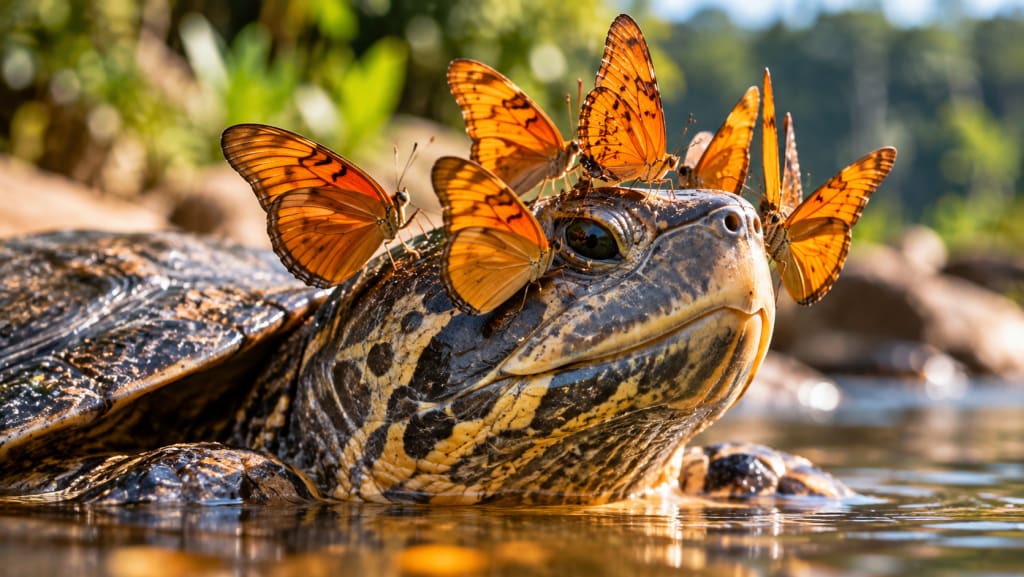
A turtle rests quietly on a log in the tropical sun.
Several bright orange butterflies settle delicately around its head.
Then, one by one, they extend their long proboscises toward the turtle's eyes and begin to drink.
The photographs are real.
And the butterflies are not comforting the turtle, cleaning its eyes out of kindness or participating in some mystical friendship.
They are looking for nutrients.
The behavior is known as lachryphagy, or tear-feeding—the consumption of tears and other eye secretions by animals, especially certain butterflies, moths, bees and other insects.
For butterflies living in nutrient-poor tropical environments, the attraction is particularly important: flower nectar provides plenty of carbohydrates but can be deficient in minerals such as sodium. Tears offer a concentrated alternative source.
Scientists have documented tear-feeding insects visiting turtles, crocodilians, birds and mammals. Recent observations have even expanded the known behavior to animals such as moose and lizards.
But one popular description of these encounters needs correcting.
This is probably not a beautiful example of mutual cooperation.
The butterfly clearly benefits.
Whether the turtle benefits at all is uncertain.
In many cases, the interaction appears closer to commensalism—one species gains while the other is largely unaffected. And scientists cannot rule out irritation or disease transmission in every tear-feeding interaction.
That makes the reality even more fascinating than the fairy-tale version.
The butterflies are not being kind.
They are solving a nutritional problem.
Yes, Butterflies Really Drink Turtle Tears
The famous images are not an internet myth.
One widely circulated photograph taken in Ecuador in 2012 shows Julia butterflies, Dryas iulia, feeding around the eyes of basking freshwater turtles.
The image became so striking that it spread widely through nature websites and social media, helping make lachryphagy one of the internet's favorite strange-animal facts.
Similar behavior has been observed elsewhere in tropical Central and South America.
Butterflies and other insects may approach turtles while the reptiles are resting or basking, land on the head and extend a proboscis toward moisture around the eye.
To us, it resembles drinking someone's tears.
Biologically, that is essentially what they are doing.
What Is Lachryphagy?
Lachryphagy refers to feeding on tears or ocular secretions.
It is most famously documented among butterflies and moths—the insect order Lepidoptera—but the behavior is not limited to them.
Researchers have recorded forms of tear-feeding involving:
- butterflies
- moths
- stingless bees and other bees
- flies
- cockroaches
Their hosts can include:
- turtles and tortoises
- crocodiles and caimans
- birds
- large mammals
- humans
- lizards
A scientific review of unusual feeding among butterflies and moths documented lachryphagy alongside sweat-feeding and, in a smaller number of species, blood-feeding.
So the turtle-and-butterfly photograph is extraordinary to look at, but the underlying strategy belongs to a much wider world of unconventional insect feeding.
Why Would a Butterfly Need Tears?
Because butterflies cannot live on sugar alone.
Adult butterflies are strongly associated with flower nectar, and nectar is an excellent source of carbohydrates.
Those carbohydrates supply energy needed for:
flight,
foraging,
courtship,
escaping predators,
and other metabolic activities.
But nectar does not always provide all the minerals an insect needs in sufficient quantities.
One of the most important is sodium.
Sodium is essential for normal cellular function and plays important roles in nerve and muscle physiology.
Terrestrial plants generally contain much less sodium than animal tissues and fluids.
That creates a nutritional challenge for herbivorous insects.
A butterfly may obtain plenty of calories while still being short of certain micronutrients.
Sodium Is a Big Deal for Butterflies
Scientists recognized the importance of sodium in butterfly feeding behavior decades ago.
A classic 1974 experiment involving tiger swallowtail butterflies found that males were attracted to sodium-containing solutions at very low concentrations, supporting the idea that sodium acquisition is one of the central purposes of a behavior known as puddling.
Later research showed that sodium availability can influence biological traits including muscle and nervous-system investment in butterflies.
The lesson is simple:
Salt is not just seasoning for humans.
For many animals, sodium is a biologically valuable resource worth actively searching for.
Tear-Feeding Is Related to “Mud-Puddling”
If you have ever seen a crowd of butterflies gathered on wet soil, you may already have witnessed the more common version of this behavior.
It is called puddling or mud-puddling.
Instead of visiting flowers, butterflies gather on:
wet soil,
mud,
riverbanks,
animal dung,
urine,
carrion,
sweat,
or other mineral-rich surfaces.
They use their proboscises to take in fluid and extract dissolved nutrients.
National Geographic has documented butterflies feeding not only from flowers but also from dung, rotting animal material, sweat and tears in search of salts and other nutrients that are limited in their normal plant-based diets.
Lachryphagy can therefore be understood as a particularly dramatic form of nutrient scavenging.
Why settle for salty mud if a living animal is producing mineral-rich fluid from its eyes?
A Butterfly's Proboscis Is Perfect for the Job
Adult butterflies do not chew food the way mammals do.
Instead, they possess a long tubular mouthpart known as the proboscis.
When not being used, it is usually coiled.
When the butterfly feeds, it uncoils and functions somewhat like a flexible drinking tube.
This makes butterflies particularly well suited to extracting liquid from tiny sources.
Flower nectar is the obvious example.
But the same equipment works on:
fruit juice,
sap,
muddy water,
sweat,
and tears.
When a butterfly sits beside a turtle's eye, it can place the tip of its proboscis into the thin layer of fluid around the eyelid and draw from it.
The turtle therefore becomes, from the butterfly's perspective, a mobile mineral source.
Why Are Male Butterflies Often the Ones Puddling?
One particularly interesting detail is that male butterflies are frequently more enthusiastic puddle-feeders than females.
That has led researchers to connect sodium acquisition with reproduction.
In some butterfly species, males can transfer nutrients to females during mating as part of the spermatophore—the package containing sperm and additional substances.
Sodium obtained through puddling may therefore benefit male reproductive success and can potentially contribute nutrients later transferred to females.
This helps explain why a male butterfly might invest time and energy searching for unusual mineral sources instead of simply visiting flowers.
The tear is not dessert.
It may be reproductive capital.
Does Sodium Actually Improve Butterfly Mating Success?
There is evidence that sodium availability can influence reproductive biology, although the effects vary among species.
Research on butterfly puddling has investigated connections between sodium, male flight performance, courtship and mating success.
The broad conclusion is that mineral acquisition can matter substantially enough for natural selection to favor apparently bizarre feeding behavior.
So when a butterfly lands on a turtle's face, it may be doing something that ultimately helps it compete for mates or reproduce successfully.
Nature often produces beautiful scenes for very practical reasons.
Why Turtle Tears?
Tears contain water, salts and other dissolved compounds.
Studies of reptile and bird tears have detected electrolytes including:
sodium,
chloride,
potassium,
calcium,
and other components.
Researchers have also found proteins and compounds such as urea in tears from various animals.
This makes ocular fluid potentially valuable to nutrient-seeking insects.
But we should be careful with a popular claim often attached to the turtle photographs:
not every turtle involved is producing extremely salty tears simply because it lives in the sea.
Many of the iconic Amazon observations involve freshwater river turtles, not sea turtles.
So describing every case as butterflies exploiting a sea turtle's special salt-excretion system would be inaccurate.
The broader principle is safer:
eye secretions contain nutrients that some insects find valuable.
Sea Turtle “Tears” Are Especially Interesting
Sea turtles add another biological twist.
Living in salt water creates an enormous osmoregulatory challenge.
Sea turtles consume seawater and salty food, but their kidneys alone are not sufficient for eliminating all of the excess salt.
They possess specialized glands near the eyes that help excrete concentrated salts.
The secretion can look like crying.
Researchers studying green turtles have directly measured sodium secretion and tear production by these salt glands.
So when humans see a sea turtle apparently “crying,” especially while nesting, those tears should not automatically be interpreted emotionally.
They perform important physiological functions.
Are Turtles Crying Because They Are Sad?
There is no evidence that turtles produce emotional tears in the human sense.
Humans are unusual in producing tears strongly associated with emotional states such as grief or joy.
Reptile ocular secretions primarily serve physiological purposes such as:
lubricating the eye,
protecting the ocular surface,
and, in marine turtles, helping eliminate excess salt.
Research comparing tears across birds and reptiles shows that these secretions are chemically complex and adapted to the animal's environment.
The poetic image of butterflies comforting a crying turtle is therefore misleading.
The turtle is not necessarily sad.
And the butterfly is definitely hungry for something.
Is Lachryphagy Common in the Amazon?
It is documented there, but calling it an everyday event would be misleading.
The Amazon provides excellent conditions for observing mineral-seeking behavior because sodium can be relatively scarce in terrestrial ecosystems.
Butterflies are frequently seen puddling along riverbanks.
Tear-feeding is much more unusual.
One field observer describing a spectacular aggregation of butterflies around Amazonian turtles estimated that seeing such an event with so many butterflies was extremely lucky.
That rarity partly explains why the photographs feel magical.
Even in environments where the biological conditions exist, seeing the interaction at the perfect moment is something special.
Bees Drink Turtle Tears Too
Butterflies do not have exclusive rights to reptile tears.
Researchers have documented bees feeding from the eyes of river turtles in the Ecuadorian Amazon.
A natural-history account from Yasuní National Park described bees visiting turtles and connected the behavior to the search for sodium and other nutrients that can be difficult for terrestrial herbivores to obtain.
Subsequent scientific literature has documented bees feeding from the eye secretions of:
turtles,
tortoises,
crocodilians,
and even green iguanas.
So the phenomenon is broader than the famous butterfly photographs suggest.
Moths Are Even More Adventurous Tear-Drinkers
Moths may be among the most remarkable lachryphagous insects.
Researchers have documented moths drinking from:
mammal eyes,
birds,
reptiles,
and humans.
In 2018, a researcher in Brazil observed a moth feeding around the eye of a sleeping black-chinned antbird in the Amazon.
The bird remained asleep while the moth used its proboscis near the eye.
The observation was significant because tear-feeding from birds had rarely been documented in that region.
And in 2025, researchers reported moths feeding around the eyes of a bull moose in Vermont—the first documented observation of its kind involving moose and a rare temperate-zone example of lachryphagy.
Apparently, even a moose can become an insect's mineral bar.
Cockroaches Can Drink Tears Too
The list gets stranger.
Researchers working in the Ecuadorian Amazon reported a cockroach positioned around the eye of a sleeping anole lizard.
The insect appeared to be feeding on ocular secretions.
The observation extended lachryphagy into another insect group and another reptile host.
The authors noted that tear-feeding appears to provide minerals and potentially proteins needed by insects whose normal diets may be nutrient limited.
Nature repeatedly arrives at the same solution:
If a nutrient-rich liquid is available, something will eventually evolve to drink it.
Does Tear-Feeding Hurt the Turtle?
This is where the viral version of the story becomes too confident.
Posts often say:
“It doesn't hurt the turtle at all.”
Science cannot support such an absolute statement.
In many photographed butterfly-turtle interactions, the turtles appear calm and continue basking.
That suggests the feeding may be minimally disruptive.
Researchers and conservationists often describe those cases as potential commensalism.
But “the turtle does not visibly react” is not the same as proving that the interaction has zero cost.
Possible concerns include:
eye irritation,
obstruction of vision when many insects gather,
microbial transfer,
and disease transmission.
A review of tear-feeding Lepidoptera has specifically discussed possible medical effects and pathogen transmission associated with lachryphagy.
The Turtle Conservation Society of Malaysia similarly notes that researchers cannot yet confidently classify all butterfly-turtle tear-feeding as harmless commensalism because potential ocular effects and pathogen transmission remain insufficiently studied.
So Is It Cooperation?
Probably not in the way social-media posts suggest.
Biologists distinguish several kinds of interspecies relationships.
Mutualism
Both species benefit.
Commensalism
One benefits while the other experiences little or no meaningful effect.
Parasitism
One benefits while the other experiences a cost.
In the classic butterfly-turtle scene, the butterfly clearly benefits.
The turtle's benefit is uncertain.
There is no strong evidence that butterflies provide the turtle with a useful service equivalent to the benefit they receive.
That makes commensalism a better working description when the turtle appears unaffected.
Calling it “pure cooperation” goes beyond the evidence.
Nature does not need every beautiful interaction to be a friendship.
Could the Turtle Actually Benefit?
People sometimes propose that butterflies might clean around the eye or remove substances that would otherwise attract more troublesome insects.
That is possible in principle.
But it has not been demonstrated strongly enough to describe the relationship confidently as mutualism.
Until researchers identify a measurable advantage for the turtle, the scientifically conservative interpretation is that the insect benefits while the turtle may simply tolerate it.
Sometimes doing nothing is the turtle's entire contribution.
Why Doesn't the Turtle Just Brush the Butterflies Away?
Turtles have limited options for removing a delicate insect sitting beside the eye.
A butterfly is extremely lightweight.
A basking turtle may also be focused on warming itself rather than reacting to every small contact.
In photographs, turtles sometimes appear remarkably tolerant.
But researchers have observed different reactions depending on the insect.
Some accounts suggest turtles may become more agitated around buzzing bees than around quietly perched butterflies.
So the turtle's apparent patience should not be romanticized as an intentional decision to “share.”
It may simply not be worth interrupting a good basking session.
Butterflies Have Stranger Diets Than Most People Realize
The popular image of a butterfly is almost aggressively wholesome.
Beautiful insect.
Beautiful flower.
Sweet nectar.
End of story.
Actual butterfly feeding ecology is considerably stranger.
Depending on the species, adults may consume fluids from:
rotting fruit,
tree sap,
mud,
animal droppings,
urine,
carrion,
sweat,
and tears.
Some butterflies have even been photographed feeding on dead fish or other animal remains.
These alternative foods can provide nutrients that flowers cannot.
The butterfly garden version of nature is therefore true.
It is simply incomplete.
Nectar Is Fuel, Not a Complete Diet
One way to think about butterfly nutrition is to separate energy from micronutrients.
Sugary nectar is excellent fuel.
But an organism also needs raw materials for physiological processes.
A human could not remain healthy indefinitely by eating only glucose dissolved in water.
Butterflies face their own version of that problem.
Their nutritional requirements differ from ours, of course, but the principle remains:
calories are not everything.
Puddling and lachryphagy allow butterflies to supplement an otherwise nutrient-limited adult diet.
Why Tropical Forests Encourage Strange Feeding Strategies
Tropical forests contain extraordinary biodiversity.
But abundant life does not mean every nutrient is equally abundant.
Some tropical soils are heavily weathered.
Rainfall can wash soluble minerals away.
Sodium in particular can be limited far from marine environments.
For animals dependent heavily on plants, that creates pressure to seek alternative mineral sources.
You can see similar behavior across the animal kingdom.
Parrots visit mineral-rich clay licks.
Mammals seek natural salt deposits.
Butterflies congregate on wet riverbanks.
And some insects go straight to the eyes of other animals.
Evolution does not care whether the solution looks elegant.
If it works, it can persist.
Tear-Feeding Shows How Species Become Connected in Unexpected Ways
The turtle is not evolving to feed the butterfly.
The butterfly is not helping the turtle raise its young.
Yet their lives intersect because one animal produces something another animal needs.
That is one of ecology's recurring themes.
Waste from one organism becomes a resource for another.
A secretion used for one physiological function acquires a completely different ecological function when another species discovers it.
The turtle's eye fluid exists for the turtle.
To the butterfly, it is a mineral source.
Both statements can be true simultaneously.
It Is Also a Reminder That Beautiful Nature Photos Can Hide Complicated Biology
A photograph freezes one moment.
We naturally create a story around it.
Butterflies gathering around a turtle look gentle.
So we imagine friendship.
A turtle appears still.
So we imagine generosity.
The scene resembles a fairy tale.
So we give it a fairy-tale explanation.
Science asks a different set of questions:
What nutrient is being transferred?
Which species benefits?
How common is the interaction?
Does the host experience a cost?
Which sex of butterfly participates?
Why did the behavior evolve?
The scientific explanation does not make the photograph less beautiful.
It makes the photograph deeper.
Is the Famous Butterfly-and-Turtle Photo Real?
Yes.
Authentic photographs of butterflies feeding around turtle eyes have existed for years.
A particularly famous Ecuadorian image from September 2012 depicts Julia butterflies feeding on turtles while the reptiles bask on a log.
However, the internet now contains many AI-generated and digitally manipulated wildlife images.
So a specific viral photograph should still be evaluated individually.
The existence of fake images does not make the biological behavior fake.
Lachryphagy itself is thoroughly documented.
Why This Nature Fact Goes Viral Again and Again
The appeal is easy to understand.
It combines opposites.
A heavy turtle.
A delicate butterfly.
A reptile.
An insect.
Tears.
Color.
Stillness.
And a behavior almost nobody expects.
It seems emotionally meaningful even though the biological explanation is nutritional.
There is also something wonderful about discovering that a familiar animal still contains surprises.
Everyone knows butterflies drink nectar.
Far fewer people know some butterflies also drink tears.
The Scientific Version Is Better Than the Myth
The viral version usually goes something like this:
A turtle cries.
Butterflies gently drink its tears.
The turtle willingly helps its beautiful friends obtain minerals.
Nobody is harmed.
Nature demonstrates perfect cooperation.
It is charming.
But the scientifically grounded version is much richer:
Certain butterflies are nutritionally limited by plant-based diets.
They have evolved behaviors for extracting sodium and other nutrients from unusual sources.
One of those sources is vertebrate eye fluid.
Freshwater turtles basking in tropical environments can become convenient feeding stations.
The butterflies benefit.
The turtles often appear to tolerate them.
Scientists are still determining whether the relationship is always harmless.
That is not less magical.
It is evolution doing what evolution does best:
finding opportunities nobody would have designed.
Nature Is Not Perfectly Balanced—It Is Constantly Negotiated
One final phrase from viral posts deserves reconsideration:
“Nature is perfectly balanced.”
Ecology is rarely that tidy.
Nature contains:
cooperation,
competition,
predation,
parasitism,
disease,
mutualism,
exploitation,
accidents,
and temporary arrangements that shift as environments change.
Lachryphagy is fascinating precisely because it does not fit easily into a sentimental story.
The butterfly's need for sodium intersects with the turtle's physiology.
The result happens to look beautiful.
But beauty is our interpretation.
The biology is about survival.
Butterflies Drinking Turtle Tears: The Real Takeaway
Yes, butterflies sometimes drink turtle tears.
Yes, the behavior has a wonderfully strange scientific name:
lachryphagy.
And yes, sodium and other nutrients are a major reason insects seek out animal tears and other bodily fluids.
But several common viral claims need refinement.
The turtles are not known to be emotionally crying.
Tear-feeding has not been proven universally harmless.
The interaction should not automatically be described as mutual cooperation.
And nectar deficiency is more complicated than simply saying butterflies need tears in order to survive.
What we are observing is an unusual form of supplementary feeding.
Butterflies exploit mineral sources wherever they can find them:
mud,
sweat,
dung,
carrion,
and, occasionally, the eye of a patient turtle.
It is one of those moments when natural history feels stranger than fiction.
A butterfly lands.
The turtle remains still.
A tiny proboscis uncoils.
And a nutrient that began inside one animal becomes part of the life of another.
No fairy tale required.
Nature came up with something stranger.
Frequently Asked Questions
Do butterflies really drink turtle tears?
Yes. Tear-feeding by butterflies on turtles has been documented and photographed in tropical regions, including Ecuador and the Amazon basin.
What is the behavior called when butterflies drink tears?
It is called lachryphagy, meaning feeding on tears or ocular secretions.
Why do butterflies drink turtle tears?
They are believed to obtain nutrients, especially sodium and other minerals, that can be limited in their normal plant-based diets.
Don't butterflies get everything they need from nectar?
No. Nectar is rich in carbohydrates but does not necessarily provide all required minerals in sufficient amounts. Butterflies can supplement their diet through puddling and other unusual feeding behaviors.
Why is sodium important for butterflies?
Sodium contributes to normal nerve and muscle function and can also influence reproductive biology. Research has demonstrated that sodium strongly stimulates puddling behavior in some butterflies.
Are male butterflies more likely to drink salty fluids?
In many species, males engage in puddling more frequently than females. Sodium acquired by males can contribute to reproductive function and, in some species, nutrients may be transferred to females during mating.
What is mud-puddling?
Mud-puddling is the behavior in which butterflies and other insects drink from wet soil or other moist surfaces to obtain salts and minerals.
Do butterflies drink anything besides nectar?
Yes. Depending on the species, adult butterflies may consume fluids from rotting fruit, tree sap, mud, dung, urine, carrion, sweat and tears.
What part of the butterfly drinks the tears?
The butterfly uses its long tubular mouthpart, called a proboscis, to draw up liquid.
Are turtle tears salty?
Turtle eye secretions contain electrolytes, including sodium and chloride. Sea turtles also possess specialized salt glands near their eyes that help eliminate excess salts.
Are all tear-drinking turtles sea turtles?
No. Some of the best-known photographs and observations involve freshwater river turtles.
Do turtles cry because they are sad?
There is no evidence that turtles produce emotional tears like humans. Their eye secretions primarily serve physiological functions such as protecting the eye and, in marine species, removing excess salt.
Does it hurt turtles when butterflies drink their tears?
Often the turtles appear relatively undisturbed, but scientists cannot say that tear-feeding is universally harmless. Possible eye irritation or pathogen transmission cannot be completely excluded.
Is the relationship between butterflies and turtles mutualism?
It has not been clearly demonstrated as mutualism because there is no established benefit to the turtle.
Is it commensalism?
When the butterfly benefits and the turtle experiences no meaningful effect, the interaction can reasonably be described as commensalism. Researchers remain cautious because the exact effects on turtles have not been fully studied.
Are butterflies helping clean the turtle's eyes?
There is no strong evidence showing that eye cleaning provides a significant benefit to turtles during these interactions.
Why doesn't the turtle remove the butterfly?
Butterflies are extremely lightweight, and basking turtles may simply tolerate them. The cost of reacting may be small compared with remaining still and continuing to bask.
Do bees drink turtle tears?
Yes. Bees have been documented feeding on turtle eye secretions, including observations in the Ecuadorian Amazon.
Do moths drink tears?
Yes. Numerous species of moths engage in lachryphagy. They have been observed feeding around the eyes of reptiles, mammals, birds and humans.
Do moths drink bird tears?
Yes. Researchers have documented moths feeding from the eyes of sleeping birds, including an observation involving a black-chinned antbird in the Brazilian Amazon.
Do insects drink mammal tears?
Yes. Tear-feeding has been documented on mammals, and a 2025 study reported moths visiting the eyes of a bull moose in Vermont.
Can insects drink human tears?
Some tear-feeding insects have been documented around human eyes as well. Certain species may cause discomfort, and tear-feeding insects can potentially carry pathogens.
Can cockroaches drink tears?
Apparently so. Researchers reported a cockroach apparently feeding on ocular secretions from an anole lizard in the Ecuadorian Amazon.
Are the famous photos of butterflies drinking turtle tears real?
Authentic photographs exist. A widely circulated 2012 image from Ecuador shows Julia butterflies drinking around the eyes of basking turtles.
What species of butterfly appears in the famous Ecuador photo?
The widely circulated photograph identifies the butterflies as Julia butterflies, Dryas iulia.
Where has butterfly lachryphagy been observed?
Tear-feeding occurs primarily in tropical and subtropical regions, with observations from Central and South America, Africa and Asia. Rare examples have also been documented in temperate regions.
Why is sodium scarce in some tropical forests?
Heavy rainfall and soil chemistry can make soluble minerals such as sodium relatively scarce in some terrestrial tropical environments, particularly for animals feeding largely on plants.
Why do butterflies gather on animal dung?
Dung can contain salts and other nutrients lacking in nectar. Butterflies can extract these dissolved nutrients using their proboscises.
Do butterflies eat dead animals?
Some butterflies drink fluids from carrion. They are not chewing flesh like a predator, but decomposing animal material can provide useful salts and nutrients.
Is lachryphagy rare?
It is much less commonly observed than ordinary nectar feeding or mud-puddling, although its frequency varies among species and environments.
Is lachryphagy unique to butterflies?
No. Moths, bees, flies, cockroaches and other insects have also been documented feeding on tears or ocular secretions.
Is tear-feeding dangerous to the animal?
Usually the photographed interactions appear mild, but some forms of lachryphagy can irritate the eye or potentially spread pathogens. The effect depends on the insect and host.
Is the butterfly-turtle interaction really “pure cooperation”?
That description is too strong. The butterfly clearly benefits, while no comparable benefit to the turtle has been established. Commensalism is a better tentative description when the turtle is unaffected.
What makes lachryphagy scientifically interesting?
It demonstrates how animals solve nutritional shortages by exploiting unexpected resources. A fluid produced by one species for its own physiological needs can become a valuable food source for another.
What is the biggest misconception about butterflies drinking turtle tears?
The biggest misconception is that the turtle is voluntarily helping its butterfly “friend.”
The reality is more fascinating:
the butterfly is opportunistically harvesting nutrients from the turtle's eye secretions, while the turtle often seems to tolerate the encounter.
It may look like a fairy tale.
But the evolutionary explanation is even stranger.


