
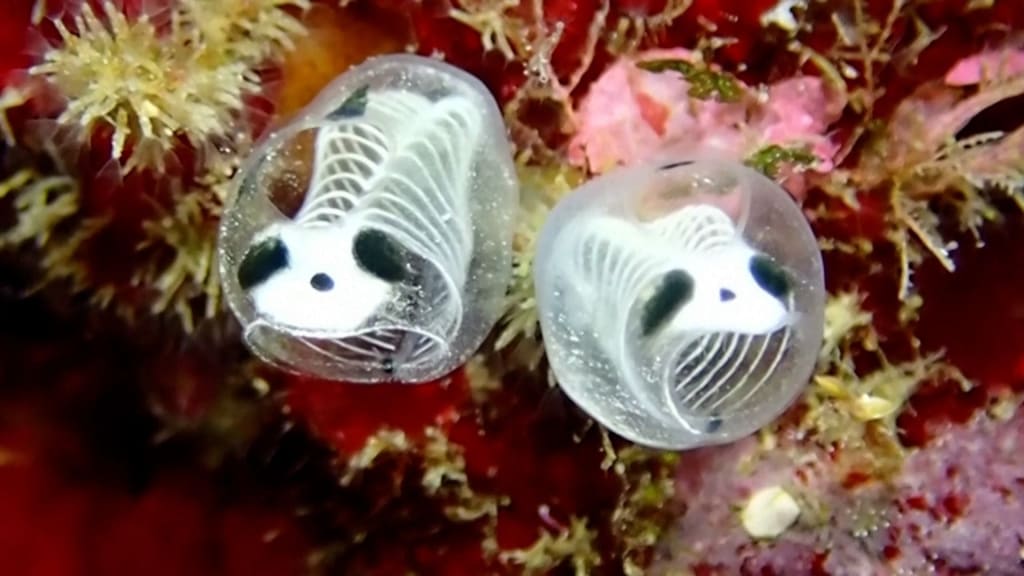
The Skeleton Panda Sea Squirt: The Tiny Ocean Animal That Looks Like a Panda Wearing a Skeleton
Yet the skeleton panda sea squirt is neither a panda nor a creature with visible bones.
Its scientific name is Clavelina ossipandae, and it belongs to a group of marine invertebrates known as ascidians, tunicates, or sea squirts. These small animals spend their adult lives attached to underwater surfaces, quietly filtering microscopic food from passing seawater.
What makes this particular species extraordinary is its appearance.
The front of its transparent body carries a white patch with dark markings that resemble the eyes and nose of a panda. Across the rest of the body, white horizontal blood vessels create the illusion of a tiny rib cage. A darker line lower on the body can even look like the end of a spine or tail.
Photographs of the unusual animal circulated among divers and across the Japanese internet before scientists formally confirmed that it represented a previously undescribed species. Researchers published its scientific description in February 2024 after examining specimens collected near Kumejima Island in Okinawa, Japan.
Despite its dramatic nickname, the animal is harmless.
It does not hunt, bite, sting, or chase prey. It survives by drawing seawater through its body, trapping microscopic particles, and releasing the filtered water through a second opening.
Its eerie appearance is simply the visible anatomy of a remarkably small filter feeder.
What Is the Skeleton Panda Sea Squirt?
The skeleton panda sea squirt is a colonial ascidian belonging to the genus Clavelina.
Its full scientific name is:
Clavelina ossipandae
The species was formally described by Japanese zoologists Naohiro Hasegawa and Hiroshi Kajihara in the journal Species Diversity. Their study compared its anatomy and DNA with other members of the genus and concluded that its distinctive combination of features justified recognition as a separate species.
An individual member of a sea-squirt colony is called a zooid.
In C. ossipandae, each zooid has its own transparent outer covering but remains connected to neighboring individuals through tissue at the base and short vascular connections known as stolons. The collected colonies contained between one and four zooids.
The zooids examined by the researchers measured approximately 7 to 14 millimeters long, although living individuals have been reported to reach about 20 millimeters.
That means the entire “panda skeleton” can be smaller than a human fingernail.
Why Is It Called the Skeleton Panda Sea Squirt?
The nickname came before the scientific name.
Japanese divers and internet users called the animal gaikotsu-panda-hoya, meaning “skeleton panda sea squirt” or “skeleton panda ascidian.”
The name refers to two visual features:
- The white-and-black pattern near the top resembles a panda’s face.
- The white transverse vessels look like the ribs of a skeleton.
When scientists formally named the species, they preserved the popular comparison.
The name ossipandae combines the Latin word os, meaning bone, with a Latinized reference to the giant panda. The researchers explained that the name was chosen because the animal’s white anterior region and black markings resemble a panda face, while its white transverse vessels evoke skeletal ribs.
The genus name Clavelina has a different origin. It can be translated as “little bottle,” referring to the bottle-like shape of many animals in this group.
Together, the full name effectively describes a tiny bottle-shaped creature that looks like a panda skeleton.
Is the White “Skeleton” Made of Bones?
No.
Sea squirts are invertebrates, meaning they do not possess the internal bony skeleton found in mammals, birds, reptiles, and many fish.
The white rib-like lines visible through the animal’s body are transverse blood vessels.
Because the surrounding body is colorless and transparent, these vessels stand out clearly. Their repeated horizontal arrangement creates an extraordinarily convincing illusion of ribs inside a tiny chest.
The resemblance is an example of pareidolia, the human tendency to recognize familiar shapes—especially faces—in unrelated patterns.
Humans readily perceive:
- Eyes in dark patches
- A nose in a central dot
- Ribs in repeated white lines
- A skull in the pale upper section
- A tail or spine in the lower black marking
The animal does not actually possess any of those panda-like features.
Its appearance results from ordinary biological structures arranged in a way that strongly resembles a familiar animal.
What Creates the Panda Face?
The scientific description identifies a white patch between the animal’s two siphons and four characteristic dark markings.
These include:
- A small black point between the siphons
- Two elongated black markings on the sides of the front region
- A dark line farther down the back
- A black endostyle visible through the transparent body
Together, the two side markings and central point create what looks like a panda’s eyes and nose.
Scientists have not yet established a clear purpose for the panda-like dark markings.
They may be related to pigmentation, internal anatomy, protection from light, signaling, camouflage, or another biological function. It is also possible that they have no special adaptive purpose beyond being part of the species’ inherited coloration.
The researchers formally described the pattern but did not demonstrate that it evolved to imitate any other animal. The resemblance to a panda exists primarily from a human point of view.
Where Was the Species Found?
The documented specimens came from Tonbara, a diving location off the southeastern coast of Kumejima Island in Japan’s Okinawa Islands.
Researchers collected four colonies on March 14, 2021, at depths between approximately 10 and 20 meters. The animals were growing around a large offshore rock in the East China Sea.
The location can be difficult to access outside winter because of tides, currents, wind direction, and sea conditions.
This difficulty may partly explain why the animal remained scientifically undescribed even after local divers had photographed it.
As of the formal description, the species was known only from the Tonbara site.
That does not necessarily mean it exists nowhere else.
Its actual distribution may be broader, but scientists cannot officially include additional regions until reliable observations or specimens confirm its presence there. Many small marine organisms remain overlooked because they live in restricted habitats, are difficult to collect, or closely resemble already known species.
Divers Discovered It Before Scientists Named It
The skeleton panda sea squirt demonstrates how local observation can contribute to scientific discovery.
Divers around Kumejima had photographed the strange animal before researchers formally examined it. Images shared by a local diving business attracted public attention because the creature did not resemble familiar sea squirts.
Its popularity eventually reached scientists, including ascidian specialist Naohiro Hasegawa.
Researchers then needed physical specimens.
Members of the public helped fund an expedition through crowdfunding, allowing scientists and local collaborators to travel to the remote diving site and collect colonies for analysis.
The species therefore followed an unusual path toward scientific recognition:
- Local divers saw and photographed it.
- Social media users gave it a memorable nickname.
- Public interest drew the attention of specialists.
- Crowdfunding supported specimen collection.
- Scientists studied its anatomy and DNA.
- The animal received an official scientific name.
This does not mean social-media popularity alone can establish a new species.
Formal taxonomy requires detailed comparison, preserved specimens, anatomical documentation, genetic evidence where available, and publication in a scientific journal.
However, public photographs can alert scientists to organisms they might otherwise never encounter.
How Scientists Confirmed It Was a New Species
An unusual appearance is not enough by itself to prove that an animal belongs to a new species.
Existing species can vary in color, size, or shape. Juveniles may look different from adults. Environmental conditions can alter pigmentation. Two species can also look nearly identical while being genetically distinct.
The researchers therefore examined several forms of evidence.
External Appearance
They documented the transparent body, white anterior patch, black markings, white transverse vessels, and colony structure.
Internal Anatomy
Specimens were dissected and examined for features such as:
- Muscle arrangement
- Digestive structures
- Pharyngeal slits
- Number of stigmatal rows
- Reproductive organs
- Larval anatomy
Colony Organization
The zooids were individually enclosed rather than deeply embedded together in one shared outer mass. They were connected mainly through their basal tissue and short vascular stolons.
Genetic Analysis
The researchers sequenced part of the mitochondrial cytochrome c oxidase subunit I gene, commonly used in animal identification and evolutionary comparison.
Their phylogenetic analysis supported placement of the species within Clavelina and indicated that it was closely related to Clavelina australis.
The final description distinguished C. ossipandae from 44 other recognized species in the genus using a specific combination of anatomical and visual traits.
What Exactly Is a Sea Squirt?
A sea squirt is a marine animal belonging to a larger group known as tunicates.
Adult sea squirts are usually attached to:
- Rocks
- Coral
- Shells
- Docks
- Pilings
- Reefs
- Boat hulls
- Other hard underwater surfaces
They may live alone or form colonies.
A typical adult has a sac-like or bottle-like body with two main openings called siphons.
One siphon draws water in.
The other releases water back into the environment.
The name “sea squirt” comes from the ability of some species to contract suddenly and expel a jet of water when disturbed.
The protective outer covering is called the tunic, which gives tunicates their scientific group name.
Although sea squirts may look like sponges or strange plants, they are animals with digestive, circulatory, reproductive, muscular, and nervous structures.
How Does the Skeleton Panda Sea Squirt Eat?
Like other sea squirts, C. ossipandae is a filter feeder.
It does not swim after prey or bite pieces from plants. Instead, it continuously processes the water moving around its body.
The feeding process works roughly as follows:
- Water enters through the oral or incurrent siphon.
- The water moves into a large filtering chamber known as the pharynx or branchial basket.
- Mucus traps microscopic food particles.
- Cilia move the captured material toward the digestive tract.
- The food passes through the esophagus, stomach, and intestine.
- Filtered water and waste leave through the atrial or excurrent siphon.
The animal may consume microscopic organisms and organic particles suspended in seawater, including plankton, bacteria, and detritus.
The white “ribs” visible through its body are part of the circulation surrounding this filtration system, not structures used to capture larger prey. Sea squirts depend on moving water to bring food and oxygen to them.
This may help explain why C. ossipandae was observed in a location with significant water movement.
A steady current can continually deliver suspended food to animals that remain fixed in one place.
Why Does It Have Two Openings?
The two siphons create an organized flow of water through the body.
The oral siphon draws water inward.
The atrial siphon releases it.
This separation prevents incoming water from immediately mixing with outgoing water and helps maintain efficient filtration.
In photographs, the two siphons can contribute to the illusion of a face. Their placement near the white patch and dark markings makes the front of the animal appear almost deliberately arranged like a head.
Biologically, however, they function more like intake and exhaust openings than a mouth and nose in the mammalian sense.
Is It One Animal or a Colony?
A photographed cluster contains several individual zooids.
Each zooid is a complete functional animal capable of filtering water. The individuals remain connected at the base and form a small colony.
The type specimens studied by scientists contained colonies of one, two, or four zooids. Each individual maintained its own thin transparent tunic and was joined to neighboring zooids through the basal tunic and short vascular stolons.
Colonial sea squirts can reproduce asexually by budding.
A new zooid grows from the existing colony while remaining connected to it. This allows the colony to expand without depending on a separate larva settling beside it.
Sea squirts can also reproduce sexually and produce swimming larvae.
The skeleton panda specimens contained eggs, embryos, and larvae within brood pouches, indicating that the studied colonies were actively reproducing.
The Animal Begins Life as a Swimming Larva
Adult sea squirts remain attached to a surface, but they do not begin life that way.
Their larvae are small, mobile, and tadpole-like.
A larva swims through the water while searching for a suitable place to settle. Once it attaches to a surface, it undergoes a dramatic transformation.
The tail is absorbed.
The body reorganizes.
The animal develops into the stationary filter-feeding adult form.
The C. ossipandae larvae examined by scientists measured approximately 1.25 millimeters long and possessed a trunk, tail, sensory structures, and adhesive organs used during settlement.
This brief swimming stage allows a colony’s offspring to reach new surfaces even though the adults themselves remain fixed in place.
Sea Squirts Are Distant Relatives of Humans
The skeleton panda sea squirt may look like a jelly-filled bottle, but its evolutionary history connects it to vertebrates.
Sea squirts belong to the phylum Chordata, the same broad animal group that includes:
- Fish
- Amphibians
- Reptiles
- Birds
- Mammals
- Humans
Chordates possess a flexible supporting structure called a notochord at some stage of development.
Adult sea squirts no longer display an obvious notochord, but their swimming larvae possess a notochord and a dorsal nerve cord. These structures help support and control the larval tail.
After the larva attaches and changes into an adult, the tail and notochord are absorbed.
This makes sea squirts important to evolutionary and developmental biology.
Their simple adult appearance hides a developmental plan related to the ancestral body structure from which vertebrates evolved.
The skeleton panda sea squirt is therefore more closely related to a human than it is to a sponge, coral, jellyfish, or mollusk.
Does It Really Squirt Water?
Sea squirts receive their common name because some contract their muscles when touched, disturbed, or removed from the water.
That contraction forces water through the siphons, producing a visible squirt.
The scientific description of C. ossipandae noted that its living zooids could shrink easily when stimulated.
Whether an observer sees an obvious jet depends on the animal’s position, the amount of water inside it, and how it is disturbed.
Divers should not touch the animals merely to make them squirt.
Handling can damage their delicate tunics, disrupt feeding, expose them to disease, or detach them from their substrate.
Is the Skeleton Panda Sea Squirt Dangerous?
No known evidence indicates that it is dangerous to humans.
It is a tiny stationary filter feeder without:
- Teeth
- Claws
- Venom
- Stinging cells
- A biting mouth
- A hunting response
Its name and skull-like appearance may seem ominous, but the animal poses no known threat to swimmers or divers.
The more realistic danger runs in the opposite direction.
Its small colonies could be damaged by:
- Careless touching
- Collection
- Anchors
- Fishing equipment
- Sedimentation
- Reef disturbance
- Pollution
- Destructive tourism
- Changes in currents or water quality
Because the species is currently documented from only one site, scientists do not yet have enough information to evaluate its population size, conservation status, environmental tolerance, or long-term vulnerability.
Is It Rare?
It is scientifically accurate to say that C. ossipandae has a very limited documented distribution.
It is not yet possible to say confidently how rare it is across the wider ocean.
A species can appear rare for several different reasons:
- It genuinely has a tiny population.
- It lives only in one specialized habitat.
- It is seasonal.
- It is difficult to see.
- Its habitat is rarely visited.
- Researchers have not yet surveyed the right areas.
- It has been mistaken for another species.
The original description reported it only from Tonbara near Kumejima Island. The location’s difficult currents and seasonal accessibility may make regular observation challenging.
More surveys are needed before scientists can determine whether the species is:
- Endemic to Kumejima
- Present elsewhere in Okinawa
- Distributed across the Ryukyu Islands
- Found more widely in the East China Sea
- Naturally uncommon
- Simply underreported
“Known from one location” and “only exists in one location” are not necessarily the same statement.
Why Transparency Is Useful in Marine Animals
The formal species description records the body as colorless, transparent, and gelatinous, but it does not establish why transparency evolved in C. ossipandae.
In marine animals generally, transparency can provide several possible advantages.
It may reduce visibility to predators.
It may allow light to pass through tissues.
It may result from the thinness and composition of the body wall.
It may also be energetically cheaper than producing dense pigmentation across the entire body.
For a stationary animal, complete invisibility is impossible because internal organs, food, blood vessels, and pigments remain visible. In this species, transparency actually makes the white and black internal features more noticeable to human observers.
What may function as partial camouflage in the ocean creates a striking skeletal appearance in photographs.
What Is the Purpose of the Black-and-White Pattern?
Scientists do not currently have a confirmed answer.
Possible hypotheses include:
- Camouflage against the reef background
- Protection from ultraviolet light
- Structural coloration
- Pigmentation associated with organs
- Recognition between zooids
- Predator deterrence
- Developmental patterning without a specific external function
However, the original taxonomic study was designed primarily to describe and classify the animal, not to experimentally determine the evolutionary purpose of its coloration.
Any strong claim that the markings “scare predators,” “attract mates,” or “copy pandas” would therefore go beyond the evidence.
The panda resemblance is certainly real to human eyes.
The biological meaning of the markings remains unknown.
Why the Discovery Matters
The skeleton panda sea squirt is not important only because it photographs well.
Its discovery highlights several broader scientific lessons.
Marine Biodiversity Is Still Poorly Documented
Even relatively shallow, accessible reef environments contain animals that have not received formal scientific names.
Small Species Are Easy to Overlook
A two-centimeter whale would be impossible to miss. A two-centimeter transparent filter feeder can remain undocumented for years.
Local Knowledge Matters
Divers, fishers, photographers, and residents often encounter unusual species before professional researchers do.
Public Interest Can Support Science
Crowdfunding helped researchers obtain the samples required for formal description.
Taxonomy Remains Essential
A species cannot be studied, protected, compared, or monitored effectively if scientists do not know that it exists.
Appearance Can Draw Attention to Overlooked Animals
Pandas receive enormous public affection partly because of their recognizable faces. A tiny invertebrate with similar markings can inspire curiosity about marine biology that a less visually striking animal might not receive.
Can the Skeleton Panda Sea Squirt Clean the Ocean?
Sea squirts filter particles from water as part of feeding, but describing them as miniature machines that “clean the ocean” can be misleading.
They do remove suspended material from the water they process.
However, they also:
- Produce waste
- Respire
- Compete for food and space
- Become food for other animals
- Cycle nutrients
- Participate in the broader reef ecosystem
Filter feeding is a normal ecological process, not a complete solution to pollution.
Sea squirts cannot remove large plastic debris, oil, toxic chemicals, or all disease-causing material from the ocean.
Their ecological role is better understood as participation in the movement of nutrients and energy between the water column and the seafloor community.
For C. ossipandae specifically, researchers have not yet published enough ecological data to quantify how much water it filters or what effect its colonies have on the surrounding ecosystem.
Is It Related to a Panda?
No.
The giant panda is a vertebrate mammal and member of the bear family.
The skeleton panda sea squirt is a colonial marine invertebrate.
Their last shared ancestor lived hundreds of millions of years ago.
The similarity is entirely visual.
Both happen to display contrasting black-and-white patterns that human observers interpret as panda-like.
The name does not indicate biological relationship, mimicry, shared behavior, or common habitat.
Is It Related to Coral?
No, although it may live on or near reef structures.
Corals are cnidarians related to sea anemones and jellyfish. Their bodies contain stinging cells and are organized very differently from tunicates.
Sea squirts are chordates.
They possess a pharyngeal filtering system and produce tadpole-like larvae with a notochord.
The two animals may live beside each other, but they belong to distant branches of the animal family tree.
Is It a Plant, Sponge, or Jellyfish?
It is none of those.
Its stationary adult lifestyle can make it look plant-like.
Its pores and filtering behavior can make it seem similar to a sponge.
Its transparent gelatinous body can resemble a jellyfish.
However, anatomical and genetic evidence place it firmly among tunicates in the chordate lineage.
Unlike a sponge, it has organized organs, muscles, a digestive tract, a heart, a nervous system, and a larval stage with chordate characteristics.
Unlike a jellyfish, it does not possess tentacles armed with stinging cells.
Unlike a plant, it must consume organic material for energy.
Frequently Asked Questions
What is the skeleton panda sea squirt’s scientific name?
Its scientific name is Clavelina ossipandae. It was formally described as a new species in 2024.
Why does it look like a panda?
A white patch and several black markings near the front resemble a panda’s eyes and nose. The resemblance is a human interpretation of its natural pigmentation.
Does it have a real skeleton?
No. The rib-like white lines are transverse blood vessels visible through its transparent body.
How large is it?
Individual zooids may reach approximately 20 millimeters, although the preserved type specimens measured between about 7 and 14 millimeters.
Where does it live?
It is currently known from Tonbara, near Kumejima Island in Okinawa, Japan, at depths of approximately 10 to 20 meters.
When was it discovered?
Divers had photographed it before its formal identification. Researchers collected specimens in March 2021 and published the scientific description in February 2024.
What does it eat?
It filters tiny suspended particles from seawater, likely including plankton, bacteria, and organic detritus, as other sea squirts do.
How does it eat?
Water enters through one siphon and passes across a mucus-covered pharyngeal filtering structure. Food particles are trapped and moved into the digestive system, while filtered water exits through another siphon.
Why is it called a sea squirt?
Some sea squirts contract when disturbed and force water out through their siphons.
Is it dangerous?
No known evidence suggests that it is harmful to humans. It is a tiny stationary filter feeder.
Is it a single animal?
Each visible body is an individual zooid. Several zooids can remain connected at the base to form a colony.
Can it swim?
Adults remain attached to the substrate. Its tadpole-like larvae can swim briefly before settling and transforming into stationary adults.
Is a sea squirt related to humans?
Distantly, yes. Sea squirts and humans both belong to the chordates. Their larvae possess a notochord and dorsal nerve cord.
Why are the adults so different from the larvae?
After settling, the larva undergoes metamorphosis. It absorbs its tail and notochord and develops into a stationary filter feeder.
What do the black markings do?
Their exact function is currently unknown. Scientists have documented the pattern but have not proven why it evolved.
Is it endangered?
It has not been adequately assessed. Its known range is limited, but scientists do not yet have enough population data to determine its conservation status.
Can it be kept in an aquarium?
There is little published information about maintaining this species in captivity. Its habitat, water flow, food requirements, and sensitivity are not sufficiently documented for it to be treated as an ordinary aquarium animal.
Why did scientists take so long to describe it?
It is tiny, occurs at a difficult-to-access dive site, and required physical specimens and detailed anatomical and genetic study before researchers could confirm that it was new.
What was the research paper called?
The formal description was titled “Graveyards of Giant Pandas at the Bottom of the Sea? A Strange-Looking New Species of Colonial Ascidians in the Genus Clavelina (Tunicata: Ascidiacea).”
What is the study’s DOI?
The DOI is:
10.12782/specdiv.29.53
Final Thoughts
The skeleton panda sea squirt looks like something created for an animated fantasy.
Its transparent body reveals white lines resembling ribs. Dark markings form what appears to be a panda’s face. Several individuals gather together like a tiny collection of underwater skeletons.
Yet every strange detail belongs to a real living animal.
The ribs are blood vessels.
The panda face is a pattern of pigment, organs, and anatomy.
The transparent body is a protective tunic surrounding a miniature filter feeder.
Its life is quiet.
Water enters through one siphon and leaves through another. Microscopic food becomes trapped inside. The adult remains attached to the reef while currents pass through its body.
Before that stationary life begins, however, it exists as a swimming larva carrying a notochord—the evolutionary feature that places it in the same broad animal group as fish, birds, bears, and humans.
That combination makes Clavelina ossipandae more than an internet curiosity.
It demonstrates how appearances can hide evolutionary history.
A creature that seems part panda, part skeleton, and part jelly is actually a distant chordate relative with a complex life cycle, colonial organization, and highly efficient filtering anatomy.
Its path to scientific recognition is equally remarkable.
Divers noticed it.
Internet users named it.
The public helped fund the search.
Scientists collected it, dissected it, sequenced its DNA, and confirmed that the ocean had been hiding another species in plain sight.
The skeleton panda sea squirt does not need to be large, dangerous, or intelligent to be extraordinary.
Sometimes one of nature’s most memorable animals is barely two centimeters long, permanently attached to a rock, and quietly filtering seawater while wearing what looks like the world’s smallest panda mask.


