
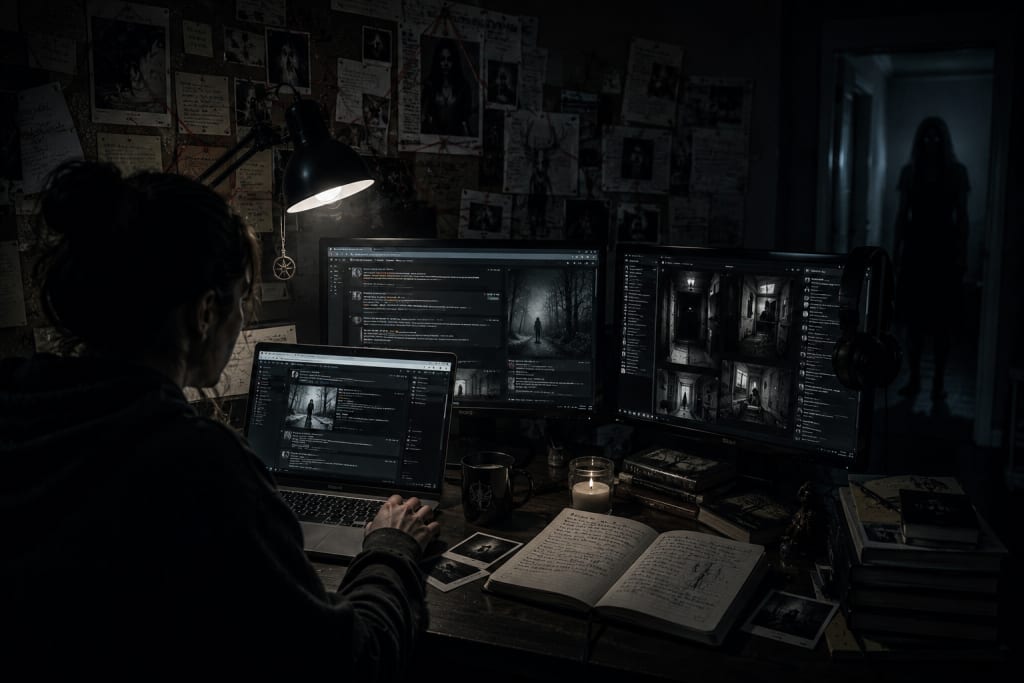
Darkest Mysteries Online: Raw Paranormal Accounts for the Digital Age
The internet has changed the way we tell ghost stories.
Once, the strangest tales were passed around campfires, whispered in school corridors, shared at family gatherings, or printed in strange little paperbacks found on dusty shelves. A haunted hospital story might travel through nurses, cleaners, night guards, and patients. A missing-time abduction account might circulate in UFO magazines or late-night radio shows. A terrifying coincidence caught on tape might remain local rumor unless a television documentary picked it up.
Now, the strange travels instantly.
A security camera clip appears online. A Reddit confession goes viral. A missing-person thread becomes a community obsession. A nurse posts about footsteps in an empty ward. A truck driver describes losing thirty minutes on a lonely highway. A family discovers an old recording with a voice no one remembers hearing. A podcast collects the atmosphere, reshapes the fear, and turns scattered digital unease into an immersive listening experience.
That is the world where Darkest Mysteries Online — The Strange and Unusual Podcast finds its audience.
The podcast positions itself as a home for dark mystery storytelling, with descriptions across podcast platforms emphasizing haunted hospitals, missing-time abductions, unsolved murders, eerie coincidences caught on tape, and strange accounts that feel drawn from the internet’s deepest corners. Apple Podcasts describes the show as exploring “the shadow” through haunted hospitals, missing-time abductions, unsolved murders, and eerie coincidences caught on tape. GreatPods describes an earlier version as pulling from Reddit confessions, cold-case reports, alien encounters, near-death experiences, and stories that defy explanation.
There is an important detail, though: the current Spreaker description says each episode is an original dark mystery built from patterns, fears, and unexplained moments that surface in real life, while also saying these are “not retellings” or “secondhand accounts.” That framing matters. The show is not simply a documentary archive of verified paranormal incidents. It lives in a space between confession-style horror, folklore, internet-era mystery, and immersive fiction that feels close enough to reality to disturb the listener.
And perhaps that is exactly why it works.
The Appeal of Internet-Born Horror
Modern horror no longer needs an old castle. It can begin with a timestamp.
A voicemail at 2:17 a.m. A CCTV clip from an empty hallway. A dashcam recording from a country road. A hospital monitor beeping in a room where no patient is assigned. A missing-time story posted by someone who sounds too ordinary to be inventing mythology. The internet has made horror feel less distant because it arrives in familiar formats.
This is one of the reasons shows like Darkest Mysteries Online fit the current era. The podcast’s premise taps into the way people now encounter fear: through screens, audio clips, anonymous posts, algorithmic recommendations, and stories that claim to come from “real people.”
That format has a special emotional effect. A polished horror film announces itself as entertainment. A traditional ghost story often begins with theatrical cues. But an internet-style account feels different. It may start casually. It may sound like someone explaining what happened after work. It may contain small details that seem too mundane for fiction: a hospital badge scanner, a janitor’s cart, a highway mile marker, a security room, a phone battery at 11 percent.
Those ordinary details create trust. Then the story bends.
The horror comes not from gothic decoration, but from the possibility that the world we already know has a hidden layer. A hospital becomes haunted not because it looks like a ruined asylum, but because a nurse hears a patient calling from a room demolished years ago. A missing-time account becomes disturbing not because a UFO appears immediately, but because two people check their phones and realize forty minutes have vanished. An eerie coincidence becomes terrifying not because it is impossible, but because it is just possible enough to make the listener uncomfortable.
This is the emotional territory Darkest Mysteries Online explores: stories that feel like they could have happened, or already did.
Haunted Hospitals: Fear in Places Built for Healing
Few settings are more naturally suited to paranormal storytelling than hospitals.
Hospitals are places of birth, death, pain, recovery, exhaustion, emergency, grief, and long night shifts. They are full of machines that make strange sounds, corridors that look identical, rooms where people have died, and staff who work under extreme emotional pressure. Even without ghosts, hospitals can feel haunted by memory.
That is why haunted hospital stories remain so effective. They invert the purpose of the place. A hospital is supposed to protect life, but a haunted hospital suggests that not everything leaves when the body is gone. A call light turns on in an empty room. A child laughs in a closed ward. A nurse sees a patient standing beside the bed, then learns the patient died hours earlier. A security guard hears footsteps in a wing no one uses anymore.
The horror works because hospitals are already liminal spaces. People enter them at moments of vulnerability. Families wait for news. Doctors fight time. Nurses move between life and death every day. The building holds emotional residue.
In a podcast format, hospital horror becomes even more intimate. Audio can recreate the loneliness of fluorescent corridors, the squeak of shoes on polished floors, the distant hum of vending machines, the sudden buzz of a nurse-call system. The listener does not need to see the ghost. They only need to hear the empty hallway.
Darkest Mysteries Online benefits from that atmosphere because its stories often lean into the “raw account” style. A haunted hospital narrative told like a first-person report can feel more disturbing than a heavily dramatized one. The more normal the speaker sounds, the more abnormal the event becomes.
That is the secret of modern haunted storytelling: calm narration can be scarier than screaming.
Missing-Time Abductions: The Terror of a Broken Clock
Missing-time stories are among the most unsettling parts of UFO and paranormal culture. The idea is simple but deeply disturbing: someone experiences a gap in memory that cannot be easily explained. Minutes or hours vanish. A road trip takes longer than it should. A person remembers driving under a strange light, then suddenly finds themselves far away with no memory of the journey. A couple leaves a restaurant at 9:00 p.m. and arrives home after midnight, though the drive takes twenty minutes.
The missing-time motif became especially associated with alien abduction narratives in the twentieth century. The famous Betty and Barney Hill case, widely discussed in UFO history, helped establish missing time as a key feature of abduction lore. The Britannica entry on the Hills notes that the couple reported a strange experience in 1961 and later underwent hypnosis, after which a narrative of alien abduction became widely known.
But missing time is powerful even outside UFO belief. It touches a primal fear: the fear of losing ownership of one’s own mind.
A haunted house may threaten the body. A monster may threaten survival. Missing time threatens memory, identity, and control. If something happened and you cannot remember it, then part of your own life has been taken from you. That is why these stories linger.
In the digital age, missing-time accounts have found new life. People compare GPS records, call logs, timestamps, dashcam footage, smartwatches, doorbell cameras, and location history. A modern missing-time story can include data. That makes it feel harder to dismiss, even when the explanation may still be ordinary: fatigue, stress, dissociation, poor memory, device error, or misread timing.
A podcast like Darkest Mysteries Online can use this perfectly. The story can begin with something technical: a phone log, a traffic camera, a receipt timestamp, a smartwatch recording an impossible pause. Then the emotional horror grows around the gap.
The scariest part is not always what someone remembers. It is what they do not.
Eerie Coincidences Caught on Tape
Coincidence has always been one of the great engines of mystery. Human beings are pattern-seeking creatures. When two unlikely events line up, we feel meaning pushing through randomness.
A person dreams of a friend, then receives news the friend died. A family video captures a voice saying a name no one heard at the time. A security camera records a figure outside a house minutes before a disappearance. A radio plays a song connected to a dead relative at the exact moment someone is speaking about them. A stranger appears in the background of several unrelated videos.
Most coincidences are just coincidences. But some feel too precise, too emotional, or too visually documented to ignore.
This is where “caught on tape” horror becomes powerful. The phrase itself carries an old-school authenticity. Even though most recordings now are digital, “caught on tape” still suggests evidence. It promises that something happened outside pure memory. There is a file. A clip. A frame. A sound.
But recordings do not always settle mysteries. They often create new ones. A blurry figure can be interpreted many ways. A voice on audio may be interference, compression noise, or pareidolia. A shadow may be a person, an animal, a reflection, or nothing at all. Yet once a clip enters the imagination, uncertainty becomes the hook.
Podcasts are especially good at this because they do not have to show everything. They can describe the recording, play a sound, or build tension around what the tape seems to reveal. The listener’s imagination fills in the gaps, often more effectively than a video could.
That is why eerie coincidence stories remain so strong in audio. They let the listener become investigator. Was it chance? A warning? A spirit? A mistake? A hoax? A sign?
The story does not need to answer everything. In fact, it is often better when it does not.
Why “Raw Accounts” Feel More Frightening
The phrase “raw accounts” is central to the appeal of modern paranormal podcasts. It suggests immediacy. It suggests that the story has not been polished into something artificial. It sounds like testimony.
Of course, listeners should be careful. Podcast storytelling can be edited, dramatized, fictionalized, or inspired by real motifs rather than strictly factual. In the case of Darkest Mysteries Online, the current Spreaker description frames episodes as original dark mysteries inspired by patterns and fears rather than direct retellings. That does not weaken the show’s appeal; it clarifies the kind of experience being offered.
The “raw account” style works because it imitates the way people tell strange experiences when they are not trying to be literary. They repeat themselves. They include odd details. They say what they thought at the time. They admit confusion. They sound unsure.
That uncertainty is persuasive. A narrator who explains everything perfectly can feel fake. A narrator who says, “I know how this sounds, but I still cannot explain what happened,” feels human.
This is why internet horror often uses confession formats: Reddit posts, anonymous emails, recovered logs, police-style summaries, voicemail transcripts, security reports, workplace incident notes. These formats create realism through structure. They make the audience feel like they are reading or hearing something they were not supposed to find.
Darkest Mysteries Online belongs to this wider tradition of pseudo-documentary dread. It thrives on the sensation that the listener is not simply consuming a story but opening a file.
The Podcast as Digital Campfire
Podcasts have become the modern campfire.
People listen alone in bed, during night drives, while working late, during long commutes, or through headphones in dark rooms. This solitude makes horror more personal. A film is often watched with others. A podcast speaks directly into the ear.
That intimacy changes everything. A ghost story heard through headphones can feel like a secret. The narrator’s voice becomes close. Sound design can place footsteps behind the listener, a whisper beside them, a door closing somewhere in the distance. The outside world disappears.
This is why mystery and paranormal podcasts have become so popular. They restore an ancient form of storytelling through modern technology. The voice returns as the main instrument of fear.
Dark stories also suit long-form audio because suspense needs time. A haunted hospital account can slowly build from an ordinary shift to a final impossible encounter. A missing-time story can move from confusion to evidence to dread. An eerie coincidence can begin as a funny accident before revealing a pattern that feels deeply wrong.
The listener stays because the format feels personal. It is not just “watch this scary thing.” It is “listen to what happened.”
That difference matters.
Haunted Hospitals and the Ethics of Fear
There is one delicate issue with haunted hospital stories: hospitals are real places of suffering. Turning them into spooky entertainment can be disrespectful if handled carelessly.
The best haunted hospital stories understand this. They do not treat death as decoration. They recognize grief, exhaustion, and human vulnerability. A ghost in a hospital is not just a jump scare. It is often tied to unfinished care, a patient who never left, a child searching for a parent, a nurse still making rounds, or a room that carries memory.
That emotional grounding makes the story stronger. It also makes it more responsible.
Modern paranormal storytelling works best when it respects the people behind the fear. A haunted hospital should not become a cartoon asylum full of cheap shocks. It should feel like a place where real people lived, suffered, worked, healed, and died.
That is also why first-person style can be effective. A nurse, janitor, doctor, patient, or security guard narrator brings the setting down to human scale. The hospital is not just a creepy building. It is someone’s workplace. Someone’s last room. Someone’s memory.
Fear becomes more powerful when it has compassion.
Missing-Time Stories and the Fear of Being Taken
Missing-time abduction stories are not only about aliens. They are about violation.
The person who experiences missing time often feels that something happened without consent. Their body may show strange marks. Their clothes may be disturbed. Their vehicle may be in a different place. They may wake with fear but no memory. Even if the story is fictional or psychologically explainable, the emotional core is disturbing because it suggests loss of agency.
This is why abduction narratives can be controversial. They often resemble trauma stories. Some researchers and skeptics have argued that hypnosis, sleep paralysis, cultural expectation, and memory distortion can shape abduction claims. Others interpret them spiritually or literally. Either way, the stories can feel emotionally real to the people who tell them.
A podcast handling missing-time material should therefore be careful. The strongest approach is not to declare every account proof of extraterrestrial contact. It is to explore the horror of the gap itself.
What does a person do when their own memory becomes unreliable? How do they explain an impossible timestamp? How do they tell a loved one without sounding unstable? How do they return to normal life after feeling that something unknown touched them?
Those questions are more frightening than any flying saucer.
The Power of Eerie Coincidences
Eerie coincidence stories sit between paranormal and psychological horror. They do not always involve ghosts, monsters, or aliens. Sometimes the terror is simply pattern.
A woman hears the same phrase from three strangers in one day, then finds it written in her dead father’s notebook. A man records a video at an abandoned motel and later notices a person in the window wearing the same jacket as his missing brother. A podcast episode is uploaded before the event it seems to describe. A phone plays a voicemail from a number that has been disconnected for years.
Stories like these are unsettling because they challenge randomness. Most people can accept one coincidence. But when coincidences stack, the mind begins to suspect design.
This is why “eerie coincidence caught on tape” is such a strong concept. It combines the emotional force of synchronicity with the apparent objectivity of recording. A coincidence remembered can be dismissed. A coincidence recorded feels harder to escape.
But again, ambiguity is key. If the story proves too much, it becomes fantasy. If it proves too little, it becomes forgettable. The best coincidence stories remain suspended between explanation and impossibility.
That suspended state is where mystery lives.
Why These Stories Feel More Real Now
Modern life has made the paranormal feel both less believable and more believable at the same time.
On one hand, people are more skeptical. They know about editing, AI-generated images, deepfakes, staged videos, algorithmic hoaxes, and viral misinformation. A ghost photo no longer carries the same authority it might have once had. People ask for metadata, original files, witness statements, and debunking.
On the other hand, modern surveillance has made the world feel constantly recorded. Doorbell cameras, dashcams, hospital cameras, phone audio, smart devices, and location logs mean that strange events may leave traces. That gives paranormal storytelling new tools.
A ghost story no longer has to rely only on “I saw something.” It can include: “The motion sensor activated.” “The baby monitor recorded it.” “The GPS showed us somewhere we never drove.” “The hospital camera cut out for exactly thirteen seconds.” “The voicemail arrived from a dead phone.”
Even when fictionalized, these details feel modern. They update the ghost story for the data age.
Darkest Mysteries Online benefits from this cultural shift. It understands that today’s fear is not only the unknown. It is the unknown appearing inside systems that are supposed to record everything.
The Fine Line Between True Crime and Paranormal Mystery
The podcast’s platform descriptions mention unsolved murders and cold-case-style material alongside paranormal and strange phenomena. This combination reflects a major trend in modern mystery media: the blending of true crime, supernatural dread, and internet folklore.
That blend can be powerful, but it also requires care. True crime involves real victims, real families, and real trauma. Paranormal framing can sometimes sensationalize tragedy if it turns human suffering into spooky atmosphere without respect.
The best mystery storytelling keeps the human stakes intact. An unsolved murder should not be treated the same way as a fictional haunted warehouse. A missing-person story should not become aesthetic content without empathy. If a podcast uses true-crime-inspired patterns, it should preserve seriousness even when the story is original or fictionalized.
This is where Darkest Mysteries Online’s “original dark mystery” framing may actually help. By building stories from patterns and fears rather than directly retelling real cases, the show can create true-crime atmosphere without exploiting specific victims—at least in principle.
That distinction is important for modern audiences, who are increasingly aware of the ethics of crime entertainment.
Why Listeners Keep Coming Back
People return to dark mystery podcasts for several reasons.
The first is curiosity. Humans are drawn to unresolved questions. We want to know what happened in the room, where the missing minutes went, who appeared on the tape, why the hospital ward was sealed, or why the same symbol appears in unrelated places.
The second is controlled fear. Horror podcasts allow listeners to experience dread safely. The listener can pause, turn on the light, or switch episodes. That control makes fear pleasurable.
The third is pattern-seeking. Mystery stories invite the brain to connect clues. A good podcast does not just scare the listener; it makes them think.
The fourth is emotional release. Haunted stories often deal with grief, guilt, memory, and unresolved trauma. Missing-time stories deal with control and vulnerability. Coincidence stories deal with fate. These are not shallow fears. They reflect real emotional questions.
The fifth is community. Listeners share episodes, discuss theories, compare experiences, and recommend similar stories. The podcast becomes part of a larger digital folklore network.
A show like Darkest Mysteries Online does not exist in isolation. It belongs to a culture of online mystery consumption where every listener is also a potential investigator, witness, skeptic, or storyteller.
The Voice Matters
In paranormal podcasting, voice is everything.
A good narrator can make a simple story terrifying. A poor narrator can make even strong material feel flat. The voice must carry doubt, tension, pacing, and emotional credibility. It must sound close enough to be intimate, but distant enough to feel like testimony.
Some platforms describe versions of Darkest Mysteries Online as using a disembodied computer voice, at least in earlier listings. Amazon Music’s listing for a 2023 version describes it as a collection of bizarre stories from Reddit narrated by a disembodied computer voice. That detail is fascinating because synthetic or detached narration can either weaken emotion or create an uncanny effect, depending on execution.
A human voice can sound vulnerable. A synthetic voice can sound cold, anonymous, and archival. For internet horror, that coldness can work. It can feel like a file being read by a machine, a case report generated from corrupted data, or a voice with no body. In a world of AI narration and automated content, even the storyteller can become part of the unease.
That is very modern horror: not just ghosts in the machine, but the machine telling ghost stories.
The Difference Between Belief and Atmosphere
Not every listener needs to believe the stories are literally true. That is one of the strengths of this genre.
Some listeners come as believers. They are open to ghosts, abductions, curses, and synchronicities. Others come as skeptics who enjoy the psychology and structure of the stories. Some come for atmosphere. Some come for background listening. Some come for the thrill of almost believing.
A good paranormal podcast can serve all these audiences by maintaining ambiguity. It should not overexplain. It should not mock belief. It should not demand belief either. It should create the conditions where the listener can sit inside uncertainty.
That uncertainty is the real attraction.
When a haunted hospital story ends, the listener may not think, “This proves ghosts exist.” They may think, “I would not want to work there at night.”
That is enough.
Darkest Mysteries Online and the New Folklore Machine
Every era has a folklore machine.
In ancient societies, folklore moved through oral tradition. In the nineteenth century, it moved through newspapers, pamphlets, séance reports, and local gossip. In the twentieth century, it moved through radio, pulp magazines, television, and paperback collections. Today, folklore moves through Reddit, podcasts, TikTok, YouTube, Discord, livestreams, and algorithmic feeds.
Darkest Mysteries Online is part of this new folklore machine. It collects the emotional patterns of internet fear—haunted workplaces, missing time, impossible recordings, cold cases, strange disappearances, cursed objects, abandoned buildings—and reshapes them into long-form audio.
Its platform descriptions show how broad that territory is: haunted hospitals, missing-time abductions, unsolved murders, eerie coincidences, alien encounters, near-death experiences, and strange accounts that resist easy explanation.
This matters because folklore is not dead. It has simply changed format. The ghost story now has metadata. The campfire now has headphones. The anonymous villager has become the anonymous poster. The old haunted road has become a dashcam clip. The séance table has become an RSS feed.
The fears are ancient. The delivery system is new.
Why Haunted Media Thrives in Uncertain Times
Dark mystery content often becomes more popular during uncertain cultural moments. When people feel anxious about the future, they become drawn to stories that give shape to uncertainty.
A ghost story says: the past is not gone.
An abduction story says: control can be taken away.
A missing-person story says: ordinary life can break open.
An eerie coincidence says: randomness may not be random.
A haunted hospital story says: even institutions built to save us cannot protect us from everything.
These are not just spooky ideas. They are emotional metaphors for modern life. People live with economic uncertainty, technological change, health anxiety, social isolation, surveillance, climate fear, and distrust of institutions. Paranormal stories translate those pressures into narrative form.
That is why the genre continues to evolve. It gives people a way to feel fear, organize it, and survive it.
The Best Way to Listen
A podcast like Darkest Mysteries Online is best approached as atmospheric mystery storytelling rather than courtroom evidence. That does not mean dismissing it. It means understanding the experience it offers.
Listen for the pattern. What fear is the story exploring? Is it grief? Isolation? Institutional secrecy? Lost memory? A place that should be safe but is not? A recording that reveals too much? A coincidence that feels like fate?
The best dark stories are not only about what happened. They are about what the event means.
A haunted hospital may be about the fear that suffering leaves marks. A missing-time abduction may be about the terror of losing control. A caught-on-tape coincidence may be about the human need to find meaning in chaos.
When heard this way, the podcast becomes more than a collection of scares. It becomes a map of modern unease.
Final Verdict
Darkest Mysteries Online — The Strange and Unusual Podcast belongs to the new generation of digital mystery storytelling. Its world is built from haunted hospitals, missing-time abductions, unsolved-case atmosphere, eerie coincidences, alien encounters, near-death experiences, and strange stories that feel close enough to reality to unsettle the listener. Podcast listings describe it as exploring the shadow through haunted hospitals, missing-time abductions, unsolved murders, and eerie coincidences caught on tape, while the current Spreaker framing presents episodes as original dark mysteries built from patterns, fears, and unexplained moments rather than simple retellings.
That combination is exactly what makes the show interesting. It does not simply reproduce old ghost stories. It reflects how fear works now: through recordings, timestamps, anonymous accounts, workplace horror, digital traces, and stories that travel online before anyone can fully explain them.
Whether one listens as a believer, skeptic, horror fan, or mystery addict, the appeal is clear. The podcast understands that the modern world has not killed the paranormal imagination. It has given it new rooms to haunt.
The haunted hospital corridor now has security cameras. The abduction story now has GPS logs. The eerie coincidence now has audio evidence. The ghost story now arrives through headphones, late at night, in a voice that may sound too calm for the things it is saying.
And that is the lasting power of Darkest Mysteries Online. It turns the internet itself into a haunted archive—one where every file, tape, confession, and unexplained gap seems to whisper the same uncomfortable question:
What if the strangest stories online are not simply stories at all?


