
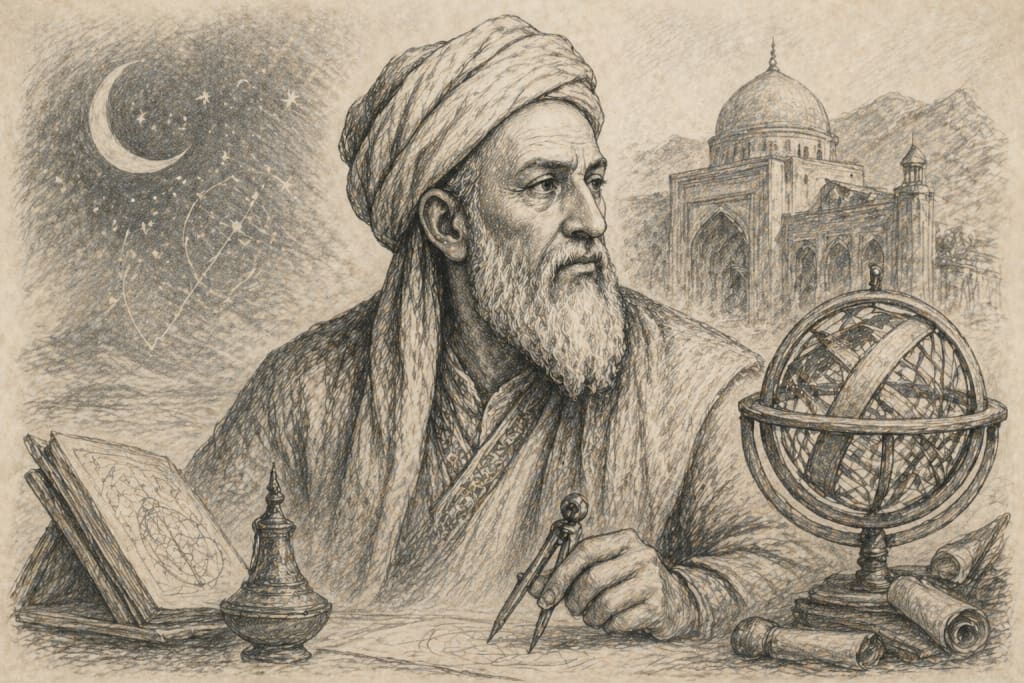
Omar Khayyam: The Rebel Sage Who Questioned Existence Before Existentialism Had a Name
Nearly a thousand years before Jean-Paul Sartre declared that human beings were condemned to be free, and centuries before Albert Camus imagined life as an absurd struggle against silence, a Persian sage from Nishapur had already stared into the same abyss—and smiled.
His name was Hakim Omar Khayyam.
To the casual reader, Khayyam is often remembered as the poet of wine, roses, dust, and fleeting pleasure. To mathematicians, he was a brilliant mind who worked on cubic equations and the foundations of geometry. To historians of science, he was one of the astronomers associated with the creation of the Jalali calendar, a solar calendar so accurate that later scholars praised it as more precise than the Gregorian system. Britannica notes that the Jalali calendar used eight leap years in every thirty-three-year cycle and was more accurate than the present Gregorian calendar.
But none of these labels fully captures him.
Khayyam was not merely a poet, not merely an astronomer, not merely a mathematician, and not merely a philosopher. He was one of those rare figures in history whose mind refused to stay inside one discipline. He lived at the crossroads of science and poetry, reason and wonder, doubt and desire. He measured the heavens with mathematical precision, then returned to the human heart and asked why life, with all its beauty, must end in dust.
That contradiction is what makes him immortal.
The Man Behind the Myth
Omar Khayyam, more fully known as Abu’l-Fath Umar ibn Ibrahim Khayyam Nishapuri, was born around 1048 in Nishapur, in the Persian cultural world of the Seljuk period. Encyclopaedia Iranica identifies him as a celebrated polymath and poet, best known today for the Rubaiyat, or quatrains, attributed to him.
The title Hakim matters. In the Persian and Islamic intellectual tradition, a hakim was not simply a doctor or philosopher in the narrow modern sense. A hakim was a sage: someone trained in wisdom, science, philosophy, medicine, mathematics, and the deeper structure of existence. Khayyam belonged to this world of integrated knowledge, where astronomy was not separate from metaphysics, and poetry was not separate from truth.
He lived in an age when the Persianate intellectual world was one of the great engines of global thought. Baghdad, Nishapur, Isfahan, Ray, Bukhara, Samarkand, and other centers formed a vast network of scholarship. The intellectual inheritance of figures such as al-Khwarizmi, al-Razi, Avicenna, al-Biruni, and later Rumi shaped the imagination of the region. They were not all contemporaries—Rumi, for example, was born in 1207, decades after Khayyam’s death—but they belonged to the same grand civilizational river of Persian, Islamic, and Central Asian learning.
Khayyam stood in that river as one of its most fascinating and difficult figures.
The Scientist Who Reformed Time
If Khayyam had never written a single poem, his name would still deserve remembrance.
His scientific achievements were formidable. Britannica describes his systematic work on solving cubic equations through the intersection of conic sections, as well as his critiques of Euclid’s theory of parallels and theory of proportion. These were not casual intellectual hobbies. They placed Khayyam among the serious mathematical thinkers of the medieval world.
But his most famous scientific legacy is the Jalali calendar.
During the reign of the Seljuk Sultan Malik-Shah, Khayyam was invited to Isfahan to take part in astronomical observations needed for calendar reform. An observatory was built, and a new solar calendar was produced. Britannica states that the Jalali calendar was adopted in 1075 by Malik-Shah and was more accurate than the Gregorian calendar. Encyclopaedia Iranica also notes that Khayyam owes much of his reputation among Iranians to his role in establishing the Jalali calendar, even though early sources do not always give abundant detail about his exact part in the project.
That last point is important. History is not always as clean as legend. Khayyam was part of a wider astronomical effort, not necessarily a lone genius inventing time by himself. But his association with that reform remains central to his reputation.
The calendar’s brilliance lies in its relationship to the solar year. It was designed to keep Nowruz, the Persian New Year, aligned with the spring equinox. In other words, it tried to make civil time obey cosmic time. It was not merely a calendar. It was astronomy turned into daily life.
There is something deeply symbolic about this. Khayyam, the poet of life’s brevity, was also the scientist who helped refine the measurement of time. The man who told humanity to cherish the passing hour was also one of the men who calculated that passing hour with astonishing precision.
Before Sartre and Camus, There Was Khayyam
Calling Khayyam an “existentialist” is tempting—but historically risky.
Existentialism, as a formal modern school of thought, belongs to the nineteenth and twentieth centuries. Sartre, Camus, Kierkegaard, Nietzsche, Heidegger, and others shaped its modern vocabulary. Khayyam did not write in that tradition. He did not speak of “existence preceding essence” in Sartre’s terms. He did not build a systematic philosophy of absurdity like Camus.
And yet, when we read the Rubaiyat, we find a voice that feels startlingly close to modern existential anxiety.
Khayyam asks what it means to live under the shadow of death. He questions religious certainty. He mocks human arrogance. He distrusts easy answers. He looks at the universe and refuses to pretend that the silence of the heavens is simple. Stanford Encyclopedia of Philosophy describes the Rubaiyat as a philosophical commentary on the human condition and notes that Khayyam’s poetic voice became a form of protest against what he saw as an unjust world.
This is why Khayyam feels modern.
He does not beg for misery before the divine. He does not romanticize suffering as a holy achievement. He does not reduce life to obedience. Instead, he returns again and again to the urgency of being alive. The cup, the garden, the beloved, the morning, the song—these are not shallow decorations. They are his rebellion against meaninglessness.
Where later existentialists might speak of absurdity, Khayyam speaks of dust. Where Camus imagines Sisyphus happy, Khayyam imagines the human being raising a cup beneath an indifferent sky. Both gestures contain defiance. Both say: life may be brief, but it is still ours.
Was Khayyam a Believer, a Skeptic, or Something Else?
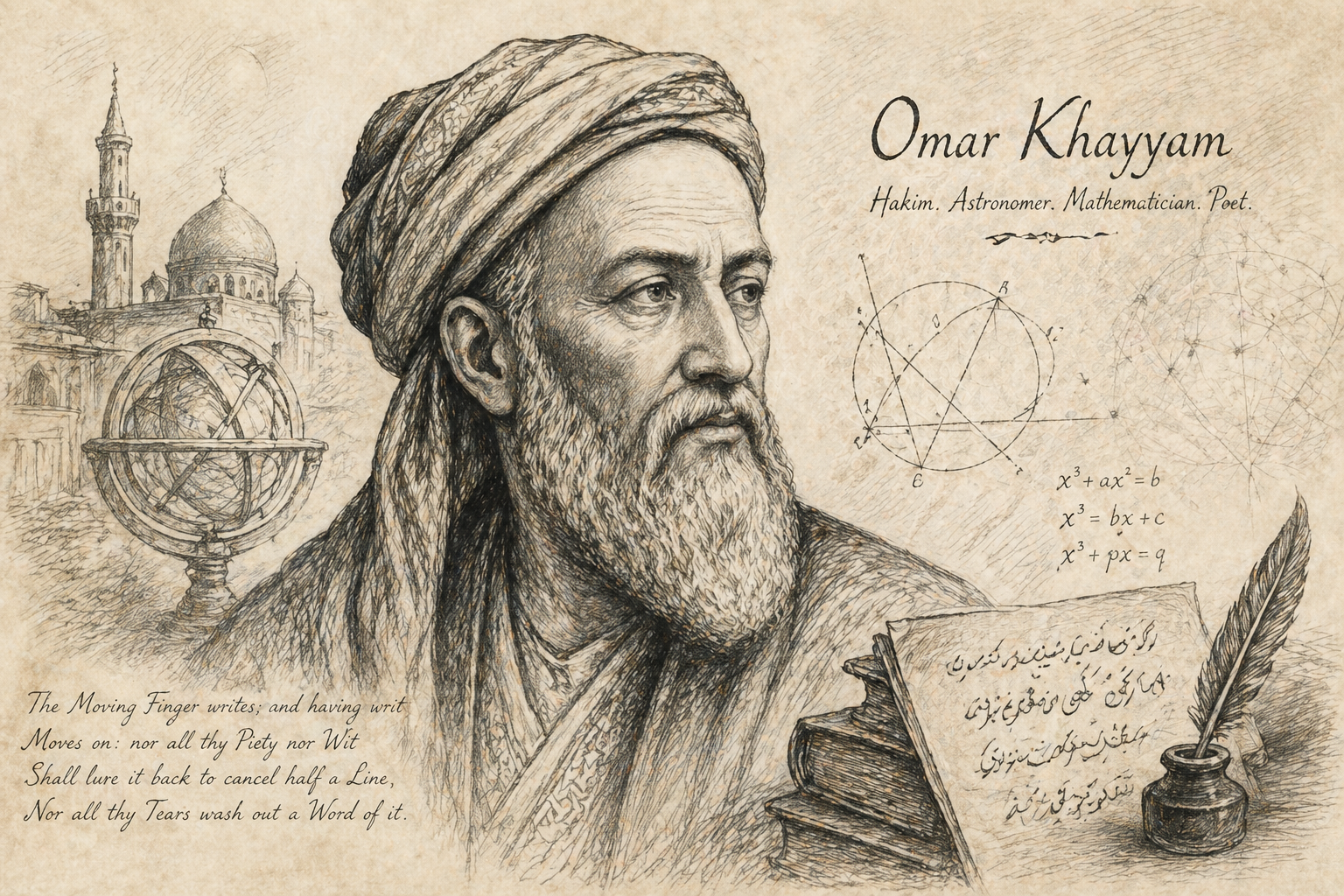
The question of Khayyam’s religious identity has always been controversial.
Some readers see him as a skeptic, rationalist, agnostic, or even a quiet rebel against religious orthodoxy. Others interpret his wine and tavern imagery through Sufi symbolism, arguing that his poetry is mystical rather than anti-religious. Still others separate the historical Khayyam of philosophical prose from the literary Khayyam of the Rubaiyat.
The truth is complex.
Stanford Encyclopedia of Philosophy notes that Khayyam’s philosophical treatises indicate belief in life after death and align in some ways with traditional Islamic eschatological doctrine. Yet the poetic Khayyam casts doubt on the afterlife and uses verse to challenge jurists who spoke too confidently of heaven and hell.
So it is too simple to say, “Khayyam was not Muslim” as a blunt historical fact. It is safer—and more interesting—to say this: the Khayyam of the Rubaiyat is not doctrinal in tone. He is skeptical, ironic, restless, and allergic to rigid certainty. He may have lived inside an Islamic intellectual world, but his poetry often resists the comfort of official answers.
That resistance is exactly why he still matters.
Khayyam’s rebellion was not the rebellion of loud slogans. It was the rebellion of the thinking mind. He challenged arrogance wherever he found it: in theologians, rulers, philosophers, and perhaps even in himself. He did not replace religion with cheap certainty. He replaced certainty with inquiry.
That is a far more dangerous act.
The Rubaiyat: Wine, Dust, and Human Joy
The Rubaiyat is one of the most famous poetic works associated with the Persian world, but it is also one of the most complicated. Many quatrains have been attributed to Khayyam over the centuries, and scholars have long debated which are authentic. Stanford Encyclopedia of Philosophy directly acknowledges the difficulty of separating authentic from inauthentic Rubaiyat.
Still, the Khayyamic voice is unmistakable.
It is a voice of urgency. It says that life is short, death is certain, and the present moment is not to be wasted. It is often misunderstood as simple hedonism. But Khayyam’s joy is not shallow pleasure. It is philosophical joy. He praises wine not merely because wine intoxicates, but because it symbolizes immediacy, beauty, fellowship, and freedom from fear.
His poetry asks: Why should human beings spend their lives trembling before imaginary certainties? Why should they allow dogma to steal wonder? Why should the brief miracle of consciousness be wasted in guilt, cruelty, and submission?
This is not decadence. It is humanism.
Khayyam does not deny suffering. He sees it clearly. But he refuses to let suffering become the whole truth of life. Against the decaying dogmas of his age, he raises the fragile dignity of human happiness.
That is why his poetry still feels rebellious.
The Rationalist Against Orthodoxy
Khayyam was not merely a poet of pleasure. He was a defender of reason.
Stanford’s account presents him as a philosopher-sage who defended rationalism against the rise of orthodoxy and tried to revive the spirit of rational inquiry that had flourished in earlier centuries of Islamic civilization.
This is one of the keys to understanding him. Khayyam was not anti-intellectual, anti-science, or anti-spiritual. He was anti-dogma. He opposed the death of questioning. He resisted the arrogance of those who claimed to know the invisible with perfect certainty while failing to understand the visible world with humility.
In that sense, Khayyam belongs not only to Persian literature, but to the global history of free thought.
He reminds us that skepticism is not always cold. It can be humane. It can be tender. It can be full of music. His doubt does not destroy beauty; it intensifies it. Because life is uncertain, the garden matters more. Because death is real, friendship matters more. Because heaven is unknown, kindness on earth matters more.
This is the moral core of Khayyam.
The Legend and the Historical Man
Like many great figures, Khayyam has become partly myth.
In the West, his image was reshaped by Edward FitzGerald’s nineteenth-century translation-adaptation, The Rubáiyát of Omar Khayyám. Britannica notes that Khayyam’s poems attracted comparatively little Western attention until FitzGerald’s celebrated version made them famous, with its memorable phrases and romanticized tone.
FitzGerald’s Khayyam is beautiful, but not always historically pure. He is partly Persian poet, partly Victorian invention, partly existential rebel, partly wine-loving sage. Yet this hybrid image became enormously influential. Through translation, Khayyam entered world literature as a symbol of doubt, pleasure, mortality, and defiance.
But the historical Khayyam was more than the Western fantasy.
He was a disciplined scholar. A mathematician. An astronomer. A court-connected intellectual. A teacher. A philosopher formed by the traditions of Avicenna and Greek thought. A Persian mind navigating the pressures of Seljuk power, religious orthodoxy, scientific ambition, and poetic immortality.
To reduce him to wine is to misunderstand him.
To reduce him to science is also to misunderstand him.
Khayyam’s greatness lies in the union of both: the measuring instrument and the metaphor, the equation and the quatrain, the observatory and the tavern.
Why Khayyam Still Feels Dangerous
Khayyam remains dangerous because he asks questions that institutions often fear.
What if human happiness matters more than obedience?
What if doubt is more honest than certainty?
What if the present life deserves love, not contempt?
What if religious language can become a prison?
What if the universe does not owe us explanations?
What if joy itself is a form of resistance?
These questions did not disappear with the medieval world. They are still alive.
In modern society, we may not live under the same forms of authority Khayyam knew, but we still face dogmas: political dogmas, religious dogmas, economic dogmas, technological dogmas, ideological dogmas. We still meet people who speak with absolute certainty about things they barely understand. We still see human joy sacrificed to systems that demand fear, productivity, obedience, or tribal loyalty.
Khayyam’s answer is not escapism. It is awareness.
He does not say life is easy. He says life is brief. He does not say truth is simple. He says certainty is often dishonest. He does not say pleasure solves everything. He says joy may be the most human answer to impermanence.
That is why his poetry feels alive after nearly a thousand years.
Final Verdict: The Heart, the Mind, and the Human Hour
Hakim Omar Khayyam was one of civilization’s great border-crossers.
He stood between science and poetry, faith and skepticism, discipline and desire, cosmic order and human fragility. He helped refine the measurement of time, then used poetry to remind humanity that time cannot be possessed. He studied mathematics with rigor, then wrote verses that laughed at the arrogance of certainty. He lived inside a religious civilization, yet his poetic voice often pushed against doctrinal comfort and demanded freedom for the human mind.
Was he an existentialist before existentialism? Not in the formal academic sense.
But emotionally, philosophically, and poetically, he anticipated many of its deepest concerns: death, meaning, freedom, absurdity, doubt, and the urgent need to live fully before the curtain falls.
Khayyam’s true legacy is not wine, nor rebellion alone, nor even the calendar. His legacy is the defense of the human hour—the fragile, luminous present in which thought, love, beauty, and joy become possible.
He did not ask humanity to kneel before misery.
He asked humanity to think.
He asked humanity to live.
And nearly a thousand years later, that request still sounds revolutionary.


