
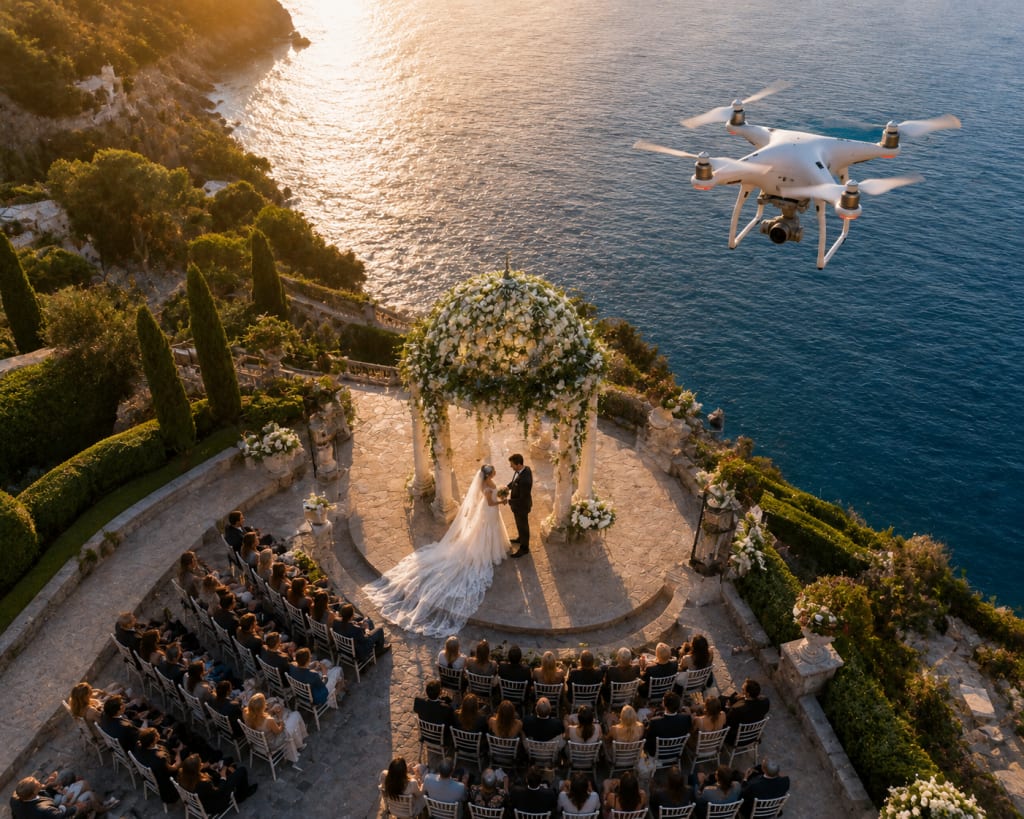
Drone Wedding Photography: The Sky-High Trend of 2026
Wedding photography has always been about memory.
A bride walking toward the aisle. A groom trying not to cry. Parents watching quietly from the front row. Friends laughing too loudly during cocktail hour. The first dance. The rings. The flowers. The nervous hands. The dramatic entrance. The messy dance floor. The final goodbye.
But in 2026, wedding photography is not only looking across the room.
It is looking from the sky.
Drone wedding photography has become one of the most in-demand visual trends of the year, giving couples dramatic aerial shots that traditional cameras simply cannot capture. From sweeping venue reveals to cinematic beach ceremonies, mountain elopements, luxury estate weddings, vineyard receptions, desert celebrations, and massive group portraits shaped like hearts or initials, drones are turning weddings into something that feels closer to a film trailer than a regular photo album.
Aerial wedding photography is no longer treated only as a luxury extra. Wedding trend reports for 2025–2026 increasingly describe drone footage as part of the expected visual package for outdoor and destination weddings, especially among mid-to-high-end videographers. Common requests include aerial venue reveals, bird’s-eye views of ceremony layouts, and sweeping exit shots.
That is the reason the trend is exploding.
A drone does not just document a wedding.
It gives the wedding scale.
It shows the full beauty of the venue, the landscape, the guests, the architecture, and the couple’s place inside it all. A ground camera can show emotion. A drone can show the world around that emotion.
Together, they create a fuller story.
Why Drone Wedding Photography Is Everywhere in 2026
Couples today do not want wedding photos that look like everyone else’s.
They want cinematic storytelling. They want editorial romance. They want social-media-ready visuals. They want a wedding film that opens with a sweeping shot of the venue, glides over the coastline, rises above the garden, reveals the ceremony setup, and makes the day feel bigger than life.
That is exactly what drones do.
A drone can capture the scale of a wedding in one shot. It can show the guests arranged around a ceremony arch, the couple standing alone in a field, the reception glowing under string lights, or a destination venue surrounded by mountains and sea.
This is why drone photography fits the 2026 wedding mood so perfectly. Wedding photography trends are leaning toward cinematic atmosphere, movement, magazine-style composition, and documentary emotion. Photographers are mixing polished editorial visuals with unposed storytelling, creating galleries that feel both beautiful and alive.
Drone shots add the cinematic layer.
They create the opening scene.
They make the wedding feel like a movie.
The Venue Reveal Shot
One of the most popular drone wedding shots is the venue reveal.
It usually begins far above or outside the location, then moves slowly toward the ceremony site, estate, beach, resort, castle, garden, or rooftop. The camera reveals the full environment before narrowing into the wedding itself.
This works beautifully because wedding venues are often chosen for emotional reasons. Couples spend months searching for the right place: a seaside resort, a countryside estate, a hilltop villa, a historic mansion, a forest clearing, a lakeside dock, a desert retreat, or a family property.
Traditional photography captures pieces of that place.
A drone captures the whole dream.
For destination weddings, the venue reveal becomes even more powerful. If a couple chooses Santorini, Bali, Tuscany, Phuket, Cox’s Bazar, the Maldives, Udaipur, Dubai, or a mountain retreat, they want the location to feel like part of the love story. A drone makes that possible in seconds.
The shot says: this is where it happened.
Not just the aisle.
Not just the décor.
The entire world around the moment.
The Bird’s-Eye Ceremony Shot
Another major 2026 drone trend is the bird’s-eye ceremony shot.
From above, the ceremony becomes a composition: rows of chairs, floral arches, pathways, guests, trees, architecture, water, and the couple at the center. It turns the wedding layout into visual art.
This shot works especially well for outdoor ceremonies because the drone can rise above the setup without blocking anyone’s view. It captures symmetry, design, color, and scale.
From the ground, a ceremony may feel intimate.
From the sky, it becomes iconic.
Couples love this because it shows all the work that went into the wedding design. The aisle shape, floral installations, seating plan, mandap, chuppah, arch, altar, or beach setup becomes visible as a complete design. For planners and decorators, drone shots are also valuable because they showcase the event production in a way ground photos cannot.
This is one reason wedding planners are embracing drones too.
Aerial shots do not only flatter the couple.
They flatter the entire event.
The Couple Alone in a Vast Landscape
One of the most romantic uses of drone wedding photography is placing the couple inside a huge landscape.
A bride and groom standing on a cliff.
A couple walking through a vineyard.
Two people holding hands on an empty beach.
A newlywed pair surrounded by desert sand.
A couple kissing in the middle of a green field.
From the ground, the photographer captures intimacy.
From above, the drone captures poetry.
These shots are powerful because they make love feel small and enormous at the same time. The couple becomes tiny inside the landscape, but emotionally they remain the center of the frame. It creates a feeling of privacy inside grandeur.
This style works beautifully for elopements and intimate weddings. A small ceremony can feel visually massive if the location is dramatic. Couples who skip big guest lists often invest more in meaningful scenery, and drone photography helps justify that choice.
It tells the story visually:
We did not need a huge crowd.
We had the whole world.
Group Portraits From the Sky
Drone group portraits are becoming a fun wedding trend in 2026.
Instead of lining everyone up in rows, couples are using drones to capture guests arranged in creative shapes: hearts, initials, circles, spirals, wedding dates, cultural patterns, or even messages.
This works especially well for large weddings where traditional group photos can feel stiff. A drone turns the group shot into an activity. Guests participate, laugh, wave, and become part of a living design.
For South Asian weddings, where guest lists can be large and venues are often colorful, aerial group shots can be especially striking. Imagine hundreds of guests in bright outfits arranged around the couple, captured from above like a festival of color.
The challenge is coordination. Someone has to direct the guests, arrange the shape, and move quickly before people lose patience. But when done well, the result is unforgettable.
It becomes the kind of image everyone shares.
Drone Wedding Films Feel More Cinematic
Drone photography is beautiful, but drone videography may be even more powerful.
A wedding film with aerial footage instantly feels more cinematic. A slow rise over the venue, a sweeping pass over the reception, a glide above the couple walking through a landscape, or a final pull-away shot at sunset can transform a wedding video into a short film.
This is why many couples now book drone services through videographers rather than photographers alone. The aerial movement adds emotion. It gives the film rhythm. It creates transitions between scenes.
A good wedding film might use drone footage to:
Open with the venue.
Transition from ceremony to reception.
Show guests arriving.
Reveal the couple’s portrait location.
Capture a beach or mountain setting.
Show the reception lights at night.
End with a dramatic pull-back shot.
The drone does not replace close-up moments. It supports them. A wedding film still needs faces, voices, vows, laughter, tears, and music. But the drone gives the story visual breathing space.
It makes the wedding feel like a world.
Why Destination Weddings Love Drones
Drone wedding photography is especially popular for destination weddings.
When couples travel for a wedding, the location is part of the investment. They are not just choosing a venue; they are choosing a backdrop, a travel experience, and a visual identity. Drone footage helps capture that investment.
A beach wedding without a drone may show sand, flowers, and water behind the couple.
A beach wedding with a drone shows the full coastline, waves, resort, sunset, and ceremony setup from above.
A mountain wedding without a drone may show peaks behind the couple.
A mountain wedding with a drone shows the couple surrounded by valleys, ridgelines, forests, and sky.
That difference matters.
Destination weddings are about atmosphere. Drones are atmosphere machines.
For wedding albums, aerial shots become the images that establish place. For reels and highlight films, they become the shots that make viewers stop scrolling.
That is why couples planning scenic weddings increasingly ask about drone coverage early in the booking process.
The Social Media Factor
Drone wedding photography is booming partly because of social media.
Aerial shots perform well online because they are instantly dramatic. They look expensive. They look cinematic. They give viewers a perspective they do not see every day.
On Instagram, TikTok, YouTube Shorts, and Facebook, drone clips make excellent opening hooks. A wedding reel that begins with a sweeping aerial reveal feels more premium before the couple even appears.
This matters because modern couples often think about both memory and shareability. They want a beautiful private record, but they also want visuals that look good online.
Drone footage gives them that.
It creates thumb-stopping moments:
The venue from above.
The couple spinning in an empty courtyard.
Guests dancing under lights.
The wedding exit from the sky.
A boat arrival.
A fireworks show.
A beach ceremony.
A rooftop reception.
The result feels less like a home video and more like a luxury wedding campaign.
The Safety Side Couples Must Understand
Drone wedding photography looks effortless, but it requires serious planning.
A drone is not just a flying camera. It is an aircraft. It has batteries, propellers, weight, flight restrictions, weather limits, and safety risks. It should not be flown carelessly over crowds, near airports, in restricted airspace, during strong wind, or around obstacles like trees, power lines, tents, and buildings.
Wedding planning sources emphasize that successful drone photography requires coordination, weather monitoring, local permissions, no-fly-zone checks, and scheduling shots during low-traffic moments to avoid disrupting the event.
This is why couples should never hire a drone operator only because they own a drone.
They need skill, legal knowledge, insurance, and event experience.
A wedding is not the place for someone to “try a cool shot.”
A drone crash can injure guests, damage property, ruin a ceremony, or create legal problems. The operator must know when not to fly. That judgment is just as important as technical skill.
Legal Rules and Licenses Matter
Drone laws vary by country, region, and venue, but one principle is consistent: commercial drone work usually requires proper authorization.
In the United States, paid drone photography generally requires an FAA Part 107 Remote Pilot Certificate. Commercial operators must understand airspace rules, flight limits, weather considerations, and safety requirements. 2026 drone photography guidance continues to emphasize Part 107 certification for paid photography work.
In other countries, rules differ. India has DGCA guidelines. The UK has Civil Aviation Authority requirements. The EU has its own drone categories and rules. Resorts, historic sites, religious venues, national parks, and private estates may also have their own restrictions.
Couples should ask:
Is the drone operator licensed or certified?
Do they have insurance?
Does the venue allow drones?
Is the location near an airport or restricted zone?
Are permits required?
Can the drone legally fly over people?
What happens if weather prevents flying?
Will the drone disturb the ceremony?
Is there a backup plan?
These questions may not sound romantic, but they protect the day.
A dream aerial shot is not worth a safety incident.
Weather Can Ruin Drone Plans
Drone wedding photography is weather-dependent.
Wind, rain, storms, heavy fog, extreme heat, and poor visibility can make drone flying unsafe or impossible. Even if the wedding itself continues beautifully, the drone may stay grounded.
This is one reason couples need realistic expectations. Drone coverage should be treated as a valuable add-on, not the only visual plan. A good photographer and videographer must be able to create a stunning wedding story without aerial footage if weather changes.
The best drone operators check conditions before and during the event. They know wind limits, battery behavior, visibility rules, and safe flight windows.
Sunrise and sunset can be ideal for drone shots because the light is softer and more cinematic. But those windows are short. If the timeline is delayed, the opportunity may disappear.
Planning matters.
A drone shot may last only 20 seconds in the final film, but it may require careful timing, location scouting, and weather luck.
Drones Should Not Distract From the Ceremony
A drone can create beautiful visuals, but it can also be noisy and distracting.
Most couples do not want a buzzing aircraft hovering above their vows. Guests may look up instead of watching the ceremony. Audio recording may pick up drone noise. Some religious or intimate moments may feel less sacred if a drone is flying too close.
The best wedding drone operators understand discretion.
They capture wide shots from a distance.
They avoid flying during emotional spoken vows unless planned carefully.
They coordinate with the photographer, videographer, planner, and officiant.
They do not fly low over guests.
They know when the shot is not worth the disruption.
Drone photography should enhance the wedding story.
It should never become the main character.
The Best Moments for Drone Coverage
Drone shots work best when used selectively.
Not every moment needs aerial coverage. In fact, too much drone footage can make a wedding film feel impersonal. The magic is in contrast: intimate close-ups mixed with grand aerial views.
The best drone moments usually include:
Venue reveal before guests arrive.
Outdoor ceremony setup.
Couple portraits in scenic areas.
Group formations.
Guests arriving at a large venue.
Reception layout before dinner.
Outdoor cocktail hour.
Golden-hour couple walk.
Sparkler exit or car exit.
Fireworks or drone light show.
Destination landscape shots.
Drone footage is weakest when used indoors, in crowded tight spaces, during highly emotional close moments, or where noise and safety become problems.
The rule is simple:
Use drones for scale.
Use ground cameras for emotion.
Drone Wedding Photography Costs
Drone wedding photography costs vary widely depending on location, operator experience, package type, travel, licensing, insurance, and whether the service is included with a larger photo-video team.
Some photographers include limited drone coverage in premium packages. Some videographers include drone footage as standard for outdoor weddings. Others charge separately for aerial photography or bring in a specialized drone pilot.
The cost may increase if the venue requires permits, special insurance, travel to remote areas, or complex coordination.
Couples should not choose the cheapest drone option automatically. A low-cost operator without proper licensing or insurance can create major risk.
It is better to pay for someone professional than to save money and invite disaster.
Ask to see real wedding drone work, not only landscape reels. Weddings are different from real estate or travel footage. The operator must understand timing, people, ceremony flow, and emotional storytelling.
Drone Shows vs Drone Photography
One related trend is the rise of drone shows at luxury weddings.
Drone shows use fleets of synchronized drones with lights to create shapes, initials, hearts, dates, symbols, or animated sequences in the sky. They are different from drone photography, but both reflect the same sky-high wedding trend.
Drone shows can replace or supplement fireworks, especially where fireworks are restricted or environmentally discouraged. Brides has covered luxury weddings using drone shows to depict a couple’s love story as part of the guest experience.
This is a more expensive and complex option than drone photography, but it shows where wedding entertainment is heading. Couples want spectacle, personalization, and unforgettable visuals.
A drone photographer captures the wedding from the sky.
A drone show turns the sky into part of the wedding.
Both are part of the same aerial revolution.
Why Drones Work So Well With Luxury Weddings
Luxury weddings are often built around design and scale.
Large floral installations, custom structures, dramatic tablescapes, resort venues, palace courtyards, private islands, estate lawns, and destination landscapes are expensive to create. Ground photography captures details, but drones show the full investment.
For high-end weddings, aerial photography can showcase:
Symmetry of the ceremony layout.
The scale of floral décor.
The architecture of the venue.
Outdoor reception lighting.
Guest flow.
Custom dance floors.
Poolside or beachfront design.
Luxury cars or boat arrivals.
The full destination environment.
This is why planners and venues love drone imagery. It helps market future events. It shows their work at its most impressive.
For couples, it creates images that feel grand and timeless.
For vendors, it creates portfolio gold.
Why Smaller Weddings Also Benefit
Drone photography is not only for luxury weddings.
Small weddings, elopements, and intimate ceremonies can benefit even more from drones if the location is beautiful. A 20-person cliffside ceremony, forest elopement, or beach wedding may not have the scale of a ballroom event, but aerial footage can make it feel emotionally vast.
For smaller weddings, drones can create a sense of solitude and romance.
The couple alone in nature.
A tiny ceremony surrounded by mountains.
A quiet beach with only close family.
A rural home wedding seen from above.
A backyard celebration glowing at night.
The drone helps show that intimacy does not mean visually small. Sometimes the quietest weddings create the most poetic aerial images.
The “Too Much Drone” Problem
Like any trend, drone wedding photography can be overused.
A wedding film with endless aerial shots may feel cold. Viewers want to see faces, hands, tears, laughter, and movement on the ground. If the drone dominates the film, the wedding can start to feel like a real estate commercial.
The best editors use drone footage sparingly.
Aerial shots should establish place, transition between scenes, and add grandeur. They should not replace emotional storytelling.
This is the difference between cinematic and gimmicky.
A drone is a tool.
Not a style by itself.
The strongest wedding films still depend on taste, pacing, music, editing, and human emotion.
Questions Couples Should Ask Before Booking
Before adding drone coverage, couples should ask clear questions.
Is drone coverage included in the package or extra?
Who operates the drone?
Are they licensed for commercial work?
Do they have liability insurance?
Has the venue approved drone use?
Are permits required?
What happens if weather prevents flying?
How many drone shots are included?
Will drone footage be used in the final film?
Will we receive aerial photos too?
Can the drone fly during the ceremony?
How will guest safety be handled?
Does the operator know local laws?
These questions prevent disappointment. They also help couples distinguish professionals from hobbyists.
A good drone operator will answer confidently and honestly.
A risky operator will dismiss concerns.
Choose the first one.
The Future of Drone Wedding Photography
Drone wedding photography will continue evolving.
Drones are becoming smaller, quieter, smarter, and safer. Newer models offer better obstacle avoidance, improved stabilization, stronger cameras, longer battery life, and automated cinematic flight paths. These improvements make aerial wedding visuals easier to capture without massive equipment.
But the future is not only technical.
The creative direction is changing too.
Instead of random aerial clips, couples want drone footage integrated into storytelling. They want intentional shots, not just “cool views.” They want the drone to support the mood of the film: romantic, editorial, cinematic, nostalgic, luxurious, or documentary.
The best wedding creators in 2026 are not using drones because they can.
They are using drones when the story needs the sky.
Final Verdict
Drone wedding photography is one of the biggest wedding visual trends of 2026 because it gives couples something traditional cameras cannot: scale, atmosphere, and cinematic grandeur. Aerial footage can reveal the venue, showcase the landscape, capture ceremony layouts, create dramatic couple portraits, and turn a wedding film into something that feels polished and unforgettable.
Wedding trend reports now describe drone footage as increasingly standard for outdoor, scenic, and mid-to-high-end weddings, with couples requesting venue reveals, bird’s-eye ceremony views, and sweeping exits. But the trend comes with responsibility. Drone coverage requires legal compliance, venue approval, weather planning, insurance, safety awareness, and skilled operators. Commercial drone photographers in the U.S. generally need FAA Part 107 certification, and other countries have their own rules.
The best drone wedding photography does not replace emotional storytelling.
It completes it.
The ground camera captures the tears.
The drone captures the world around them.
And in 2026, that sky-high perspective is exactly why couples cannot stop asking for it.
