
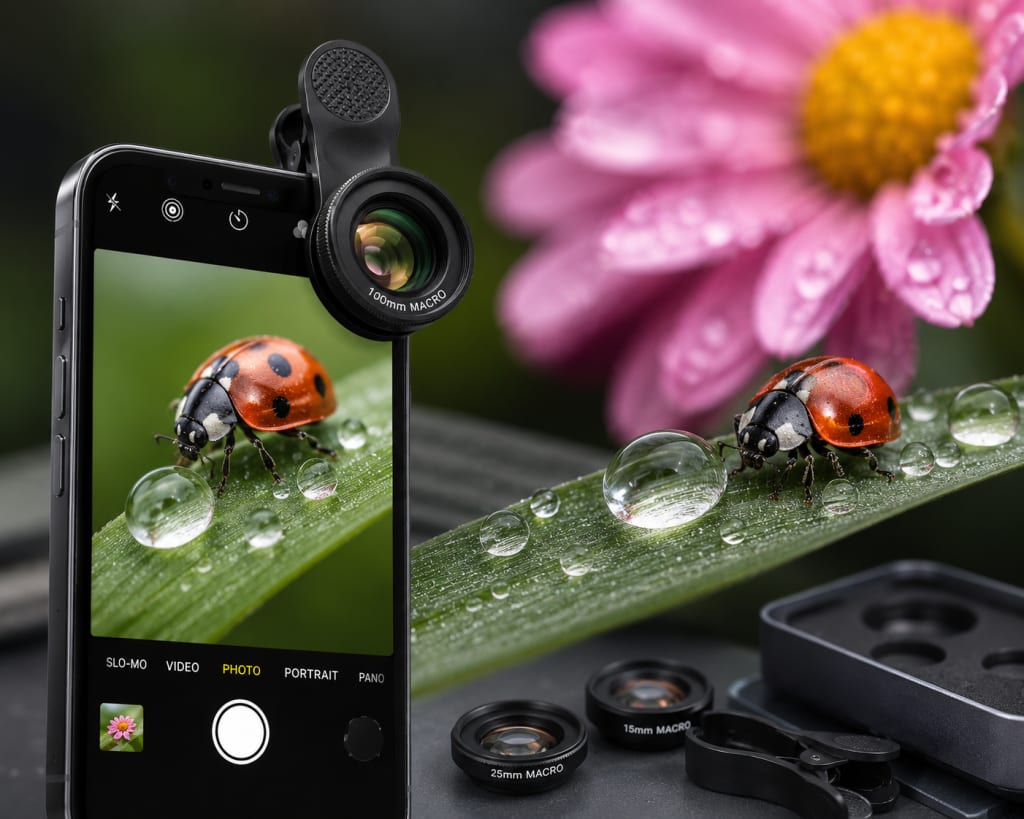
Smartphone Macro Lenses: Tiny Tech, Big Shots
The most magical photographs are not always taken from mountaintops, helicopters, or luxury studios.
Sometimes they are hiding on a leaf.
Inside a flower.
On the wing of an insect.
Across the texture of a coffee bean.
In the sparkle of a ring.
On the surface of rain-soaked glass.
In the tiny fibers of fabric, the ridges of a coin, the veins of a petal, or the miniature world living quietly under our eyes every day.
That is why smartphone macro lenses have become one of the most exciting mobile photography trends. They turn the ordinary phone camera into a close-up exploration tool, allowing anyone to capture tiny subjects with dramatic detail. Instead of needing a professional DSLR or mirrorless camera with a dedicated macro lens, creators can now clip, mount, or attach a small lens to their phone and enter a hidden visual universe.
Macro photography has always been fascinating because it changes scale. A small object becomes enormous. A drop of water becomes a crystal dome. A flower becomes an alien landscape. An insect becomes a creature from a fantasy film. A watch dial becomes architecture. Everyday objects suddenly look strange, beautiful, and cinematic.
Smartphones already made photography accessible. Macro lenses are making the invisible feel accessible too.
What Is a Smartphone Macro Lens?
A smartphone macro lens is an accessory that lets your phone camera focus much closer than usual. It magnifies tiny subjects so you can capture close-up details that a normal phone camera may miss.
Some modern phones already include built-in macro modes, often using the ultrawide camera or a dedicated macro sensor. But external macro lenses can still offer better magnification, sharper detail, more creative control, and a more serious close-up look when paired with a good phone camera.
Most smartphone macro lenses attach in one of three ways:
A clip-on mount.
A dedicated phone case mount.
A magnetic or bayonet-style lens system.
Clip-on lenses are usually cheaper and easier to use across different phones. Case-based lenses are often more stable and better aligned. Premium systems from brands like Moment, Sandmarc, and ShiftCam are popular among mobile creators because they use higher-quality glass and more secure mounting methods. Moment’s T-Series lenses, for example, are designed for newer smartphones and attach through compatible cases or mounts, with options including macro lenses for close-up photography.
The core idea is simple: tiny lens, huge creative possibilities.
Why Macro Photography Feels So Addictive
Macro photography is addictive because it changes how you look at the world.
A normal camera encourages you to look outward: landscapes, people, buildings, streets, skies, sunsets, and travel scenes. A macro lens encourages you to look closer. It turns your attention toward details you usually ignore.
Suddenly, a flower is not just a flower. It is color, texture, pattern, pollen, shadow, curve, and geometry.
A kitchen spice is not just spice. It is crystal, grain, dust, and color.
A butterfly wing is not just beautiful. It is a field of microscopic scales.
A simple coin becomes a landscape of scratches, ridges, symbols, and history.
This is why macro photography is so satisfying for creators. It rewards patience and curiosity. You do not need to travel to a famous location. You can find subjects at home, in a garden, on a desk, in a market, at a café, or after rain.
The world becomes photographable again.
Not because it changed.
Because your eyes did.
Why Smartphone Macro Lenses Are Trending
Smartphone macro lenses are trending because they sit at the perfect intersection of creativity, affordability, and social media.
People want unique images. Everyone has sunset photos, food photos, selfies, and street shots. Macro photography stands out because it shows something familiar in an unfamiliar way. A close-up of a flower’s center, a water droplet on a leaf, or a tiny insect’s eye immediately feels different in a feed full of ordinary pictures.
The trend also fits the creator economy. Small businesses use macro shots for jewelry, skincare, handmade crafts, watches, food, fabric, makeup, and product details. Hobby photographers use them for insects, plants, textures, and daily creative challenges. Social media creators use them for satisfying close-up videos and reels.
Another reason is that smartphone cameras have improved dramatically. Computational photography, better sensors, image stabilization, HDR, and AI processing have made phone cameras more capable than ever. Digital Camera World’s 2026 macro photography guide even includes a smartphone category, showing how seriously mobile macro capability is now being treated in broader photography discussions.
In the past, macro felt like a specialist genre.
Now it is in people’s pockets.
Built-In Macro Mode vs External Macro Lens
Many premium phones now have built-in macro features. Some use the ultrawide lens to focus close. Others use dedicated macro cameras. These modes are convenient because they require no accessory.
But built-in macro has limits.
Some phone macro modes rely on lower-quality sensors. Some produce distortion at the edges. Some require very close focusing distances that block light. Some oversharpen details. Some struggle with depth of field. Some give decent results only in bright light.
External macro lenses can improve the experience by giving stronger magnification, better subject isolation, and more interesting optical character. They can also make the phone feel more like a creative camera system.
That said, not every external lens is better. Cheap clip-on lenses can cause blur, color fringing, soft edges, alignment problems, and frustration. A poor lens may produce worse results than your phone’s built-in macro mode.
The choice depends on your goal.
For casual close-ups, built-in macro may be enough.
For creative detail shots, product photography, insects, flowers, and serious mobile photography, a good external macro lens can be worth it.
What Can You Shoot With a Smartphone Macro Lens?
The best part of macro photography is that subjects are everywhere.
You can shoot:
Flowers.
Leaves.
Insects.
Butterfly wings.
Water droplets.
Jewelry.
Watches.
Coins.
Food textures.
Coffee beans.
Spices.
Fabric fibers.
Makeup products.
Skincare textures.
Wood grain.
Paper texture.
Electronic circuits.
Toy details.
Miniatures.
Eyes.
Feathers.
Shells.
Moss.
Rust.
Ice crystals.
Soap bubbles.
The trick is to stop thinking only about objects and start thinking about surfaces, patterns, and details.
A cracked wall may look boring from far away but fascinating up close. A spoonful of sugar can become a field of crystals. A slice of orange can look like stained glass. A worn leather bag can reveal texture and history. A raindrop on a leaf can reflect an entire scene.
Macro photography turns small subjects into big stories.
Why Lighting Matters More Than the Lens
In macro photography, light is everything.
When you move very close to a subject, your phone and lens may block light. The closer you get, the harder it becomes to keep the subject bright and sharp. Small subjects also reveal harsh shadows quickly.
Natural light is usually best for beginners. A bright window, cloudy outdoor light, or soft morning light can create beautiful macro shots. Direct midday sun can be too harsh, but it can also create dramatic shadows if used intentionally.
For product macro shots, a small LED light, ring light, or softbox can help. Even a white paper sheet can bounce light back onto the subject. A diffuser can soften harsh sunlight. A dark background can make colorful subjects pop.
Good lighting can make an inexpensive macro lens look better.
Bad lighting can make an expensive lens look weak.
The lens magnifies the subject.
The light creates the photograph.
The Depth of Field Problem
Macro photography has one major challenge: depth of field.
When you shoot very close, only a thin slice of the subject may be in focus. The front of a flower petal might be sharp while the rest melts into blur. An insect’s eye may be sharp but its wings soft. A ring stone may sparkle while the band falls out of focus.
This can be beautiful, but it can also be frustrating.
To improve focus:
Keep the phone steady.
Shoot in bright light.
Tap carefully on the exact focus point.
Move the phone slowly forward and backward instead of relying only on autofocus.
Use burst mode if needed.
Avoid wind when shooting flowers or insects.
Use a small tripod for still subjects.
Take multiple shots from slightly different distances.
Professional macro photographers often use focus stacking, where several images focused at different distances are combined into one sharper final photo. Many dedicated cameras now include focus bracketing or stacking features, and macro guides continue to highlight their importance for close-up work.
Phones are getting better at computational focus, but for now, patience still matters.
Macro rewards slow shooting.
Stability Is the Secret
Tiny movements become huge problems in macro photography.
When the subject is magnified, even a small hand shake can blur the image. Breathing, wind, finger movement, and tapping the shutter can all affect sharpness.
To get better results:
Use both hands.
Rest your elbows on a surface.
Use a mini tripod.
Use a phone clamp.
Use a timer or remote shutter.
Shoot several frames.
Avoid moving subjects until you practice.
For insects and outdoor subjects, stability is harder because the subject may move. That is part of the challenge. Many great macro shots require patience, waiting, and a lot of failed attempts.
If you are shooting jewelry, watches, coins, or product details, use a tripod whenever possible. Your images will look sharper and more professional immediately.
A macro lens gives magnification.
Stability gives clarity.
Why Macro Is Perfect for Small Businesses
Smartphone macro lenses are especially useful for small businesses.
A jewelry seller can show gemstone cuts, engraving, clasp details, and texture.
A skincare brand can show cream texture, serum drops, and packaging materials.
A food creator can capture sugar crystals, melted chocolate, spice grains, or steam details.
A watch seller can show dial texture and mechanical details.
A craft seller can show stitching, leather grain, handmade imperfections, or material quality.
A cosmetics seller can capture shimmer, pigment, brush texture, and product swatches.
This matters because online buyers cannot touch products. Macro shots help communicate quality. They show craftsmanship, texture, and detail.
For small sellers who cannot afford professional studio photography, a smartphone macro lens can be a practical upgrade. Good lighting, a clean background, and a steady phone can create product photos that feel much more premium.
Tiny details can sell big.
Macro Video: The Hidden Opportunity
Macro is not only for photos.
Smartphone macro lenses can create mesmerizing videos. Close-up video of coffee being ground, paint mixing, water droplets moving, insects walking, honey pouring, makeup powder breaking, fabric being stitched, or jewelry sparkling can be extremely satisfying.
Macro video works well for:
Instagram Reels.
TikTok.
YouTube Shorts.
Product ads.
Behind-the-scenes craft clips.
Food content.
Nature videos.
ASMR-style visuals.
Science education.
The key is slow movement. Fast camera motion becomes disorienting at macro distances. Smooth, controlled movement looks cinematic. A small slider, tripod, or steady hand can help.
Macro video makes tiny processes feel dramatic.
A droplet falling can look like a movie scene.
A coffee bean cracking can feel epic.
A ring catching light can become luxury advertising.
Choosing a Smartphone Macro Lens
When buying a smartphone macro lens, consider these factors.
First, check compatibility. Some lenses require specific cases or mounts. Premium lenses may not work properly if not aligned with the correct phone camera.
Second, look at magnification. Common macro lenses include 10x, 15x, 20x, and higher. More magnification is not always better. Higher magnification is harder to focus and requires more light.
Third, consider working distance. This means how far the lens must be from the subject. A little working distance is helpful because you do not block all the light or scare insects away.
Fourth, check optical quality. Good glass matters. Cheap plastic lenses may create blur and distortion.
Fifth, check mounting stability. A lens that shifts slightly can ruin focus.
Sixth, think about ecosystem. Brands like Moment offer lens systems built around cases and mounts for newer phones, while other brands offer clip-on flexibility. Tom’s Guide’s 2026 iPhone lens guide highlights brands like Moment and Sandmarc as major players in premium mobile lens accessories.
Seventh, check whether you really need it. If your phone already has an excellent macro mode and you shoot casually, an external lens may not be necessary.
The best lens is not the one with the biggest number.
It is the one you will actually use.
Clip-On Lenses: Good or Bad?
Clip-on macro lenses are popular because they are cheap and simple.
They can work well for beginners, especially if you just want to experiment. You clip the lens over your phone camera, open the camera app, move close to the subject, and shoot.
But clip-on lenses have drawbacks.
They can be hard to align perfectly.
They may slip.
They may not fit well over large camera bumps.
They can scratch if poorly made.
They may block other lenses.
They may produce soft corners.
They may struggle with phone cases.
For casual fun, clip-ons are fine. For serious product work or consistent results, a case-mounted lens system is usually better.
Think of clip-ons as the entry point.
Think of mounted lenses as the upgrade.
Macro Lens Mistakes Beginners Make
The most common beginner mistake is getting too close without enough light.
Macro lenses have specific focusing distances. If you are too far, the subject is blurry. If you are too close, it is also blurry. You need to find the sweet spot.
Another mistake is expecting everything to be sharp. Macro naturally creates shallow focus. Choose one important point and make that sharp.
Another mistake is shooting in messy backgrounds. Macro enlarges details, including dust, fingerprints, and clutter. Clean your subject and background.
Another mistake is using digital zoom too much. Digital zoom can reduce quality. Let the macro lens do the magnification first.
Another mistake is photographing moving subjects too early. Start with still subjects like coins, leaves, flowers, jewelry, or food. Then move to insects once you understand focus and light.
Macro is simple to start but difficult to master.
That is what makes it fun.
Best Beginner Macro Ideas
If you are new to smartphone macro photography, start with easy subjects.
Try a flower near a window.
A water droplet on a leaf.
The texture of a strawberry.
Coffee foam.
A coin.
A ring.
A watch face.
Salt crystals.
A feather.
Fabric texture.
A pencil tip.
A soap bubble.
A printed page.
A dry leaf.
A piece of chocolate.
These subjects are easy because they do not run away. They let you practice distance, focus, and lighting.
Once you get comfortable, try insects, spiders, butterflies, bees, ants, and other tiny creatures. Move slowly and avoid harming them. The best nature macro photography respects the subject.
A good macro photographer is curious, not careless.
Editing Macro Photos
Macro photos often benefit from light editing.
You can adjust:
Brightness.
Contrast.
Sharpness.
Texture.
Clarity.
Highlights.
Shadows.
Color temperature.
Saturation.
Crop.
But be careful. Over-sharpening can make macro photos look crunchy and artificial. Too much saturation can make flowers look fake. Heavy contrast can crush delicate detail.
The goal is to enhance what was already there.
Not turn every insect into a video-game creature.
Apps like Lightroom Mobile, Snapseed, VSCO, and phone-native editors can handle most macro edits. For product work, consistent color is especially important. A ring, fabric, lipstick, or food item should look accurate, not just dramatic.
For art, edit creatively.
For sales, edit honestly.
Macro Photography and Science Curiosity
One of the most beautiful things about smartphone macro lenses is that they encourage scientific curiosity.
Children and adults can use them to explore plants, insects, rocks, leaves, fabrics, shells, and everyday materials. A phone becomes a simple microscope-like creative tool.
Of course, a macro lens is not the same as a microscope. It will not show true microscopic life. But it can reveal details beyond normal vision and make people ask questions:
Why does this leaf have tiny hairs?
How is an insect wing structured?
Why does salt look like a crystal?
What does fabric look like up close?
Why do flower petals have veins?
How does a water droplet reflect light?
Macro photography makes observation feel exciting.
It turns everyday life into a tiny science expedition.
Why Macro Works So Well for Nature Lovers
Nature macro is one of the most rewarding uses of smartphone lenses.
You do not need a national park. A small garden, roadside plant, balcony flowerpot, park bench, or rainy leaf can become a subject. Tiny ecosystems are everywhere.
Insects, moss, fungi, seeds, bark, flowers, raindrops, and soil textures all offer endless possibilities.
But nature macro requires respect.
Do not damage plants for a shot.
Do not harm insects.
Do not trap animals.
Do not disturb nests.
Do not use harsh lights too close to living creatures for too long.
Do not enter restricted natural areas.
A great macro shot should not come at the cost of the subject.
The best nature photographers are gentle.
Smartphone Macro for Jewelry and Luxury Content
Jewelry and watches are perfect macro subjects because they are built from detail.
A macro lens can show gemstone facets, metal texture, engraving, dial finishing, bracelet links, pearls, clasps, and reflections. This is why many small jewelry sellers and watch collectors love macro photography.
But reflective objects are tricky.
Jewelry reflects everything: your phone, your hand, your room, your light, and your background. To improve results, use soft diffused light and clean backgrounds. A white paper tent or simple DIY lightbox can help.
For rings, try shooting at a slight angle instead of straight down. For watches, avoid harsh reflections on the glass. For gemstones, move the light around until the stone sparkles without blowing out highlights.
Macro can make inexpensive jewelry look better.
But it can also reveal dust and fingerprints brutally.
Clean everything first.
The Future of Smartphone Macro Photography
Smartphone macro photography will keep improving.
Phones are gaining better sensors, improved autofocus, AI-assisted depth processing, computational focus stacking, and stronger close-focus capabilities. External lenses are also improving, with better glass, stronger mounts, and designs built for large modern camera modules.
The future may bring:
AI-assisted macro focus.
Automatic focus stacking on phones.
Better built-in macro sensors.
Smaller premium external lenses.
Improved lighting accessories.
AR-assisted composition guides.
More creator-focused product photography tools.
But even as the technology improves, the heart of macro photography will remain the same.
Look closer.
Notice more.
Turn small things into visual stories.
That is why the trend will last.
It is not only about gear.
It is about attention.
Smartphone macro lenses are tiny tools with huge creative potential. They allow everyday phone users to capture flowers, insects, jewelry, food, fabrics, textures, and product details with a level of intimacy that normal photography often misses. In a world where everyone is taking wide shots, selfies, and travel photos, macro photography offers something different: a hidden world revealed through close attention.
Modern phones already include increasingly capable macro modes, but external macro lenses can still offer stronger magnification, more creative control, and better close-up results when paired with good lighting and steady shooting. Premium mobile lens systems from brands like Moment, Sandmarc, and others show that smartphone photography accessories are becoming serious creative tools rather than simple gimmicks.
The best part is accessibility. You do not need a professional studio or expensive camera to begin. You need a phone, a macro lens, good light, patience, and curiosity.
A leaf becomes a landscape.
A ring becomes architecture.
A droplet becomes a universe.
That is the magic of smartphone macro photography.
Tiny tech.
Big shots.
