Understanding Nilsson’s Power Model: The Framework That Redefined How We Interpret Human Strength, Influence, and Social Dynamics
In the landscape of theoretical models that attempt to explain power—how it emerges, how it flows, and how it shapes human societies—few frameworks are as compelling, adaptable, and quietly influential as Nilsson’s Power Model. Though lesser known outside academic and psychological circles, the model has begun to gain traction in organizational studies, leadership research, social psychology, and even digital culture analysis.
Nilsson’s work offers a profound, structured approach to understanding power not as a blunt force, but as a dynamic, multi-dimensional system shaped by perception, context, and relationship. It is a model ambitious enough to describe global politics and intimate enough to decode household dynamics. In an era where power is increasingly decentralized, contested, and redefined by digital spaces, Nilsson’s insights have never been more relevant.
This is a comprehensive, magazine-ready exploration of Nilsson’s Power Model—its origins, its mechanics, and why it has become a powerful tool for dissecting influence in the modern world.
What Is Nilsson’s Power Model?
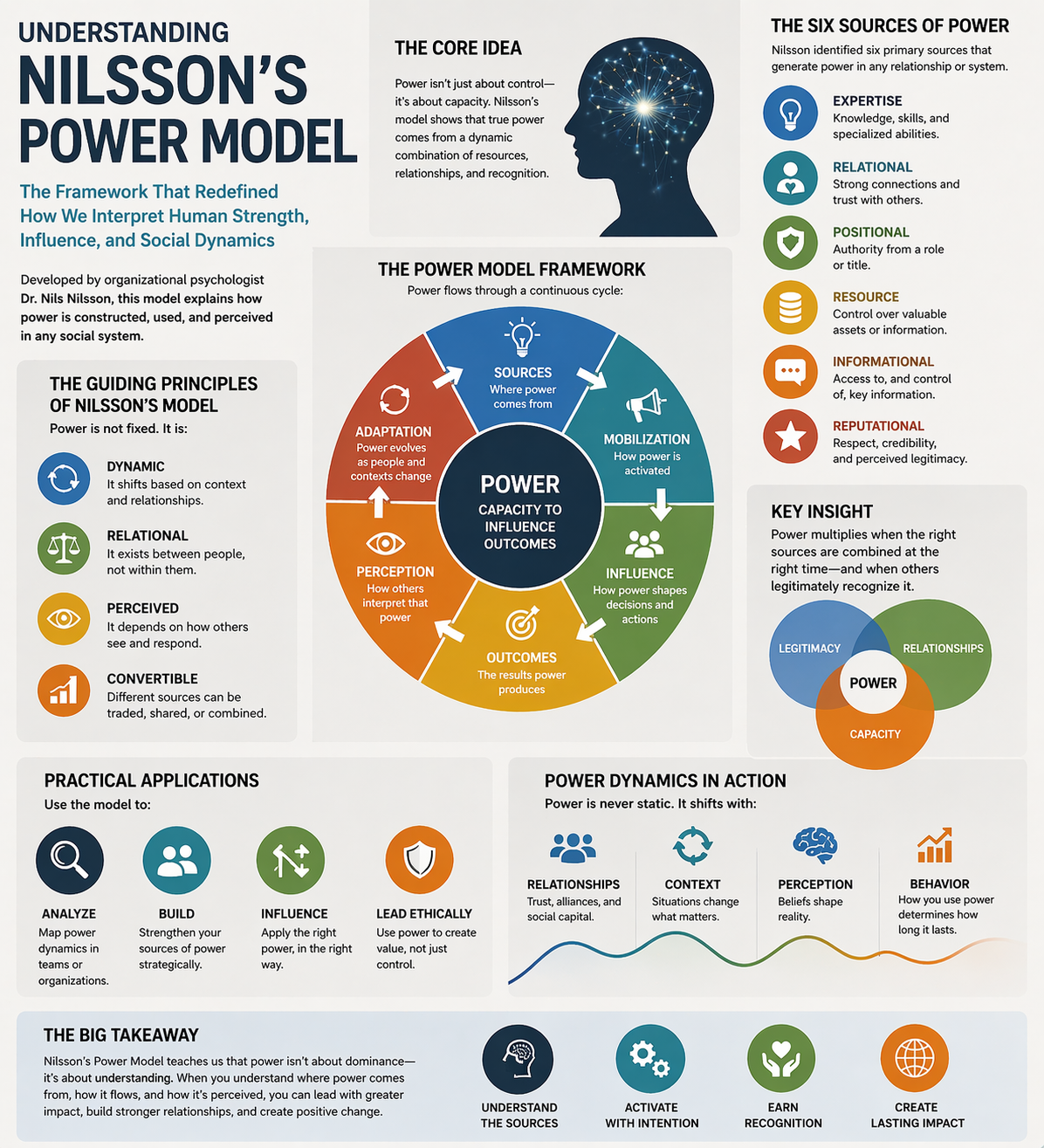
Nilsson’s Power Model is a conceptual framework that breaks power into three primary dimensions:
Power to Act
Power Over Others
Power With Others
Rather than treating power as a singular force, Nilsson positioned it as a spectrum that can shift, collapse, or expand depending on context. His model emphasizes that power is not merely about dominance but about the interplay between capability, authority, and cooperation.
The significance of this framework lies in its ability to explain not only political or economic power, but also interpersonal influence, community structures, and psychological self-determination.
A Brief Timeline of Nilsson’s Framework
1960s–1970s:
Nilsson’s early academic work evolves from leadership theory, behavioral psychology, and the newly emerging field of social constructivism. Initial drafts propose a two-axis model of “personal competency” and “social dominance.”
1980–1987:
Nilsson integrates sociological thought into the model—particularly ideas about collective agency. The third dimension, Power With, is introduced, transforming the model into a triangular structure.
1990s:
Organizational scholars adopt the model for leadership analysis, particularly in Scandinavian corporate environments known for flat hierarchies.
2000s:
The model sees renewed interest in political science and psychotherapy, which use its framework to understand trauma, disempowerment, and interpersonal conflict.
2015–Present:
With the expansion of online activism, decentralized technologies, and shifting workplace structures, Nilsson’s Power Model becomes a tool for analyzing digital influence, platform power, and social movements.
The Three Dimensions Explained
1. Power to Act (Personal Capacity)
This is the most inward-facing dimension. It represents agency, ability, skill, and psychological empowerment—essentially an individual’s internal engine.
It includes:
decision-making ability
self-confidence
competency and expertise
mental resilience
autonomy
Nilsson argued that societies often underestimate this form of power because it is not outwardly visible. Yet it is foundational: a person without internal power cannot sustain external power.
In psychological contexts, Power to Act is associated with self-efficacy and personal growth.
In organizational environments, it reflects an employee’s ability to innovate and contribute effectively.
2. Power Over Others (Control and Authority)
This is the dimension most people instinctively associate with power. It represents influence exerted downward or outward, involving hierarchy, enforcement, and dominance.
Examples include:
political authority
managerial control
parental control
coercion, threats, or reward systems
Nilsson never denied that Power Over is necessary in some contexts—governments, institutions, and families require structure. But he warned that when this dimension becomes too large relative to the other two, systems slide toward authoritarianism, abuse, or stagnation.
This dimension explains:
toxic leadership
micro-management
political coercion
domestic dominance patterns
3. Power With Others (Collective Strength)
Nilsson’s most influential contribution is the concept of shared power—the idea that cooperation creates a type of power impossible to achieve individually or through coercion.
It includes:
alliances
collaboration
social cohesion
movements and activism
mutual respect
From corporate team-building to global protests, “Power With” is the engine behind large-scale change. Nilsson argued that societies flourish when this dimension is valued alongside individual agency.
The Visual Map: Nilsson’s Power Triangle
Nilsson’s model is often represented as a triangle, with each point representing one dimension of power. The size of each point shifts based on the person, group, or institution being analyzed.
Balanced Triangle:
Personal agency, authority, and collective power are equal.
Result: healthy systems, adaptable organizations, empowered individuals.
Dominance-Skewed Triangle:
Power Over is disproportionately large.
Result: authoritarianism, fear-based leadership, burnout, rebellion.
Collaboration-Skewed Triangle:
Power With is dominant.
Result: democratic strength, but potential inefficiency if personal agency is weak.
Individualism-Skewed Triangle:
Power to Act becomes overemphasized.
Result: brilliance or innovation, but fragmentation and poor group cohesion.
Nilsson didn’t view any configuration as inherently wrong—but argued that imbalance is what creates dysfunction.
Why Nilsson’s Power Model Is a Masterpiece of Social Theory
1. It’s Universally Applicable
Nilsson’s model works in:
families
political systems
corporate structures
friendships
romantic relationships
activism
digital communities
Its flexibility is what makes it profound.
2. It Reveals Invisible Power Structures
By mapping power visually, the model exposes:
who is marginalized
who is overburdened
how systems erode mental health
why groups fracture
It diagnoses the unseen architecture beneath human behavior.
3. It Helps Explain Modern Problems
Social media algorithm dominance = Power Over
Online activist communities = Power With
Influencers and personal brands = Power to Act
Nilsson’s triangle perfectly describes power dynamics in the digital age.
4. It Encourages Ethical Leadership
The model champions leaders who:
empower individuals
share decision-making
build cohesive teams
avoid domination
It predicts that long-term stability comes not from control, but from balance.
5. It Connects Psychology and Politics
Few theories unite both micro and macro power.
Nilsson’s does.
The same model can explain:
a controlling spouse
a controlling government
a controlling employer
And it can propose remedies for all three.
Nilsson’s Model in Action: Real-World Examples
In Corporations
If a manager relies exclusively on Power Over, employees become disengaged. Productivity collapses. Innovation dies. Nilsson’s model pushes organizations toward empowerment and shared agency.
In Democracies
When Power With fades and Power Over grows, democracies begin sliding into authoritarianism. Nilsson’s triangle becomes a warning system.
In Therapy
Patients with trauma often lose their Power to Act. therapy aims to rebuild this internal point of the triangle to restore balance.
In Social Movements
Movements thrive on Power With. The collapse of activism often occurs when leaders pursue Power Over instead.
Nilsson’s Lasting Legacy
Nilsson’s Power Model has endured because it is not just theoretical—it is profoundly human. It acknowledges that power is not merely about control or authority. It is a dance of internal strength, external influence, and collective collaboration.
His model reframes power as a living system: it grows, decays, reshapes itself, and adapts. It warns against domination, champions autonomy, and recognizes community as a form of force.
In a world increasingly defined by extremes—hyper-individualism on one side and mass manipulation on the other—Nilsson’s balanced approach offers a vital blueprint for restoring harmony. Whether applied to national governance, workplace culture, family systems, or digital communities, the model reveals one truth:
Power is healthiest when shared, not seized.
Nilsson’s triangle remains one of the most elegant and insightful tools for understanding how humans shape the world—and how the world, in turn, shapes us.
