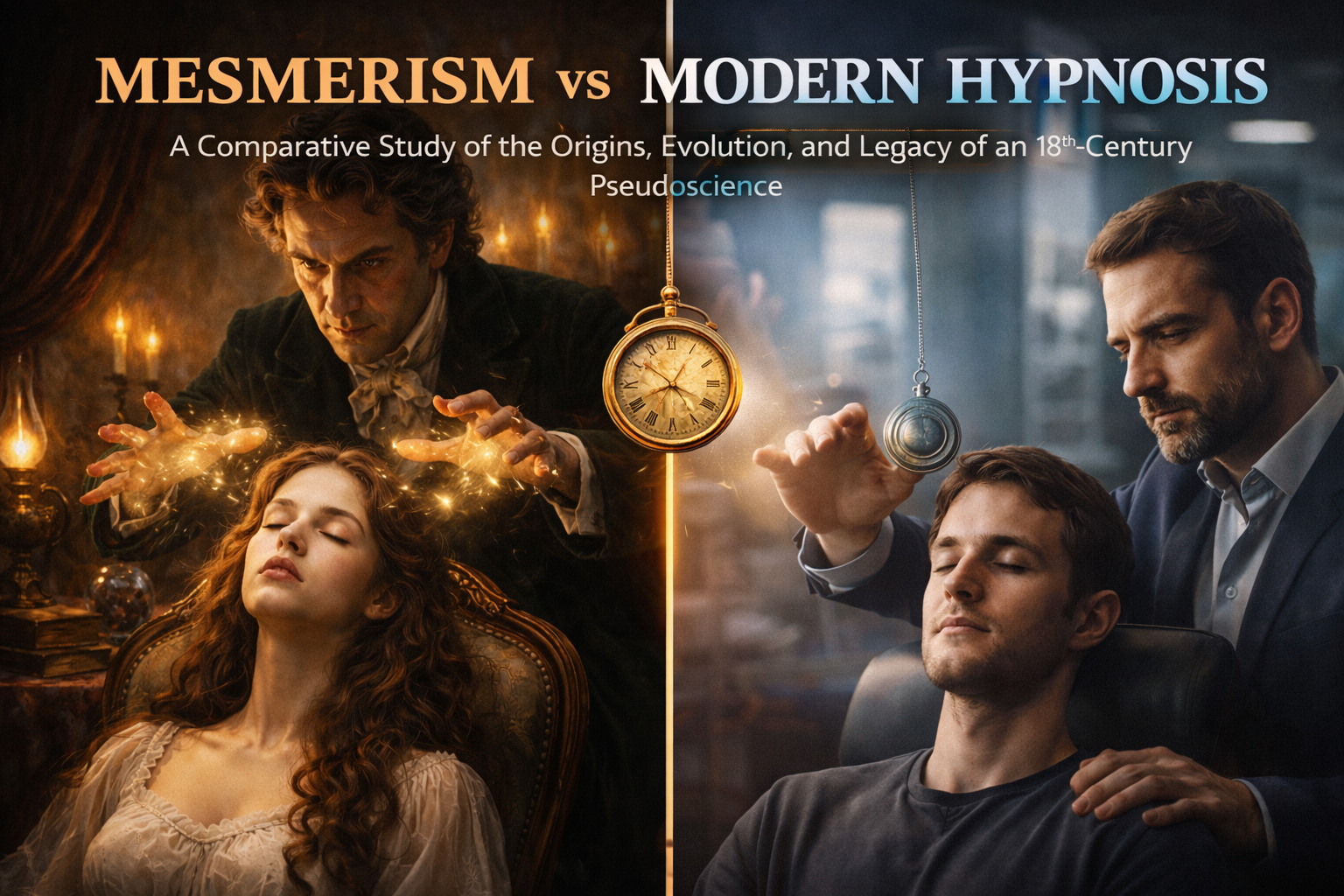
Mesmerism vs. Modern Hypnosis: A Comparative Study of the Origins, Evolution, and Legacy of an 18th-Century Pseudoscience
Few concepts in the history of psychology have traveled a stranger path than mesmerism. What began as an 18th-century theory of invisible “animal magnetism” evolved — through controversy, reinvention, and scientific scrutiny — into what we now call hypnosis. Today hypnosis is studied in clinical psychology, neuroscience, and therapeutic practice. But mesmerism, the belief system that started it all, remains a fascinating mixture of pseudoscience, charisma, spectacle, and cultural influence. Understanding the differences — and the surprising continuities — between mesmerism and modern hypnosis reveals not only how scientific ideas evolve, but how human beings respond to belief, suggestion, and psychological authority.
Mesmerism was never truly about magnets or mysterious fluids; it was about the power of human attention, the willingness to be guided, and the psychological relationship between healer and subject. Modern hypnosis stripped away the mysticism, replacing it with measurable mechanisms: suggestion, trance states, dissociation, and cognitive focus. Yet the legacy of Franz Anton Mesmer still pulses beneath contemporary practice, a reminder that the human mind is far more malleable — and mysterious — than Enlightenment rationality could admit.
Origins: Mesmer’s Magnetic Universe vs. Psychology’s Cognitive Model
Franz Anton Mesmer believed illness resulted from imbalances in a universal, invisible fluid he called “animal magnetism.” He claimed he could manipulate this fluid using hand passes, eye contact, magnets, and theatrical rituals to restore harmony. Mesmer’s system was metaphysical; it treated the human body as a vessel influenced by cosmic energies. Healing required aligning oneself with a natural force, almost like tuning an instrument.
Modern hypnosis rejects any metaphysical explanation. Instead of unseen magnetic currents, hypnosis is understood through cognitive and neurological mechanisms: heightened suggestibility, focused attention, altered awareness, and dissociation. Where Mesmer saw fluids and forces, psychologists see internal mental processes. Hypnosis today is based on observable patterns — changes in brain activity, shifts in perception, and vulnerability to verbal cues — not mystical energy.
Yet the two share a core commonality: both rely on human susceptibility to suggestion, though each interprets it differently. Mesmer saw it as proof of magnetism. Modern psychologists see it as a property of consciousness.
Technique: The Theatrics of Mesmer vs. the Minimalism of Hypnosis
Mesmer’s treatments were dramatic: darkened rooms, music, ritual gestures, metal rods, communal “crisis” events where patients shook or fainted, and Mesmer himself as a charismatic center of attention. His technique was as much performance as healing. Mesmer understood theatrics intuitively — not as fraud, but as part of the mechanism. His subjects entered an altered state partially because the environment encouraged it.
Modern hypnosis emphasizes calm, concentration, and verbal guidance. There are no props, rods, or magnetic baquets. Its power lies in subtlety — the therapist’s voice, breathing patterns, gentle instruction. The trance is inward, personal, and psychologically structured. Hypnotists strip away everything external to focus solely on attention modulation.
Still, a comparison reveals a profound continuity:
Both methods rely heavily on context — the atmosphere, the authority of the practitioner, and the willingness of the subject. Mesmer dressed his technique in spectacle; hypnosis dresses itself in clinical neutrality. But the psychological relationship — healer and believer — remains foundational.
Purpose and Application: Mesmerism’s Spiritual Healing vs. Hypnosis’s Clinical Practice
Mesmerism positioned itself as a universal cure-all. Mesmer and his followers claimed to heal blindness, paralysis, hysteria, chronic pain, and even spiritual crisis. It was, in essence, a philosophy disguised as medicine. It offered not just treatments but a worldview: human suffering was energetic imbalance, and Mesmer was the conductor who restored harmony.
Modern hypnosis is far more modest and evidence-based. It is used for pain management, phobias, addiction treatment, trauma therapy, and behavioral modification. Studies show hypnosis is particularly effective for anxiety, anesthesia, memory recall, and habit change. It is not a universal cure; it is a clinical tool.
Yet a subtle reflection appears: both use trance states to access deeper psychological processes. Mesmer’s mystical framing obscured this, but modern science has revealed the real mechanism — not magnetism but the power of the subconscious mind.
Scientific Standing: Mesmerism Debunked vs. Hypnosis Legitimated
In 1784, the French Royal Commission — which included Benjamin Franklin — investigated Mesmer’s methods. Their conclusion was harsh: animal magnetism did not exist. The effects were due to imagination, expectation, and psychological influence. Mesmerism was labeled pseudoscience.
Ironically, the Commission’s “debunking” accidentally revealed the foundations of modern hypnosis. They noted that patients responded because of belief, suggestion, and the healer’s authority — precisely the elements that psychology later recognized as hypnotic mechanisms. Mesmer lost credibility, but the seeds of hypnosis were planted.
Today hypnosis is accepted in scientific and therapeutic fields. Mesmerism, meanwhile, remains a historical curiosity — an early attempt to understand psychological phenomena before psychology existed.
Cultural Influence: Mesmerism’s Mystique vs. Hypnosis’s Misrepresentation
Mesmerism left a huge cultural imprint: Gothic literature, Victorian séances, occult movements, stage magic, spiritual healing, and the entire aura of “magnetizers” who populated 19th-century Europe and America. Mesmer became a symbol of mysterious mental influence, a proto-hypnotist wrapped in mysticism.
Hypnosis, on the other hand, suffers from Hollywood misrepresentation — pocket watches, evil hypnotists, mind control. In truth, hypnosis cannot override free will or implant commands. It deepens focus, not obedience.
Yet both suffer from the same cultural problem: people misunderstand the mechanism because the experience feels otherworldly. Mesmerists and hypnotists both tap into a peculiar human capacity: the ability to enter a dissociative state where imagination becomes temporarily real.
Psychological Insight: Mesmerism’s Unwitting Discovery vs. Hypnosis’s Scientific Refinement
Mesmer’s most enduring contribution was accidental. He discovered — without understanding it — that humans can be guided into suggestible states through ritual, authority, and expectation. He stumbled into the subconscious long before Freud. Mesmer believed he was manipulating fluids. In reality, he was activating psychological processes modern neuroscience now recognizes: altered perception, trance, selective attention, and the placebo effect.
Modern hypnosis refined these discoveries, distilling the essence of suggestion into a systematic framework. Where mesmerism was all instinct and spectacle, hypnosis is structured, researched, and neurologically supported.
The real comparison is this:
Mesmer discovered the door.
Hypnosis learned how to walk through it.
Legacy: Mesmerism as Myth, Hypnosis as Method
Today mesmerism exists mostly as historical lore — charming, strange, theatrical, and discredited. Its ideas live on in spiritual healing, alternative medicine, and esoteric traditions, but not in science.
Hypnosis, however, stands as a legitimate therapeutic practice with measurable outcomes and growing neuroscientific evidence. Yet both remain part of the same lineage — two stages in humanity’s attempt to understand the malleability of the mind.
Mesmerism represents the pre-scientific imagination: mystical, intuitive, symbolic. Hypnosis reflects the modern scientific worldview: psychological, measurable, pragmatic.
And together, they show that the human mind is far more susceptible, flexible, and mysterious than most rational frameworks allow.