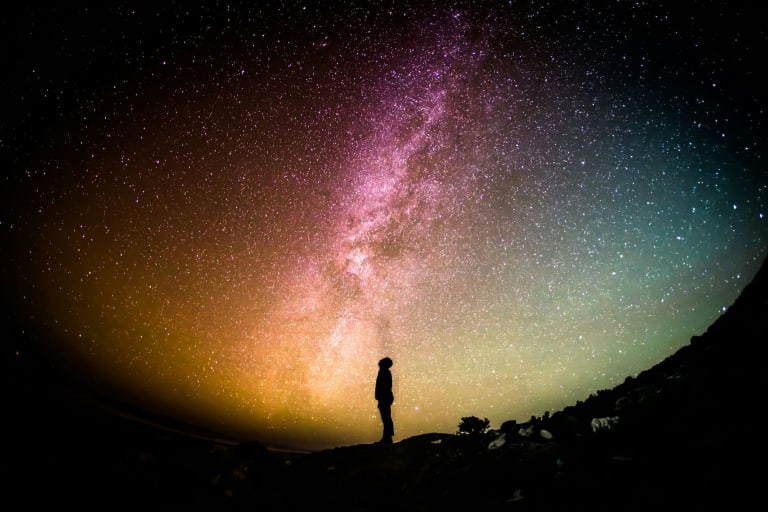
We Are Small Universes: The Astonishing Link Between DNA and the Stars
There are certain scientific comparisons that do more than inform. They rearrange the way we feel about existence.
One of them is this: a genome-length DNA molecule contains atoms on roughly the same order of magnitude as the number of stars in a typical galaxy. It is not a perfect one-to-one cosmic equation, and the exact number depends on what, exactly, you are counting. But the comparison is real enough to stop you in your tracks. Out there, a galaxy turns in darkness with more than 100 billion stars. In here, inside the double helix that helps build a human being, matter is assembled on a similarly staggering scale.
That does not mean your DNA is literally a galaxy, of course. It means something more interesting: vastness is not only a feature of the sky. It is also a feature of life.
We are used to thinking of scale in one direction. Big things inspire awe. Nebulae, black holes, galaxies, the architecture of the universe. But biology forces a reversal. It says that the very small can be just as overwhelming as the very large. A single copy of the human genome contains about 3 billion base pairs of DNA. Because each base pair is made of two nucleotides, and each nucleotide is a substantial molecular structure built from carbon, hydrogen, oxygen, nitrogen, and phosphorus, a genome-length DNA double helix contains on the order of 10¹¹ atoms—that is, on the order of hundreds of billions of atoms, depending on the exact composition counted.
That is why the original claim feels so powerful. Even if “100 billion” should be treated as a poetic approximation rather than a rigid fixed number, the scale is still breathtakingly close in spirit. The Milky Way alone contains more than 100 billion stars, according to NASA. A full genome-length DNA molecule, built from billions of base pairs and the chemistry that supports them, lives in the same general numerical universe.
The Double Helix as an Interior Cosmos
DNA is often described as the blueprint of life, and that metaphor is useful, but it can sound flatter than the reality deserves. DNA is not just a code written in abstraction. It is a physical molecule—twisted, packed, folded, copied, repaired, read, and protected in every living cell. NHGRI describes DNA as the molecule that carries genetic information for development and function, built from two strands wound around each other in the famous double helix. Each strand has a backbone of sugar and phosphate, with bases attached in a specific sequence.
That sequence is where biological information lives. But the molecule itself is not some light, ghostly thread. It is made from matter—real atoms arranged with exquisite discipline. And once you start thinking in atoms, the scale becomes difficult to ignore.
A molecule small enough to fit inside a cell nucleus is still so chemically rich that it reaches astronomical quantities at the atomic level.
That is one of the deepest scientific lessons a person can absorb: small does not mean simple.
Why the Comparison Works So Well
The DNA–galaxy comparison is emotionally effective because it joins two kinds of wonder people often keep separate.
On one side is cosmic awe: the kind we feel when looking up at the night sky and trying to imagine a galaxy with its hundreds of billions of stars.
On the other is biological awe: the kind we feel when realizing that a single cell contains machinery, instruction, storage, repair, replication, and regulation at a level of sophistication no human engineer has come close to matching.
Put them together and something shifts.
The stars are no longer only “out there.” Complexity is no longer only “inside microscopes.” The universe stops looking divided between a grand outer cosmos and a minor inner self. Instead, the same lesson appears at both scales: matter, when organized by nature, becomes astonishing.
NASA says astronomers estimate that the Milky Way contains more than 100 billion stars. NHGRI says one copy of the human genome contains about 3 billion base pairs. Once you connect genome size with the chemistry of nucleotides, the result is a molecule built from a star-like abundance of atoms.
That is not mystical. It is scientific.
And it still feels almost spiritual.
Every Cell Carries a Universe of Instructions
What makes the comparison even more astonishing is that DNA is not just chemically large. It is functionally dense.
The atoms in DNA are not sitting there randomly like a pile of dust. They are arranged in sequences that help store and transmit genetic information. NHGRI emphasizes that DNA carries the instructions needed for the development and functioning of living organisms. In humans, that means each cell carries access to the molecular basis for growth, repair, cellular specialization, reproduction, and inherited traits.
So when you say that a DNA molecule contains atoms on the order of a galaxy’s stars, you are not only making a size comparison. You are making a comparison between two different kinds of organized abundance.
A galaxy holds stars, gas, dust, magnetic fields, dark matter, and gravitational architecture across enormous distances.
DNA holds chemistry shaped into language.
One spins.
The other encodes.
One burns.
The other instructs.
Both are, in their own way, structures of staggering order.
We Are Not Separate From the Cosmos
This is the deeper philosophical power of the idea.
People often talk about human beings as if we are tiny and insignificant in comparison to the universe. There is some truth in that. On the largest scales, we are physically small. But the DNA–stars comparison reminds us that smallness and significance are not the same thing.
We are made of the same matter that fills the universe. The atoms in our DNA were forged through cosmic history. The carbon, oxygen, nitrogen, phosphorus, and hydrogen that make life possible did not appear apart from the cosmos; they emerged from it. DNA is not a rebuttal to cosmic vastness. It is one of its most extraordinary outcomes.
And that changes the emotional register.
Instead of saying, “The universe is huge, and we are nothing,” the better lesson may be:
The universe is huge, and somehow it became intimate.
It became chemistry.
It became cells.
It became heredity.
It became memory written in molecules.
It became a form capable of looking at stars and understanding, however dimly, that something similar in scale is woven into its own body.
A Better Way to State the Claim
The original line is beautiful, but if we want it scientifically cleaner, it is best phrased like this:
A genome-length DNA molecule contains atoms on roughly the same order of magnitude as the number of stars in a typical galaxy.
That version does three useful things.
First, it avoids implying an exact fixed count when the real number depends on the specific molecule and the method of counting.
Second, it preserves the awe.
Third, it keeps the science honest.
Because the truth does not need exaggeration. The truth is already enough.
A human genome contains about 3 billion base pairs. A galaxy like the Milky Way contains more than 100 billion stars. A DNA molecule built at genome scale reaches an atomic abundance in that same broad range of magnitude.
That is already one of the most astonishing sentences science allows us to say.
The Wonder of Relative Scale
What this comparison ultimately teaches is not just a fact about DNA. It teaches a principle about reality itself: scale changes wonder, but it does not diminish it.
At one scale, we stand beneath galaxies.
At another, galaxies vanish into a molecule.
At one scale, stars scatter across darkness.
At another, atoms line up into a code that can make a nervous system, a heartbeat, a hand, a face, a memory, a child.
The universe does not only produce grandeur through size. It produces grandeur through structure.
That is why the comparison lingers.
It does not merely tell us something.
It places us somewhere.
Not outside the cosmos, looking in.
But inside it, carrying one version of its vastness within us.
Final Verdict
There are not literally “exactly as many” atoms in every DNA molecule as stars in every galaxy, and the clean scientific version needs that caution. But the heart of the claim is real: a genome-length DNA molecule is built from an almost unimaginably large number of atoms—on the same broad order of magnitude as the number of stars in a typical galaxy. With the human genome containing about 3 billion base pairs, and the Milky Way holding more than 100 billion stars, the comparison is not fantasy. It is a powerful approximation grounded in real scale.
And that is what makes it unforgettable. The cosmos is not only above us. It is also within us—compressed into chemistry, folded into the double helix, and passed from generation to generation in structures so dense with matter and meaning that they deserve the same awe we give the stars.
FAQ
1. Is it true that a DNA molecule has as many atoms as a galaxy has stars?
Not as an exact universal count, but for a genome-length DNA molecule, the number of atoms is on roughly the same order of magnitude as the number of stars in a typical galaxy.
2. How many base pairs are in one copy of the human genome?
One copy of the human genome contains about 3 billion base pairs.
3. How many stars are in the Milky Way?
NASA says the Milky Way contains more than 100 billion stars.
4. Why is the DNA comparison only approximate?
Because the exact atom count depends on what DNA segment you mean, its specific base sequence, and how the chemistry is counted. Different DNA molecules contain different numbers of atoms.
5. Why does this comparison matter?
Because it reveals how astonishing biological complexity is. A molecule inside a cell can reach a scale of atomic abundance comparable, in order of magnitude, to the number of stars in a galaxy.