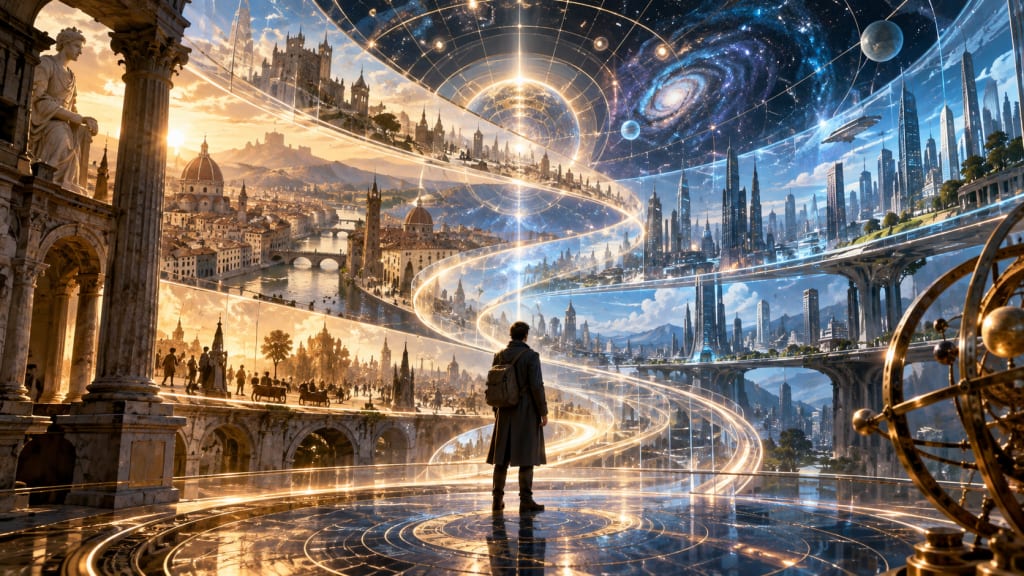
What If Time Travel Doesn't Break Reality—but Reveals How Time Really Works?
Imagine stepping into a machine, travelling 50 years into the past and preventing your own birth.
You now face the grandfather paradox.
If you were never born, who travelled back in time?
But suppose physics does not allow the contradiction to occur.
Perhaps your attempt was always part of history. Your gun jams. You miss. The person you thought was your grandfather was somebody else.
Or perhaps you succeed—but only because you have entered a different branch of reality where your own history remains untouched.
There is an even stranger possibility.
Maybe nothing is being "changed" at all.
Perhaps the past, present and future already belong to one complete four-dimensional structure, and what we experience as history unfolding is only our perspective from inside it.
In such an "all-at-once" universe, travelling to the past would not rewrite reality.
Your journey would already be part of the structure.
This sounds like science fiction, but several pieces of serious physics touch surprisingly close to these questions.
General relativity permits mathematical spacetimes containing closed timelike curves, paths that return to an earlier spacetime event.
Quantum physicists have developed models in which particles interact with their own past.
Researchers have experimentally simulated some of those models using photons and quantum computers.
Retrocausal interpretations of quantum mechanics explore whether future measurement conditions might help determine descriptions of earlier events.
And in 2026, researchers demonstrated a quantum-computing protocol that could be interpreted—under postselection—as recovering information "before" that information was generated. (journals.aps.org)
None of this means scientists have built a time machine.
No human, object or usable message has been experimentally sent backward through time.
What these experiments are doing is arguably more fundamental.
They are asking:
Does nature itself require the future to be generated from the past—or could an entire history be constrained as one self-consistent whole?
First: Einstein's Equations Do Not Completely Ban Time Travel
Special relativity famously prevents ordinary matter from accelerating beyond the speed of light.
That might seem to kill backward time travel immediately.
General relativity complicates the story.
Einstein's theory describes gravity not simply as a force but as the curvature of spacetime.
And certain solutions of Einstein's equations contain trajectories called closed timelike curves, or CTCs.
A timelike curve is essentially a path through spacetime that a massive observer could physically follow while always moving locally forward in their own proper time.
A closed timelike curve eventually loops back to an earlier spacetime location.
From the traveller's perspective:
Monday comes before Tuesday.
Tuesday comes before Wednesday.
Nothing locally moves backward.
Yet the geometry of spacetime eventually brings the traveller to an event in what outside observers would describe as the traveller's past.
Closed timelike curves appear in several mathematical solutions of general relativity, which is why time travel has been treated as a genuine foundational physics question rather than merely science fiction.
This does not mean our universe contains usable CTCs.
The known examples often require extraordinary conditions, unusual global spacetime geometries or speculative structures such as traversable wormholes.
Stephen Hawking famously proposed a chronology protection conjecture, suggesting that unknown physical effects may prevent macroscopic time machines from forming.
But general relativity by itself does not simply display an error message saying:
Time travel forbidden.
And that is where the paradoxes begin.
The Grandfather Paradox Is Really a Consistency Problem
Suppose you enter a closed timelike curve and travel backward.
You then prevent the event that caused you to enter the time machine.
The contradiction seems unavoidable.
You travelled back because event A happened.
You prevent event A.
Therefore you never travel back.
Therefore you do not prevent event A.
Therefore event A happens.
And around we go.
But physicists and philosophers noticed something important.
The existence of a causal loop does not automatically produce a logical contradiction.
Only an inconsistent causal loop does.
A perfectly self-consistent loop is strange but not logically impossible.
Suppose you go back to stop your younger self from entering the time machine.
Instead, during the confrontation, your actions accidentally cause your younger self to enter it.
There is a loop.
But there is no contradiction.
The older you always appeared in the younger you's past.
Your attempt to alter history was part of the history you were trying to alter.
The Novikov Principle: You Can Travel Back, but You Cannot Create a Contradiction
This idea became associated with the Novikov self-consistency principle.
The basic proposal is that if closed timelike curves exist, only events that are globally self-consistent can occur.
It is not necessarily that some supernatural force stops you from killing your grandfather.
Rather, the complete solution to the laws of physics simply cannot contain mutually contradictory events.
Researchers have studied classical models involving objects passing through hypothetical wormhole time machines and interacting with earlier versions of themselves.
In some models, the allowed trajectories turn out to be precisely the self-consistent ones. (arxiv.org)
This creates an unusual view of causation.
Normally we specify the state of a system now and calculate what happens later.
With a time loop, that strategy may no longer be enough.
The future can constrain the past because both must fit into the same global history.
That sounds suspiciously similar to the "all-at-once" idea.
And quantum mechanics makes the situation even stranger.
David Deutsch Asked What Happens When a Quantum System Meets Its Past Self
In 1991, physicist David Deutsch proposed a famous quantum model of closed timelike curves.
Imagine two quantum systems.
One moves normally forward through time.
The other follows a CTC.
The two interact.
After the interaction, the state travelling through the time loop must emerge in exactly the state required to produce itself.
That creates a fixed-point consistency condition.
Deutsch showed that quantum mechanics could mathematically produce consistent states even for scenarios corresponding to classical time-travel paradoxes.
The price is substantial.
Deutsch CTC models introduce nonlinear behavior unlike ordinary quantum mechanics and produce remarkable theoretical consequences.
But they demonstrate something profound:
a mathematical model can contain backward-time causal structure without logical contradiction.
The paradox does not necessarily destroy the theory.
The theory changes what outcomes are possible.
In Some Interpretations, the Traveller Does Not Rewrite Their Own History
Deutsch's work is often discussed alongside the many-worlds interpretation of quantum mechanics.
A popular way of imagining the idea is this:
You travel into the past.
You kill your grandfather.
But you have not erased the history from which you came.
Instead, you interact with another branch of the quantum state.
In your original branch, your grandfather survived, you were born and you entered the time machine.
In another branch, he dies before having descendants.
No single history contains the contradiction.
This resembles the branching-timeline solution beloved by science fiction.
But caution is necessary.
There is no experimental evidence that macroscopic time travellers create parallel histories, and the precise relationship between Deutsch's CTC model and many-worlds ontology remains conceptually debated.
Researchers have also developed multiple-history wormhole models in which paradoxes that challenge simple self-consistency can be avoided by allowing distinct histories. (arxiv.org)
So branching reality is a theoretical possibility within certain approaches.
It is not an observed property of time.
Another Quantum Model Uses Teleportation and Postselection
Deutsch's model is not the only way physicists have combined quantum theory with closed timelike curves.
Seth Lloyd and collaborators developed another framework known as a postselected closed timelike curve, or P-CTC.
The idea uses mathematics related to quantum teleportation.
Ordinary quantum teleportation does not send matter instantaneously from one place to another.
It transfers a quantum state using entanglement, measurement and classical communication.
P-CTC models add postselection.
Postselection means keeping only experimental outcomes satisfying a particular condition and discarding the rest.
In the time-travel interpretation, inconsistent outcomes can effectively receive zero probability.
Only histories compatible with the required final condition survive.
Lloyd and colleagues experimentally tested aspects of this framework and showed how their P-CTC model resolves a simulated grandfather-type paradox.
Again, no particle physically travelled through a wormhole into yesterday.
The experiment reproduced the mathematical behavior predicted by the hypothetical CTC model.
That distinction is essential.
Scientists Have Actually Simulated Closed Timelike Curves in the Laboratory
In 2014, researchers at the University of Queensland performed an experimental simulation of Deutsch-style CTC behavior using photons.
They represented a quantum bit interacting with what mathematically behaves like an older version of itself.
The simulated CTC produced some bizarre predicted effects, including behavior allowing perfect discrimination between quantum states that ordinary quantum mechanics cannot perfectly distinguish.
The experiment demonstrated something impressive.
But it did not create a physical loop in spacetime.
No photon actually emerged before the experiment began.
Instead, ordinary quantum systems were configured so that their input-output relationships reproduced those of a hypothetical closed-timelike-curve model.
Think of it as building a physical analog computer that solves the equations of a strange universe.
The simulation tells us what the theory predicts.
It does not prove that the strange universe exists.
In 2026, Quantum Computers Simulated an Even Stranger Time Loop
This field is still active.
In April 2026, researchers published a proof-of-principle experiment in Physical Review Research using cloud-accessible Quantinuum and IBM quantum processors.
They combined quantum information scrambling with a simulated postselected closed timelike curve.
Quantum information scrambling occurs when initially localized information becomes spread across many degrees of freedom through entanglement.
In ordinary circumstances, recovering that original local information becomes difficult.
The researchers constructed a protocol in which postselection allowed the experiment to be interpreted as retrieving scrambled quantum information through a consistent simulated time loop.
Under the P-CTC interpretation, the information could be described as being decoded before the original information was generated.
That sentence sounds sensational.
So the qualification must be equally clear:
The researchers did not send a usable message into the physical past.
The experiment used ordinary quantum circuits and postselection to reproduce correlations mathematically equivalent to a particular hypothetical model of time travel.
Still, it demonstrates how sophisticated these simulations have become.
Time-travel physics is no longer confined to chalkboard thought experiments.
Researchers can now implement the mathematical structures on actual quantum hardware.
A 2026 Study Even Defined the "Retrocausal Capacity" of a Quantum Channel
The theoretical work is advancing too.
In June 2026, Kaiyuan Ji, Seth Lloyd and Mark Wilde published a paper in Physical Review Letters studying the retrocausal capacity of quantum channels.
They mathematically asked how much classical or quantum information could be transmitted from the future to the past if a noisy postselected closed timelike curve were available.
They derived information-theoretic limits for such hypothetical channels.
This is important for understanding how physicists use seemingly science-fiction language.
The paper is not reporting the discovery of a backwards-time communication device.
It asks:
Given a mathematical model with retrocausal structure, how much information could that structure carry?
Physics frequently studies the consequences of hypothetical systems before knowing whether nature realizes them.
Black-hole thermodynamics, wormhole physics and quantum gravity are filled with such work.
Retrocausality Is Not the Same Thing as Time Travel
Another concept often mixed into these discussions is retrocausality.
The two ideas are related but distinct.
Time travel normally means an object or observer follows a path that returns to an earlier time.
Retrocausality means later conditions or events participate somehow in determining earlier physical descriptions.
No astronaut is required.
Some interpretations of quantum mechanics use this possibility to reconsider one of quantum theory's strangest features:
entanglement.
Two entangled particles can produce correlations stronger than any local classical hidden-variable theory can explain.
Bell's theorem famously demonstrated the problem.
One response is quantum nonlocality.
Another explored possibility is to relax an assumption about the direction of causal dependence.
Perhaps hidden variables associated with an earlier system can depend partly on future measurement settings.
This is the family of ideas called retrocausal quantum models. (journals.aps.org)
Does Quantum Entanglement Mean the Future Changes the Past?
Not necessarily.
This is one of the most abused ideas in popular quantum writing.
Experiments such as Wheeler's delayed-choice experiment and the delayed-choice quantum eraser can make it appear as if a measurement performed later determines what a photon "really did" earlier.
In a famous 2000 delayed-choice quantum-eraser experiment, entangled photons allowed researchers to sort earlier detections into subsets showing different interference correlations based on measurements involving their entangled partners.
But this does not provide a telephone to yesterday.
You cannot use the future measurement to alter an already recorded earlier detector result in a controllable way.
You also cannot choose today's measurement and transmit yesterday's winning lottery numbers to yourself.
The relevant correlations become visible only when the measurement records are later compared and sorted.
Standard quantum mechanics explains these experiments without requiring usable backward-in-time signalling.
Some retrocausal interpretations provide alternative descriptions.
But the experiments themselves do not uniquely prove retrocausality.
That distinction matters enormously.
So What Is an "All-at-Once" Universe?
Now we reach perhaps the most interesting idea.
Physics is usually taught dynamically.
Take the universe at time A.
Apply equations.
Calculate time B.
Repeat.
Past → present → future.
But this is not the only way physical laws can be formulated.
Some powerful principles in physics work by applying conditions to an entire history.
The principle of least or stationary action is a classic example.
Instead of imagining nature making one tiny decision after another as time advances, the mathematics can identify an entire trajectory satisfying a global extremization condition.
Some researchers have explored analogous all-at-once formulations of quantum mechanics.
In these approaches, initial and final boundary conditions can jointly constrain what occurs between them.
Ken Wharton and Nathan Argaman have investigated retrocausal models in which events are represented continuously through spacetime and certain physical quantities are solved "all at once" rather than unfolding exclusively from past to future.
This is not the standard interpretation of quantum mechanics.
It is an active foundational research program.
But conceptually, it changes the question completely.
Instead of asking:
How does the future reach backward and change the past?
we might ask:
What complete spacetime history satisfies all the physical constraints?
Nothing needs to "travel backward" in the everyday sense.
The whole pattern is simply consistent.
Imagine a Crossword Puzzle Instead of a Movie
A useful analogy is a crossword.
Normally we imagine causation like writing a sentence:
you write the first word,
then the second,
then the third.
Earlier words determine what comes next.
An all-at-once model is more like solving a crossword puzzle.
A word across constrains a word down.
The word down constrains another word across.
Information about the bottom of the puzzle can help determine a word near the top.
But nothing literally travels backward through the paper.
The final crossword is one globally consistent structure.
A spacetime history governed by initial and final constraints could work conceptually like that.
Each event must fit with every other relevant event.
The future can participate in constraining the past without requiring a little signal to fly backward through time.
This is one reason all-at-once approaches are interesting to researchers studying retrocausality.
Is This the Same as the Block Universe?
Not exactly, although the ideas fit naturally together.
According to the block universe, or eternalist, picture of time, past, present and future are all equally real.
The universe is a four-dimensional spacetime structure.
Your birth is one region of that structure.
Reading this sentence is another.
Events tomorrow occupy another.
From this perspective there is no objectively moving cosmic "now" sweeping through reality.
Different events simply have temporal relationships to one another, much as different locations have spatial relationships.
Relativity strongly motivates taking the absence of a universal present seriously.
Observers moving relative to one another can disagree about which spatially separated events are simultaneous.
However, relativity alone does not mathematically force every philosophical claim associated with eternalism.
The block universe remains partly an interpretation of what relativity tells us about time.
In a Block Universe, Time Travel Would Not Necessarily Rewrite Anything
Suppose the universe really is one complete four-dimensional block.
You are born in 2000.
In 2050 you enter a time machine.
You arrive in 1990.
From the ordinary perspective, it sounds like you have gone back and inserted yourself into a history that had already happened.
From the block-universe perspective, there is no "already happened" in quite that sense.
Your 1990 arrival was always one spacetime event.
Your 2000 birth was another.
Your 2050 departure was another.
All belong to the same four-dimensional geometry.
You remember your childhood before entering the machine because those events occur earlier along your personal worldline.
But the complete structure already contains every point of that worldline.
Time travel would therefore be less like editing a movie and more like discovering that the movie's film reel contains a loop.
That picture naturally favors self-consistency.
There is no original history to overwrite.
There is simply the history.
The Bootstrap Paradox Is Stranger Because Nothing Is Contradictory
Not every time-travel puzzle involves an outright contradiction.
Consider the bootstrap paradox.
In 2050, an elderly physicist gives you a notebook containing the equations for a revolutionary time machine.
You travel to 1920 and give the notebook to the physicist as a young student.
She spends her life preserving the notebook.
In 2050 she gives it back to you.
Who wrote the equations?
Nobody.
The information exists in a causal loop.
There is no logical contradiction.
Every event is consistent.
But the explanation seems incomplete.
The equations have no ordinary origin.
Deutsch highlighted related problems involving knowledge and causal loops in his 1991 analysis. (journals.aps.org)
The bootstrap paradox therefore reveals a different challenge.
Self-consistency may prevent contradiction.
It does not automatically give every event a satisfying causal origin.
Could Quantum Physics Eliminate Impossible Histories?
Postselected CTC models provide one striking answer.
Imagine many possible quantum histories.
Some are self-consistent.
Some generate contradictions.
Postselection mathematically removes the inconsistent ones.
Their probability becomes zero.
Only self-consistent histories contribute.
The 2026 P-CTC quantum-computer experiment explicitly describes its postselection condition in terms of a Novikov-like requirement: the allowed outcome must be consistent with how the relevant state was prepared in the simulated past.
This does not establish that the real universe operates through cosmic postselection.
But it demonstrates mathematically how a quantum theory can avoid the familiar contradiction.
The grandfather paradox is not "solved" by allowing both contradictory outcomes.
The inconsistent history simply never survives the rule.
Could Entropy Have Something to Do With the Arrow of Time?
There is another layer to the mystery.
Most fundamental microscopic equations do not contain the obvious one-way direction of time that dominates everyday life.
A video showing idealized planetary motion can generally be reversed and still satisfy the underlying dynamical laws.
But a video of a glass shattering looks obviously wrong when reversed.
Why?
Entropy.
The second law of thermodynamics says that the entropy of an isolated macroscopic system overwhelmingly tends to increase.
That statistical asymmetry gives us the familiar thermodynamic arrow:
ordered past → more disordered future.
It helps explain why we remember yesterday rather than tomorrow, why eggs scramble but do not spontaneously unscramble and why ageing proceeds in one direction.
The arrow of time therefore may not be written into microscopic dynamics in the same way it appears in human experience.
This has profound implications for discussions of time travel.
Scientists Have Reversed Quantum Dynamics—but Not Time Itself
In 2019, researchers used an IBM quantum computer to demonstrate a protocol that reversed the evolution of a small quantum state.
Popular headlines described this as "reversing time."
Technically, the researchers implemented backward-time dynamics for a controlled quantum system.
They mathematically reversed its evolution so that an initially spread-out state returned toward an earlier configuration.
They did not travel into yesterday.
Nothing caused the laboratory clock to run backward.
The result instead demonstrates an important principle:
At microscopic scales, reversing an evolution is not prohibited in the simplistic way everyday thermodynamics might suggest.
What makes macroscopic reversal essentially impossible is the overwhelming statistical difficulty of controlling all the necessary degrees of freedom.
Reassemble one quantum state?
Possible under carefully designed conditions.
Reverse every molecule in a shattered glass, the surrounding air, emitted heat, photons and observer's brain?
Effectively impossible.
CTC Models Can Even Produce Decreasing Entropy
Closed-timelike-curve models push the question further.
In 2019, researchers studying both Deutsch CTCs and postselected CTCs constructed quantum circuits in which entropy could decrease.
They investigated what hypothetical CTCs would imply for the second law of thermodynamics.
This shows that introducing closed causal structures can radically alter ordinary thermodynamic reasoning.
But an important correction is needed.
Entropy reversal is not currently an established solution to the grandfather paradox.
It is better understood as another indication that hypothetical time loops would force us to reconsider assumptions about information, thermodynamics and causality.
The logical paradox is usually handled through self-consistency, postselection, branching histories or related mechanisms.
Entropy addresses the physical arrow distinguishing past from future.
The two questions interact, but they are not identical.
Some Modern Physics Even Allows Opposing Arrows of Time
Recent theoretical work has explored how arrows of time can emerge from fundamentally time-symmetric dynamics.
A 2025 Scientific Reports paper examined open quantum systems in which entropy increases away from a particular temporal origin in both temporal directions, generating opposing arrows while preserving a type of overall time symmetry. (nature.com)
Other theoretical work has studied quantum superpositions of thermodynamic processes with opposing time arrows.
None of this demonstrates that a human being can reverse their thermodynamic arrow and walk into the past.
But it reinforces a deeper point:
The directionality we associate with time may emerge from physical conditions rather than belonging to every fundamental equation in the form we intuitively expect.
There May Be No Fundamental "Flow" of Time at All
This is perhaps the most unsettling possibility.
Physics uses time extraordinarily successfully.
But the equations do not obviously contain the sensation we call the passage of time.
We experience a moving present.
The past feels fixed.
The future feels open.
Yet relativity provides no universal cosmic present shared by every observer.
The block-universe interpretation takes this seriously.
Past and future are not places that disappear or have yet to be created.
They are different regions of spacetime.
What we call "now" may be more like "here":
special to our perspective but not a privileged location in the universe.
If so, asking how the future can influence the past may contain a hidden assumption—that reality itself is being continuously manufactured moment by moment.
Perhaps it is not.
"All-at-Once" Physics Takes That Possibility Seriously
Recent foundational work continues to explore explicitly time-symmetric and all-at-once quantum models.
A 2024 study of time and event symmetry described all-at-once retrocausality as a framework in which physical laws constrain an entire history rather than beginning at one privileged moment and evolving exclusively forward.
In such approaches, earlier and later boundary conditions can participate mutually in determining a solution.
That can make apparent retrocausality conceptually less bizarre.
The future is not firing signals backward.
The complete spacetime solution simply has constraints at more than one temporal boundary.
Again, these are foundational models, not an experimentally established replacement for conventional quantum mechanics.
But they challenge our everyday picture of causation.
Why Bell's Theorem Makes Retrocausality Interesting
Bell's theorem showed that quantum correlations cannot be explained by a broad class of theories combining locality with conventional hidden variables.
One assumption entering typical Bell analyses is sometimes described as measurement independence: the hidden variables characterizing particles before measurement are not determined by which measurements will later be chosen.
Retrocausal models relax that temporal assumption.
Future measurement settings may help constrain earlier hidden variables.
Wharton and Argaman showed that such locally mediated models are not excluded simply by Bell's theorem and can maintain Lorentz-covariant spacetime descriptions, although constructing a complete model reproducing all quantum phenomena remains a major unsolved challenge. (journals.aps.org)
That does not prove retrocausality.
It means the conceptual door is not mathematically closed.
But One 2026 Result Also Shows How Carefully "Retrocausal" Must Be Used
Interestingly, not every model that looks retrocausal genuinely requires backward causation.
A 2026 Physical Review A paper examined a stochastic hidden-variable model previously described using future boundary conditions.
The researchers showed that the same trajectories could be reproduced using an equivalent forward-time formulation with ordinary initial conditions, although the alternative description required a different type of guidance term. (journals.aps.org)
That is a useful warning.
An equation containing future boundary conditions does not automatically prove that nature literally sends causal influence backward.
Sometimes mathematically different descriptions produce exactly the same observable physics.
Interpretation matters.
Could We Ever Actually Travel Into the Past?
At present, physics provides no demonstrated mechanism.
No known technology can create a macroscopic closed timelike curve.
No experimentally verified traversable wormhole exists.
No laboratory experiment has transported matter into its own past.
No quantum experiment has allowed controllable communication with yesterday.
And simulated CTCs are exactly that:
simulations.
There is also a profound theoretical problem.
General relativity predicts spacetime structures that quantum theory may ultimately forbid.
Near the extreme conditions required for a time machine, quantum fields could behave violently enough to destroy the causal loop before it forms.
That broad possibility motivates Hawking's chronology protection idea.
A full answer may require quantum gravity—a theory successfully combining general relativity with quantum mechanics—which physicists still do not possess.
So the honest answer is:
We do not know whether backward time travel is physically possible.
Travelling Into the Future Is a Completely Different Story
One form of "time travel" is unquestionably real.
Relativity allows different observers to experience different amounts of elapsed time.
Move extremely fast and your clock runs differently relative to someone who remained behind.
Stay near a sufficiently strong gravitational field and gravitational time dilation changes your elapsed time relative to distant observers.
Astronauts, satellites and precision atomic clocks have measured such effects.
In principle, a sufficiently fast journey could allow you to experience a few years while many more passed elsewhere.
You would effectively arrive in Earth's future.
But there is no paradox.
You have never travelled backward along your own worldline.
Backward time travel is the hard case.
What Would It Mean If Past and Future Were Equally Real?
Suppose future physics eventually favors a genuinely all-at-once description.
That would dramatically change our intuition about reality.
Your future would not necessarily be something the universe has not created yet.
It might already occupy another part of spacetime.
That immediately raises uncomfortable questions.
Is the future fixed?
What happens to free choice?
If tomorrow already exists, are today's decisions real decisions?
The block-universe response is subtle.
Your decisions would still be part of the spacetime structure.
The fact that an event belongs to a complete history does not mean it occurred without causes, deliberation or choice.
When you decide tomorrow, that decision may be exactly why later events take the form they do.
Knowing that a complete book exists does not imply that the characters' actions are absent from the story's causal structure.
Whether that satisfies our intuition about freedom becomes partly a philosophical question.
The Future Could Be Real Without Being Knowable
Another common mistake is:
If the future already exists, why can't we see it?
But existence and accessibility are different.
A distant galaxy exists even if no signal from its current state has reached us.
Likewise, the structure of spacetime could contain later events without observers at earlier events having information about them.
Relativity constrains which events can exchange signals through their light cones.
A block universe does not automatically allow information from tomorrow to arrive today.
That is why eternalism is not equivalent to precognition.
The block could be complete while inhabitants remain informationally trapped inside ordinary causal structure.
Maybe Paradoxes Are Telling Us Our Intuition Is Wrong, Not the Mathematics
Time-travel paradoxes feel devastating because human reasoning assumes a particular model of time:
There is one present.
The past no longer exists.
The future does not yet exist.
Reality updates continuously.
A traveller enters the past and changes an already completed history.
Under that picture, contradiction comes easily.
But change the ontology and the paradox changes too.
Under Novikov self-consistency:
Only globally consistent events occur.
Under branching-history models:
The traveller interacts with another history rather than deleting their own.
Under postselected quantum models:
Inconsistent outcomes have zero probability.
Under an all-at-once model:
The entire history is solved as one consistent spacetime structure.
None of these possibilities has been experimentally established as the true solution to physical time travel.
But each teaches us something important.
The paradox may not prove time travel impossible.
It may prove that our ordinary conception of time cannot survive it.
The Experiments Are Really About Causality, Not Building a Time Machine
This is the part easily lost in sensational headlines.
Physicists simulating CTCs are not secretly one step away from sending people into ancient Rome.
They are using extreme thought experiments to interrogate basic principles.
Can quantum mechanics remain consistent when causal order becomes strange?
What happens to information?
Does entropy still behave normally?
How do initial and final boundary conditions interact?
Could a theory be local in spacetime while allowing future measurement settings to participate in explaining earlier variables?
What becomes of computation if a system can interact mathematically with its past?
These questions matter even if macroscopic time machines are forever impossible.
They expose assumptions so deeply embedded in ordinary physics that we rarely notice them.
Perhaps Time Is Not Something the Universe "Does"
The deepest possibility is that time is not fundamentally a universal process in which reality is created one moment after another.
Maybe spacetime simply is.
Past.
Present.
Future.
One structure.
From inside that structure, conscious observers experience memory in one direction, entropy increasing in one direction and causes normally preceding effects.
That produces the overwhelming impression of a moving present.
But the underlying description might be timeless in a deeper sense.
Or perhaps this is completely wrong, and a future theory of quantum gravity will reveal genuine temporal becoming as fundamental.
Physics has not decided the question.
What We Know—and What We Absolutely Do Not
The science is fascinating enough without exaggerating it.
We know that:
- General relativity contains mathematical solutions with closed timelike curves.
- Classical self-consistent time-loop models can avoid straightforward contradictions.
- Quantum models such as Deutsch CTCs and postselected CTCs provide different mathematical mechanisms for consistency.
- Laboratory experiments have simulated predictions of hypothetical CTC models.
- A 2026 experiment used IBM and Quantinuum processors to simulate postselected recovery that can be interpreted as information being decoded before its generation.
- Modern researchers continue to explore retrocausal and all-at-once formulations of quantum theory.
- The microscopic laws of physics are much more time-symmetric than everyday thermodynamic experience suggests.
We do not know that:
- physical closed timelike curves exist in our universe,
- traversable time machines can be built,
- information has actually been transmitted into the past,
- quantum entanglement proves retrocausality,
- delayed-choice experiments rewrite history,
- entropy reversal allows people to travel backward,
- or the block universe has been experimentally established as the uniquely correct interpretation of time.
Those distinctions are where real physics ends and speculation begins.
The Bigger Question Is Not "Can We Visit Yesterday?"
The most exciting lesson from modern time-travel research may have nothing to do with tourists visiting dinosaurs.
Closed timelike curves are useful because they force physics into its most uncomfortable corner.
They make us ask what causality actually means.
They force us to distinguish logical contradiction from merely strange causation.
Quantum simulations show that mathematical consistency can survive situations that look impossible to classical intuition.
Retrocausal models question whether the arrow from past to future must be fundamental.
All-at-once approaches ask whether physical history should be solved globally instead of generated sequentially.
And the block universe asks whether the future is fundamentally different from a distant place.
Perhaps time travel will ultimately prove impossible.
Even then, trying to understand it may reveal something deeper.
The universe may not be a movie continually rendering its next frame.
It could be more like the entire reel.
Every event occupying its place.
Every cause and effect fitting into one self-consistent structure.
We experience that structure one moment at a time.
But reality itself might not.
And if that possibility is even approximately correct, then the strangest lesson of time-travel physics would not be that we can change the past.
It would be that the past, present and future were never separate pieces of reality to begin with.