
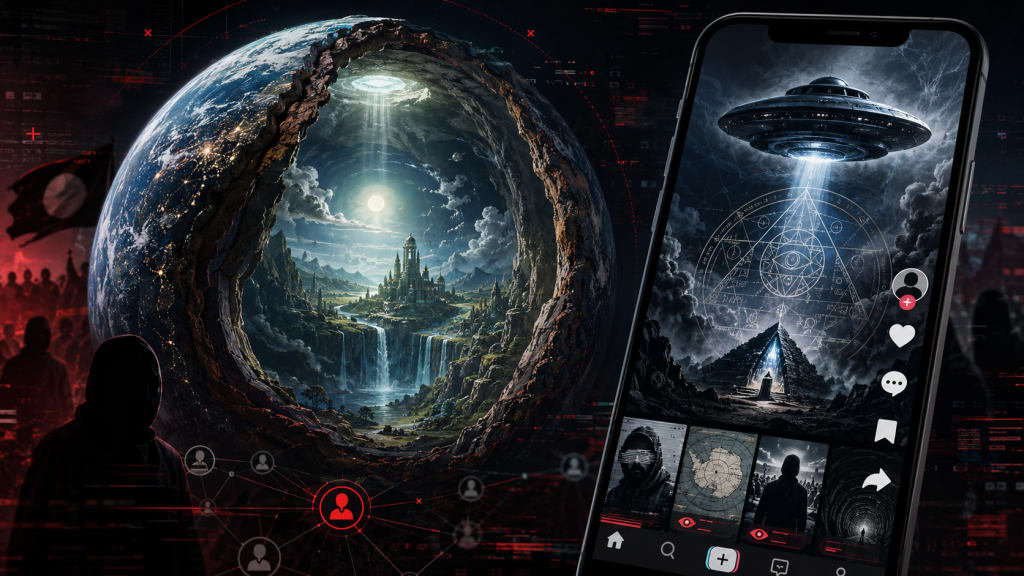
Hollow-Earth Myths and Nazi UFOs on TikTok: How Occult Pseudoscience Fuels Extremist Ideology
TikTok has become one of the world’s most powerful engines for visual storytelling. A strange idea can move from an obscure forum to millions of screens in days. A myth can become an aesthetic. A conspiracy can become a meme. A fringe belief can be repackaged with dreamy music, glowing maps, artificial intelligence art, and short captions that feel mysterious instead of dangerous.
One of the clearest examples is the rise of Hollow-Earth and Agartha content on TikTok.
At first glance, these videos may look harmless or even entertaining. They show hidden civilizations, secret tunnels beneath Antarctica, glowing underground kingdoms, ancient maps, lost races, UFOs, and “forbidden history.” The style is often cinematic. The tone is curious. The content may feel like fantasy, alternative history, or occult mystery.
But underneath some of this content is something darker.
Researchers and extremism watchers have warned that online Agartha and Hollow-Earth trends can overlap with Nazi UFO myths, esoteric Hitlerism, white-supremacist symbolism, and extremist ideology. The danger is not that every video about hidden worlds is extremist. The danger is that occult pseudoscience can become a soft doorway into radical ideas.
The pathway often begins with curiosity. A viewer sees a video about a hidden civilization inside Earth. Then another video mentions Agartha. Then another connects Agartha to Antarctica. Then another introduces Nazi UFOs, “Vril energy,” lost Aryan civilizations, or secret elite knowledge. Eventually, the viewer may encounter content that uses mystical language to promote racial hierarchy, antisemitic conspiracy theories, or admiration for Nazi imagery.
The process can be subtle. It may be hidden behind irony, fantasy visuals, coded symbols, and “just asking questions” language. That is what makes it effective. Extremist ideas do not always arrive as open propaganda. Sometimes they arrive as mystery content.
What Are Hollow-Earth Myths?
Hollow-Earth myths are beliefs or stories claiming that the Earth is hollow or contains vast hidden worlds beneath its surface. In some versions, there are underground cities. In others, ancient beings, lost civilizations, secret entrances, or advanced technologies exist below the crust.
The idea has appeared in fiction, occult writing, fringe religious movements, fantasy literature, and conspiracy culture. It has also been attached to places such as the North Pole, South Pole, Tibet, the Himalayas, and Antarctica.
Scientifically, the Earth is not hollow. Geology, seismology, gravity measurements, volcanic activity, plate tectonics, and planetary science all support the modern understanding of Earth’s structure: crust, mantle, outer core, and inner core. The Hollow-Earth idea does not survive scientific scrutiny.
But myths do not spread because they are scientifically strong. They spread because they are emotionally powerful.
Hollow-Earth stories offer mystery. They suggest that official knowledge is incomplete. They promise hidden truths. They make ordinary geography feel magical. They give people the feeling that reality has secret layers known only to the initiated.
That emotional appeal makes the myth perfect for social media.
What Is Agartha?
Agartha, sometimes spelled Agarttha or Agarta, is a mythical underground kingdom or hidden civilization often associated with esoteric traditions and Hollow-Earth mythology. In modern internet culture, Agartha is frequently presented as a secret inner-world society with advanced technology, spiritual wisdom, or ancient origins.
On TikTok and other platforms, Agartha content often uses a specific visual style: glowing underground cities, ancient temples, Nordic-looking figures, futuristic flying craft, Antarctic landscapes, and dramatic music. AI-generated imagery has made this aesthetic easier to produce than ever.
The problem is that some versions of the Agartha myth have been blended with racist and extremist ideas. In these versions, Agartha becomes linked to “Hyperborea,” “Aryan” mythology, Nazi occultism, UFOs, and claims about hidden superior races. Researchers have noted that modern Agartha memes can overlap with white-supremacist dog whistles and esoteric neo-Nazi themes.
This does not mean every person who posts about Agartha understands the extremist background. Many users may simply like the fantasy aesthetic. But the symbolism can still work as a recruitment pathway when extremist communities use it intentionally.
What Are Nazi UFO Myths?
Nazi UFO myths are conspiracy theories claiming that Nazi Germany developed advanced flying saucers, anti-gravity technology, secret spacecraft, or hidden bases in Antarctica or inside the Earth.
These stories became popular in fringe literature after World War II and expanded during the UFO boom of the mid-20th century. They often combine real historical facts with fabricated claims.
The real historical facts include Germany’s wartime interest in advanced weapons, rocketry, experimental aircraft, and unusual engineering projects. Nazi Germany did conduct rocket research and developed weapons technologies that influenced postwar aerospace programs.
The fictional leap is the claim that the Nazis built operational flying saucers, escaped to hidden Antarctic bases, entered the Hollow Earth, or maintained a secret UFO fleet. These claims belong to conspiracy mythology, not established history. Fringe writers in the 1960s and later tied Nazi UFO claims to occult societies, alien contact, “Vril” energy, and underground civilizations.
Some Nazi UFO stories were also promoted by figures linked with Holocaust denial and far-right propaganda. That matters because these myths are not neutral science fiction. In extremist circles, they can be used to glorify Nazi Germany, rewrite history, and portray fascism as spiritually or technologically superior.
Why These Myths Go Viral on TikTok
TikTok is built for short, emotionally engaging content. Hollow-Earth and Nazi UFO myths fit the platform perfectly because they are visual, mysterious, and easy to compress into a 30-second story.
A typical viral format may include:
A dramatic question
A strange map
A hidden entrance claim
AI-generated ruins or underground cities
A reference to Antarctica
A mysterious voiceover
A claim that “they don’t want you to know”
A quick cut to UFO imagery
A comment section full of speculation
This format does not require proof. It requires atmosphere.
TikTok also rewards content that makes people pause, rewatch, comment, or argue. Conspiracy content often performs well because it creates curiosity and conflict. Viewers ask for “part two.” Others debunk it. Believers defend it. Skeptics mock it. The engagement keeps the content moving.
This is how fringe mythology becomes platform-native. It is no longer a long conspiracy book. It is a mood, a sound, a visual template, and a comment-thread experience.
The Role of AI-Generated Images
AI image tools have made occult pseudoscience more visually persuasive.
A few years ago, someone promoting Agartha or Nazi UFO myths needed old illustrations, edited photos, or low-quality graphics. Now they can generate realistic-looking underground cities, ancient machines, glowing tunnels, polar entrances, and retro-futuristic aircraft in seconds.
These images are not evidence, but they feel evidential.
A viewer may know intellectually that an image is artificial, yet still feel drawn into the story. The visual detail makes the myth feel more concrete. It gives the imagination something to hold.
This creates a new problem for media literacy. In the past, fake evidence often looked fake. Now, fantasy can look cinematic, polished, and emotionally convincing.
AI-generated conspiracy visuals are especially risky when they blend with extremist aesthetics. A beautiful image can soften a hateful idea. It can make propaganda feel like art.
How Occult Pseudoscience Becomes Extremist
Occult pseudoscience becomes extremist when mystical or fringe claims are used to support political hatred, racial hierarchy, authoritarianism, or antisemitic conspiracy theories.
The pathway often looks like this:
First, the viewer is introduced to a harmless-sounding mystery: hidden civilizations, ancient wisdom, lost technology, or forbidden history.
Second, the content suggests that mainstream science and history are lying.
Third, it introduces secret groups, hidden bloodlines, or suppressed knowledge.
Fourth, it connects those ideas to racial myths, “Aryan” legends, or Nazi occult themes.
Fifth, it blames modern society’s problems on demonized groups, elites, or minorities.
Sixth, it presents extremist ideology as the key to restoring a lost golden age.
This structure is not new. Far-right occultism has long used mythology, symbols, and pseudohistory to make political extremism feel ancient, mystical, and heroic.
TikTok simply makes the pathway faster and more visual.
Why “Just a Meme” Can Still Matter
Many users defend extremist-adjacent content by saying it is “just a meme” or “just an aesthetic.” Sometimes that may be true. But irony has become one of the main ways extremist ideas travel online.
A symbol appears for half a second.
A caption uses coded language.
A creator says it is only a joke.
A comment section fills with people who understand the reference.
New viewers become curious.
The plausible deniability is part of the strategy.
This does not mean every edgy meme is a recruitment tool. But extremist communities often use humor and ambiguity to test boundaries. If a video is removed, they claim censorship. If viewers object, they say critics cannot take a joke. If curious users engage, they guide them deeper.
This is why media researchers describe some online extremist content as using “weaponised irony.” The joke is not always separate from the ideology. Sometimes the joke is the delivery system.
The TikTok Algorithm Problem
TikTok’s recommendation system is designed to learn from user behavior. If someone watches, likes, comments on, or searches for a topic, the platform may show more similar content.
This can be useful for music, cooking, travel, and education. But it becomes risky when curiosity about fringe content leads to more fringe content.
A user may watch one Hollow-Earth video for entertainment. The platform may then recommend Agartha videos. Then Nazi UFO videos. Then occult history videos. Then “traditionalist” or white-supremacist-coded content. The path is not always direct, but recommendation systems can create clusters of interest.
Research into TikTok has found that conspiracy content exists on the platform, and extremist researchers have repeatedly raised concerns about white-supremacist material and coded propaganda circulating there.
The issue is not that every viewer becomes radicalized. Most do not. The issue is exposure, normalization, and repetition. When harmful ideas appear repeatedly in entertaining formats, they may begin to feel less extreme.
Why Young Audiences Are Especially Vulnerable
TikTok has a large youth audience, and younger users may be more likely to encounter conspiracy content through entertainment rather than deliberate research.
A teenager may not search for extremist ideology. They may search for UFOs, ancient civilizations, Antarctica mysteries, or scary history. The content then introduces coded themes. Because the material is packaged as mystery or fantasy, the ideological layer may not be obvious.
Young users are also still developing critical thinking, historical knowledge, and media literacy. If they have not learned about Holocaust denial, fascist symbolism, antisemitic conspiracy structures, or white-supremacist mythology, they may not recognize the signals.
This is why education matters. The answer is not panic, but context.
Young viewers need to learn that not every “forbidden history” video is harmless. Some are gateways into extremist worldviews.
The Pseudoscience Pattern: “They Are Hiding the Truth”
Most conspiracy content uses a familiar emotional formula:
Official history is fake.
Scientists are lying.
Schools hide the truth.
The media is controlled.
Ancient people knew more than us.
A secret group erased the evidence.
Only insiders can see the pattern.
This formula is powerful because it flatters the viewer. It makes the viewer feel awake, chosen, and smarter than the public. It turns skepticism into identity.
Healthy skepticism asks for better evidence.
Conspiracy thinking treats lack of evidence as proof of suppression.
That difference is crucial.
A scientific thinker says, “What evidence would change my mind?”
A conspiratorial thinker says, “Any evidence against my belief was planted or hidden.”
Hollow-Earth and Nazi UFO myths rely heavily on this second pattern. When there is no geological evidence for a hollow planet, believers may claim the evidence is hidden. When no credible historical evidence proves Nazi flying saucers, believers may claim the records were destroyed or suppressed.
This makes the myth almost impossible to disprove for committed believers.
Why Antarctica Appears So Often
Antarctica is a favorite setting for conspiracy theories because it is remote, harsh, politically unusual, and difficult for ordinary people to visit. Its distance makes it easy to imagine hidden bases, secret entrances, lost technology, or suppressed discoveries.
Nazi UFO myths often use Antarctica because Nazi Germany did send an expedition to the region before World War II. That real fact becomes the seed for fictional claims about underground bases and postwar Nazi survival.
This is a classic conspiracy technique: start with a real historical detail, then attach unsupported claims to it.
A real expedition becomes a secret base.
Real rocket research becomes anti-gravity UFOs.
Real myths become proof of hidden races.
Real redactions become evidence of a cover-up.
The mixture of truth and fiction makes the story more persuasive than pure invention.
The White-Supremacist Aesthetic Hidden in Fantasy
One of the most dangerous parts of Agartha and Nazi UFO content is the aesthetic layer.
Some videos do not openly praise fascism. Instead, they use visual codes: idealized pale figures, ancient warrior imagery, Nordic mythology, lost “pure” civilizations, militarized beauty, glowing temples, and claims about hidden ancestral knowledge.
This can make white-supremacist ideas feel romantic rather than hateful.
The viewer is not immediately told, “Support extremism.” Instead, they are invited to admire a fantasy of lost greatness, purity, order, and hidden power. Over time, that aesthetic can prepare the viewer for more explicit ideology.
This matters because extremist recruitment is often emotional before it is political. People may be drawn by beauty, belonging, mystery, or identity before they understand the ideology underneath.
How Nazi UFO Myths Rewrite History
Nazi UFO myths often perform a subtle form of historical revisionism.
They shift attention away from Nazi crimes and toward fantasy technology. Instead of focusing on genocide, war, occupation, and mass suffering, these myths portray Nazis as secret geniuses, cosmic explorers, or guardians of forbidden knowledge.
This is dangerous because it can soften the moral reality of Nazism.
When Nazi history is turned into UFO mythology, atrocity becomes adventure. Fascism becomes aesthetics. Genocide is pushed into the background. The regime’s victims disappear from the story.
That is one reason these myths are attractive to extremist communities. They allow admiration without immediately stating admiration. They make Nazi imagery feel mysterious, futuristic, or rebellious.
A responsible media culture must reject that reframing. Nazi ideology was not mystical wisdom. It was a violent, racist, antisemitic political project that caused catastrophic human suffering.
How Platform Moderation Struggles With This Content
Moderating Hollow-Earth and Nazi UFO content is difficult because the material often sits between fantasy, misinformation, and extremism.
A video about underground cities may be harmless fantasy.
A video about Nazi UFOs may be historical misinformation.
A video using Nazi symbols or praising Nazi ideology is extremist propaganda.
A video using coded language may be harder to classify.
A video using irony may claim to be satire.
This creates enforcement challenges. Platforms must distinguish between education, criticism, fiction, conspiracy, and promotion. Bad actors exploit that ambiguity.
ISD’s research found that white-supremacist content remained findable on TikTok, and WIRED reported that extremists used coded language and symbols to evade moderation.
TikTok says hateful behavior and extremist ideologies are not allowed and that it removes a large amount of such content, but research continues to show enforcement gaps.
The lesson is clear: moderation cannot rely only on obvious symbols. It must understand coded culture, aesthetics, and cross-platform migration.
The Cross-Platform Pipeline
TikTok is rarely the final destination. Many extremist-adjacent communities use TikTok as a discovery platform, then move interested users elsewhere.
A TikTok video may introduce a myth.
A comment section may direct users to search terms.
A profile may link to another platform.
A Telegram channel, Discord server, podcast, or fringe website may provide more explicit material.
This pipeline matters because mainstream platforms often host the soft version, while smaller or less moderated spaces host the harder ideology.
A user may begin with Hollow-Earth aesthetics and end up in communities discussing antisemitic conspiracies, racial myths, or extremist politics.
This is why the early content matters. Gateway content does not need to be openly extremist to be useful to extremists.
How to Recognize Dangerous Patterns
Viewers should be cautious when conspiracy videos include several warning signs together.
Warning signs include:
Claims that official history is entirely fake
Repeated use of “forbidden knowledge” framing
Glorification of Nazi technology or imagery
Mythic claims about superior ancient races
Obsession with Antarctica as a secret base
Use of occult terms tied to far-right mythology
Coded extremist symbols or references
Claims that modern society is controlled by hidden enemies
Antisemitic or racist comments in the community
Instructions to move to less moderated platforms
AI-generated images presented as if they support real history
Mockery of fact-checking as weakness
One sign alone may not prove extremist intent. But patterns matter.
How Parents and Educators Can Respond
The best response is not panic or mockery. Young viewers are often drawn to these videos because they are mysterious and visually compelling. Simply saying “that is stupid” may push them deeper into defensive curiosity.
A better approach is to ask questions:
Where did this claim come from?
What evidence would prove it?
Is this video using real documents or just images?
Does it mix real history with fantasy?
Who benefits if people believe this?
Are there extremist symbols or comments around it?
Does the creator encourage fear or hatred?
Does the content blame a group of people?
Can we compare this with reliable historical sources?
The goal is to teach critical thinking, not humiliation.
Media literacy works best when it respects curiosity while challenging manipulation.
How Journalists Should Cover These Trends
Journalists should cover Hollow-Earth and Nazi UFO TikTok trends carefully. Overcoverage can accidentally amplify fringe content. Undercareful coverage can normalize extremist aesthetics.
Good coverage should:
Avoid embedding extremist content unnecessarily
Avoid sensational headlines that make the myth sound plausible
Explain the historical background
Clearly separate fiction from evidence
Avoid naming obscure extremist creators unless needed
Center the risks of radicalization and misinformation
Protect young audiences from curiosity traps
Include expert voices
Avoid repeating symbols or slogans in a promotional way
Explain how coded aesthetics work
The goal is to inform, not advertise.
What Platforms Should Do
Platforms should improve moderation around extremist pseudoscience without banning harmless fantasy content.
Useful steps include:
Better detection of coded extremist aesthetics
Stronger enforcement against Nazi glorification
Clearer labels on conspiracy misinformation
Reduced recommendation of extremist-adjacent content
Faster removal of hateful content
Better reporting tools
Cross-platform threat intelligence
Age-sensitive safeguards
Researcher access to platform data
Context panels for viral pseudoscience topics
More human review for ambiguous cases
AI moderation can help, but it must be paired with cultural expertise. Extremist content often changes language and style quickly. Moderators need to understand not only words, but visual codes and meme culture.
Why Debunking Alone Is Not Enough
Debunking Hollow-Earth claims is easy scientifically. The Earth is not hollow. Nazi flying saucers did not escape into underground Antarctic civilizations. Agartha is a myth, not a verified location.
But debunking facts may not be enough because the appeal is emotional.
These myths offer:
Mystery
Identity
Rebellion
Community
A sense of superiority
A feeling of secret knowledge
A heroic fantasy of hidden order
To counter them, society needs more than fact-checks. It needs better education, healthier communities, stronger historical memory, and digital spaces that do not reward manipulative content.
People do not leave conspiracy thinking only because they see a correction. They leave when the belief no longer meets their emotional needs.
A Healthier Way to Explore Mystery
There is nothing wrong with loving mystery. Ancient history, archaeology, mythology, science fiction, folklore, and speculative storytelling can be wonderful. Curiosity is not the enemy.
The problem begins when mystery becomes a cover for hate.
A healthy approach to mystery asks:
Is this story presented as fiction, myth, or fact?
What evidence supports it?
Does it respect real history?
Does it avoid demonizing groups?
Does it encourage learning or paranoia?
Does it invite wonder without promoting hatred?
People can enjoy fantasy worlds, underground-city fiction, UFO stories, and occult-themed art without accepting racist pseudoscience or Nazi mythology.
The key is knowing the difference.
Final Thoughts: When Myth Becomes a Gateway
Hollow-Earth myths and Nazi UFO videos on TikTok may look like strange entertainment, but they reveal a deeper problem in digital culture. Social media can turn fringe mythology into viral aesthetics. AI can make false worlds look beautiful. Algorithms can connect curiosity to extremism. Irony can hide ideology. Pseudoscience can become a gateway to hate.
Not every Hollow-Earth video is extremist. Not every Agartha meme is a recruitment tool. Not every person sharing UFO content understands the historical baggage. But the overlap between occult pseudoscience and far-right ideology is real enough to take seriously.
The danger is normalization.
When Nazi symbols, white-supremacist myths, and fascist aesthetics appear inside fantasy content, they become less shocking. When viewers see them repeatedly, they may become part of the background. When extremist ideas are wrapped in mystery and beauty, they can feel less like hate and more like hidden knowledge.
That is why media literacy matters.
The answer is not to fear every myth. The answer is to understand how myths are used.
Hollow-Earth stories belong in fiction, folklore, and critical history. Nazi UFO myths belong in the study of conspiracy culture and propaganda, not in romanticized digital aesthetics. TikTok users, parents, educators, journalists, and platforms all need to recognize when curiosity is being redirected toward extremism.
The internet can make ancient myths feel new again.
But it can also make old hatred look like a secret world waiting to be discovered.
Frequently Asked Questions
What are Hollow-Earth myths?
Hollow-Earth myths claim that the Earth is hollow or contains hidden underground civilizations. These claims are not supported by modern geology or planetary science.
What is Agartha?
Agartha is a mythical underground kingdom often connected to Hollow-Earth and esoteric traditions. On social media, it is frequently presented through fantasy visuals, occult themes, and conspiracy narratives.
What are Nazi UFO myths?
Nazi UFO myths claim that Nazi Germany developed flying saucers, anti-gravity craft, or secret bases in Antarctica or inside the Earth. These claims are conspiracy mythology, not established history.
Why are Hollow-Earth and Nazi UFO videos popular on TikTok?
They are visually dramatic, mysterious, easy to compress into short videos, and often use AI-generated images, music, and “forbidden history” framing to attract attention.
Are all Hollow-Earth videos extremist?
No. Some are fantasy, satire, or harmless curiosity. The concern is content that blends Hollow-Earth myths with Nazi imagery, racial mythology, antisemitism, or white-supremacist aesthetics.
How do extremist ideas hide in occult pseudoscience?
They often appear through coded symbols, myths about superior ancient races, Nazi occult references, antisemitic conspiracy structures, or romanticized fascist aesthetics.
Why is “just a meme” not always harmless?
Extremist communities sometimes use irony and memes to normalize symbols, test platform boundaries, and attract curious viewers while denying serious intent.
Can TikTok’s algorithm promote conspiracy content?
Research has found conspiracy and extremist content on TikTok, and recommendation systems can expose users to related content based on engagement. The degree and pathway can vary by user behavior and platform enforcement.
How can viewers identify risky content?
Be cautious of videos that glorify Nazi technology, use “forbidden history” framing, blame hidden enemies, present AI images as evidence, or connect myths to racial superiority.
What should parents do if teens watch this content?
Ask open questions, compare claims with reliable sources, explain extremist symbolism, and teach how conspiracy content uses mystery and aesthetics to manipulate curiosity.
Is it wrong to enjoy UFO or myth content?
No. People can enjoy mythology, science fiction, and mystery content responsibly. The key is separating fantasy from fact and rejecting content that promotes hate or pseudoscience.
What is the main danger of this trend?
The main danger is normalization: extremist ideology can be made to look mysterious, artistic, ironic, or entertaining, making it easier for users to absorb harmful ideas without recognizing them.


