
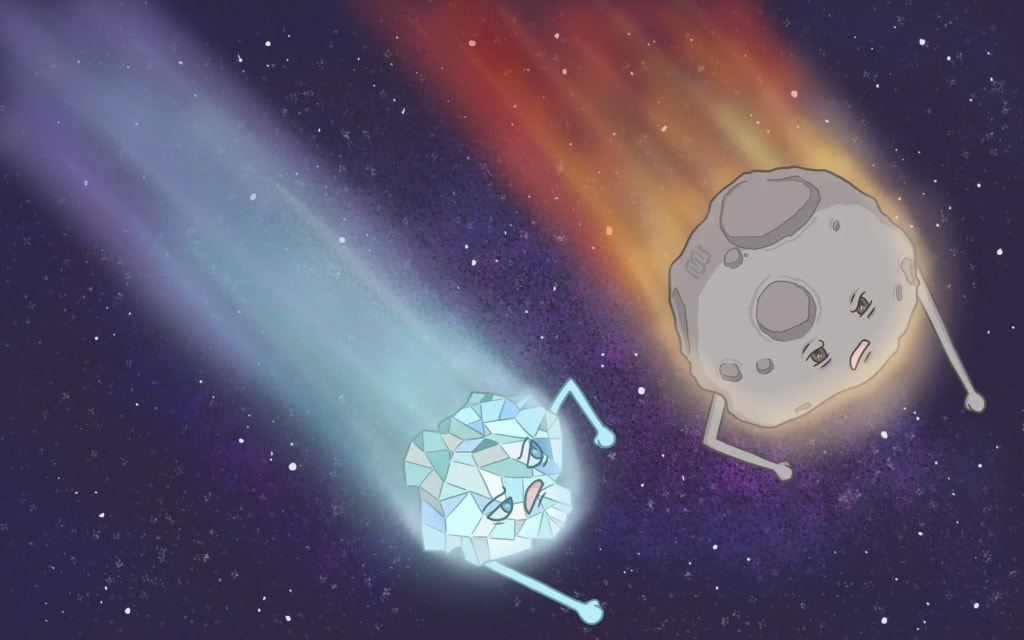
Comets vs. Asteroids: Cosmic Cousins with Different Faces
At first glance, comets and asteroids may seem like very different objects in our solar system. Comets dazzle the night sky with glowing tails, while asteroids appear as dark, rocky wanderers. But in truth, the two are more like siblings than strangers—built from the same basic cosmic ingredients, yet shaped by their composition and their journeys around the Sun.
What Are Asteroids?
Composition: Asteroids are mostly rock and metal, leftovers from the early solar system.
Location: Most of them orbit between Mars and Jupiter in the asteroid belt, though some travel near Earth or beyond.
Appearance: Because they lack ice, asteroids generally appear as solid, rocky bodies without the spectacular tails of comets.
Asteroids come in several types:
C-type (Carbonaceous): Rich in carbon, dark in appearance.
S-type (Silicaceous): Made of silicate rock and some metal.
M-type (Metallic): Composed largely of nickel and iron.
What Are Comets?
-
Composition: Comets are often called “dirty snowballs”, made of ice mixed with rock and dust.
-
Location: They come from colder regions of the solar system—the Kuiper Belt and the distant Oort Cloud.
-
Behavior Near the Sun:
-
As a comet approaches the Sun, solar heat causes its ices to vaporize.
-
Gas and dust stream out, forming a coma (cloudy atmosphere) around the nucleus and a glowing tail that always points away from the Sun due to the solar wind.
-
This tail makes comets spectacular to watch and historically significant, often seen as omens in ancient times.
The Overlap: When Asteroids Act Like Comets
The boundary between comets and asteroids is not always sharp. Some objects blur the distinction:
Active Asteroids: These are asteroid-like objects that suddenly display comet-like activity, such as developing a tail. This happens when hidden ice inside them is exposed and begins to sublimate (turn directly from solid to gas).
Extinct Comets: Some comets lose their ice after repeated trips near the Sun. Once their icy material is gone, they look and behave like rocky asteroids.
Main-Belt Comets: A rare group of icy objects in the asteroid belt that occasionally exhibit cometary tails.
These categories show that comets and asteroids are really part of a continuum of small solar system bodies, shaped by their chemistry and orbits.
Why Comets and Asteroids Matter
-
Solar System History
-
Both are leftovers from the formation of planets 4.6 billion years ago.
-
Studying them helps scientists understand the building blocks of Earth and other worlds.
-
-
Water and Life
-
Many scientists think comets (and some water-rich asteroids) may have delivered water and organic molecules to early Earth, potentially seeding life.
-
-
Planetary Defense
-
Both can collide with planets. While most are harmless, larger impacts can have global consequences (as with the asteroid that contributed to the extinction of the dinosaurs 66 million years ago).
-
Learning about their orbits and compositions is essential for protecting Earth.
-
-
Future Resources
-
Asteroids rich in metals could one day be mined for resources.
-
Comets, with their abundant water ice, may serve as fuel depots for future deep-space missions.
-
Conclusion: Two Sides of the Same Coin
Asteroids and comets are not opposites—they are variations of the same cosmic story. Asteroids are rockier, comets are icier, but both were born from the same solar nebula billions of years ago. Their differences arise mainly from composition and how close they wander to the Sun.
The discovery of active asteroids shows that the line dividing them is not fixed but fluid. Some asteroids can behave like comets, and some comets eventually become asteroid-like.
Ultimately, comets and asteroids remind us that the solar system is not static but dynamic, full of objects that evolve, overlap, and surprise us. Whether rocky or icy, comet-tailed or bare, each carries secrets of our origins—and perhaps keys to our future in space.


