
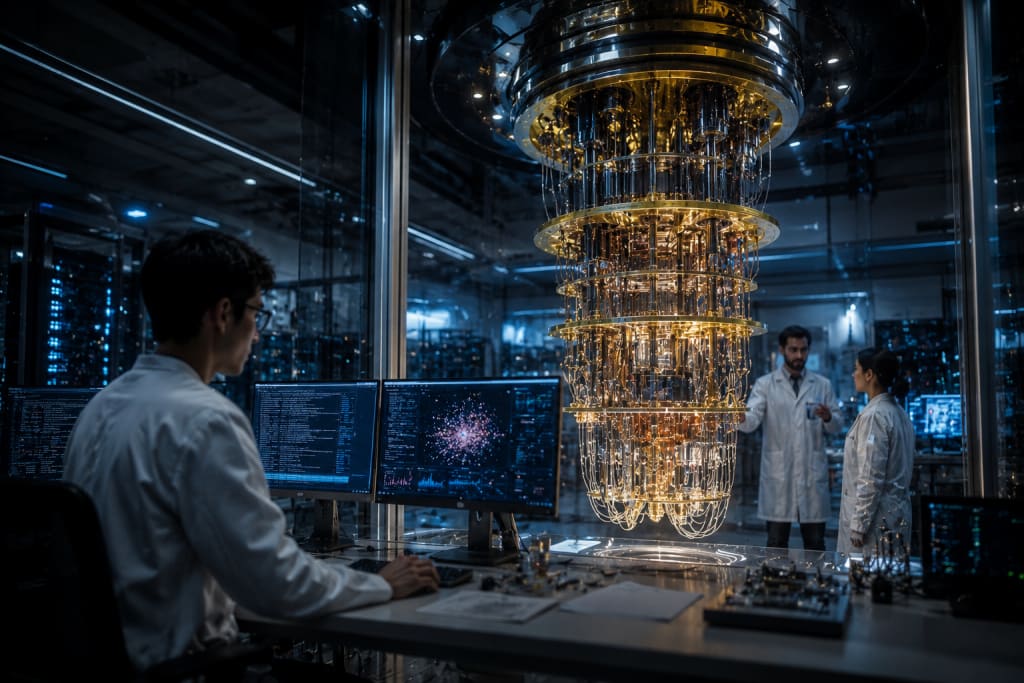
Quantum Computing for Humans: Why 2026 Feels Like the First Real Breakthrough Year
For decades, quantum computing existed in a strange limbo. It was always almost here—promising world-changing power, yet forever trapped in labs, headlines, and theoretical diagrams. Each year brought incremental progress, followed by the same caveat: not yet practical, not yet stable, not yet useful.
By 2026, that tone has changed.
Quietly, without a single dramatic “quantum moment,” the field crossed a psychological threshold. Quantum computers are still imperfect, still expensive, still limited—but they are no longer abstract. For the first time, they are doing things classical computers genuinely struggle with, and doing them reliably enough to matter.
This isn’t the age of universal quantum machines replacing laptops. It’s something subtler—and arguably more important: the moment quantum computing stopped being a science experiment and started becoming infrastructure.
Why Quantum Computing Took So Long
To understand why 2026 feels different, it helps to understand why progress was so slow.
Quantum computers don’t scale like classical ones. You can’t just shrink transistors and pack more onto a chip. Qubits are fragile. They decohere. They are disturbed by heat, vibration, cosmic radiation, and measurement itself. Every additional qubit multiplies complexity rather than adding it linearly.
For years, the industry chased qubit counts because they were easy to headline. “We built a 100-qubit system.” Then 500. Then 1,000. But raw qubit numbers turned out to be misleading. A thousand unstable qubits are far less useful than fifty reliable ones.
The real bottleneck wasn’t size. It was error.
The Shift from “More Qubits” to “Better Qubits”
The breakthrough wasn’t one invention. It was a change in priorities.
Researchers began focusing less on headline qubit counts and more on error rates, coherence times, and error correction schemes. Instead of asking, “How big can we build this?” they asked, “How long can it behave like a quantum system before collapsing into noise?”
By 2026, several architectures crossed an important line: they could perform meaningful computations longer than the errors accumulated. That sounds technical, but the implication is profound.
For the first time, quantum systems can complete tasks that are not trivially simulatable by classical computers—without immediately drowning in their own mistakes.
This is what people actually mean when they say “breakthrough.”
Quantum Advantage Becomes Narrow—but Real
Earlier hype painted quantum computers as universal problem solvers. That was never realistic.
What’s emerging instead is narrow quantum advantage: specific problems where quantum methods outperform classical ones, even if only in limited domains.
In 2026, these domains include:
Certain types of molecular simulation
Optimization problems with massive combinatorial spaces
Probabilistic modeling in complex systems
Materials science and catalyst discovery
These aren’t consumer-facing miracles. They are industrial, scientific, and infrastructural gains. But they matter enormously.
When quantum computers can simulate chemical interactions that classical supercomputers approximate poorly, drug discovery accelerates. When they explore optimization spaces that classical systems choke on, logistics, energy grids, and financial modeling improve.
The gains are quiet—but compounding.
Hybrid Computing: The Real Story No One Talks About
One reason quantum computing is finally useful is that it stopped trying to work alone.
The dominant model in 2026 is hybrid computing. Classical computers handle what they’re good at: control logic, data preprocessing, error mitigation, result interpretation. Quantum processors handle the narrow, hard parts—the parts where classical math becomes intractable.
Think of quantum systems as accelerators, not replacements. Like GPUs were for graphics and AI, quantum processors slot into workflows rather than redefining them entirely.
This reframing lowered expectations—and unlocked progress.
Why You Don’t “Feel” the Breakthrough Yet
For most people, quantum computing still feels distant. There’s no quantum phone. No quantum laptop. No app powered visibly by qubits.
That’s because infrastructure breakthroughs rarely feel personal at first.
You don’t feel better roads until supply chains improve. You don’t notice faster fiber until services adapt. Quantum computing’s impact will be indirect at first—embedded in research outcomes, optimized systems, and industrial efficiencies.
When better batteries appear faster, when new materials reduce emissions, when drugs are discovered in months instead of years, quantum computing will be part of the story—even if it never gets named.
The Security Elephant in the Room
No discussion of quantum computing is complete without cryptography.
The fear is familiar: sufficiently powerful quantum computers could break widely used encryption schemes. This is true in theory—and still distant in practice.
But the psychological impact is already here.
By 2026, governments and large organizations are actively transitioning toward quantum-resistant cryptography. Not because quantum computers can break encryption today, but because cryptographic systems must be secure for decades. Data stolen now can be decrypted later.
This is another sign of maturity. Quantum computing no longer lives in the future tense. It influences decisions now.
Separating Reality from Marketing
As quantum becomes commercially relevant, hype returns—this time with better vocabulary.
Every vendor claims advantage. Every system is “scalable.” Every roadmap promises fault tolerance “soon.” For non-experts, it’s difficult to distinguish substance from storytelling.
The key markers of real progress in 2026 are not bold claims, but boring ones:
Lower error rates
Longer coherence times
Reproducible results
Stable hybrid workflows
Measurable classical comparison benchmarks
True breakthroughs are technical, not theatrical.
Why 2026 Feels Like a Turning Point
Quantum computing didn’t suddenly become easy in 2026. It became credible.
The field moved from speculation to specialization. From promise to proof. From “someday” to “in specific cases, now.”
This is often how deep technology changes the world—not with fireworks, but with quiet inevitability.
The most important moment in quantum computing may not be when it replaces classical systems, but when people stop asking whether it will work—and start asking how to integrate it responsibly.
That question, finally, is worth answering.


