
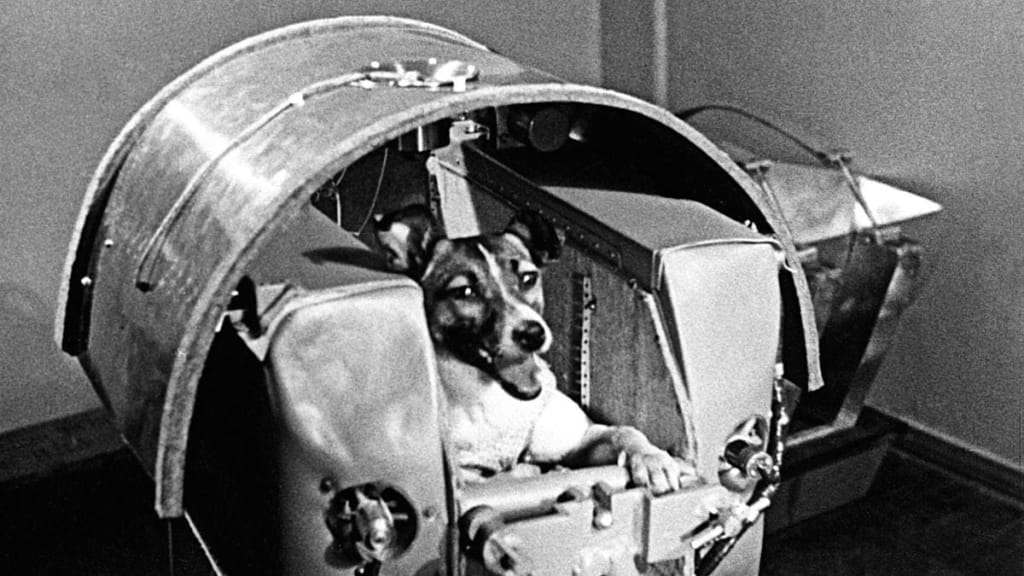
Laika: The Dog We Sent Into Space Knowing She Would Never Come Home — The Dark Side of Humanity's Greatest Scientific Triumphs
On November 3, 1957, humanity celebrated one of its greatest technological achievements.
A Soviet rocket roared into the sky, carrying a living creature beyond Earth's atmosphere and into orbit.
For the first time in history, an animal was circling our planet inside an artificial spacecraft.
The newspapers announced a triumph.
Scientists celebrated a milestone.
Governments recognized the strategic implications of a new era of space exploration.
And millions of people around the world learned the name of a small dog from Moscow.
Laika.
She was presented as a pioneer.
A brave traveler.
A symbol of scientific progress.
But there was something the celebrations obscured.
The people who sent Laika into space already knew they had no way to bring her home.
There was no landing system.
No recovery capsule.
No parachute capable of returning her safely to Earth.
No rescue plan waiting to be activated if something went wrong.
The spacecraft was built to reach orbit, not to bring its passenger back.
And Laika had no understanding of the mission for which she had been selected.
She had been a stray dog surviving on the streets of Moscow.
Now, strapped inside a metal capsule atop an enormous rocket, she was about to become one of the most famous animals in human history.
She would also become its victim.
For decades, the Soviet account suggested that Laika had survived for days in orbit before dying peacefully.
The truth was considerably darker.
Her spacecraft overheated. The conditions inside became increasingly dangerous, and she died within hours of launch.
It took roughly 45 years for the circumstances of her death to be publicly clarified.
Today, November 3, 2026, marks 69 years since Laika's flight.
Her story is frequently remembered as an inspiring chapter in the history of space exploration.
And, in one important sense, it was a scientific milestone.
But remembering only the achievement means overlooking the suffering deliberately built into the mission—and the political urgency that placed a living animal inside a spacecraft without a way home.
Laika's story forces us to confront one of science's most uncomfortable questions.
When a technological breakthrough demands the sacrifice of a life that cannot consent, should history remember only the discovery—or also the decision that made it possible?
Historical details supported by NASA, the Smithsonian National Air and Space Museum, and the Science Museum. NASA+2
Before She Became a Symbol, Laika Was Just a Stray Dog

Long before her photograph appeared in newspapers, Laika was an ordinary mixed-breed dog living on the streets of Moscow.
She had no famous ancestry.
No prestigious breeding.
No previous purpose in the eyes of the space program.
She was simply one of countless stray animals navigating the cold streets of a large city.
Soviet scientists believed that dogs accustomed to surviving outdoors might tolerate the hardships of experimental spaceflight better than pampered household pets.
They were looking for small, relatively calm animals capable of fitting inside extremely confined spacecraft compartments.
Laika met those requirements.
She was also known as Kudryavka, meaning approximately Little Curly.
The name Laika, commonly associated with barking or a type of northern hunting dog, became the name the world remembered.
Why the Soviet Union Chose Dogs
Before humans could be sent into space, researchers needed to understand how launch acceleration, weightlessness, confinement, and other conditions might affect living organisms.
The Soviet program used dogs in a series of experimental flights.
Some missions involved suborbital launches, with capsules returning to Earth.
Some animals survived.
Others died.
Those experiments produced physiological information, but they also imposed considerable suffering and risk.
Laika's mission was different because Sputnik 2 was intended to enter orbit.
She would travel around Earth rather than briefly reaching space before returning.
That made the mission scientifically and politically significant.
It also presented a problem that had never been solved for her spacecraft.
How could the Soviet Union bring a living passenger back from orbit?
The answer was simple.
It couldn't.
And the launch went ahead anyway.
Sputnik 2: A Spacecraft Built in a Hurry, Not Built for Survival
To understand why Laika was sent on a one-way journey, we must understand the extraordinary political atmosphere of 1957.
On October 4, the Soviet Union launched Sputnik 1, the world's first artificial satellite.
It was a technological sensation.
The achievement demonstrated that Soviet rockets could carry payloads into orbit.
It also intensified Cold War concerns in the United States, where the same advances had obvious implications for long-range missile technology.
The Soviet leadership wanted to capitalize on the success.
A second spectacular launch was ordered to coincide with the 40th anniversary of the Bolshevik Revolution.
That anniversary fell on November 7, 1957.
The result was Sputnik 2, launched less than a month after Sputnik 1.
NASA's historical account explicitly describes the second spacecraft as hurriedly prepared to capitalize on the propaganda value of the first satellite.
The Deadline Was Political. The Consequences Were Biological.
Sputnik 2 was more complicated than its predecessor.
It carried life-support equipment, environmental controls, scientific instruments, and sensors monitoring Laika's physical condition.
But the engineering team had extremely limited preparation time.
A working orbital reentry and recovery system was not available.
Developing one would have required a fundamentally different mission and more time.
Instead, the spacecraft was designed for a flight that would end without its living passenger returning.
Laika's death was therefore not an unforeseen possibility introduced by a single technical malfunction.
The particular way she died was not what the engineers had intended.
But her death was anticipated from the beginning.
That is the moral distinction at the center of her story.
A mission can encounter an unexpected failure.
Laika's mission also contained a planned, irreversible absence of rescue.
The spacecraft could fulfill its principal political objective even if its passenger never survived the journey.
And that is precisely what happened.
The Final Hours: What Happened Inside Sputnik 2?

On November 3, 1957, Sputnik 2 lifted off from the Soviet launch site at Tyura-Tam, now associated with the Baikonur Cosmodrome.
Laika was strapped inside her small pressurized compartment.
Her body was connected to monitoring equipment that transmitted physiological information to scientists on Earth.
The sensors measured changes in her heartbeat, breathing, and other responses to launch conditions.
The rocket accelerated.
The vibrations and forces of launch placed enormous stress on her body.
According to historical accounts based on flight telemetry, her heart rate rose dramatically during ascent, reaching approximately three times its resting level. Her breathing rate also increased sharply.
We cannot know precisely what Laika experienced or understood.
But the physiological data establishes that the launch placed her under severe stress.
The First Living Passenger in Orbit
Sputnik 2 successfully reached orbit.
Scientifically, this was a remarkable achievement.
A living mammal had survived the powerful acceleration of launch and reached the environment of orbital spaceflight.
The Soviet Union had demonstrated that a spacecraft could carry a living organism beyond Earth and transmit physiological measurements back to the ground.
For scientists considering future human missions, this was important information.
But as the spacecraft continued circling Earth, conditions inside Laika's compartment deteriorated.
The thermal-control system malfunctioned.
Heat built up.
The spacecraft's configuration and failure to separate properly from part of its launch vehicle contributed to the heating problem.
Temperatures inside the cabin rose to dangerous levels.
And Laika's body could not withstand them.
She Died Within Hours, Not Days
Modern historical accounts generally place her death within approximately five to seven hours of launch, though the precise moment cannot be established with certainty.
Researchers examining the original telemetry concluded that severe overheating and physiological stress caused her death.
The Smithsonian's Laika Declassified explains that Soviet records eventually showed the cabin's thermal-control failure, with the original mission data becoming fragmentary as conditions worsened.
The tragedy was twofold.
Laika had been sent on a mission with no possibility of a safe return.
And she died much sooner, and under far worse conditions, than the already fatal mission plan anticipated.
The world saw the launch of a living creature into space.
What it did not see was the suffering taking place inside the spacecraft.
The Lie That Followed Laika Around the World
The Soviet authorities did not immediately tell the public what had happened.
Instead, official communications maintained the impression that Laika remained alive for days.
Accounts circulated that she had survived for approximately a week before dying peacefully.
Some descriptions suggested that she had been humanely euthanized after completing her scientific mission.
These versions made the flight easier to present as a controlled technological achievement.
They also concealed the failure of the spacecraft's environmental system.
For decades, the more disturbing details remained out of public view.
The Truth Emerged in 2002
In October 2002, Russian scientist Dmitry Malashenkov presented information about the original mission showing that Laika had died within hours because of overheating and stress.
The revelation contradicted the longstanding public account.
It was not merely a correction to a historical timeline.
It fundamentally changed how the mission could be understood.
For almost half a century, the story had often been told as the tragic but carefully managed death of an animal pioneer.
The evidence instead revealed a rushed mission whose inadequate thermal controls contributed to an early and distressing death.
Why Concealing Her Death Matters
The secrecy is not a minor detail.
It illustrates how governments can control the public meaning of scientific achievements by selectively revealing information.
The successful launch was celebrated immediately.
The technical failure and Laika's suffering were obscured.
One part of the story served political prestige.
The other threatened it.
The public was allowed to celebrate the accomplishment without being given the evidence needed to fully judge its cost.
And this raises a troubling question about the relationship between technological progress and state power.
When scientific achievement becomes a national competition, who decides which failures are revealed—and whose suffering is considered acceptable to hide?
Laika Was Not a Volunteer. She Was a Subject.
The language used to describe Laika often makes her sound almost human.
She is called a cosmonaut.
A pioneer.
An explorer.
A hero.
These terms reflect the enormous emotional connection people developed with her story.
But they can also obscure a fundamental distinction.
Human astronauts understand that spaceflight involves risks.
They can receive explanations, undergo training, make decisions, and—in principle—consent to participation.
Laika could do none of these things.
She did not choose to travel into orbit.
She did not understand the geopolitical competition behind the mission.
She could not refuse when the capsule door was closed.
And she could not ask to come home.
The Problem With Calling Her Death a Sacrifice
A sacrifice can describe the loss of something valuable for a larger purpose.
But when we say Laika sacrificed her life, the wording can imply that she willingly gave it.
The more accurate moral description is that her life was sacrificed by the people directing the mission.
She did not make that decision.
Scientists and political authorities made it for her.
The distinction does not mean everyone involved lacked compassion.
Some researchers developed strong emotional bonds with the animals under their care.
But personal affection did not change the essential structure of the experiment.
Laika's life was treated as expendable in pursuit of a scientific and political objective.
The Scientists Who Loved Her—and Still Sent Her to Die
One of the most heartbreaking details of Laika's story involves the people who worked with her.
Soviet physician Vladimir Yazdovsky reportedly took Laika home before her mission so that she could spend time playing with his children.
He knew she had very little time left.
According to accounts of his later recollections, he wanted to give her a brief experience of ordinary affection before the launch.
The episode reveals the emotional contradiction at the heart of the mission.
Laika was not necessarily surrounded by people who felt nothing for her.
She was surrounded by people who could care for her as an individual while participating in a system that had already decided she would die.
This is perhaps more disturbing than the image of a cruel scientist who simply doesn't care.
It demonstrates how people can become involved in harmful institutional decisions even while recognizing the suffering those decisions cause.
The Regret That Came Decades Later
Oleg Gazenko, a leading scientist in the Soviet program that trained animals for spaceflight, later expressed deep regret about Laika's death.
His reflections were particularly significant because they came from someone directly involved in the research rather than from an outside critic.
In later interviews, he questioned whether the information gained from her mission had been sufficient to justify what happened.
His regret challenges a familiar defense of painful scientific experiments: that suffering is automatically justified whenever knowledge is gained.
Knowledge has value.
But that does not answer every moral question about the methods used to obtain it.
The World Celebrated. Some People Protested.
Laika's flight became a global news event.
To many observers, it represented an astonishing achievement.
The Soviet Union had sent a living organism into orbit less than a month after launching the first artificial satellite.
The accomplishment suggested that human spaceflight might be closer than previously imagined.
But there was another reaction.
Animal welfare advocates questioned the decision to send a dog on a mission with no recovery system.
Protests occurred in Britain and the United States.
Some demonstrators gathered outside Soviet diplomatic offices.
Others used signs, public statements, and organized expressions of grief to criticize the experiment.
The National Canine Defence League called for dog owners to observe a moment of silence.
A World Divided Between Admiration and Outrage
The conflicting reactions exposed a deeper tension.
Scientific progress was widely celebrated, especially during the technological competition of the Cold War.
At the same time, Laika's fate was unusually difficult for the public to treat as an abstract laboratory experiment.
She had a name.
A face.
A recognizable personality in photographs.
She looked like an ordinary dog someone might have welcomed into their home.
That made her suffering emotionally accessible.
The public could understand what had happened to her in a way that technical descriptions of rocket engineering could not fully capture.
For some people, Laika became evidence of humanity's extraordinary ingenuity.
For others, she became a symbol of the cruelty that could accompany that ingenuity.
And both reactions were directed toward the same historical event.
The Cold War Turned a Living Creature Into a Political Message
To understand the decision to launch Laika, it is impossible to separate science from politics.
The United States and the Soviet Union were competing for technological, military, and ideological influence.
The country that could launch spacecraft demonstrated advances in rocketry.
And the rockets capable of placing satellites into orbit were closely related to technologies with military applications.
Sputnik 1 had already shocked the world.
Sputnik 2 offered another opportunity for Soviet leaders to demonstrate superiority.
The pressure to achieve another public success was enormous.
When the Deadline Becomes More Important Than the Passenger
Sputnik 2's rushed development timetable is central to the tragedy.
The spacecraft was prepared with a political deadline in mind.
That deadline limited opportunities for testing and engineering refinement.
A recovery system was not available.
And the mission proceeded despite the certainty that Laika could not survive indefinitely.
The launch itself could be counted as successful even if her life ended.
This reflects a dangerous possibility in any large institution: the metrics used to define success may exclude consequences that deserve equal attention.
A rocket reaches orbit.
A mission earns international prestige.
A technical record is broken.
But if the definition of success does not include the welfare of a living passenger, the celebration becomes morally incomplete.
Was Laika's Death Scientifically Necessary?
This is the hardest question in the story.
It cannot be answered simply by declaring that her mission produced no useful information.
It did produce data.
Laika's physiological measurements helped researchers understand aspects of how a living mammal responded to launch acceleration and the early stages of orbital flight.
Her mission also demonstrated that an organism could survive the journey into orbit.
These were meaningful findings during a period when human orbital spaceflight had not yet occurred.
But the existence of useful information does not automatically prove that the experiment was necessary in its specific form.
Could the Mission Have Been Designed Differently?
The most troubling feature of Sputnik 2 was that it had no return capability.
The Soviet program had already conducted suborbital animal flights involving recovery systems.
Later missions would also demonstrate that living animals could orbit Earth and return safely.
This suggests that the ultimate challenge was not whether safe recovery would ever be possible.
It was whether the leadership was prepared to wait until an appropriate system had been developed.
That delay would have undermined the political timetable.
Historians have consequently questioned whether the decision to proceed without recovery was driven more by propaganda requirements than by scientific necessity.
This does not mean returning an animal safely from orbit was technically easy in 1957.
It was a difficult engineering challenge.
But difficulty and urgency are different things.
And the choice not to wait remains central to evaluating the mission.
Scientific Progress and Moral Progress Are Not the Same Thing
Technology can advance faster than the ethical principles governing its use.
An experiment may demonstrate something never achieved before while also violating standards of care we consider essential.
Laika's story reveals that tension.
Sputnik 2 expanded humanity's technical capabilities.
But the deliberate absence of a return plan raises a separate question about whether the mission respected the interests of the animal whose life made it possible.
Both aspects belong in the historical record.
Neither should erase the other.
The Dogs Who Came After Laika—and Returned Alive

On August 19, 1960, two more Soviet dogs entered orbit.
Their names were Belka and Strelka.
This time, the mission had a crucial difference.
The spacecraft was designed to return its passengers to Earth.
The dogs completed their orbital flight and were recovered alive.
The mission also carried other biological specimens, helping scientists study the effects of spaceflight on living organisms.
Belka and Strelka's successful return was a major step toward human orbital missions.
Less than a year later, on April 12, 1961, Yuri Gagarin became the first human to orbit Earth.
His historic flight aboard Vostok 1 marked another extraordinary achievement in space exploration.
Why This Makes Laika's Story More Painful
Belka and Strelka demonstrated that progress in space exploration could eventually include safe recovery.
Their mission does not prove that a recoverable orbital vehicle could have been ready for Laika in November 1957.
But it shows that the scientific program continued toward that goal.
Laika's flight became part of the history leading to human spaceflight.
Yet she herself received none of the protections that later missions made possible.
She was remembered as a pioneer, but denied the possibility of completing the journey.
The Spacecraft Continued Orbiting After Laika Was Dead
There is another detail that makes her story unusually haunting.
Sputnik 2 did not immediately fall back to Earth after Laika died.
The spacecraft continued circling the planet.
Its batteries eventually failed.
Scientific transmissions ended.
But the satellite remained in orbit for months.
On April 14, 1958, Sputnik 2 reentered Earth's atmosphere and burned up.
According to historical records, it completed approximately 2,570 orbits before its destruction.
For months, the spacecraft continued its journey long after the living creature inside it had died.
From Earth, it was another object tracing a path around the planet.
But it also carried the remains of an animal whose journey had been celebrated as a triumph of human ambition.
The Cruel Irony of the First Space Dog
Laika traveled farther from home than almost any living creature before her.
Yet she had no way of returning.
Her image became associated with discovery and exploration.
Yet she had made no choice to explore.
Her mission demonstrated humanity's increasing mastery of technology.
Yet the people responsible could not—or would not—provide for her safe return.
That contradiction is what makes the story so emotionally powerful.
She became famous for going somewhere extraordinary.
But what she needed was something ordinary.
Safety.
Care.
And the chance to come home.
How Laika Became a Symbol of the Ethics of Animal Experimentation
Laika's death became part of a broader conversation about the use of animals in scientific research.
Animals had already been used in experiments for centuries, and scientific research involving animals did not begin with the Space Race.
But Laika's highly publicized flight gave the ethical debate an unusually visible subject.
People could see photographs of her.
They knew her name.
And they understood that she had been sent into orbit without the possibility of recovery.
The issue was no longer simply whether animal research could produce useful information.
It was whether achieving a research goal justified the suffering imposed on an animal.
The Three Rs of Animal Research
Modern animal-research ethics commonly refer to the principles known as the Three Rs.
Principle | Meaning |
|---|---|
Replacement | Use alternatives to animal experiments wherever scientifically feasible |
Reduction | Minimize the number of animals required |
Refinement | Reduce suffering and improve animal welfare when animal use cannot be avoided |
These principles were formally articulated by W. M. S. Russell and R. L. Burch in 1959, two years after Laika's flight.
It would be inaccurate to suggest that Laika's death alone created them.
However, her mission occurred during an era when the ethics of animal experimentation were becoming increasingly visible in public debate.
Today, animal research is subject to legal and institutional oversight in many countries, although standards, enforcement, and accepted practices differ.
Laika's story remains a powerful reminder of why ethical review must consider the welfare of research subjects as well as potential scientific benefits.
The Dark Side of Progress: What Laika's Story Reveals About Science and Technology

The ethical questions raised by Laika's mission are not limited to the Space Race.
They extend to how modern societies evaluate technological achievement.
Scientific discoveries can improve lives, reduce suffering, and expand human understanding.
But the pursuit of innovation can also create incentives to minimize risks, conceal failures, or treat vulnerable individuals as acceptable costs.
The tension appears in many fields, although the circumstances differ dramatically.
Medical research must balance experimentation with informed consent.
Artificial intelligence development raises questions about accountability, labor, and potential harms.
Environmental technologies must be evaluated for impacts across their entire supply chains.
And aerospace engineering continues to require difficult decisions about safety, responsibility, and acceptable risk.
Laika's experience is not identical to any of these modern concerns.
But it offers an enduring principle.
The ability to accomplish something does not, by itself, establish that we should accomplish it in a particular way.
Who Gets to Define Success?
Imagine two descriptions of the same mission.
One says that humanity successfully placed the first animal into orbit.
The other says that a government sent a dog into space knowing she could not return, and that she died within hours because her spacecraft overheated.
Both descriptions refer to the same event.
Both contain essential historical information.
Yet they leave the reader with profoundly different impressions.
The first emphasizes technological capability.
The second emphasizes moral responsibility.
A complete history of science should contain both.
Otherwise, progress risks becoming a story told entirely from the perspective of those who benefit from it.
Remembering Laika Without Romanticizing Her Suffering
Laika has been commemorated in books, illustrations, films, songs, stamps, and monuments.
In 2008, a memorial honoring her was unveiled in Moscow.
She has become one of the most recognizable animals in the history of space exploration.
These tributes can be meaningful.
They preserve her memory and remind future generations of the place animals occupied in early space research.
But remembrance becomes more complicated when tragedy is transformed into an uncomplicated celebration.
Calling Laika a hero may express affection.
Calling her brave may acknowledge the extraordinary circumstances she endured.
Yet these descriptions must not imply that she freely accepted a mission that would end her life.
She was not an astronaut making a calculated professional decision.
She was a dog placed into an experiment by human beings.
Her suffering should not disappear beneath the symbolism of scientific achievement.
Perhaps the Most Respectful Tribute Is to Tell the Truth
We can recognize the scientific significance of her flight.
We can acknowledge the researchers who worked under immense technological and political pressure.
We can understand why the Soviet Union regarded Sputnik 2 as a milestone.
And we can still conclude that Laika deserved better.
These positions are not mutually exclusive.
History is often most meaningful when we refuse to simplify it into stories of pure glory or pure evil.
Laika's mission was a genuine technological achievement.
It was also a deliberately fatal experiment involving an animal that could not consent.
The fact that one statement is true does not make the other less important.
Frequently Asked Questions
When did Laika go into space?
Laika was launched aboard Sputnik 2 on November 3, 1957, becoming the first animal to orbit Earth.
Was Laika the first animal ever sent into space?
No. Animals had traveled on earlier suborbital flights. Laika was the first animal to achieve Earth orbit.
Did scientists know Laika would die?
Yes. Sputnik 2 had no system for returning her safely to Earth. Although the exact timing and cause of her death were not planned, the mission offered no realistic possibility of survival.
How did Laika actually die?
Historical evidence indicates that Laika died from severe overheating and physiological stress within hours of launch. The spacecraft's thermal-control system malfunctioned.
Did Laika survive for seven days?
No. Early Soviet accounts suggested that she survived for several days, but information publicly disclosed in 2002 showed that she died much earlier.
Did Laika return to Earth?
No. Sputnik 2 remained in orbit until April 14, 1958, when it reentered the atmosphere and burned up.
Did Laika's mission help human spaceflight?
Yes. The mission produced information about physiological responses to launch and early orbital flight and demonstrated that a living mammal could reach orbit. Whether those findings justified her death is a separate ethical question that even some participating scientists later raised.
How old would Laika's mission be in 2026?
November 3, 2026, marks the 69th anniversary of Laika's launch and death.
The World Reached the Stars. Laika Never Came Home.
Sixty-nine years ago, a small stray dog became one of the most famous living creatures on Earth.
She did not discover a scientific principle.
She did not design a rocket.
She did not volunteer to explore the heavens.
She simply existed at a moment when the ambitions of powerful nations had grown larger than the technologies available to fulfill them safely.
Human beings wanted to reach space.
They wanted to demonstrate national superiority.
They wanted to prove that life could survive beyond the familiar boundaries of Earth.
And Laika became part of that extraordinary endeavor.
The rocket worked.
The spacecraft reached orbit.
The political message was delivered.
The scientific instruments transmitted information.
But the passenger died.
There is something profoundly unsettling about the distance between those outcomes.
From the perspective of engineering, Sputnik 2 achieved an unprecedented objective.
From the perspective of Laika, the mission offered no future.
And for decades, even the truth about her death was hidden behind the language of controlled experimentation and national achievement.
Laika's story does not require us to reject space exploration.
The discoveries that followed Sputnik transformed humanity's understanding of Earth and the universe.
The journey toward human spaceflight produced remarkable scientific knowledge and technological innovation.
But genuine admiration for those achievements should not require us to overlook their costs.
Indeed, the more extraordinary the accomplishment, the more important it becomes to examine how it was achieved.
We often describe the history of technology through its firsts.
The first satellite.
The first animal in orbit.
The first human in space.
The first steps on the Moon.
These milestones deserve their place in history.
But behind some of them are stories that cannot be captured by the word success alone.
Laika was one of those stories.
Her journey reminds us that technological capability and ethical responsibility do not always advance at the same speed.
That the celebration of progress can silence the suffering that accompanies it.
And that a civilization should be judged not only by how far it can travel, but also by how it treats those who cannot choose whether to accompany it.
On November 3, 1957, humanity proved it could send a living creature into orbit.
It also revealed that reaching a new frontier did not necessarily mean we had learned how to treat life with greater compassion.
Laika never saw Earth again.
She never returned to the streets of Moscow.
She never had the chance to live the ordinary life that was taken from her.
Her spacecraft eventually vanished into the atmosphere.
But the questions raised by her journey have never disappeared.
We remember Laika as the first dog to orbit Earth.
Perhaps we should remember her just as importantly as the dog who was never given the chance to come home.
Rest peacefully, Laika. You deserved more than a place in history. You deserved a life.
Sources and Further Reading
- NASA — 60 Years Ago: The First Animal in Orbit. Historical overview of Sputnik 2, its hurried development, and the absence of a recovery system.
- Smithsonian Air & Space — Laika Declassified. Examination of Soviet records, the spacecraft's overheating, and the decades-long secrecy surrounding her death.
- Smithsonian — The Sad Story of Laika and Her One-Way Trip Into Orbit. Flight telemetry, physiological stress, and the mission's human and animal-welfare dimensions.
- Science Museum — Dogs in Space. The role of animal research in early spaceflight and Laika's fatal one-way mission.
- NCBI Bookshelf — Anti-Vivisection and the Profession of Medicine in Britain. Academic historical analysis of public attitudes and early protests surrounding Laika's flight.
- Radio Free Europe/Radio Liberty — Laika the Space Dog. Archival material, commemorations, and Oleg Gazenko's later regrets.
- The Washington Post — How a Moscow Stray Became the First Dog in Orbit (November 3, 2026). Contemporary anniversary reporting and the continuing animal-rights debate.
- TIME — Laika the Cosmonaut Dog. Coverage of the Soviet announcement, public reaction, and recollections of her handlers.
