Why Octopuses Punch Fish: The Strange Science of Underwater Cooperation, Control, and Possible Spite
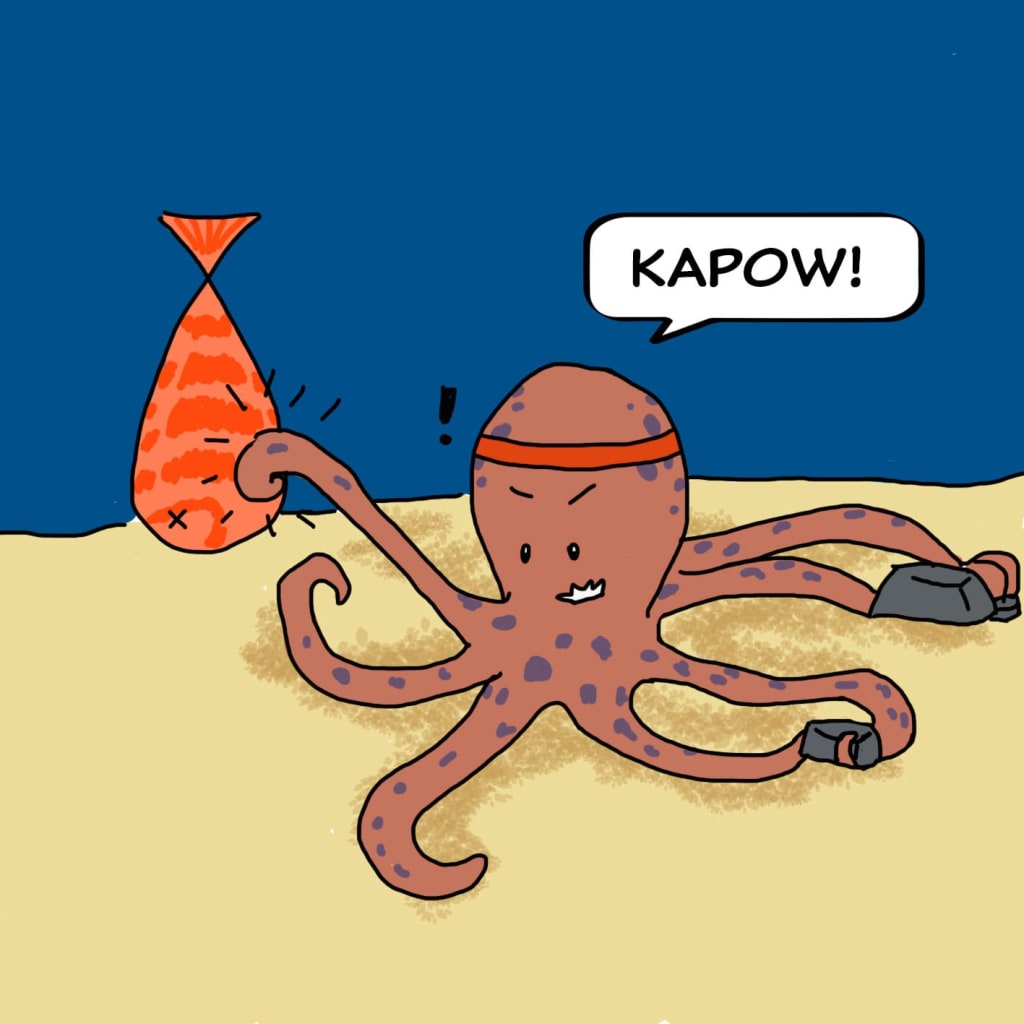
The image is so bizarre that it sounds almost invented: an octopus, deep in a coral-reef hunting group, suddenly extending one arm and punching a fish.
Not nibbling it.
Not grabbing it as prey.
Not defending itself from an attack.
Punching it.
And yet that is exactly the kind of behavior marine biologists have documented. In a 2021 paper in Ecology, researchers described octopuses punching fish during collaborative interspecific hunting events, a finding strange enough to go viral but real enough to sit comfortably inside peer-reviewed animal-behavior science.
What makes the story even more fascinating is that the punching is not random violence in a social vacuum. It happens in the middle of mixed-species hunts, where octopuses and reef fish hunt together in ways that appear coordinated and strategically useful to both sides. More recent work published in Nature Ecology & Evolution in 2024 goes further, showing that these octopus-fish hunting groups display complex functional dynamics, shifting leadership roles, and composition-dependent behaviors rather than simple accidental clustering.
That means the punch is not just funny. It is a clue.
It suggests that octopuses are not merely intelligent in the familiar puzzle-solving sense. They may also be capable of managing cooperation in messy, moment-to-moment ways—rewarding, displacing, correcting, or perhaps sometimes lashing out at partners who are not behaving as expected. That is a far richer picture of octopus life than the old stereotype of the clever but solitary sea alien.
The Hunt: How Octopuses and Fish Work Together
To understand the punch, you first have to understand the hunt.
Octopuses do not move through reef environments the way fast predatory fish do. They are slower, but they have something fish do not: reach, flexibility, and the ability to probe deeply into crevices, holes, and coral structures where prey hide. Fish, on the other hand, are faster and better positioned to snatch prey that flee open cover.
That creates a natural tactical fit.
The 2021 Ecology paper and later reporting describe octopuses acting like the reef’s flushers or bulldozers—using their arms and body to disturb hidden prey—while accompanying fish capitalize on escape routes. In these mixed-species hunts, each side brings a different advantage.
This kind of partnership was not entirely unknown before the “punching” story. Fish collaboration with other species has been documented in reef systems for years. But the octopus-fish version is especially striking because octopuses are usually imagined as loners. The newer 2024 study on Octopus cyanea and various fish partners showed that these hunting groups are not chaotic accidents. They display patterns of leadership, response, and group-level organization that suggest a surprisingly sophisticated form of temporary alliance.
So the real shock is not merely that octopuses punch fish. It is that they are engaged in enough socially structured cooperation for punishment or correction to make sense at all.
The Punch Itself
The original Ecology paper described punching as an explosive motion of one arm directed at a specific hunting partner, strong enough to actively displace the fish toward the edge of the group or away from it. This is not a vague brush-off. It is a targeted, forceful movement aimed at another hunter.
And in many cases, the logic appears fairly clear.
Some fish benefit from the octopus’s work without contributing much. They hover close, crowd the action, or position themselves to steal flushed prey. When the octopus punches one of these fish, the immediate effect is to move it aside and restore the octopus’s access to the hunting space. That fits a straightforward interpretation: partner control.
This is the explanation emphasized by the paper itself. The study’s keywords include “partner control,” and that is important because it grounds the behavior in a functional, scientifically conservative framework. The octopus is not necessarily being petty in a human sense. It may be policing a cooperative interaction so that freeloading becomes less profitable.
That alone would already be remarkable.
But Some Punches Look… Needless
Here is where the story becomes more provocative.
According to reports based on the research, not every punch had an obvious immediate payoff. Some were delivered without any clear visible theft of food, direct obstruction, or instant tactical benefit. That is the part that led Eduardo Sampaio and others to cautiously raise the possibility of something like spite, irritation, or punishment tied to earlier behavior rather than immediate necessity.
This is where popular retellings often overshoot.
Scientists did not prove that octopuses are acting out of human-style malice. They did not prove emotional “spite” in the full psychological sense. What they did suggest is that some punching behavior may not be reducible to immediate prey access and may instead reflect a more socially complex form of punishment, frustration, or correction.
That distinction matters.
A careful reading of the science says:
- some punches clearly help the octopus control the hunt,
- some may discourage exploitative partners,
- and some remain ambiguous enough to raise deeper questions about octopus social cognition.
That is already extraordinary without forcing the most dramatic interpretation.
Why This Matters for Octopus Intelligence
Octopuses are already famous for intelligence. They solve puzzles, escape enclosures, manipulate objects, and show extraordinary camouflage control. But much of that public image is built around individual cleverness.
The fish-punching research points toward something broader: relational intelligence.
If an octopus can distinguish between useful and useless partners in a mixed-species hunt, adjust its behavior accordingly, and sometimes displace particular fish at particular moments, then it is not simply acting as a solitary hunter reacting to motion. It may be assessing the behavior of others within a temporary social system.
The 2024 Nature Ecology & Evolution paper strengthens that picture. It found that mixed-species hunting groups with octopuses exhibit hidden mechanisms of leadership and social influence, meaning the octopus is not just another body in the swarm. It may sometimes function as a central actor whose behavior shapes the movement and effectiveness of the whole group. That is a profound shift in perspective.
It suggests that octopuses may not only be smart in isolation—they may be smart in relation.
Is This Really Cooperation?
Even here, the scientists stay more cautious than the internet does.
Not all researchers fully agree on how cooperative these hunting groups are in the richer sense. Some may see them as forms of opportunistic association rather than deep collaboration. One species disturbs prey; another benefits; both stay near each other because it works often enough.
But the newer evidence suggests the interaction is more structured than mere coincidence. The fish and octopus appear to move together in functionally meaningful ways, and the octopus’s corrective aggression implies that group composition and behavior matter to it.
The best way to put it is this:
These are probably not friendships.
But they are more than accidents.
And that middle zone—between pure instinct and fully social intention—is exactly where some of the most interesting animal cognition lives.
What Species Are Involved?
The research and reporting most often discuss day octopuses (Octopus cyanea) working with reef fish in the Red Sea, including species such as blacktip groupers and others that follow the octopus during hunts. Even general species summaries now note that day octopuses have been observed participating in group hunts and striking fish, likely to discipline exploitative partners or reduce crowding.
That ecological setting matters. Coral reefs are crowded, visually complex, and tactically rich. Cooperation is useful because prey have many escape routes and hiding spots. In that world, the octopus is a uniquely valuable partner—but also one that may not tolerate lazy or selfish companions for long.
Are Octopuses “Spiteful”?
This is the most seductive question and the one that demands the most caution.
The short answer is: possibly in a limited behavioral sense, but not proven in a full psychological one.
“Spite” is a human-loaded word. It implies intention, resentment, and a desire to impose cost even without direct gain. The fish-punching observations do not prove that octopuses are having that kind of inner emotional episode. What they do show is that octopuses sometimes direct aggression toward collaborators even when the immediate advantage is not obvious, and that this behavior may function as delayed punishment, annoyance, or group enforcement.
So the scientifically fair version is:
octopuses may show behavior that resembles punishment or irritation, and in some cases that resembles what humans would casually call spite—but the deeper mental state remains open to interpretation.
That is still an astonishing sentence to be able to write about a cephalopod.
What the Punch Reveals About Animal Minds
The great value of this story is not the meme-level humor of “octopus punches fish for being lazy,” though that part is undeniably memorable.
The deeper value is that it forces us to expand our view of what intelligence can look like.
For a long time, animal cognition was often sorted into neat boxes:
- tool users,
- social mammals,
- problem-solving birds,
- instinct-driven fish,
- alien-but-smart octopuses.
The octopus-fish hunting studies blur those boxes. Here we have a cephalopod—already evolutionarily distant from humans—participating in dynamic interspecies hunts, responding selectively to partners, and possibly enforcing behavioral standards inside the group.
That is not just weird.
It is conceptually disruptive.
It suggests that sophisticated social behavior may arise in more forms, and in more minds, than older frameworks were comfortable admitting.
Final Verdict
Yes, octopuses really have been observed punching fish during cooperative hunts. The behavior was documented in a peer-reviewed 2021 study, and later research in 2024 showed that these octopus-fish hunting groups are more organized and behaviorally complex than they first appeared. In many cases, the punch seems to serve a practical function: displacing freeloaders, reducing crowding, or keeping the hunt moving. In some cases, the immediate benefit is less clear, which is why researchers have cautiously entertained ideas like punishment, irritation, or something close to what humans would call spite..
That does not prove octopuses are petty in the human sense. But it does prove something almost as interesting: these animals are participating in richer interspecies interactions than most people ever imagined. Beneath the reef, in the middle of a hunt, a single strike from one arm may be telling us that octopus intelligence is not just clever—it may also be social, strategic, and far more nuanced than we are only now beginning to understand.