Emma Chamberlain’s Pixie Cut: Met Gala’s Boldest Look
Some Met Gala looks are remembered because of the dress.
Some are remembered because of the jewelry.
Some are remembered because of the drama, the theme, the designer, the red-carpet pose, or the viral interview moment that follows.
But every so often, a beauty detail becomes the entire conversation.
For Emma Chamberlain, that detail was her platinum pixie cut.
At the 2026 Met Gala, Chamberlain arrived in a custom Mugler look that already had enough fashion power to dominate headlines. The gown was designed by Miguel Castro Freitas and hand-painted by artist Anna Deller-Yee, turning Chamberlain’s body into a living canvas. Vogue reported that the dress took 40 hours to paint, used 30 base colors, and needed four days to dry. The look fit the evening’s “Fashion Is Art” direction with unusual precision, merging couture, painting, performance, and red-carpet image-making into one dramatic statement.
Yet even beside that painterly dress, the hair refused to be background.
Chamberlain’s short, sharp, icy-blonde pixie gave the entire look its attitude. It made the gown feel less like a delicate artwork and more like a fearless fashion declaration. It sharpened her face, opened the neckline, emphasized the makeup, and added a modern edge to an already conceptual outfit. Cosmopolitan listed her spiky pixie among the best short-hair moments from the 2026 Met Gala, crediting hairstylist Sami Knight for the look.
That is why the pixie mattered.
It was not just a haircut.
It was punctuation.
A Haircut That Changed the Whole Mood
A Met Gala gown can be spectacular, but hair decides how the look reads.
Long waves can make a dress romantic. A slick bun can make it severe. Wet-look hair can make it sensual. A bob can make it retro. A pixie can make it daring, editorial, and almost rebellious.
Emma Chamberlain’s pixie did exactly that.
The cut was short enough to feel confident but not harsh. The platinum tone made it luminous. The spiky texture gave it movement and attitude. Instead of softening the painted Mugler gown, the hair sharpened it. It created contrast between the fluid body-as-canvas dress and the sculptural, almost punk-like beauty direction.
That contrast is what made the look memorable.
If Chamberlain had worn long, flowing hair, the gown might have felt more ethereal. If she had worn a sleek updo, it might have leaned more classic. The pixie made it feel current, disruptive, and unmistakably Emma.
It said: this is not just fashion fantasy.
This is fashion with teeth.
Emma Chamberlain Understands the Met Gala Assignment
Emma Chamberlain has become one of the most interesting recurring figures at the Met Gala because she does not approach the carpet like a traditional celebrity guest.
She is an internet personality, fashion insider, interviewer, style experimenter, and modern red-carpet translator all at once. She is often there not only to be photographed, but also to speak with other stars as Vogue’s red-carpet correspondent. That creates a unique pressure: she has to look like part of the fashion conversation while also participating in it.
At the 2026 Met Gala, she leaned fully into transformation.
Her Mugler gown was not simply pretty. It was conceptual. Vogue described the look as turning Chamberlain’s body into a canvas, and Chamberlain herself told Vogue that she enjoys fashion most when she can become a complete blank canvas.
That quote explains the whole look.
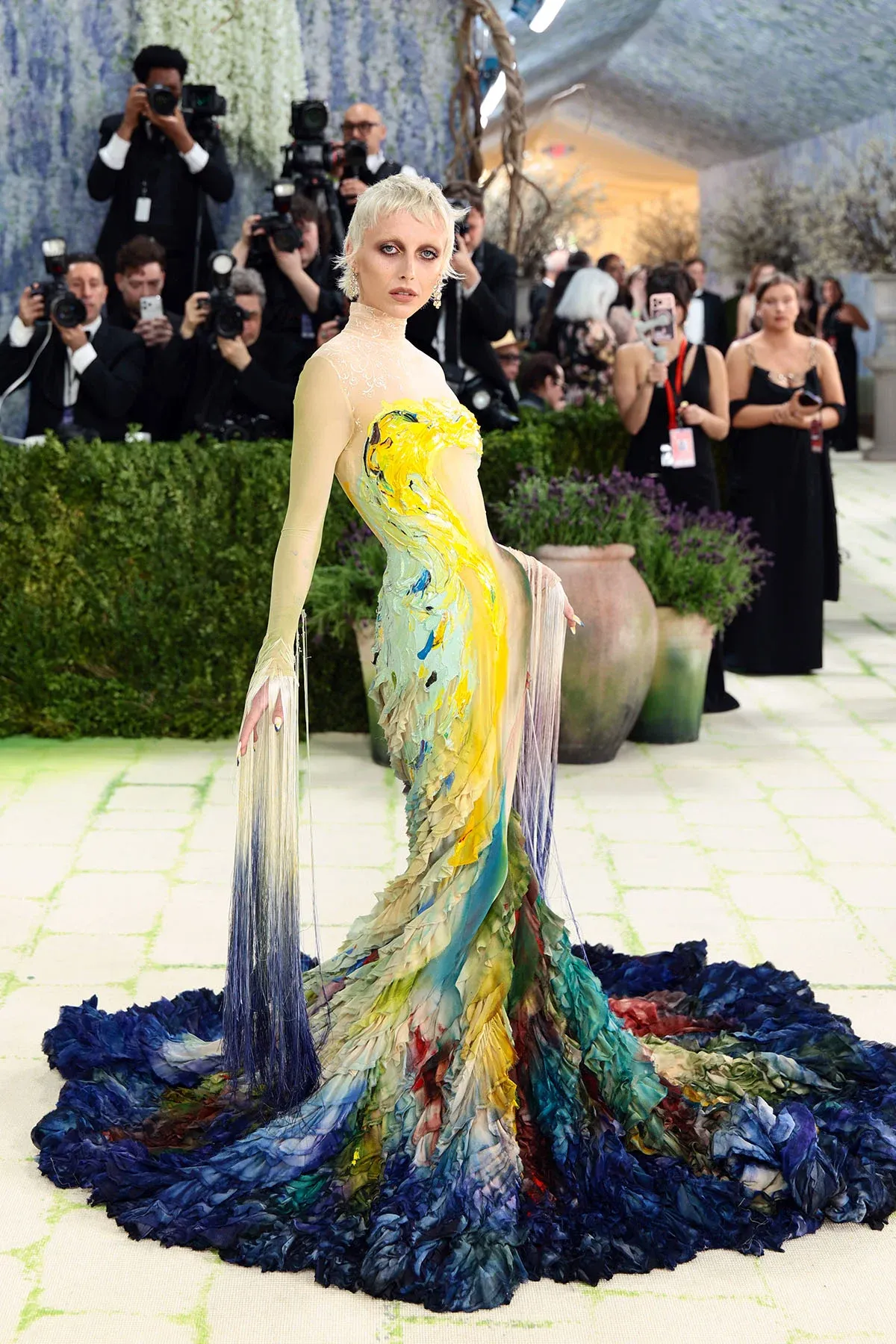
The painted dress literally made her body part of the artwork. The pixie cut completed the transformation by removing unnecessary softness. It stripped the styling down to face, form, color, and attitude.
A bold gown needs a bold beauty decision.
The pixie gave it one.
Why the Pixie Cut Works So Well on Emma
Not every celebrity pixie cut feels natural. Sometimes it looks like a temporary stunt, a wig experiment, or a forced attempt at reinvention.
Chamberlain’s pixie works because it matches her style evolution.
She has never had a static public image. She moved from relatable YouTube casualness into luxury fashion without losing the slightly offbeat, self-aware quality that made her famous. Her best looks often contain a little tension: polished but not too polished, glamorous but not predictable, high-fashion but still slightly strange.
The pixie cut fits that identity perfectly.
It frames her face in a way that feels both delicate and strong. It allows her features to carry more expression. It makes accessories and makeup more visible. It gives her a slightly androgynous edge without erasing glamour. It also helps her stand apart in a red-carpet environment where long waves, extensions, and sculptural updos often dominate.
That is why the 2026 Met Gala hair felt so successful.
It did not feel like Emma wearing a trend.
It felt like Emma refining her own fashion language.
The Platinum Color Made It Even Stronger
The cut alone was not the entire story. The color mattered just as much.
A dark pixie would have created a moodier look. A brunette pixie might have felt softer or more grounded. But the platinum blonde made the hair feel electric. It caught the light, contrasted with the painted gown, and gave the entire beauty moment a futuristic edge.
Platinum hair has a long fashion history. It can evoke Old Hollywood, punk, sci-fi, mod style, high glamour, or icy minimalism depending on how it is styled. On Chamberlain, paired with spiky texture and a painted Mugler gown, it felt modern and slightly dangerous.
That is the beauty of platinum: it is never neutral.
It announces itself.
At the Met Gala, where the entire point is visual impact, that matters.
Short Hair Ruled the Red Carpet
Chamberlain was not the only star whose short hair became part of the night’s beauty conversation. The 2026 Met Gala had several notable short-hair moments, and Cosmopolitan’s roundup placed Chamberlain’s spiky pixie among the best of them, alongside other cropped, bobbed, or sculptural looks.
This reflects a bigger beauty shift.
For years, red carpets were dominated by long hair: Hollywood waves, waist-length extensions, sleek ponytails, and dramatic updos. Those styles are still everywhere, but short hair is having a fashion comeback because it feels more personal. A pixie cannot hide behind length. It exposes the face, the styling, the confidence, and the bone structure.
Short hair also photographs differently. It creates negative space around the neck and shoulders. It allows a gown’s neckline or upper-body construction to stand out. It puts more emphasis on makeup, earrings, and facial expression.
For a theme built around fashion as art, short hair made sense. It treated the head and face as part of the composition.
Chamberlain’s pixie was one of the clearest examples of that idea.
The Pixie as a Power Move
There is a reason pixie cuts still feel bold.
Even though the haircut has existed for decades, it continues to carry cultural weight. Long hair is often associated with traditional femininity, softness, glamour, and beauty norms. Cutting it short can feel like a rejection of those expectations, or at least a refusal to depend on them.
That is why a pixie on a major red carpet often reads as a power move.
It says the person wearing it is not afraid of exposure. No curtain of hair. No easy softness. No automatic glamour trick. Just face, attitude, styling, and confidence.
Emma Chamberlain’s pixie did not look severe in a cold way. It looked playful, sharp, and self-possessed. The spiky styling added energy. The platinum shade added brightness. The short length added confidence.
It made the whole Met Gala look feel intentional from head to toe.
How It Played Against the Mugler Gown
The Mugler dress was already a major fashion statement. Designed by Miguel Castro Freitas and hand-painted by Anna Deller-Yee, it turned Chamberlain into a walking artwork. British Vogue reported that Chamberlain and stylist Jared Ellner connected with Castro Freitas around Paris Fashion Week and that the “Fashion Is Art” dress code made Mugler feel like the right choice.
The gown had softness because of the painted effect. It had visual complexity because of the color work. It had body focus because of the way it used Chamberlain as the canvas.
The pixie balanced all of that.
Instead of competing with the dress, it cleared visual space. It kept the head styling clean but not boring. It allowed the artwork of the gown to breathe while adding an edge that prevented the look from becoming too delicate.
That balance is hard to achieve.
A dramatic dress plus dramatic hair can become too much. A dramatic dress plus boring hair can feel unfinished. Chamberlain’s pixie landed in the sweet spot: strong enough to matter, restrained enough to support the full look.
The Beauty Detail That Made the Look Viral
Met Gala beauty often becomes viral when it has one clear takeaway.
For Chamberlain, the takeaway was easy: the pixie.
People could discuss the hand-painted dress, the Mugler collaboration, the body-as-canvas concept, and the fashion-art theme. But the hair gave casual viewers something immediate to react to.
It was short.
It was blonde.
It was spiky.
It was bold.
That matters in the social-media age. A red-carpet look needs layers for fashion critics, but it also needs one instant visual hook for everyone else. Chamberlain’s pixie provided that hook.
It made the look recognizable even in a cropped image. It made her silhouette distinct. It gave headlines a beauty angle. It helped the outfit travel beyond fashion circles into general pop-culture conversation.
At the Met Gala, a successful look does not only appear.
It circulates.
The pixie helped it circulate.
Emma’s Red-Carpet Evolution
Chamberlain’s relationship with fashion has become increasingly sophisticated over the years.
She began as a relatable digital creator known for humor, editing style, and internet authenticity. But unlike many influencers who struggle to cross into high fashion convincingly, Chamberlain became a natural fit for the luxury world because she never seemed to be chasing perfection. She brought curiosity, weirdness, and self-awareness.
Her Met Gala appearances have reflected that evolution. She has worn major fashion houses, experimented with tailoring, gothic moods, dramatic silhouettes, and beauty transformations. In 2025, for example, she wore a custom black pinstripe Courrèges look with an extremely low back and sharply styled pixie hair, a look widely covered for its daring silhouette and tailored theme connection.
The 2026 pixie did not arrive out of nowhere. It continued a pattern: Chamberlain using hair and styling to push her image toward sharper, more editorial territory.
She is not simply dressing up for the Met.
She is building a fashion identity in public.
Why Fans Respond to Her Beauty Risks
Emma Chamberlain’s fans respond to her style risks because they feel connected to her broader personality.
She does not present herself as untouchable. Even in couture, she often carries a sense of humor and slight awkwardness that makes her fashion choices feel less intimidating. That makes bold beauty decisions like a pixie cut easier for fans to admire. She looks glamorous, but not sealed inside celebrity perfection.
That is rare.
Many stars wear bold looks, but the styling can feel distant. Chamberlain’s strength is that she makes high fashion feel conversational. She can stand in a hand-painted Mugler gown with a platinum pixie cut and still seem like someone who might make a self-deprecating joke about it later.
That relatability gives her beauty risks more impact.
Fans do not only see a haircut.
They see a person they have watched evolve choosing something brave.
The Pixie Cut Trend Is Bigger Than One Night
Chamberlain’s Met Gala pixie also reflects a wider fashion and beauty trend: the return of statement short hair.
Pixie cuts, bixies, cropped bobs, micro bobs, shags, and short sculptural styles are becoming more visible because they offer a break from the sameness of long, glossy, extension-heavy beauty. In a culture saturated with filtered hair perfection, a pixie feels refreshingly direct.
It also matches the current mood of personal reinvention. Many people are using hair as a way to signal a new chapter. A dramatic cut can say more than a new outfit because it changes how the face itself is read.
Chamberlain’s pixie works in that context. It feels like a beauty signature for someone moving deeper into her fashion-editorial era.
It is not sweet.
It is not safe.
It is not trying to please everyone.
That is exactly why it works.
What Made It Met Gala-Worthy
The Met Gala is not a normal red carpet. A beautiful look is not enough. The best outfits feel like interpretations of a theme, extensions of a persona, and memorable images all at once.
Chamberlain’s pixie helped her meet that standard.
The dress answered the theme through painting and body-as-canvas construction. The hair answered the theme through form. It made her face part of the artwork. It created a sculptural beauty shape. It added modernity to the couture concept.
A Met Gala look should make viewers pause.
This one did.
Not because it was the biggest.
Not because it was the loudest.
Because every part of the look seemed to understand the same idea: Emma Chamberlain was not just wearing art.
She was being styled as art.
Final Verdict
Emma Chamberlain’s platinum pixie cut was one of the boldest beauty moments of the 2026 Met Gala because it transformed an already striking Mugler gown into a complete fashion statement. The custom dress, designed by Miguel Castro Freitas and hand-painted by Anna Deller-Yee, made Chamberlain’s body a canvas for the night’s fashion-art theme. But the sharp, spiky pixie gave the look its edge, confidence, and instantly viral beauty identity.
The haircut worked because it felt like Emma: modern, slightly rebellious, fashion-aware, and unafraid of looking different. It framed her face, elevated the makeup, opened the silhouette, and added a punk-like energy to the painterly gown. Cosmopolitan named her spiky pixie among the standout short-hair moments of the night, confirming that the look was not only a dress story but a beauty story too.
At the Met Gala, the most memorable appearances are the ones where every detail matters.
For Emma Chamberlain, the gown was the artwork.
But the pixie was the exclamation point.