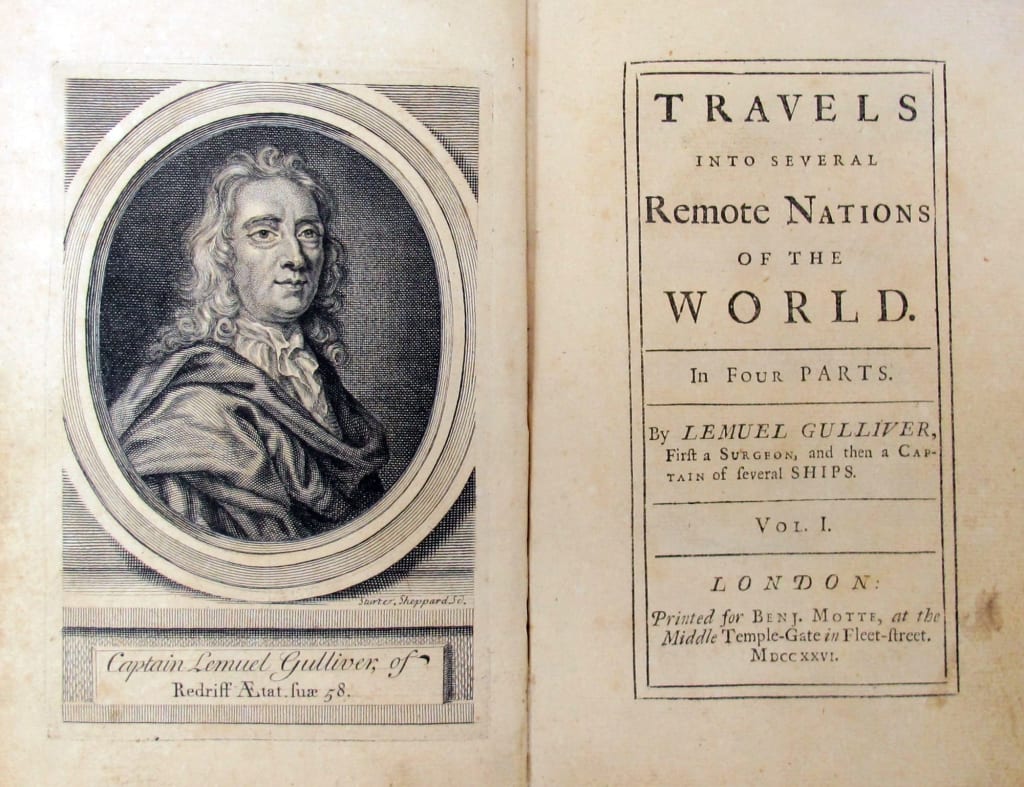
Gulliver's Travels Turns 300: How Jonathan Swift's Extraordinary Voyages Changed Literature Forever
Imagine waking up on an unfamiliar beach.
You attempt to move, only to discover that your arms, legs, and hair have been tied to the ground.
Tiny ropes stretch across your body.
Then you notice something extraordinary.
Human figures, barely six inches tall, are climbing over you.
Some carry miniature weapons. Others shout in a language you cannot understand. Their entire civilization seems to exist on a scale completely different from your own.
You are a giant in a world of tiny people.
It sounds like the beginning of a modern fantasy adventure.
But nearly 300 years before today's elaborate fictional universes, an Irish writer imagined this astonishing scene—and used it to expose some of humanity's most ridiculous and dangerous qualities.
On October 28, 1726, Jonathan Swift published one of the most influential works in literary history.
The book was Gulliver's Travels.
And the world of literature would never be quite the same.
First published anonymously in London by Benjamin Motte, the book presented itself as the genuine travel memoir of a ship's surgeon named Lemuel Gulliver.
Its pages carried readers to kingdoms of miniature people, lands inhabited by giants, floating islands of eccentric intellectuals, and a civilization ruled by intelligent horses.
The adventures were wildly imaginative.
But beneath the fantasy lay something much sharper.
Swift was writing about political corruption, religious divisions, imperial ambition, intellectual arrogance, and the uncomfortable contradictions of human nature.
His strange fictional societies were distorted reflections of the real world.
And his criticism was so effective that readers immediately recognized the political and social absurdities hidden beneath the adventures.
The book became an extraordinary publishing success.
Its first printing is widely reported to have sold out within a week, with further printings following rapidly.
Three centuries later, Gulliver's Travels remains in print, continues to inspire new adaptations, and is celebrated as one of the great achievements of world literature.
Yet perhaps its greatest achievement is that the story has never stopped making people think.
Children can enjoy its impossible worlds.
Adults can discover its ruthless satire.
And readers separated by centuries can recognize the same human weaknesses Swift was mocking in 1726.
To celebrate the book's 300th anniversary, we revisit the extraordinary imagination, political courage, and enduring literary genius behind Gulliver's Travels.
Author: Jonathan Swift (1667–1745) | Publisher: Benjamin Motte | First publication: London | Genre: Satire, fictional travel narrative, adventure and political allegory
Verified using the original-edition bibliographies and the 2026 tercentenary exhibitions organized by Trinity College Dublin and Armagh Robinson Library. Armagh Robinson Library & No 5+2
The Book That Pretended to Be a True Story
One of the cleverest things about Gulliver's Travels is that it did not initially announce itself as an extravagant fantasy by Jonathan Swift.
Instead, the title page presented the work as:
Travels into Several Remote Nations of the World. In Four Parts. By Lemuel Gulliver, First a Surgeon, and then a Captain of Several Ships.
The author named on the book was not Swift.
It was the fictional protagonist.
The narrative included realistic descriptions of voyages, geographical details, unfamiliar customs, and encounters with distant civilizations.
Its style resembled the travel accounts that had become popular among European readers during the age of maritime exploration.
Swift used the familiar conventions of travel writing to make his impossible worlds feel strangely credible.
A Fictional Traveler With a Serious Face
Lemuel Gulliver is not initially presented as an extravagant hero.
He is a practical, educated man with experience as a surgeon and sailor.
He observes unfamiliar societies and attempts to describe them in a matter-of-fact manner.
The contrast between his calm narration and the extraordinary things happening around him creates much of the book's humor.
A nation of tiny people becomes a plausible political system.
A kingdom of giants acquires recognizable social institutions.
A flying island is described with the seriousness of a geographical discovery.
And a society governed by horses becomes an opportunity to examine human behavior.
The more seriously Gulliver describes these places, the more ridiculous—and revealing—they can become.
Why Swift Concealed His Identity
The anonymity was not simply a literary trick.
Swift was deeply involved in the political and religious arguments of his time.
His writing frequently attacked institutions, public figures, and abuses of power.
Publishing a biting satire under a fictional identity allowed the book to create mystery while maintaining the illusion of an authentic travel narrative.
Swift's authorship became widely known, but the initial disguise contributed to the book's extraordinary reception.
As literary scholar J. Paul Hunter explains in The Cambridge Companion to Jonathan Swift, the combination of anonymity, realistic storytelling, and provocative content helped turn the book into an immediate public sensation.

Voyage One: Lilliput, Where Tiny People Have Enormous Egos
Historical illustration by J. J. Grandville from the Lilliput portion of Gulliver's Travels. Public-domain artwork hosted on Revlox Cloudinary.
The first voyage is undoubtedly the most famous.
After a shipwreck, Gulliver awakens on the island of Lilliput, where the inhabitants are approximately six inches tall.
To the Lilliputians, Gulliver is an enormous creature.
His body becomes a geographical obstacle.
His possessions seem like extraordinary machines.
And his physical strength could potentially transform their military and political balance.
At first, the situation appears to be a delightful fantasy built around the difference in size.
But Swift quickly reveals a darker joke.
The Lilliputians may be tiny, but their political ambitions are immense.
Their society is filled with vanity, rivalry, manipulation, and absurd regulations.
The Great War Over Which End of an Egg to Break
Among the book's most memorable political jokes is the conflict between Lilliput and its rival empire, Blefuscu.
Their dispute involves the proper way to break an egg.
Should it be opened at the large end?
Or the small end?
What should be a trivial personal preference becomes the basis for serious political and religious conflict.
The two sides treat the disagreement as a matter of enormous national significance.
Swift uses this absurdity to mock the ways religious and ideological differences can become causes of persecution and war.
The particular historical references involve religious divisions in Britain and conflict with other European powers.
But the underlying criticism remains recognizable.
Human beings are capable of turning remarkably small disagreements into enormous disputes.
Politics as a Circus Performance
Another Lilliputian custom involves candidates for political office performing dangerous acrobatic tricks on a tightrope.
Success in these performances can help determine who receives favor and promotion.
The satire is unmistakable.
Instead of choosing officials primarily for competence, integrity, or wisdom, the court rewards those most skilled at entertaining and pleasing the ruler.
It is a devastating image of political favoritism.
And three centuries later, the idea of ambitious officials competing for power by performing for influential leaders still carries considerable satirical force.
The high-heeled and low-heeled factions of Lilliput similarly parody partisan rivalry, often interpreted in relation to the Whigs and Tories of Swift's Britain.
Voyage Two: Brobdingnag, Where Gulliver Becomes the Tiny One
Giants examining Gulliver through a magnifying glass, illustrated by J. J. Grandville in the nineteenth century. Public domain, via Wikimedia Commons.
In his second great adventure, Gulliver arrives in Brobdingnag.
This time, the situation is reversed.
Instead of being a giant surrounded by tiny people, he is a miniature human living among enormous inhabitants.
His physical vulnerability changes everything.
He can be picked up, examined, and treated as a curiosity.
Ordinary animals become terrifying creatures.
Even familiar human bodies appear strange when viewed at an exaggerated scale.
But the deeper meaning lies in the way Swift changes the reader's perspective.
In Lilliput, Gulliver could look down on the weaknesses of others.
In Brobdingnag, he is forced to look upward.
The King Who Exposes European Arrogance
One of the most important scenes involves Gulliver explaining the political institutions and military achievements of his homeland to the King of Brobdingnag.
Gulliver expects admiration.
He describes European government, warfare, and national greatness with considerable pride.
But the king responds with moral disgust.
The supposed achievements of European civilization appear less impressive when examined by an outsider who does not share Gulliver's assumptions.
Swift turns the scene into an attack on political corruption, cruelty, and the glorification of war.
What Gulliver considers evidence of civilization, the king interprets as evidence of human foolishness.
Why Perspective Changes the Meaning of Power
The contrast between the first two voyages is one of the book's most brilliant structural devices.
In Lilliput, Gulliver is physically powerful.
In Brobdingnag, he is physically helpless.
Yet the moral worth of a society cannot be determined by the size or strength of its inhabitants.
Swift repeatedly separates physical scale from moral character.
Greatness is not the same as goodness.
Power is not the same as wisdom.
And a civilization's impressive achievements do not necessarily make it admirable.
Voyage Three: Laputa, the Flying Island That Mocked Scientific Arrogance
The floating island of Laputa, illustrated in a nineteenth-century edition of Gulliver's Travels. Public-domain historical artwork.
The third voyage introduces some of Swift's most imaginative and eccentric inventions.
Gulliver encounters Laputa, a flying island inhabited by people fascinated with mathematics, music, and abstract thought.
The island's residents possess extraordinary intellectual interests.
But their concentration on theory often leaves them disconnected from everyday reality.
Some require assistants to redirect their attention during conversations.
They become so absorbed in complex ideas that ordinary practical matters seem almost beyond their capabilities.
It is a wonderfully absurd portrait of intelligence separated from common sense.
The Academy of Lagado: When Innovation Becomes Ridiculous
In the neighboring land of Balnibarbi, Gulliver visits the Academy of Lagado.
There, researchers pursue increasingly bizarre experiments.
One attempts to extract sunshine from cucumbers.
Another explores methods of converting human waste back into food.
Other projects involve extraordinary proposals for transforming language, architecture, agriculture, and education.
These imaginary inventions sound ridiculous.
But their purpose is more sophisticated than simply mocking scientists.
Swift is criticizing intellectual ambition that loses sight of practical benefit, human wellbeing, and reality itself.
His targets include fashionable schemes, empty expertise, and institutions that mistake novelty for genuine progress.
He is not arguing that scientific investigation is inherently foolish.
Rather, he asks whether sophisticated theories deserve admiration when their proponents cannot demonstrate useful results or understand the consequences of their work.
Why Laputa Feels Surprisingly Modern
Three centuries later, the Academy of Lagado can be read as an unexpectedly familiar satire.
Modern societies frequently celebrate technological breakthroughs, ambitious experiments, and extraordinary promises of future progress.
But technological sophistication does not automatically guarantee wisdom.
A system can be ingenious without being useful.
An invention can be impressive while creating new problems.
And an institution can spend enormous resources pursuing fashionable ideas without adequately considering their practical value.
Swift's satire encourages readers to ask a question that remains relevant in every scientific era:
Are we creating knowledge that improves human life, or are we becoming so fascinated with our own cleverness that we forget why knowledge matters?
That question is a modern application of Swift's satire, not a claim that he anticipated any particular present-day technology.
Voyage Four: The Houyhnhnms, Where Horses Are Civilized and Humans Are Not
Gulliver among the Houyhnhnms, from an 1851 edition illustrated by J. J. Grandville. Historical artwork preserved through the National Library of Poland and Wikimedia Commons.
The final voyage is the darkest and most philosophically challenging part of the novel.
Gulliver arrives in a country inhabited by intelligent, rational horses called the Houyhnhnms.
These beings value reason, order, and restraint.
But the same land is also home to the Yahoos—degraded, humanlike creatures depicted as greedy, violent, and driven by appetite.
The contrast creates one of Swift's most unsettling images.
The horses appear civilized.
The humanlike beings appear brutish.
And Gulliver gradually begins to recognize disturbing similarities between the Yahoos and the human beings he has known throughout his life.
The Most Uncomfortable Mirror in the Novel
In the earlier voyages, Swift used imaginary societies to criticize particular aspects of human civilization.
In the final voyage, his satire becomes broader and more severe.
Instead of focusing primarily on political corruption or intellectual foolishness, he questions humanity's claims to moral superiority.
The Yahoos embody some of the ugliest characteristics Swift associates with human behavior.
They are aggressive, selfish, and frequently motivated by destructive impulses.
Meanwhile, the Houyhnhnms appear to represent a society governed by reason rather than uncontrolled passion.
Yet the supposedly rational horses are not without troubling qualities of their own.
Their social order raises difficult questions about exclusion, emotional attachment, and the potential cruelty of excessive rationalism.
That ambiguity prevents the book from becoming a simple argument that humans are bad and horses are good.
Gulliver's Disturbing Return Home
By the end of his travels, Gulliver has become profoundly alienated from humanity.
His experiences among the Houyhnhnms change how he sees other people.
When he returns home, he struggles to tolerate ordinary human company.
Even his relationship with his family becomes affected by his disgust toward human behavior.
The ending is deeply unsettling.
The reader is left to wonder whether Gulliver has acquired genuine wisdom or become dangerously consumed by his hatred of humanity.
Perhaps the final irony is that his pursuit of a supposedly superior civilization has made him less capable of participating compassionately in his own.
This unresolved tension is one reason Gulliver's Travels remains so rewarding for adult readers.
The book does not merely criticize the world.
It also questions what happens when criticism becomes so absolute that it destroys our ability to recognize goodness in others.
Jonathan Swift: The Irish Writer Who Challenged an Empire
Jonathan Swift was born in Dublin in 1667.
He studied at Trinity College Dublin and later became an Anglican clergyman.
In 1713, he was appointed Dean of St Patrick's Cathedral, a position he held until his death in 1745.
But Swift's life was never confined to religious duties.
He was also a formidable political commentator and satirist.
His writing frequently attacked abuses of authority, political hypocrisy, economic injustice, and the mistreatment of Ireland.
A Writer Who Used Humor as a Weapon
Swift understood that humor could accomplish something more direct argument sometimes could not.
A reader might resist being told that their government was corrupt.
They might reject an essay arguing that their society was foolish.
But what if those same criticisms appeared in a story about tiny politicians fighting over eggs?
The absurdity creates distance.
Readers can laugh at the fictional society before realizing that the joke may be about their own.
That is one of satire's greatest powers.
It allows writers to expose uncomfortable truths without presenting them as straightforward moral lectures.
Swift mastered this approach.
His other celebrated works include A Tale of a Tub and A Modest Proposal, the latter a devastating satire of economic inequality and indifference toward the poor in Ireland.
Together, these writings established him as one of the most important satirists in the English language.
The Book Was So Politically Dangerous That Its Publisher Changed It
The publication history of Gulliver's Travels is almost as fascinating as the novel itself.
The first edition appeared anonymously in London through publisher Benjamin Motte.
But the manuscript did not reach readers exactly as Swift had intended.
Motte's publishing operation made alterations to parts of the text, apparently to reduce the risk posed by its sharp political satire.
Some of the most direct criticisms of contemporary government and court politics were softened or changed.
Swift was unhappy with these interventions.
The More Authoritative 1735 Edition
In 1735, Dublin publisher George Faulkner issued a revised version as part of an edition of Swift's collected works.
This version restored or revised important passages and benefited from greater involvement by Swift and his associates.
Scholars frequently regard the 1735 text as an important, more authoritative version.
But the history is not entirely straightforward.
The original manuscript has not survived, and different early editions preserve different readings.
Modern editors therefore examine both the 1726 and 1735 versions when studying Swift's intentions and the book's original reception.
The episode is a reminder that literary censorship and editorial interference are not exclusively modern concerns.
Even a book celebrated as a masterpiece of imaginative freedom was shaped by the political pressures surrounding its original publication.
The First Edition Became an Instant Sensation
When the book appeared on October 28, 1726, its success was extraordinary.
Contemporary reports indicate that readers across different social classes became fascinated by Gulliver's adventures.
The first printing sold rapidly.
Bibliographical accounts differ slightly on the precise sellout period: several describe the initial printing disappearing within about a week, while another major rare-book catalogue estimates two to three weeks.
The central point is undisputed.
The book sold exceptionally quickly, and additional printings followed before the end of 1726.
Its appeal crossed conventional literary boundaries.
Some readers enjoyed the fantastical adventures.
Others appreciated the political references.
Still others admired the humor, philosophical arguments, and extraordinary world-building.
The book could be approached from several directions, which helped it reach an unusually wide audience.
The Birth of a Literary Phenomenon
Today, successful novels frequently inspire sequels, adaptations, merchandise, and extensive fan communities.
In 1726, Gulliver's Travels generated its own version of a cultural phenomenon.
It inspired imitations, responses, illustrations, adaptations, and further editions.
Its fictional worlds became widely recognizable.
And its central character entered the shared imagination of readers far beyond Britain and Ireland.
Swift had created more than a successful book.
He had created a story capable of surviving dramatic changes in language, politics, culture, and publishing technology.
How Gulliver's Travels Changed Literature
The influence of Swift's masterpiece extends across several genres.
It is a work of imaginative adventure.
A political satire.
A philosophical exploration of human behavior.
A parody of travel writing.
And an important precursor to later works of speculative fiction.
Fantasy as a Way to Examine Reality
Swift demonstrated how imaginary societies could be used to investigate real social problems.
Instead of writing only about the political institutions of Britain, he invented countries whose customs exposed familiar contradictions.
This approach has remained enormously influential.
Later writers have used fictional societies, invented technologies, and alternative worlds to criticize political systems and explore human behavior.
The imaginative distance allows difficult questions to be examined from unfamiliar perspectives.
A Precursor to Science Fiction
Gulliver's Travels is not science fiction in the modern sense.
Its invented technologies and societies do not consistently rely on scientific explanations.
Nevertheless, its flying island, imaginary inventions, and systematic descriptions of unfamiliar civilizations anticipate techniques used in speculative fiction.
The Academy of Lagado, in particular, offers a recognizable early example of fiction investigating the social consequences of technological and intellectual ambition.
The Enduring Language of Lilliput and Yahoo
Few literary works have contributed such recognizable terms to everyday language.
Lilliputian became an adjective describing something extremely small or trivial.
Yahoo entered English as a term for an uncouth, noisy, or unpleasant person, derived from the humanlike creatures in Swift's final voyage.
These words demonstrate how thoroughly the novel's fictional world entered ordinary cultural expression.
Why So Many People Remember Only the Tiny People
One of the most curious aspects of Gulliver's Travels is that many people know the story without having read the complete novel.
They recognize Gulliver tied to the ground by miniature people.
They may remember his adventures among giants.
But they are often less familiar with the floating island of Laputa or the deeply unsettling world of the Houyhnhnms.
There is a historical reason for this.
The early voyages lend themselves particularly well to children's literature and visual storytelling.
They contain striking images, adventurous situations, and physical comedy.
The later portions of the book are more philosophically complicated and often more disturbing.
Consequently, many abridged editions and adaptations have emphasized Lilliput and Brobdingnag while simplifying or omitting parts of the original satire.
This has given the novel two overlapping identities.
For children, it can be a remarkable fantasy adventure.
For adults, it can be a ruthless examination of civilization and human character.
Neither reading is entirely wrong.
But the full novel offers much more than its most famous scenes suggest.
Gulliver's Travels at 300: The World Celebrates in 2026
The book's tercentenary has prompted new exhibitions and literary events, particularly in Ireland.
At Trinity College Dublin, where Swift studied, the exhibition Gulliver at 300 explores the book's remarkable publishing history.
The exhibition draws on the library's extensive collection of historical editions, illustrations, and adaptations.
According to Trinity College, the display includes materials spanning from the first publication in 1726 to interpretations produced in the twenty-first century.
It remains on display in the Long Room of the Old Library through December 2026.
Trinity College Dublin+1
En Irlande, les Voyages de Gulliver fêtent leurs 300 ansactualitte.comTrinity College Dublin is marking the novel's 300th anniversary with an exhibition exploring centuries of editions and illustrations.
Rare Editions and a Book That Never Disappeared
The anniversary celebrations also draw attention to how widely the novel has circulated.
Trinity's exhibition features more than a hundred versions of the work, including a rare Dublin abridgement from 1761.
Meanwhile, Armagh Robinson Library is celebrating the anniversary through an exhibition featuring a remarkable copy of the first edition believed to contain annotations by Swift himself.
These collections demonstrate the extraordinary variety of ways the book has been printed, illustrated, translated, and interpreted.
A work originally disguised as one sailor's travel memoir has become a global literary inheritance.
Three centuries later, the world's fascination with Lemuel Gulliver shows little sign of fading.
The Four Voyages of Gulliver's Travels at a Glance
Voyage | Imaginary destination | Main satirical themes |
|---|---|---|
First | Lilliput and Blefuscu | Political rivalry, religious conflict, ambition and petty disputes |
Second | Brobdingnag | National pride, moral perspective, warfare and abuse of power |
Third | Laputa and other lands | Misguided intellectual ambition, speculative projects and ineffective institutions |
Fourth | Land of the Houyhnhnms | Human nature, reason, pride, cruelty and the limits of civilization |
Taken together, the four voyages form a progressively darker examination of humanity.
The book begins with comic political absurdity.
It ends with profound questions about whether human beings are as rational, civilized, and morally superior as they believe themselves to be.
Why Gulliver's Travels Still Matters in 2026
It is remarkable how recognizable Swift's targets remain.
Politicians still disagree over matters that can appear absurd to outsiders.
Societies still use national pride to justify destructive behavior.
Institutions can still reward loyalty and performance over competence.
Experts can still become fascinated with ideas while neglecting practical consequences.
And human beings remain capable of extraordinary compassion and extraordinary cruelty.
These parallels do not mean Swift predicted the specific events or technologies of the modern world.
His book was deeply rooted in the political and intellectual struggles of eighteenth-century Britain and Ireland.
But the behaviors he examined were not confined to his century.
That is the quality that allows great satire to endure.
It is specific enough to reveal the world in which it was written, yet sufficiently perceptive to challenge readers who live hundreds of years later.
Perhaps the most important lesson is not simply that humanity is foolish.
It is that we often struggle to recognize our own foolishness until someone shows it to us from another perspective.
And nobody did that quite like Jonathan Swift.
Frequently Asked Questions
When was Gulliver's Travels first published?
Gulliver's Travels was first published in London on October 28, 1726, by Benjamin Motte. Its 300th anniversary fell on October 28, 2026.
Who wrote Gulliver's Travels?
The novel was written by Jonathan Swift, an Irish author, satirist, and Anglican clergyman. The first edition was published under the fictional name Lemuel Gulliver.
Is Gulliver's Travels a children's book?
The original work was written as a sophisticated satire addressing adult political, religious, intellectual, and moral concerns. Many later abridgements and adaptations were created for younger readers.
What are the four lands in Gulliver's Travels?
The four principal voyages take Gulliver to Lilliput, Brobdingnag, Laputa and other associated lands, and the country of the Houyhnhnms.
What is the main message of Gulliver's Travels?
The novel questions political ambition, national pride, human arrogance, intellectual vanity, and the belief that civilization necessarily makes people morally superior. Its message is deliberately complex and open to interpretation.
Was Gulliver's Travels successful when it was first published?
Yes. The first printing sold rapidly, commonly reported as selling out within about a week, and additional editions followed in 1726. The novel became an immediate literary sensation.
Three Hundred Years Later, Gulliver's Travels Still Holds Up a Mirror to Humanity
On October 28, 1726, readers in London encountered a remarkable book.
It promised to describe the journeys of a sailor who had visited extraordinary civilizations beyond the familiar world.
There were tiny people.
Enormous giants.
Flying islands.
And intelligent horses who seemed more rational than human beings.
At first glance, it was an irresistible invitation to adventure.
But Jonathan Swift had another purpose.
He wanted readers to laugh at the absurdities of human behavior.
He wanted them to question political authority.
To recognize the arrogance hidden beneath claims of civilization.
And to consider whether humanity's most impressive achievements were always accompanied by wisdom.
His method was brilliant.
Instead of delivering a moral lecture, he created imaginary societies that reflected our own weaknesses back at us.
Sometimes the reflection was funny.
Sometimes it was uncomfortable.
And sometimes it was deeply disturbing.
Three centuries later, the world has changed beyond anything Swift could have imagined.
Humanity has crossed oceans, explored space, developed extraordinary technologies, and transformed the ways people communicate.
Yet many of the arguments, ambitions, and contradictions he portrayed remain familiar.
That is why Gulliver's Travels continues to matter.
Not simply because its fictional worlds are memorable.
Not merely because its illustrations are beautiful or its adventures entertaining.
But because beneath every strange voyage lies a question about ourselves.
What happens when human beings become so convinced of their own greatness that they can no longer recognize their own absurdity?
Jonathan Swift asked that question 300 years ago.
And the world is still trying to answer it.
Happy 300th anniversary to Gulliver's Travels—a masterpiece that taught the world how to travel to impossible places and return with uncomfortable truths about home.
Sources and Further Reading
- Trinity College Dublin — From Lilliput to the Long Room: 300 Years of Gulliver's Travels. Official 2026 anniversary exhibition announcement and publication history.
- Dublin City Council — Gulliver 300: Swift Travels and Everlasting Tales. Biographical and historical background, including the October 28, 1726 publication.
- Armagh Robinson Library — Gulliver's Travels at 300. Anniversary exhibition, first-edition history, and Swift's annotated copy.
- Cambridge University Press — Gulliver's Travels and the Later Writings. Scholarly analysis of the book's reception and importance.
- Christie's — First Edition of Gulliver's Travels (1726). Original bibliographical details, first-week sales, and publication circumstances.
- University of Virginia — Gulliver's Travels: Annotated Digital Edition. Scholarly text, editorial commentary, and early publication changes.
- Jonathan Swift Archive — Introduction to Gulliver's Travels. Detailed account of the revised 1735 edition.
- Smithsonian Magazine — Gulliver's Travels Turns 300 (October 2026). Contemporary retrospective on the anniversary and literary legacy.
- RTÉ News — Trinity College Marks 300 Years of Gulliver's Travels. Coverage of the 2026 exhibition and rare literary editions.
- Project Gutenberg — Read Gulliver's Travels for Free. Public-domain full text.