What Is “Cult 764”? Inside the Violent Online Network Targeting Vulnerable Children
At first glance, the name sounds almost meaningless.
764.
Three numbers.
No recognizable political movement. No famous leader. No physical headquarters. No public membership organization.
Yet behind that number lies one of the most disturbing online ecosystems law-enforcement agencies have confronted in recent years: a decentralized network associated with child sexual exploitation, coercion, self-harm, extremist imagery, cybercrime and increasingly serious real-world violence.
The FBI now routinely warns parents about 764 and related violent online networks, and in September 2026 said their activity was continuing to increase. Earlier in 2026, the bureau said hundreds of subjects across the United States were under investigation in cases connected to 764-type networks.
Europol is confronting the same phenomenon internationally through Project COMPASS, describing 764 as one of the most notorious parts of a broader online ecosystem known as “The Com.”
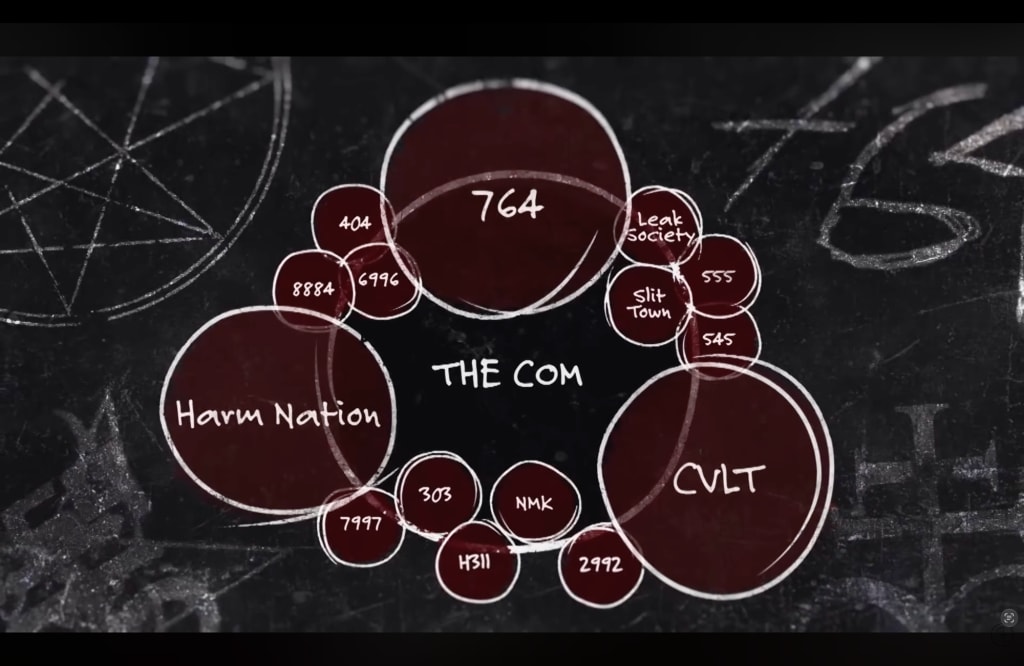
You may also encounter diagrams online showing 764 surrounded by names such as Harm Nation, CVLT, 8884 and numerous smaller groups.
Those graphics capture something real—but they can also be misleading.
764 is not best understood as a conventional cult with a headquarters, fixed hierarchy and membership card.
Nor is every disturbing online group shown beside it necessarily controlled by one central leadership.
Instead, investigators increasingly describe a fluid, transnational network of overlapping groups, splinters, imitators, victims and offenders whose affiliations can change rapidly.
And that decentralized structure is one reason the threat has proved so difficult to eliminate.
Is 764 Really a Cult?
Calling 764 a “cult” is understandable, but it requires context.
The network's founder reportedly described his original online group as a cult, and investigative reporting documented followers treating him as a kind of online cult leader.
But government agencies usually use different terminology.
The FBI and U.S. Department of Justice increasingly describe 764 and related networks as involving Nihilistic Violent Extremists, often abbreviated NVE.
Europol describes 764 as a highly dangerous decentralized online group within the broader Com ecosystem.
So “cult 764” is useful as a popular description of the group's coercive culture, but it can give the wrong impression if it suggests a single religious sect with rigid centralized leadership.
The reality is stranger.
It resembles a networked subculture of abuse.
Where Did the Name 764 Come From?
The origin is surprisingly mundane.
Investigations trace 764 to Bradley Cadenhead, a teenager from Stephenville, Texas.
He was approximately 15 when he began building what became the 764 network in 2021.
The name reportedly comes from the first three digits of ZIP codes associated with Stephenville: 764.
According to investigative reporting and court records, Cadenhead had already encountered another online exploitation community known as CVLT before establishing his own Discord server.
The first 764 community then became a meeting place for people interested in extreme violent material, sexual exploitation and coercive control of vulnerable victims.
What began around one teenager's server would eventually develop into something much larger than that original group.
Bradley Cadenhead Did Not Create the Entire Ecosystem
This distinction matters.
764 emerged from an online environment that already existed.
That broader world is often called:
The Com
or
The Community.
The term does not refer exclusively to child exploitation.
The Com is better understood as a loose internet ecosystem containing people involved in activities such as:
cybercrime,
swatting,
extortion,
harassment,
fraud,
sextortion,
and increasingly violent behavior.
764 grew inside that environment and became one of its most infamous components.
Europol now treats The Com itself as a major international law-enforcement problem.
What Is “The Com”?
“The Com” is short for “The Community.”
It is not one company, website or organized gang.
Think of it more like a loosely connected criminal online subculture.
People can move between groups.
Groups break apart.
New ones appear.
Names change.
Members may participate in several communities simultaneously.
Some portions of The Com concentrate heavily on cybercrime.
Others involve extortion.
Some center around violence or sexual exploitation.
And boundaries between them can blur.
This fluid structure helps explain why shutting down one chat room or arresting one administrator does not automatically destroy the ecosystem.
Another channel can appear.
Another group name can replace the old one.
The people may remain.
The Network Diagram Is Not a Conventional Organization Chart
The image commonly circulated online showing 764 at the top and groups such as Harm Nation, CVLT and others surrounding “The Com” should therefore be interpreted cautiously.
It is useful as a visualization of overlap.
It is not necessarily a literal chain of command.
Official cases do confirm connections between 764 and named networks.
For example, the Justice Department has described Harm Nation as connected with 764 and identified convicted defendant Kyle William Spitze as an original member of both networks.
The Justice Department has also described 8884 as a network related to 764. Its administrator Alexis Chavez was sentenced in July 2026 after pleading guilty to racketeering and child-exploitation offenses.
But the broader ecosystem constantly fragments.
An internet diagram can therefore become outdated quickly.
What Does 764 Actually Do?
The central pattern described by the FBI is sadistic online exploitation.
Members target vulnerable people—especially minors—through ordinary online spaces used by young people.
They may initially appear friendly or supportive.
Over time, the interaction can become controlling.
Personal or intimate information may then be weaponized to threaten, humiliate or blackmail the victim.
The FBI says victims can be pressured into increasingly harmful acts, while abusive material may be circulated within the network to deepen control and victimization.
The details can be extremely disturbing.
They are also unnecessary to reproduce graphically to understand the central mechanism:
gain trust, create leverage, isolate the victim and escalate control.
Children Are the Primary Concern
The FBI has said many victims are between 10 and 17 years old, while some identified victims have been even younger.
Children struggling with:
depression,
loneliness,
self-harm,
eating disorders,
suicidal thoughts,
social isolation,
or a desire to belong
may be especially vulnerable.
This does not mean children with mental-health difficulties are destined to become victims.
It means predators may deliberately search for people whose existing distress makes emotional manipulation easier.
That is one of the most unsettling features of 764-type exploitation.
Vulnerability is not incidental.
It can become the thing predators actively look for.
The Predators Can Be Young Too
Another misconception is that this is simply a group of older adults preying upon children.
Some offenders are adults.
But many participants in The Com and 764-related environments are themselves teenagers or young adults.
Current research organizations describe the broader Com ecosystem as being populated heavily by minors and young adults.
That complicates everything.
A teenager approached online by another teenager may lower their guard in a way they would not with an obviously older stranger.
The boundaries between victim and offender can also become blurred.
Some people may first enter the ecosystem as victims, later participate in abusive behavior themselves, or move through several roles.
That does not excuse criminal conduct.
But it helps explain why conventional stereotypes about online predators are insufficient.
764 Is Not Just “Sextortion”
Sextortion is an important element of the network.
But authorities warn that the behavior can escalate far beyond attempts to obtain sexual images.
The FBI describes 764-related violent networks as coercing victims toward:
self-harm,
violence,
animal abuse,
sexual exploitation,
threats against others,
and suicidal behavior.
U.S. criminal cases have also involved cyberstalking, racketeering and other forms of violence.
That is one reason federal authorities increasingly treat the phenomenon not only as child exploitation but as a national-security and violent-extremism concern.
Why Is It Called Nihilistic Violent Extremism?
The terminology can sound confusing.
Traditional extremist movements usually have recognizable political or religious objectives.
A nationalist movement wants one thing.
A jihadist organization wants another.
A revolutionary movement may seek control of a state.
Nihilistic violent extremism can be less coherent.
The FBI describes some actors as motivated by a desire for:
chaos,
fear,
social destruction,
or collapse.
But it also stresses that motivations vary greatly.
Some participants may be motivated primarily by sexual gratification.
Others seek social status.
Some want belonging.
Some enjoy dominance or cruelty.
Others embrace an ideological narrative.
And individuals can combine several motivations simultaneously.
This is important because calling every offender an ideological terrorist can obscure what is actually happening.
For some participants, ideology may be central.
For others, it may be decoration around abuse.

What Does “Accelerationism” Mean Here?
Some 764-linked individuals embrace accelerationist thinking.
Accelerationism, in extremist contexts, generally refers to the belief that existing society should be destabilized or pushed toward collapse, often through violence or chaos.
U.S. prosecutors have described 764-related networks as promoting social unrest and the destruction of the existing social order.
That helps explain why apparently unrelated acts can exist within the same ecosystem.
For someone motivated by chaos, harming a vulnerable individual may simultaneously provide:
personal gratification,
social status within the group,
and a supposed ideological contribution to social destruction.
But again, not every participant has a coherent accelerationist worldview.
What About Satanism?
This is where sensational coverage can become misleading.
764-associated spaces have repeatedly used Satanic imagery.
Some members have drawn influence from the Order of Nine Angles, or O9A, an extremist occult tradition associated with neo-Nazism and deliberate transgression.
But it would be inaccurate to conclude that 764 is simply “a Satanic cult.”
Investigations suggest some participants genuinely absorb extremist ideas.
Others appear to use Satanic, Nazi or violent symbolism primarily because it is shocking, taboo or useful for building status inside the subculture.
The ideology is therefore inconsistent.
Nihilism and cruelty can be more important unifying forces than formal religious belief.
What About Neo-Nazism?
Neo-Nazi imagery also appears throughout parts of the network.
Some affiliated individuals and splinter communities have more explicit ideological commitments.
Others use extremist symbols in a deliberately provocative way.
Researchers therefore caution against assuming every person connected to 764 has one shared political ideology.
What does appear consistently is a culture in which transgression itself can produce status.
The more shocking the material or behavior, the more notoriety someone may gain.
That social incentive can drive escalation even without a sophisticated ideology.
Status Appears to Be a Powerful Motivator
In ordinary online communities, people gain attention through:
followers,
likes,
expertise,
humor,
or popularity.
In extreme communities, the status system can invert.
The person willing to go further may become more prestigious.
More shocking behavior demonstrates commitment.
Cruelty becomes performance.
Victims become trophies.
Researchers studying The Com describe a social hierarchy in which extreme conduct can generate notoriety and influence.
That may be one of the most useful ways to understand the network.
It is not merely a collection of isolated predators.
It can function as a social environment that rewards escalation.
Why Are Gaming and Social Platforms Part of the Story?
Because that is where young people already are.
The FBI warns that 764-related actors operate through ordinary:
social-media platforms,
gaming communities,
messaging services,
and mobile applications.
This does not mean those platforms are inherently dangerous or that playing online games places a child into 764.
Millions of people use these services safely every day.
The problem is scale.
Predators do not need to lure children to obscure websites if they can encounter potential targets in normal digital spaces.
The abuse often begins somewhere that looks completely ordinary.
The Network Hides in Plain Sight
That is one reason 764 can be difficult for parents to understand.
The danger may not begin on “the dark web.”
It can begin through an ordinary chat.
A gaming interaction.
A social-media message.
A new online friend.
The transition from apparently harmless conversation to coercive control can be gradual.
By the time adults realize something is wrong, the victim may already feel terrified that private information will be exposed.
This is precisely why shame becomes so powerful.
A child may believe telling a parent will make everything worse.
Shame Is One of the Network's Strongest Weapons
The most important message for any young victim is simple:
telling someone is safer than continuing to obey the blackmailer.
Predators depend on the victim believing:
“My parents will hate me.”
“My school will find out.”
“My friends will see this.”
“I'll be punished.”
“I have already gone too far.”
That emotional trap keeps victims isolated.
The FBI explicitly warns that threatening to expose private material is one of the ways these networks maintain control.
This means a parent's reaction can make an enormous difference.
Anger may feel understandable.
But if the child expects punishment, they may hide the situation longer.
Why Arresting the Founder Did Not End 764
One of the most important facts about 764 is that the original group did not have to survive for its culture to survive.
Bradley Cadenhead was prosecuted and received an extraordinarily long prison sentence.
Yet 764 continued appearing in law-enforcement investigations.
Why?
Because the network had already become decentralized.
Knowledge had spread.
Participants had formed relationships with one another.
Subgroups existed.
Imitators appeared.
The original server was no longer necessary.
This pattern is familiar across online extremist and criminal movements.
Once a subculture becomes distributed, arresting one leader can disrupt it without eliminating it.
2025 Brought a Major Federal Takedown
In April 2025, the U.S. Department of Justice announced charges against Leonidas Varagiannis and Prasan Nepal, alleging that they had led a core 764 subgroup involved in an international child-exploitation enterprise.
One defendant was arrested in Greece and the other in North Carolina.
Prosecutors alleged that the group operated through encrypted messaging applications and coordinated the exploitation of multiple minors.
The charges carried potential life sentences.
As always with pending criminal cases, charges are allegations unless proven in court.
The arrests were significant.
They did not end the network.
2026 Has Brought Major Sentences
By 2026, several other cases had produced substantial convictions and prison terms.
In June, Erik Lee Madison was sentenced to 30 years in federal prison after pleading guilty to sexually exploiting minors and cyberstalking. Prosecutors said he had victimized at least 10 underage girls while associated with 764.
In July, Alexis Aldair Chavez, described by prosecutors as an administrator of the 8884 network related to 764, received a 40-year federal sentence after pleading guilty to racketeering and child-exploitation offenses.
Then in August, Kyle William Spitze received 77 years in federal prison for child-exploitation offenses and distributing animal-cruelty material.
The Justice Department described it as the longest federal prison sentence yet imposed on a nihilistic violent extremist.
Those cases show how seriously federal authorities now view the threat.
The FBI Investigation Has Expanded Dramatically
In February 2026, FBI Boston said the bureau was investigating more than 350 subjects nationwide connected to 764 and similar violent online networks.
All 56 FBI field offices were involved.
By a later FBI Dallas briefing, the bureau said the figure had risen above 450 subjects.
And on September 23, 2026, FBI Philadelphia issued another public warning describing a continuing sharp increase in activity involving these networks.
That trend is perhaps the clearest answer to anyone wondering whether 764 disappeared after prominent arrests.
It did not.
This Is Now an International Law-Enforcement Problem
764 is not confined to the United States.
Cases and investigations have appeared across multiple countries.
Europol's Project COMPASS is specifically designed to coordinate international law-enforcement responses to The Com.
Europol describes 764 as a particularly violent component of the ecosystem and warns that its activities have increasingly overlapped with extremist groups and networks promoting accelerationist or Satanic ideas.
That international coordination is necessary because online networks ignore borders almost completely.
A perpetrator can live in one country.
A victim can live in another.
The platform may be headquartered in a third.
Evidence may sit on servers elsewhere.
Traditional jurisdiction becomes complicated very quickly.
Does 764 Count as a Terrorist Organization?
The answer requires precision.
U.S. authorities have increasingly handled some 764 cases through counterterrorism and national-security structures.
The Department of Justice describes associated actors as nihilistic violent extremists, and its National Security Division has participated in prosecutions.
However, that is not the same thing as saying 764 is a conventional formally designated foreign terrorist organization under U.S. law.
“Terror network,” “violent extremist network,” “NVE network” and formal terrorist designation are not interchangeable legal categories.
The safest description is:
764 is a violent extremist and criminal online network that U.S. authorities increasingly investigate as both a child-exploitation and national-security threat.
The Violence Is No Longer Only Online
Perhaps the most worrying evolution is the connection between some 764-related communities and real-world violence.
Researchers and investigators have documented an increasing overlap between online exploitation networks and communities promoting physical attacks.
Some splinter networks have been tied by investigators or researchers to plots involving shootings, stabbings, arson and murder-for-hire schemes.
A June 2026 federal case, for example, charged an alleged 764 member with attempting to arrange the killings of FBI agents and a federal prosecutor. Those remain allegations unless proven in court.
The broader trajectory matters.
A network once discussed mainly in connection with online exploitation is increasingly being examined for its ability to turn digital radicalization into physical violence.
Why Teenagers Can Become Drawn Into These Communities
It is tempting to ask:
Why would anyone join this?
But extreme online subcultures rarely begin by presenting themselves honestly.
Young people may initially encounter:
dark humor,
gore,
edgy memes,
hacking culture,
nihilistic jokes,
or other teenagers who appear to share their alienation.
For some, the community can offer:
attention,
identity,
status,
belonging,
and a sense of power.
Gradually, behavior that would once have seemed shocking becomes normalized.
This process is not unique to 764.
Online communities of many kinds can shift people's perception of what is normal when everyone around them repeatedly rewards the same behavior.
764 demonstrates what can happen when that social reinforcement becomes extremely destructive.
Desensitization Matters
Seeing one disturbing image can be shocking.
Seeing thousands can change the baseline.
A person may begin searching for something more extreme to produce the same emotional reaction.
Inside status-driven violent communities, this can become competitive.
People attempt to shock one another.
What was unthinkable becomes routine.
Then yesterday's extreme becomes today's minimum requirement.
This is one reason content moderation alone is difficult.
The underlying problem is not simply a collection of prohibited images.
It is the social system surrounding them.
Why Banning Accounts Is Not Enough
Platforms have removed accounts and servers associated with these networks.
Yet members frequently return under new identities.
The challenge resembles other decentralized cybercrime communities:
delete the group,
and another appears.
Ban an account,
and another account is created.
Remove content,
and copies may already exist elsewhere.
This does not mean moderation is pointless.
Removing spaces disrupts recruitment and communication.
But platform enforcement works best when combined with:
law enforcement,
cross-platform intelligence sharing,
victim support,
parental awareness,
and early intervention.
No single company can solve the entire problem.
What Warning Signs Should Parents Look For?
The FBI emphasizes that no single sign proves a child is being exploited.
Changes must be interpreted in context.
But potential warning signs can include:
- sudden withdrawal, irritability or major behavioral changes
- unexplained changes in sleeping or eating
- abandoning normal activities or friendships
- appearing frightened of a new online friend or group
- unexplained digital gifts, gaming currency or deliveries
- evidence of self-harm
- efforts to conceal injuries
- intense or sudden fascination with mass violence
- unexplained harassment, doxxing or false police calls directed at the household
The bureau particularly urges adults to pay attention when several warning signs appear together.
Do Not Assume Secrecy Means Ordinary Teenage Privacy
Teenagers naturally want privacy.
That is healthy.
The concern is not simply:
“My child closes their bedroom door.”
It is a sudden shift accompanied by visible fear.
For example:
A child becomes panicked whenever a notification appears.
They stop sleeping.
They suddenly delete accounts.
They refuse to explain why a new online acquaintance frightens them.
They receive threats.
Their mood changes dramatically.
These patterns deserve calm attention rather than immediate accusation.
What Should a Parent Do If They Suspect 764-Type Exploitation?
The first priority should be the child's safety.
A useful response is:
believe them, stay calm and remove shame from the conversation.
Do not tell them they have “ruined their life.”
Do not threaten to publicly expose what happened.
Do not negotiate with an extorter.
And do not assume complying with further demands will make the situation disappear.
Preserve relevant evidence such as usernames, messages and platform details without redistributing abusive material unnecessarily.
Then contact appropriate law enforcement or child-protection authorities in your country.
The FBI specifically recommends preserving incident information and reporting suspected criminal exploitation rather than continuing engagement with the offender.
If There Is Immediate Danger, Treat It as an Emergency
If a child is being threatened with immediate violence, appears at imminent risk of suicide, or has suffered serious injury, online-investigation concerns become secondary.
Emergency medical and law-enforcement help should come first.
The FBI similarly advises immediate emergency assistance when a victim is at imminent risk.
The most dangerous mistake is assuming:
“This is only happening online.”
The entire 764 story demonstrates why that distinction is increasingly unreliable.
Victims Should Not Be Blamed for Sending Something
This deserves emphasis.
Young victims may initially have:
trusted someone,
shared an image,
revealed personal information,
or entered a private conversation voluntarily.
That does not make subsequent blackmail their fault.
A predator intentionally converting trust into coercion is responsible for the exploitation.
Blaming the child strengthens the extorter's greatest advantage:
silence.
The safest family message is:
Whatever you already sent, tell me. We will deal with it together.
That can break the isolation on which coercion depends.
Why “Just Keep Your Kids Offline” Is Not a Realistic Solution
Modern childhood includes the internet.
Schoolwork happens online.
Friendships happen online.
Gaming happens online.
Entertainment happens online.
Simply demanding total disconnection can discourage children from telling adults when something goes wrong.
Digital safety needs to function more like road safety.
We do not protect teenagers from cars by refusing to teach them how roads work.
We teach:
risk recognition,
boundaries,
what to do when something goes wrong,
and when to seek help.
The same principle applies here.
One of the Biggest Myths: “My Child Would Never Fall for This”
Intelligent children can be manipulated.
Technically skilled children can be manipulated.
Confident children can be manipulated.
Adults can be manipulated.
The relevant skill is not intelligence alone.
Predators exploit:
trust,
fear,
shame,
attachment,
loneliness,
and uncertainty.
Anyone who believes only “naive” people become victims is less prepared to recognize sophisticated coercion.
Another Myth: 764 Is One Group You Can Simply Block
764 has become a label for something broader than the original server.
Even the FBI has noted that the name is sometimes used colloquially as a catch-all for related violent online networks.
Names continually change.
Parents therefore should not focus only on whether the number 764 appears on a child's device.
An abusive group can use any name.
Behavior matters more than branding.
Another Myth: Every Member Is a Satanist
No.
Some participants use occult or Satanic imagery.
Some have connections to genuinely extremist traditions.
Some use neo-Nazi symbolism.
But others appear primarily motivated by:
sadism,
sexual exploitation,
attention,
status,
belonging,
or shock value.
The FBI explicitly warns that motivations are highly individualized.
Treating the phenomenon as simply “Satanists on the internet” makes it easier to miss the actual mechanics of abuse.
Another Myth: This Is Mostly About the Dark Web
Again, no.
Some of the most important recruitment and interaction happens on ordinary internet services.
The danger is precisely that extreme communities can intersect with mainstream digital life.
The child does not necessarily seek out an obscure hidden website.
The network can come to them.
Why 764 Has Become Such an Important Case Study
764 sits at the intersection of several problems that used to be studied separately:
child sexual exploitation,
cybercrime,
online radicalization,
sextortion,
self-harm communities,
violent extremism,
and youth mental health.
Historically, agencies working on those issues might operate independently.
764 demonstrates that the same online ecosystem can combine all of them.
A cybercrime case may become an exploitation case.
An exploitation case may become an extremism investigation.
An online extremist may also be a minor.
A victim may later participate in victimizing someone else.
The categories break down.
Law enforcement must adapt accordingly.
Europol's Project COMPASS Reflects That New Reality
Project COMPASS is particularly important because it treats The Com as a shared international problem rather than a collection of unrelated national cases.
Europol says the project aims to improve information sharing, operational coordination and understanding of the broader ecosystem.
That approach makes sense.
A network built on global platforms requires global investigation.
Otherwise, offenders can exploit the gaps between jurisdictions as efficiently as they exploit gaps between platforms.
764 Is a Product of the Networked Internet
Previous cults generally required physical access.
A leader needed followers nearby.
Members met somewhere.
Geography limited recruitment.
Online networks remove that constraint.
A teenager in Texas can influence another teenager thousands of miles away.
A group can exist without any member ever meeting another in person.
A hierarchy can emerge entirely through usernames.
Status can be measured through digital material.
Victims can be targeted globally.
And when one group collapses, relationships survive across different platforms.
764 may therefore tell us something important about what a 21st-century cult-like environment can look like.
It does not need a compound.
It needs a network connection.
But Calling It a Cult Should Not Make It Mysterious
There is a danger in turning 764 into internet mythology.
The stranger and more supernatural the story sounds, the easier it becomes to lose sight of the actual crimes.
There is nothing supernatural about the core mechanism.
It is exploitation.
Manipulation.
Blackmail.
Social pressure.
Abuse.
And deliberate targeting of vulnerable people.
The imagery may look occult.
The usernames may look theatrical.
The network maps may look like conspiracy diagrams.
But the victims are real.
So are the criminal cases.
The Greatest Risk Is Giving the Network Glamour
Extremist and abusive communities often benefit from notoriety.
Being called the darkest group on the internet can itself become recruitment propaganda.
That is why responsible coverage should avoid turning offenders into antiheroes.
The interesting story is not how “evil” their personas look.
It is how ordinary digital mechanisms can become tools of coercion.
A message.
A friendship.
A secret.
A threat.
A group chat.
A teenager afraid to tell anyone.
That is where prevention becomes possible.
The Arrests Matter, but Prevention Matters More
A 30-year sentence can incapacitate one offender.
A 40-year sentence can remove another.
A 77-year sentence sends an unmistakable message.
But every prosecution occurs after someone has already been harmed.
The long-term challenge is therefore not simply identifying offenders after abuse occurs.
It is making exploitation harder to begin.
That requires:
better platform detection,
rapid cross-platform cooperation,
digital literacy,
accessible mental-health support,
nonjudgmental communication between children and adults,
and law enforcement capable of following offenders across borders.
The Most Important Thing to Understand About 764
764 is not frightening because it possesses mysterious technology.
It is frightening because it takes familiar aspects of online life and combines them in an unusually destructive way.
Anonymous identities.
Youth culture.
Private messaging.
Extreme content.
Social status.
Emotional vulnerability.
Blackmail.
Ideological radicalization.
The components already existed.
764 connected them.
That is why the network has become so important to investigators.
And it is why looking only for a logo, number or group name will never be enough.
So What Is Cult 764?
The most accurate answer is this:
764 is a decentralized international online network that emerged around 2021 inside the broader ecosystem known as The Com. It became notorious for targeting vulnerable minors through coercion and blackmail, distributing child sexual abuse material, encouraging self-harm and violence, and increasingly intersecting with nihilistic and accelerationist extremism.
The original network was associated with Texas teenager Bradley Cadenhead and took its name from the Stephenville area's ZIP codes.
But today's threat is much larger than one founder.
Offshoots and related networks have continued operating.
The FBI has hundreds of subjects under investigation.
Europol is coordinating an international response.
U.S. courts have imposed decades-long sentences on convicted members and administrators.
And as recently as September 2026, the FBI was still publicly warning that activity involving these networks was increasing.
So the story of 764 is not fundamentally a story about a bizarre internet cult.
It is a warning about something larger.
An online community can become a criminal ecosystem.
A vulnerable teenager can become reachable from anywhere in the world.
Victimization can move from a phone screen into physical reality.
And a movement does not need a headquarters—or even a stable name—to survive.
Frequently Asked Questions
What is 764?
764 is a decentralized online network associated with child exploitation, extortion, self-harm coercion, violent content and nihilistic violent extremism. Authorities describe it as operating internationally.
Is 764 a real group?
Yes. The FBI, U.S. Department of Justice, Europol and multiple international law-enforcement bodies have investigated cases connected to 764.
Is 764 a cult?
The term “cult” has been used by participants and media reporting, but law enforcement more commonly describes 764 as a violent online network or nihilistic violent extremist network.
Who founded 764?
Investigative reporting traces the original 764 network to Bradley Cadenhead, who was a teenager in Stephenville, Texas.
What does 764 mean?
The name refers to the first three digits of ZIP codes associated with Stephenville, Texas, where the original network emerged.
When did 764 begin?
The network emerged around 2021, although related online communities existed earlier.
What is The Com?
The Com, short for The Community, is a loose international ecosystem of online actors and groups involved in various forms of cybercrime, exploitation, extortion and violence. 764 developed within this broader environment.
Is The Com the same thing as 764?
No. 764 is one particularly influential network within the broader Com ecosystem.
What is Harm Nation?
Harm Nation is one of the networks associated with the broader 764 environment. In August 2026, the Justice Department described convicted defendant Kyle Spitze as an original member of both Harm Nation and 764.
What is 8884?
U.S. prosecutors have described 8884 as a network related to 764. Its administrator Alexis Chavez was sentenced to 40 years in federal prison in July 2026 following his guilty plea to racketeering and child-exploitation offenses.
Are network diagrams showing 764 and its subgroups accurate?
They can be useful illustrations, but they should not be treated as permanent corporate-style organization charts. Affiliations are fluid, group names change, and individuals can participate in several networks.
Who does 764 target?
The FBI says minors and other vulnerable individuals are frequent targets. Many identified victims have been between 10 and 17 years old, although younger victims have also been reported.
How does 764 approach victims?
At a high level, offenders may build trust through ordinary online interactions before shifting toward manipulation, threats and blackmail. Detailed tactics vary.
Does 764 operate on normal social media?
Yes. Authorities warn that related actors use ordinary social media, gaming and messaging platforms rather than operating exclusively on hidden parts of the internet.
Is 764 only about child sexual exploitation?
No. Cases have also involved cyberstalking, coercive self-harm, violence, animal abuse, threats and other crimes.
Why does the FBI call some members nihilistic violent extremists?
Authorities say some actors seek chaos, social destruction or violent destabilization rather than pursuing a traditional political program. Motivations can nevertheless differ substantially between individuals.
Is 764 a neo-Nazi organization?
Some associated groups and participants use neo-Nazi ideology or symbolism, but researchers caution that the broader network does not have one uniform ideology.
Is 764 Satanic?
Some members use Satanic imagery and some have been influenced by extremist occult traditions such as the Order of Nine Angles. However, describing the entire network simply as a Satanic religious cult would be misleading.
What is accelerationism?
In violent extremist contexts, accelerationism generally refers to efforts to intensify instability or conflict in the hope that existing social or political systems will collapse.
Has 764 been linked to terrorism investigations?
Yes. U.S. national-security and counterterrorism officials participate in investigations and prosecutions involving the network. That does not mean every 764-linked offender is ideologically motivated.
Is 764 still active in 2026?
Yes. The FBI issued another warning in September 2026 about increasing activity involving 764 and related violent online networks.
How many people is the FBI investigating?
In a 2026 public briefing, the FBI said it was investigating more than 450 subjects connected to 764 and related violent online networks.
Is the FBI investigating 764 nationwide?
Yes. FBI Boston said in February 2026 that all 56 FBI field offices were involved in investigations connected with these violent online networks.
Is Europe investigating 764?
Yes. Europol operates Project COMPASS, an international coordination effort focused on The Com and related networks, including 764.
Have 764 members gone to prison?
Yes. Multiple defendants associated with 764-related networks have received substantial prison sentences.
What is the longest recent 764-related sentence?
In August 2026, Kyle William Spitze was sentenced to 77 years in federal prison. The Justice Department described it as the longest federal sentence yet imposed on a nihilistic violent extremist.
Who is Alexis Chavez?
Alexis Aldair Chavez was described by federal prosecutors as an administrator of 8884, a network related to 764. He was sentenced to 40 years in prison in July 2026.
Who is Erik Madison?
Erik Lee Madison was a 764-associated offender sentenced to 30 years in federal prison in June 2026 after pleading guilty to child sexual exploitation and cyberstalking.
Have 764 leaders been arrested internationally?
Yes. In 2025, U.S. authorities announced charges against alleged leaders Leonidas Varagiannis and Prasan Nepal, with one arrested in Greece and the other in North Carolina. Those charges were allegations at the time of the announcement, not convictions.
Why is 764 difficult to shut down?
It is decentralized. Groups fragment, change names, move between platforms and share overlapping membership.
What are the warning signs that a child may be targeted?
Possible signs include sudden withdrawal, fear surrounding online contacts, changes in sleeping or eating, unexplained gifts, evidence of self-harm, unusual secrecy combined with distress, or unexplained harassment directed at the household.
What should parents do if their child is being blackmailed online?
Stay calm, avoid blaming the child, preserve relevant evidence and contact appropriate law-enforcement or child-protection authorities. If there is an immediate danger of violence or suicide, seek emergency help immediately.
Should victims keep complying with an online extorter?
Continuing to comply generally gives the offender more control. Victims should seek help from a trusted adult and appropriate authorities rather than attempting to manage the extortion alone.
Is 764 mainly a dark-web problem?
No. Authorities say these networks operate on ordinary social-media, gaming and messaging platforms.
Is everyone associated with 764 an adult predator?
No. The wider ecosystem includes adults, teenagers and young adults. Some individuals may themselves have previously been victims.
Why do people join groups like 764?
Motives vary and can include status, belonging, sexual gratification, sadism, ideological extremism, attention or a desire to create chaos. The FBI cautions against assuming one motivation applies to everyone.
Is 764 one centralized organization?
No. It is better understood as a decentralized network with overlapping communities and offshoots.
Why is 764 so dangerous?
Because it combines several threats that are normally considered separately: online child exploitation, psychological coercion, cybercrime, extremist radicalization and real-world violence.
What is the most important fact about Cult 764?
The most important fact is that 764 is not merely an internet legend or disturbing online aesthetic.
Law-enforcement agencies across multiple countries are investigating real criminal networks connected to the name, real victims have been harmed, and substantial prosecutions continue.
Understanding that reality—without turning the offenders into mysterious internet celebrities—is one of the most effective ways to recognize the threat for what it is.