
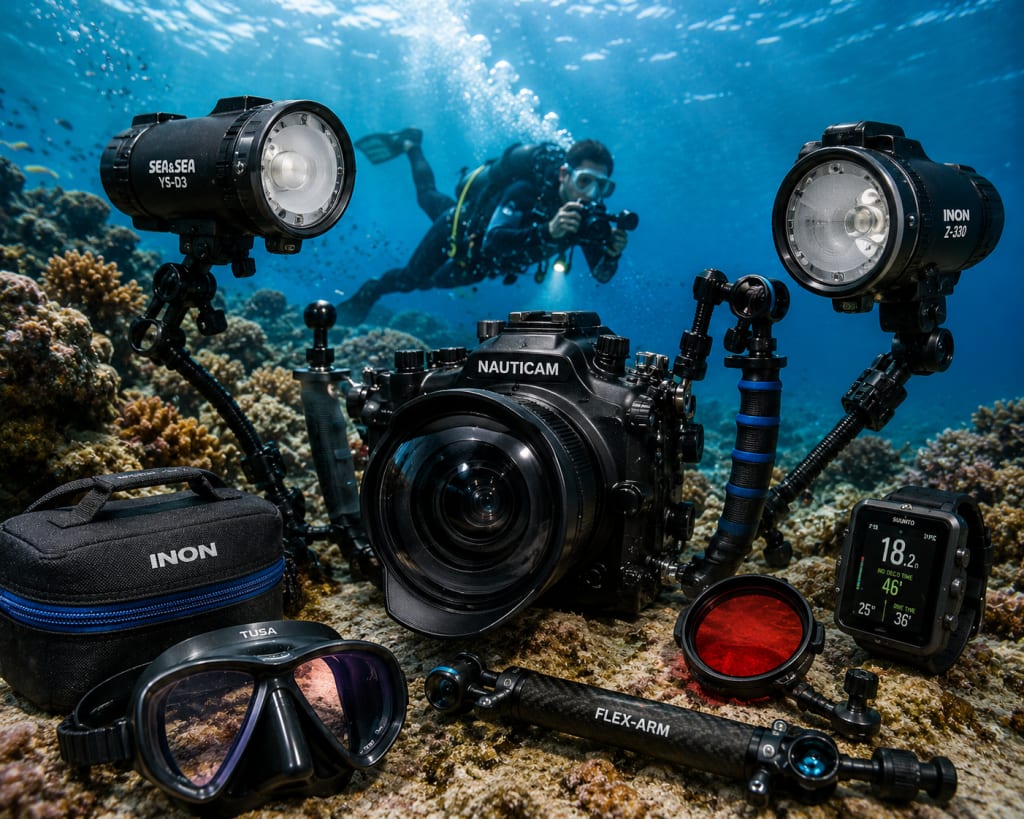
Underwater Photography Gear That’s Making Waves
Underwater photography used to feel like a specialist world.
You needed expensive cameras, bulky housings, technical diving confidence, heavy lights, trays, arms, ports, strobes, spare O-rings, and enough patience to fight backscatter, fogging, low light, color loss, buoyancy problems, and nervous fish. It was beautiful, but it was not easy.
In 2026, that world is changing fast.
Underwater photography is becoming more accessible, more cinematic, and more social-media friendly than ever. Divers, snorkelers, surfers, travel creators, marine conservationists, wedding filmmakers, reef explorers, and everyday vacationers are using a new wave of gear to capture the ocean from below the surface. The market now includes rugged compact cameras, waterproof action cameras, 360-degree cameras, smartphone housings, modular lights, wet lenses, domes, float grips, underwater drones, and compact rigs that would have felt impossible a decade ago.
The most exciting part is that you no longer need a giant professional system to start. A modern smartphone in a quality underwater housing, a GoPro-style action camera, or a rugged compact camera can produce beautiful results when paired with good light, steady technique, and a little knowledge of how water changes color.
Recent 2026 underwater camera guides are making the same point: the camera is only one part of the setup. A good underwater system also depends on housing, lighting, stabilization, mounts, lenses, and how comfortable the shooter is using it underwater.
That is why underwater photography gear is having such a big moment.
The ocean is still difficult to photograph.
But the tools are finally becoming friendlier.
Why Underwater Photography Is Booming
Underwater photography is rising because more people want experiences that feel cinematic, adventurous, and different from ordinary travel content.
A beach photo is nice. A reef shot is better. A video of someone diving through blue water, swimming with turtles, exploring coral, or floating under sunlight rays feels instantly more immersive. Social platforms reward these visuals because they stop the scroll. Underwater footage has movement, mystery, color, and atmosphere.
There is also a growing interest in marine conservation. Creators are using underwater cameras to document coral bleaching, plastic pollution, marine biodiversity, mangroves, kelp forests, freediving culture, and the beauty of fragile ecosystems. For many photographers, underwater gear is not just about pretty vacation photos. It is a way to show people what is at risk beneath the surface.
The technology has also improved. Action cameras are sharper. Smartphones are more powerful. Housings are more reliable. LED lights are smaller and brighter. Compact cameras still offer excellent macro. 360 cameras allow creators to reframe footage later. Waterproof cameras are easier for families and beginners. Even budget travelers can now start with a basic action camera or phone housing instead of a full dive rig.
Digital Camera World’s 2026 waterproof camera guide lists options across categories, from rugged compacts like the OM System Tough TG-7 to dive-ready cameras like the SeaLife Micro 3.0 and waterproof action cameras such as DJI’s Osmo Action line.
That variety is the real story.
Underwater photography is no longer one gear category.
It is an ecosystem.
Action Cameras: Small Bodies, Big Ocean Energy
Action cameras remain the easiest entry point for underwater video.
They are compact, durable, wide-angle, easy to mount, and designed for movement. A GoPro, DJI Osmo Action, or Insta360 action camera can be attached to a tray, selfie stick, mask mount, surfboard, dive handle, or chest mount. For snorkeling, freediving, surfing, kayaking, and casual diving, action cameras are hard to beat.
The strength of action cameras is simplicity. You turn them on, hit record, and capture wide immersive footage. Stabilization is usually excellent. The field of view is forgiving. The bodies are small enough to carry anywhere. Many are waterproof to shallow depths without extra housing, and deeper housings are available for scuba.
GoPro’s 2026 lineup continues to attract adventure shooters. Digital Camera World’s 2026 GoPro guide names the Hero13 Black as the most advanced model in the lineup, while noting that older options like the Hero11 Black can still offer strong value.
The downside is that action cameras are not perfect underwater. Their small sensors struggle in low light. Their wide-angle lenses are not ideal for tiny macro subjects. Built-in waterproofing is often only for snorkeling or shallow water unless you add a dive housing. Color can fade quickly as you go deeper. Audio underwater is mostly not useful. And without lights, deeper footage can look blue, green, and flat.
Still, for beginners and travel creators, action cameras are often the smartest first purchase.
They make underwater video feel possible.
360 Cameras: Capture First, Frame Later
One of the biggest underwater trends is 360-degree capture.
A 360 camera records everything around it, allowing creators to choose the final angle later. This is incredibly useful underwater because framing is hard when you are floating, fighting currents, watching your air, maintaining buoyancy, and trying not to scare marine life.
With 360 footage, you can capture the whole scene and reframe afterward for vertical reels, horizontal videos, wide establishing shots, or dramatic follow-cam angles.
The Insta360 X5 has become one of the major 2026 options in this space. Bluewater Photo’s 2026 guide highlights the X5 as a strong underwater choice for immersive 360 capture, with up to 8K 360 video, waterproofing to 49 feet or 15 meters without extra accessories, and compatibility with an Invisible Dive Case for cleaner underwater stitching down to 197 feet or 60 meters.
Insta360’s own 2026 underwater housing guide also emphasizes the X5 Invisible Dive Case, noting that its dome lenses are designed to enable full 360 capture with cleaner stitching underwater down to 60 meters.
That dome design matters because water changes how lenses behave. Standard 360 stitching can become messy underwater if the housing is not designed well. A proper dive case helps preserve the invisible-stick effect and reduces stitching problems.
The downside is workflow. 360 footage requires editing. It can consume storage. Low light still matters. And if the camera is too close to subjects, stitching can look strange. But for creators who want maximum flexibility, 360 underwater cameras are one of the most exciting categories right now.
They let you capture the dive first and decide the story later.
Smartphone Housings: The Surprise Star of 2026
One of the biggest shifts in underwater photography is the rise of serious smartphone housings.
For years, people were nervous about putting expensive phones underwater. Cheap waterproof pouches were risky, clumsy, and not suited for real photography. But modern underwater smartphone housings are changing the game. Brands like DIVEVOLK, SeaLife, Kraken, and others are creating housings that allow touchscreen control, app access, better sealing, and deeper underwater use.
This trend became even more credible when the Underwater Photographer of the Year 2026 introduced its first smartphone category, and the winning image was captured with a vivo X100 Ultra inside a DIVEVOLK SeaTouch 4 Max Platinum V2 housing. DIVEVOLK reported that Jack Ho’s winning frogfish portrait showed remarkable clarity, proving that a phone and proper housing can produce serious underwater macro work.
That is a big cultural moment.
It tells beginners that underwater photography does not always require a dedicated camera body. Your phone may already have a strong sensor, excellent computational photography, good video, RAW support, and familiar controls. A quality housing turns it into a dive camera.
Bluewater Photo’s 2026 smartphone housing guide also highlights the growing category, covering options like DiveVolk, SeaLife, and Kraken for use cases ranging from casual travel to advanced underwater imaging.
The appeal is obvious:
You already own the camera.
You already know the interface.
You can shoot, edit, and share from one device.
The image quality can be excellent in good conditions.
The downside is risk. A housing failure can destroy your phone. Touchscreen use underwater varies by system. Battery drain can be an issue. Phone overheating may happen in some cases. And serious divers need housings rated for their depth.
Still, smartphone housings may be the most disruptive underwater gear category in 2026.
They are making underwater photography feel democratic.
Rugged Compact Cameras: Still the Macro Kings
Action cameras and smartphones get the hype, but rugged compact cameras still have a strong place underwater.
The OM System Tough TG-7 remains one of the most recommended waterproof compact cameras because it is rugged, easy to carry, good for macro, and usable both above and below water. Digital Camera World’s 2026 waterproof camera guide names the TG-7 as a top waterproof camera, praising its 4K video, macro features, GPS, and durability against water, shock, cold, and crushing.
The TG series has been popular with divers for years because it does close-up work exceptionally well for its size. Add a housing, light, tray, and wet lenses, and it becomes a flexible underwater system.
Another option is the SeaLife Micro 3.0, which is designed specifically for underwater use. Digital Camera World notes that it can go as deep as 60 meters, includes a fixed wide-angle lens and built-in memory, and pairs with high-power lights.
Compact cameras sit in the middle of the underwater gear world. They are more serious than an action camera but less intimidating than a mirrorless rig. Housing Camera’s 2026 beginner guide notes that compact systems are popular because they let users start with a camera and housing, then gradually add trays, arms, lights, strobes, wet lenses, and accessories later.
That upgrade path matters.
A beginner can start simple.
A growing photographer can build a real rig over time.
Mirrorless Systems: The Serious Shooter’s Dream
For professional underwater photographers, mirrorless cameras remain the high-end choice.
A full mirrorless setup can produce superior image quality, better dynamic range, stronger autofocus, interchangeable lenses, high-resolution RAW files, and serious video performance. With the right housing, ports, strobes, and wet optics, mirrorless systems can capture reefscapes, large animals, blackwater subjects, macro creatures, and editorial-level work.
But this category is expensive and complex.
A mirrorless underwater setup may include:
Camera body.
Lens.
Housing.
Dome port.
Flat port.
Extension rings.
Vacuum system.
Tray.
Arms.
Clamps.
Strobes.
Video lights.
Focus light.
Wet lenses.
Fiber-optic cables or electronic triggers.
Buoyancy floats.
Spare O-rings.
Maintenance tools.
Backscatter’s underwater gear listings show how quickly high-end systems add up, with underwater housings for mirrorless bodies commonly costing from around $1,000 to several thousand dollars depending on the brand and camera.
This is not beginner gear. It requires diving skill, buoyancy control, maintenance discipline, and budget.
But for serious image-makers, mirrorless still rules.
A phone or action camera can create excellent content.
A well-handled mirrorless rig can create gallery-level underwater photography.
Lighting: The Real Secret Underwater
Underwater beginners often obsess over cameras, but experienced shooters know the truth: lighting matters more than people think.
Water absorbs color quickly. Red disappears first, then orange and yellow. As you go deeper, everything becomes blue or green. Even shallow water can flatten colors if the sun angle is weak or visibility is poor.
This is why underwater lights and strobes are essential.
A good dive light or video light restores color for close subjects. Strobes freeze motion and reveal detail in still photography. Focus lights help cameras lock onto subjects. Dual lights reduce harsh shadows. Arms and clamps let photographers position light away from the lens to avoid backscatter.
Without lighting, underwater images often look dull.
With lighting, coral glows, fish regain color, skin tones improve, and tiny creatures become vivid.
For video shooters, continuous LED lights are especially important. For still photographers, strobes are often preferred because they are powerful and freeze movement.
The main rule is simple:
The deeper you go, the more light you need.
The clearer and closer your subject, the better your result.
Backscatter: The Enemy of Clean Underwater Photos
Every underwater photographer eventually meets backscatter.
Backscatter appears as white specks or particles in the image, caused by suspended sand, plankton, bubbles, or debris reflecting light back into the camera. It can ruin otherwise beautiful shots.
The problem becomes worse when the light source is too close to the lens. This is why built-in flashes often perform badly underwater. The light fires straight forward, hits particles, and creates snow-like dots.
The solution is lighting angle. Move strobes or video lights away from the lens and angle them slightly outward so the edge of the beam lights the subject without blasting particles in front of the camera.
This is why trays, arms, and clamps matter.
They look like accessories, but they are part of image quality.
A small action camera with a good tray and light can produce cleaner results than a better camera with poor lighting placement.
Underwater photography is not just about sharpness.
It is about controlling water.
Domes and Split Shots
One of the most popular underwater photography looks is the split shot, also called over-under photography.
Half the frame is underwater.
Half the frame is above the surface.
A swimmer floats between two worlds. A coral reef sits below a tropical island. A turtle glides under a boat. A bride and groom kiss above water while fabric flows below. A surfer waits at the surface while waves roll overhead.
To capture these shots properly, photographers use a dome port. The dome pushes water away from the lens and creates a larger surface area for the waterline, making it easier to balance above-and-below focus.
Small action cameras can use dome accessories for split shots. Mirrorless systems use larger dome ports. Smartphone housings may also have dome options depending on the system.
Split shots are harder than they look. You need calm water, good light, clean droplets, correct exposure, and careful composition. But when done well, they are some of the most eye-catching underwater images.
They show both worlds at once.
That is why they remain so popular.
Wet Lenses: Expand Your Creative Range
Wet lenses are lenses that attach to the outside of an underwater housing while underwater.
They allow photographers to change perspective during a dive. A wide-angle wet lens can capture reefs, wrecks, divers, rays, sharks, and big scenes. A macro wet lens can magnify tiny nudibranchs, shrimp, coral polyps, and fish eyes.
Wet lenses are especially useful for compact cameras and smartphone housings because they expand creative options without changing the main camera lens.
The benefit is flexibility.
The challenge is handling.
Wet lenses can be expensive, heavy, and easy to scratch. They need mounts, holders, and careful cleaning. Switching underwater takes practice. But for growing photographers, wet lenses can transform a simple setup into a much more versatile system.
For many divers, the first serious upgrades after camera and housing are:
Tray.
Light.
Wide wet lens.
Macro wet lens.
That combination opens the underwater world dramatically.
Underwater Drones: Photography Without Getting Wet
Underwater drones, also called remotely operated vehicles or ROVs, are another category making waves.
These devices allow users to explore underwater environments from the surface using a tethered camera drone. They can be useful for boaters, researchers, fish farmers, marine inspectors, content creators, and people who want underwater footage without diving.
Underwater drones can inspect hulls, explore lakes, document reefs, capture fish behavior, or film underwater structures. Some include lights, 4K cameras, sonar, robotic arms, or long tethers.
They are not a replacement for a diver with a camera. They move differently, can disturb subjects, and are limited by tether management. But they offer access where diving may be unsafe, difficult, or unnecessary.
For content creators, underwater drones add production value. For science and inspection, they add practicality.
This category is still more expensive than casual gear, but it is becoming more accessible.
The underwater camera is no longer always in a diver’s hand.
Sometimes it is piloted from the surface.
Float Grips, Trays, and Handles
Small cameras are easy to carry, but underwater they can be awkward.
A tiny action camera is hard to hold steady. A phone housing can be bulky. A compact camera housing may become heavy or negatively buoyant. This is why handles and trays matter.
A tray gives two-handed stability. Handles make movement smoother. Float grips prevent small cameras from sinking. Arms allow lights to be positioned correctly. Lanyards prevent loss. Buoyancy floats reduce fatigue during long dives.
These accessories may seem boring compared with cameras, but they make a huge difference.
A shaky underwater video looks amateur.
A stable camera feels cinematic.
Beginners often buy a camera first and ignore support gear. Then they wonder why their footage is wobbly and blue.
The truth is simple:
Underwater, stability is quality.
Color Correction Filters: Useful but Limited
Red filters, magenta filters, and color correction filters are common underwater accessories.
They help restore color in available-light footage, especially for action cameras. A red filter can improve blue-water tropical footage. A magenta filter can help in green water.
But filters are not magic.
They work best at certain depths and lighting conditions. Too shallow, they can make footage too red. Too deep, there may not be enough red light left to recover. They also reduce light reaching the sensor.
Modern cameras and editing software can correct color better than before, but filters still have a place for simple action-camera setups without lights.
For serious work, lights or strobes are better.
Filters adjust available light.
Lights bring color back.
That difference matters.
Maintenance: The Unsexy Part That Saves Gear
Underwater photography gear lives in a hostile environment.
Saltwater, sand, pressure, humidity, sunscreen, and tiny hairs can destroy expensive equipment. A single dirty O-ring can flood a housing. One grain of sand can break a seal. Poor rinsing can corrode buttons. Fogging can ruin a dive. A loose latch can cost thousands.
Maintenance is not optional.
Every underwater shooter should learn to:
Inspect O-rings.
Clean seals.
Use silicone grease correctly.
Avoid over-greasing.
Rinse gear in fresh water.
Press buttons while rinsing.
Dry before opening.
Open housings in clean, dry spaces.
Use desiccant packs if needed.
Check for hair, sand, lint, or salt.
Test housings before real dives.
Underwater gear does not forgive carelessness.
The best camera is useless if the housing floods.
Beginner Setup: What You Actually Need
A beginner does not need everything.
For snorkeling or casual travel, a good action camera or smartphone housing may be enough. Add a floating handle and maybe a small light if shooting close subjects.
For scuba beginners, a simple compact camera or action camera in a proper dive housing is safer. Add a tray and video light when ready.
For macro lovers, a TG-7-style compact system with housing and light is a strong path.
For serious divers, a compact camera with tray, arms, lights, and wet lenses offers room to grow.
For professionals, mirrorless systems are the long-term choice.
A good beginner kit might include:
Camera or phone housing.
Proper depth-rated housing.
Float grip or tray.
Lanyard.
Microfiber cloth.
Desiccant inserts.
Small video light.
Spare batteries.
Memory cards.
Freshwater rinse routine.
Start simple.
Then upgrade based on what you actually shoot.
What Not to Buy First
Beginners often waste money by buying too much too soon.
Do not buy expensive strobes before understanding buoyancy and camera control.
Do not buy a complicated mirrorless housing before knowing whether you enjoy underwater shooting.
Do not trust cheap phone pouches for serious depth.
Do not buy accessories that do not match your camera system.
Do not assume waterproof means dive-proof.
Do not buy lights without understanding beam angle and power.
Do not buy a camera only because it has the biggest resolution number.
Underwater photography punishes gear confusion.
A simple reliable setup is better than a complicated rig you cannot control.
Safety Comes Before the Shot
Underwater photography can distract divers.
A photographer may chase a subject, lose buoyancy, touch coral, kick sand, separate from a buddy, ignore air pressure, or drift into unsafe conditions.
This is dangerous.
The first rule is to be a good diver before being a good underwater photographer.
Maintain buoyancy.
Watch your air.
Respect marine life.
Do not touch coral.
Do not harass animals.
Stay aware of currents.
Keep your buddy in sight.
Do not damage the reef for a photo.
Know when to stop shooting.
The ocean is not a studio.
The image is never worth harming yourself, your buddy, or the environment.
The Environmental Responsibility of Underwater Creators
Underwater photographers have power.
Their images can inspire people to care about the ocean. But careless photography can damage the very ecosystems being celebrated.
Responsible underwater photographers should avoid touching marine life, moving animals, breaking coral, stirring sediment, feeding wildlife for shots, blocking animal movement, or using lights in ways that stress sensitive species.
They should also be careful with geotagging rare or fragile sites. Too much attention can harm delicate environments.
A beautiful underwater image should not come from bad behavior.
The best ocean creators are ambassadors, not intruders.
The Future of Underwater Photography Gear
The next wave of underwater gear will likely focus on smarter, smaller, and more integrated systems.
Expect better smartphone housings, improved touchscreen control underwater, AI-assisted color correction, brighter compact lights, smaller strobes, better 360 stitching, lighter housings, more reliable vacuum leak systems, and easier editing workflows.
Action cameras will keep improving stabilization and dynamic range. Smartphones will keep narrowing the gap with compact cameras. Mirrorless systems will remain the professional standard. 360 cameras will become more common for travel and diving creators. Underwater drones will become more affordable and useful.
The most exciting future may be computational underwater photography. AI could help correct color loss, reduce backscatter, stabilize footage, enhance low-light scenes, and identify marine species automatically.
But gear will never replace fundamentals.
Good underwater images still require light, patience, respect, buoyancy, and timing.
Technology helps.
The ocean decides.
Final Verdict
Underwater photography gear is making waves in 2026 because the barrier to entry has never been lower and the creative potential has never been higher. Action cameras make underwater video easy. 360 cameras let creators capture everything and reframe later. Smartphone housings are turning everyday phones into serious underwater tools. Rugged compacts like the OM System Tough TG-7 and dive-focused cameras like the SeaLife Micro 3.0 remain strong options for users who want more control and macro capability.
The biggest lesson is that underwater photography is not only about the camera. Housings, lights, trays, wet lenses, domes, filters, and maintenance habits matter just as much. A simple setup with good lighting and stability can outperform an expensive camera used badly.
For beginners, the smartest path is to start with a reliable system that matches the activity: action camera for adventure, smartphone housing for convenience, compact camera for flexibility, and mirrorless only when ready for serious investment.
The ocean is difficult, unpredictable, and unforgiving.
But with the right gear and the right respect, it becomes one of the most beautiful studios on Earth.
